Home

  • Second Woman Ordained a Roman Catholic Priest in South Africa

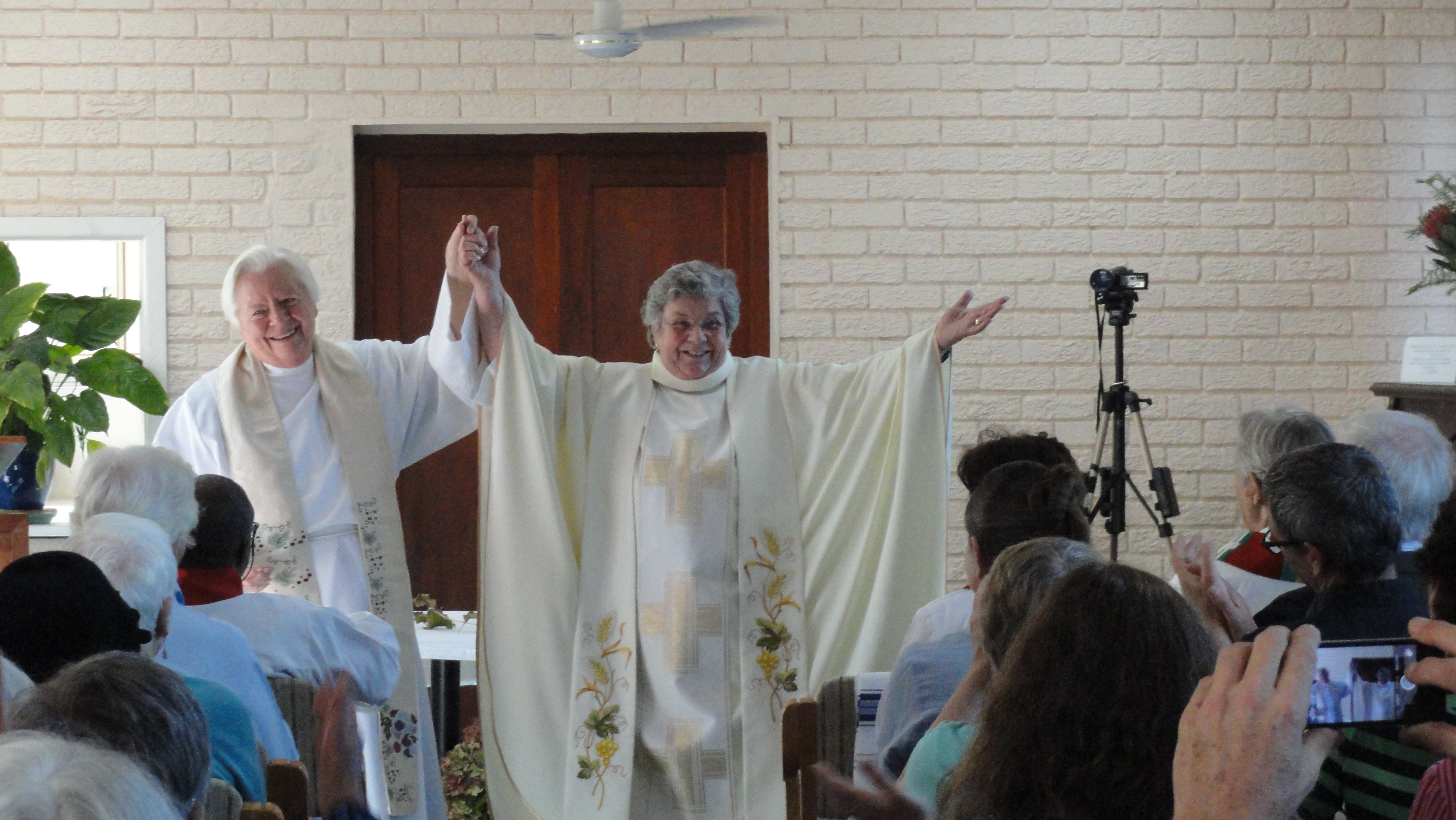
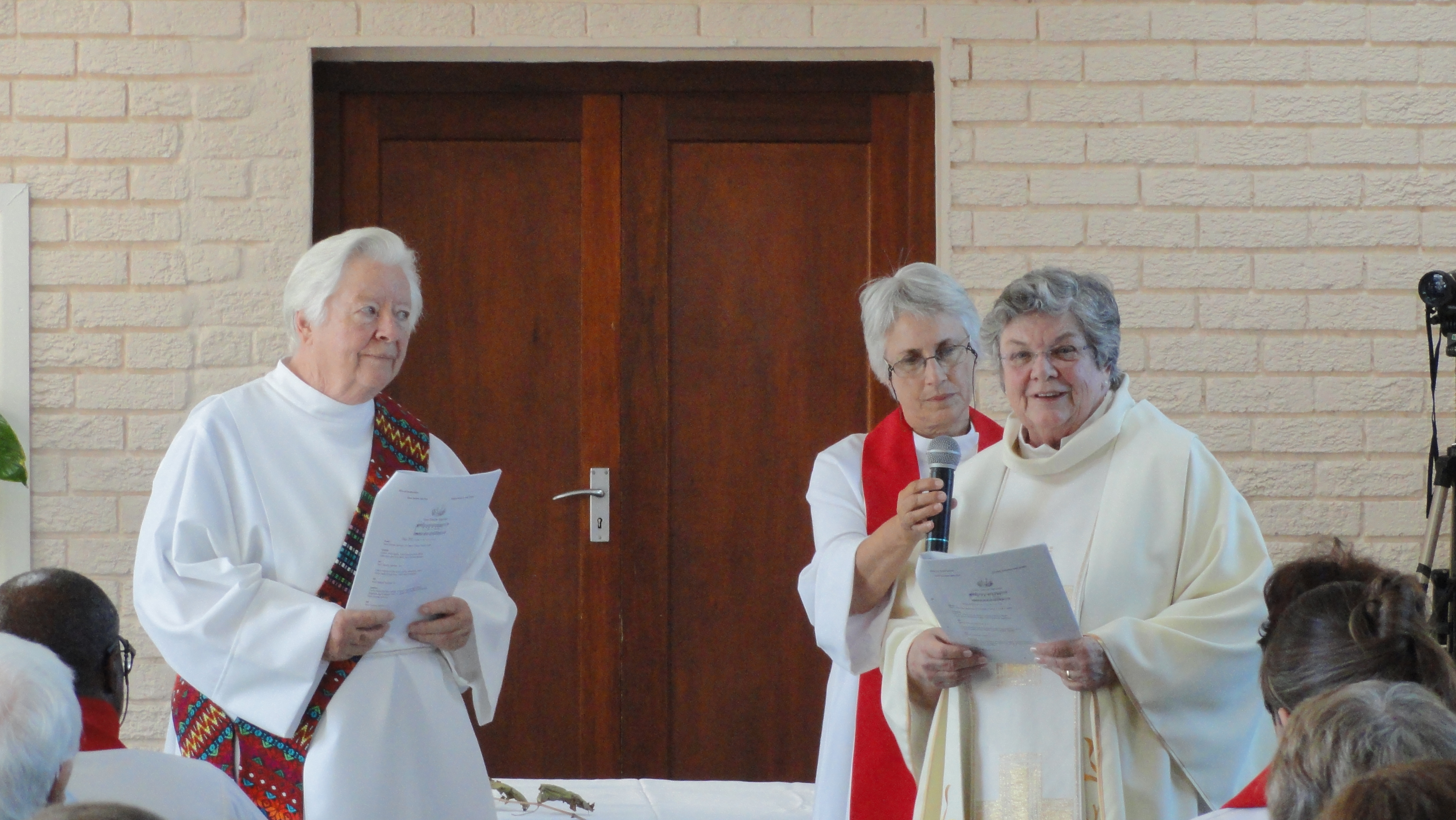
    Here are some beautiful pictures of the Ordination of Ann Ralston to the Roman Catholic Priesthood in South Africa on April 17, 2016. Bishop Patricia Fresen presiding. Rev. Mary Ryan, RCWP, eMCee.

    CONGRATULATIONS and BLESSINGS, ANN!

    DSC01388Bishop Patricia Fresen presents the newly ordained Rev. Ann Ralston to the Community

    DSC01397

    Rev. Mary Ryan addresses the community

    DSC01385

    Ann Ralston is vested

    DSC01375 Deacon Ann Ralston is ready to answer the call to the  the Priesthood

    JOY!

    DSC01388

    THANKS BE TO GOD!


  • An Extraordinary Living of the Gospel: Fr. Daniel Berrigan

    There are lights that will never go out. Here is some of the prolific media  coverage on the life and passing of one man whose life made a big difference and who showed us the way of peace and justice- Fr. Daniel Berrigan-May 9, 1921-April 30 ,2016.  “How beautiful on the mountains are the feet of those who bring good news,who proclaim peace,who bring good tidings….” (Isaiah 52:7; Romans 10:15).

    NLN Dan Berrigan 2008.jpg

    Berrigan in 2008

    Daniel Joseph Berrigan, S.J. (May 9, 1921 – April 30, 2016), was an American Jesuit priest, anti-war activist, and poet.[1][2] From Wikipedia

    From The New Yorker

    Postscript: Daniel Berrigan, 1921-2016
    BY PAUL ELIE

    The Jesuit priest and peace activist Daniel Berrigan was the last survivor of a cohort of gifted and engaged writers who shaped twentieth-century American Catholicism.
    The Jesuit priest and peace activist Daniel Berrigan was the last survivor of a cohort of gifted and engaged writers who shaped twentieth-century American Catholicism.

    He was in the elevator when we got on, riding down from his rooms in the building on 98th Street that housed the priests known as the West Side Jesuits. His hair, thick and black in the old news photographs, had gone gray. Instead of a black turtleneck and suit coat—the outfit with which he had united clerical garb with Beat style—he had on a collarless linen shirt, untucked at the waist. His face was thin and lined. At the time, in the mid-nineteen-eighties, it seemed that the Roman Catholic Church and the gay men of New York City were at war, but he was spending his time ministering to AIDS patients at St. Vincent’s Hospital, in Greenwich Village. He stepped off the elevator, and, as we trailed behind, the Jesuit priest we were with said, a little boastfully: “Dan Berrigan—that was him. He lives with us.”

    It was a significant sighting. At Fordham University, where I was a student at the time, the worldly accomplishments of the Jesuits were a point of pride, and the name Daniel Berrigan held an aura of both holiness and notoriety that was singular in the order. He had won the Lamont Poetry Prize. He had stood up against the war in Vietnam when doing so could have caused a priest to be silenced or worse. He had been one of the Catonsville Nine, whose members doused Selective Service files in Catonsville, Maryland, with napalm. After Catonsville, he’d gone underground, eluding the F.B.I. for four months before he was captured on Block Island in 1970. At the time, these actions had divided American Catholics as fiercely as Pope Paul VI’s renewal of the ban on contraception. But they led the Church toward its present position, set firmly in favor of peace and against war.
    By the time he died, at Fordham’s Jesuit infirmary, on Saturday, at the age of ninety-four, Berrigan’s aura of holiness-and-notoriety had long since yielded to another, greater aura: that of the priest whose consistency of purpose had allowed him to face down immense forces, including this nation’s war machine and celebrity culture.

    In the nineteen-fifties, the brilliant Trappist monk Thomas Merton, who would become a friend and mentor to Berrigan, published a book about St. Bernard of Clairvaux, the twelfth-century Trappist. In the book, Merton expanded on the idea of St. Bernard as “the last of the fathers,” the figure in whom the run of foundational Christian thought, which began with the apostles, came to a conclusion. Berrigan, in my opinion, was the “last of the fathers” of twentieth-century American Catholicism, the longest-surviving associate of a cohort of gifted and engaged Catholic writers, among them Merton, Dorothy Day, Flannery O’Connor, Walker Percy, and other lesser-known figures such as the Jesuit theologian John Courtney Murray and John Kennedy Toole, the author of “A Confederacy of Dunces.”

    It’s often forgotten that Berrigan, who was born in 1921 and entered a Jesuit seminary in 1939, was a member of the Second World War generation, not the Vietnam generation with which he is associated. He was six years younger than Merton, who died in 1968, and four years older than O’Connor, who died in 1964. It’s also often forgotten that the actions of the Catonsville Nine divided and challenged the Catholic left, including Berrigan’s counterparts.* “These actions are not ours,” Dorothy Day, the co-founder of the Catholic Worker newspaper, said of the Nine’s napalming of draft files. And yet Day maintained her friendship with Berrigan, corresponding with him, hosting him at the Catholic Worker movement’s houses on the Lower East Side, and agreeing wholeheartedly with his wider stance against the Vietnam War.

    Merton, meanwhile, was made nervous by the borderline violence of Berrigan’s actions and by the personal righteousness that Berrigan brought to them: “He’s a bit theatrical these days, now he’s a malefactor—with a quasi-episcopal disarmament emblem strung around his neck like a pectoral cross,” Merton wrote in his journal, in August, 1968. And yet he struck notes of solidarity with the Catonsville Nine, and wrote an essay meant, in part, to help middle-class Catholics understand the action as “in essence non-violent,” even if it “frightened more than it has edified.” The previous October, Merton had advised Berrigan to keep clear of the peace movement’s lust for relevance—“now non-violent, now flower-power, now burn-baby, all sweetness on Tuesday and all hell-fire on Wednesday,” as he described it—and had posited an ideal of the Catholic radical as a person who strove “to give an example of sanity, independence, human integrity, against all establishments and all mass movements.”

    By the nineteen-eighties, when I caught sight of him, Berrigan had taken Merton’s counsel to heart and become a figure of radical purity and apartness. Instead of cultivating followers, Berrigan developed mutually searching relationships with the next generation of figures in the Catholic peace movement: Robert Ellsberg, of Orbis Books; Carmen Trotta, of the Catholic Worker; Kathy Kelly, of Voices in the Wilderness. Instead of leading large rallies on college campuses, he sought out small protest actions, such as the Plowshares operation, in which Berrigan and several others entered a General Electric plant in King of Prussia, Pennsylvania, and struck two nuclear missile nose cones with hammers. No longer the peace movement’s leader, he was its sage and celebrant, solemnly presiding over Catholic Mass on dozens of occasions, such as during a Pax Christi retreat at N.Y.U. and at the Catholic Worker after an action at the United Nations on Hiroshima Day.
    In a moving portrait of Dorothy Day, written shortly after her death in 1980, Berrigan recalled reading a book about Day and the Catholic Worker not long after he was released from prison in 1972, after serving time for his role with the Catonsville Nine: “I stayed up all night, unable to put the book aside. What held me in thrall was an absolutely stunning consistency. No to all killing. Invasions, incursions, excusing causes, call of the blood, summons to the bloody flag, casuistic body counts, just wars, necessary wars, religious wars, needful wars, holy wars—into the fury of the murderous crosswinds went her simple word: no.”

    Berrigan’s own consistency involved rejecting not just violence but also the media influence and the resources that his notoriety might have made available to him. He created no foundation, nonprofit, or N.G.O.; headed no pacifist think tank or Jesuit school of advanced study; gave no TED talk; engaged in no stagey dialogues offering equal time to the military point of view; and never reframed the ideals of nonviolence in any pocket-size manual for personal growth. When he wrote about Catonville in his 1987 autobiography, “To Dwell in Peace,” Berrigan characterized celebrity as something like a purifying fire: “There was shortly to be a spotlight on us: it was thin as a pencil slate, and would pierce us through and through; a testing light that touched on the very soul, and illumined and burned. The light of the adversary, the light of the church, light of the eye of God? Light, perhaps, of self-knowledge: of all these together.”

    Berrigan kept clear of the trappings of fame so as to face down, as he put it, “the skeletal leer of war.” Always and everywhere, he rejected war as an evil in itself, and his opposition was a religious one, first and last. Celebrity, and the cultural power that came with it, loomed as a temptation that stood between him and the purity of his witness, which was rooted not in an idea but in the person of Jesus: his poverty, his blend of piety and righteous anger, his nonviolence and abhorrence of violence.

    “I had come of age in a church that, for all its shortcomings, honored vows and promises,” Berrigan recalled in “To Dwell in Peace.” “I had examples before me in the people of the church, especially in laypeople and nuns, of those who lived to the hilt the life commended by the Gospel. Such were my people.” Such was Daniel Berrigan, Jesuit and peacemaker, who honored his vows and promises.

    Daniel Berrigan, poet, peacemaker, dies at 94

     | 
     Jesuit Fr. Daniel Berrigan, poet and peacemaker who was one of the most influential voices in shaping Catholic thinking about war and peace during the past century, died today. He was 94.
    His death was reported by a number of sources, including Jesuit Fr. James Martin, an editor of AmericaMagazine.Berrigan gained national attention for his work against the Vietnam War, including his participation in a striking act of civil disobedience with his brother, Philip, also a priest at the time, and seven others who became known as the Catonsville Nine. In 1968, the group burned draft records in the parking lot of a Maryland selective service office from which they had taken files.

    It was one of the most spectacular and high-profile actions of a lifetime of civil disobedience and protest against militarism, nuclear weaponry and U.S. war-making.

    He was a prolific writer who achieved a remarkable lyricism and poetic force when writing about subjects that normally were explored in academic and military circles. He also plumbed the scriptures and the spiritual depths of the Christian tradition in conducting retreats that challenged the status quo and often upended participants’ presumptions about life in America.


    IN The Baltimore Sun by Peace activist, Max Obuszewski,5/3/16

    IT is difficult to realize that Daniel Berrigan, one of the most important peace and justice figures in our nation’s history, is no longer with us (“Activist priest Daniel Berrigan dies at age 94,” April 30).

    Growing up, we were encouraged to not rock the boat, to accept the fact that our government was capable of great injustices. However, the fog lifted when I found out that two Roman Catholic priests were arrested for daring to challenge a government bent on evil and destruction in Southeast Asia and Latin America. Eventually, I would meet Dan and Phil Berrigan and have the honor of being arrested with them for speaking out against our government’s criminal behavior.

    Both of these radical priests would have a great influence on me as mentors in troubled times. Both brothers rejected the comfortable life, recognizing that silence meant acquiescence in the government’s oppressive activities. Both of them were former teachers who taught us that one should take the risks of peace and suffer the consequences.

    The best way to honor and commemorate the life of Father Berrigan would be to take action. Resist the war machine, protest those responsible for climate chaos, take direct action against the 1 percent and speak out whenever you encounter injustice.

    Max Obuszewski, Baltimore

    Copyright © 2016, The Baltimore Sun
  • “But what if salt loses its flavor?” RCWP Bishop Andrea Johnson’s Ordination Homily

    In this fascinating homily RCWP-USA-East Bishop Andrea Johnson astutely traces the history of the priesthood and “plugs in” Vatican II and the RCWP Movement  as electrifying sources of church renewal. The occasion for this homily was the ordination of three women to the RC priesthood in Morristown, New Jersey on April 23, 2016. These faithful and courageous women are:  Jacqueline Clarys of the Living Water Community in Maryland, Sharon Dickinson of the Spirit of Life Community in Massachusetts, and Claire Gareaux of the Sophia Community in New Jersey. Bishop Andrea notes that they were called by God and called forth from communities to serve the people of God as servant leaders in a renewed priesthood for our times.

    Jacqueline M. Clarys's photo.

    Homily for RCWP-USA Eastern Region Priestly Ordinations

    April 23, 2016

    At The Episcopal Church of the Redeemer, Morristown, New Jersey

    “But what if salt were to lose its flavor?  How could you restore it? It would be fit for nothing but to be thrown out and trampled underfoot…..”

    Dear Sisters and Brothers, it is my great joy to be here with all of you this day to celebrate the calling forth to priestly service of three women of spirit and truth, three seekers of wisdom who have discerned a call to ordained ministry in the Roman Catholic Church. Jacqueline Clarys of the Living Water Inclusive Catholic Community, Sharon Dickinson of the Spirit of Life Catholic Community of Justice and Joy, and Claire Gareau of the Sophia Inclusive Catholic Community  – all of these women have discerned deeply their call to ordained priestly ministry with Roman Catholic Womenpriests; and today, they proclaim their readiness to serve the People of God in their communities as servant leaders. Alleluia!


    These sisters of ours, who are called forth by their communities and who have discerned their call with the Eastern region of Roman Catholic Womenpriests-USA, have chosen readings and music for this liturgy that bespeak their rich understanding of what it means to be called to this ministry. They clearly understand this role as one of servant leadership, and they embrace it.  They know that they are called above all to proclaim the Good News; to act on behalf of the powerless; to do the work of justice, while trusting in God to be their strength. They have committed themselves to an ever deeper relationship with the God whom they trust to be present to them and to uphold them in their ministry.  They know that it is the presence of the Spirit which produces the fruit in them which empowers them to overcome their own smallness – their own limitedness – and to live by love, joy, peace, patient endurance, kindness, generosity, faithfulness, gentleness and self-control. It is for this that they are anointed. They know themselves to be called to identify with the poor, the suffering and the dispossessed. They know themselves to be called to model God’s mercy and God’s justice. They know themselves to be called to be salt for the earth and light for the world. They know themselves to be called to lead- to lead with humility and courage – always seeking wisdom.

    As we stand here in 2016, our church is at a very important crossroads. Ministry is in deep crisis. It is more than evident that the model of priestly ministry in our institutional church is having great difficulty serving the needs of people around the globe. In First World countries, there is a decided shortage of male, celibate priests; and in developing countries (for example, in Africa) the model doesn’t seem to work any better for cultural, if not numeric, reasons. For many reasons, the Catholic priesthood is in crisis.


    History sheds a great deal of light on why we are where we are. Those who have made a study of how the ministry has been envisioned and has functioned over two thousand years have a great deal to tell us about how we got to this place. We know now that the apostolic church – the church during the lifetimes of Peter and Paul) – did not have priests or any sort of set (i.e., ordained) liturgical leaders. The post-apostolic period, (the time of the writing of the gospels and the pastoral epistles), knew leaders known as episkopoi (or bishops). This was a term borrowed from the secular Greco-Roman culture. These episkopoi were community leaders who were essentially managers of the community’s interests. There was no connection to priesthood at that time. Later, in the period of establishment of the church, (from the 3rd to the 5th centuries CE), bishops were located in major cities, and sometimes had presbyters to assist them with the needs of the church communities. These presbyters were considered assistants to the bishop who were essentially wisdom counselors. It was only late in this period, once the church had become the principal religion of the Roman Empire, that public churches were established and liturgical functions began to be exercised by permanently established (ordained) leaders, and these roles were taken on by the bishops and the presbyters. So, the theology of ministry (or of priesthood) has varied greatly over the different eras of church history.

    It was during the early Middle Ages, when the feudal system came into being that church and state functions began to blend together in a Europe dominated by barbarian kingdoms – in which a noble class came to dominate both the church and state power structures. This was all a far cry from the simple proclamation of the Good News and the Eucharist that celebrated the receiving and sharing of that Good News in the early Christian communities.

    By the High Middle Ages, reforms undertaken in the 11th century in order to rid the church of serious corruption actually led to the domination of all theology by the concept of Canon Law. In this way, the theology of priesthood and ministry underwent a metamorphosis that created a legalistic and clericalist foundation for the understanding of the role of the priest. It is from this theological development which wrested the priest from any sort of relationality to the community he served which led to the Reformation of the 16th century. Tragically, the Counter-Reformation undertaken by the Roman hierarchy nearly 40 years later did too little and was too late to be able to serve the purpose of useful dialogue. And so, there ensued nearly 500 years of the Catholic priesthood being frozen in this mode – a model which owed more to a late 5th century Christian philosopher, Pseudo-Dionysius, than to the thoughts of the apostles or the early fathers of the church. Indeed, the church’s present pyramidal hierarchical structures stem mainly from Pseudo-Dionysius, and not from Jesus.

    All this to say that, until the Second Vatican Council wrote its documents on the church and its ministry, we were stuck with a model of ministry (always assumed to be limited to priests) which understood the essence of ordained priesthood to be special powers that are given to priests at ordination, which set them apart from the community! Happily, the ministry documents of Vatican II changed all of that – at least on paper! Post-Vatican II priests are no longer defined mainly by the POWER to consecrate, but rather by preaching the Word. Baptism, not Holy Orders, Is unequivocally recognized as the primary sacrament of the church – and Baptism is understood to empower all. The Eucharist is seen as the whole community’s action of thanks and remembrance, and as proceeding from the preaching of the Word, and resulting in the living out of baptism. This Vatican II view of priestly ministry and sacraments effectively made room for and joyfully acknowledged the Holy Spirit as the life-POWER infusing all sacraments, and gracing all that proceeds from them.

    Vatican II indeed returned us to a more relational concept of priestly ministry which had its antecedents in the first millennium rather than the second. It is interesting to note that the Council of Chalcedon in the mid-5th century had gone so far as to declare null and void any ordination that created a priest without a permanent relationship to an established community! The priest or presbyter was to be a part of and not set apart from the community.

    All of this was very refreshing. The only problem is that from Vatican II in 1965 to this day, no structural changes – no changes in canon law – have been made accordingly to make this renewed model a reality in the institution. Enter RCWP!

    “But what if salt were to lose its flavor?  How could you restore it?

    Who are we as Roman Catholic Womenpriests? What is our model of priesthood about? In real terms, how does our vision of inclusive ministry play out in a church whose structures have historically disenfranchised the many?

    To begin with, we believe that our theology of ministry must, like that of the early church, be based on experience, and also on mutuality. It must be grounded in real life. We believe we are called to model a new way of leading which strives to empower others, to work with others in our communities to mobilize resources to serve the disenfranchised, to release creativity, and to enable stable communities to form and thrive

    Our mission is to ordain women to serve as priests in the Roman Catholic tradition in a non-clericalist manner; to acknowledge and invite the richness of gifts for pastoral ministry in the community when functioning as pastoral leader and priest; to facilitate the empowerment of people and to build trust and collaboration; to see the power in interconnectedness, and also in diversity. We offer to a renewed and emerging Catholic Church priests as servant leaders, formed in this model and living their ministry commitment according to structures that are inclusive and non-clericalist. We hope thereby to ensure that the subversive memory of Jesus is perpetuated through the proclamation of the Word and the celebration of the sacraments, especially the Eucharist, which is the core of our commitment to unity with one another – the unity that binds us in the One Body of Christ.

    Nourished by Word and Bread, we as leaders, together with the whole people of God, call forth the gifts of the community to do the work of justice, peace and integrity of life. As for the communities we serve, they are diverse; nonetheless they are all characterized by a new spirit of collaboration. What do the communities committed to renewal and led by Roman Catholic Womenpriests look like?

    • They are imbued with a spirit of discernment, and they give voice to all community members
    • They have a variety of persons functioning in a variety of ministries according to their preparation, their gifts, and their call by the community
    • There are ordained and non-ordained persons serving on teams together collaboratively
    • There is mutual respect and openness to the views of others
    • Our communities practice contemplative listening
    • There is collaboration and connection with other RCWP-led (and other progressive) Catholic communities
    • There is meaningful ecumenical and interfaith outreach.
    • There is an unbroken liturgical and theological link with Roman Catholic tradition
    • There are active social justice ministries
    • The model of diakonia or service is foundational for all who minister in the community
    • There is a deeply eucharistic (i.e. thankful) spirituality, with mindfulness of God’s indwelling presence in and through the life of the community
    • And there is a deeply catholic spirit that is ever aware of being part of a much greater whole in terms of church

    It is our great privilege to rejoice in the richness of the ministry tradition which we hold –while at the same time, remembering that throughout the church’s history, the ministry has, at the end of the day, been shaped by the needs of the people.

    We as Roman Catholic Womenpriests are a powerful voice and witness to the need for change in the way those in ordained ministry see their priestly role in the community – as servant leaders and not as superiors – as animators of communities, not people set apart from them. The call to ordination is a specific call to a specific kind of leadership – but most importantly, it is a call from God from within the community of faith.

    And so, today, we are truly thankful to our loving and compassionate God, who has given us in Jackie, Sharon and Claire an abundance of new servant leaders to continue to grow this movement for a renewed priesthood and church, and to discern a new understanding of what it means to be Catholic – of what it means to be One Body in all of our diversity.


  • Two Roman Catholic Women Priests Reflect -Sixth Sunday of Easter: My Peace I Give to You- May 1, 2016

    Whether we are struggling with what it means to live a  Christ-like life and if we can really do it, or whether we long for a time and place where justice and peace reign and shine like the sun and the splendor of God is brilliantly apparent  (Rev. 21:10-14;22-23), something we do not experience now, this Sunday’s Scriptures give us gentle guidance.  Acts 15:1-2 and 22-29 shows the conflict in the early church between the Jewish Christians who also live the Mosaic Law and follow the Jewish traditions and the gentile Christians who do not want to be circumcised. The landmark decision of the apostles and elders and “all the church’ was that “it is the decision of the Holy Spirit and of us not to place on you any burden beyond these necessities…”(and not eating the meat of idols, abstaining from blood and from the meats of strangled animals and from unlawful marriage” were the necessities-circumcision was not. )  As Rev Beverly Bingle notes below: this was the start of a new type of Christianity,not conforming to Judaism except in some ways.

    Jesus boils it down even more succinctly in Sunday’s gospel (John 14:23-29): “Whoever loves me will keep my word (will obey my teaching), and my Abba God(Father) will come to (you) and we will make our dwelling with (you). …” (J0hn 14:23) As far as we know Jesus did not speak about conforming to the letter of the Law,and sometimes he set priorities in the Law as in healing on the Sabbath, yet he fulfilled the essence of the Law in his every action and in his being (Matt 5:17). In strongly giving us the Mosaic commandment of loving God above all else and our neighbors as ourselves, he both told us and showed us how to live. John 14:15-16 says clearly”If you love me keep my commandments…and I will send you another Counselor,(Advocate, another Paraclete/Helper, the Holy Spirit) to be with you forever”.

    We learn that if we live Love and Compassion and seek justice and peace, our loving God will be with us, the Holy Spirit of God is with us. Then, we don’t have to “sweat the small stuff” worrying always if we are doing all we can to be Christians, if we are good enough or holy enough or even doing enough-if we love Jesus and follow his teachings, loving as he loved, we can stumble and fall many times and yet have the peace that Christ sent deep within us.  The Holy Spirit of God, the Spirit of truth  will teach us all we need to know- “Peace I leave with you, my peace I give to you. Not as the world gives do I give it to you. Do not let your hearts be troubled or afraid-(I will be with you)”.

    So on this Sixth Sunday of Easter, let us put aside all anxiety about the lives we lead, as long as we are responsive to the Spirit within us and let Love guide us and sometimes correct us. We are not going to do it perfectly, we are not God, we are not Christ though somewhere in our very human complexity, Christ lives and the Holy Spirit of God sets us on fire for healing, justice and peace and the pursuit of the city of God that shines like the sun, NOW and forever.

    Love and blessings,

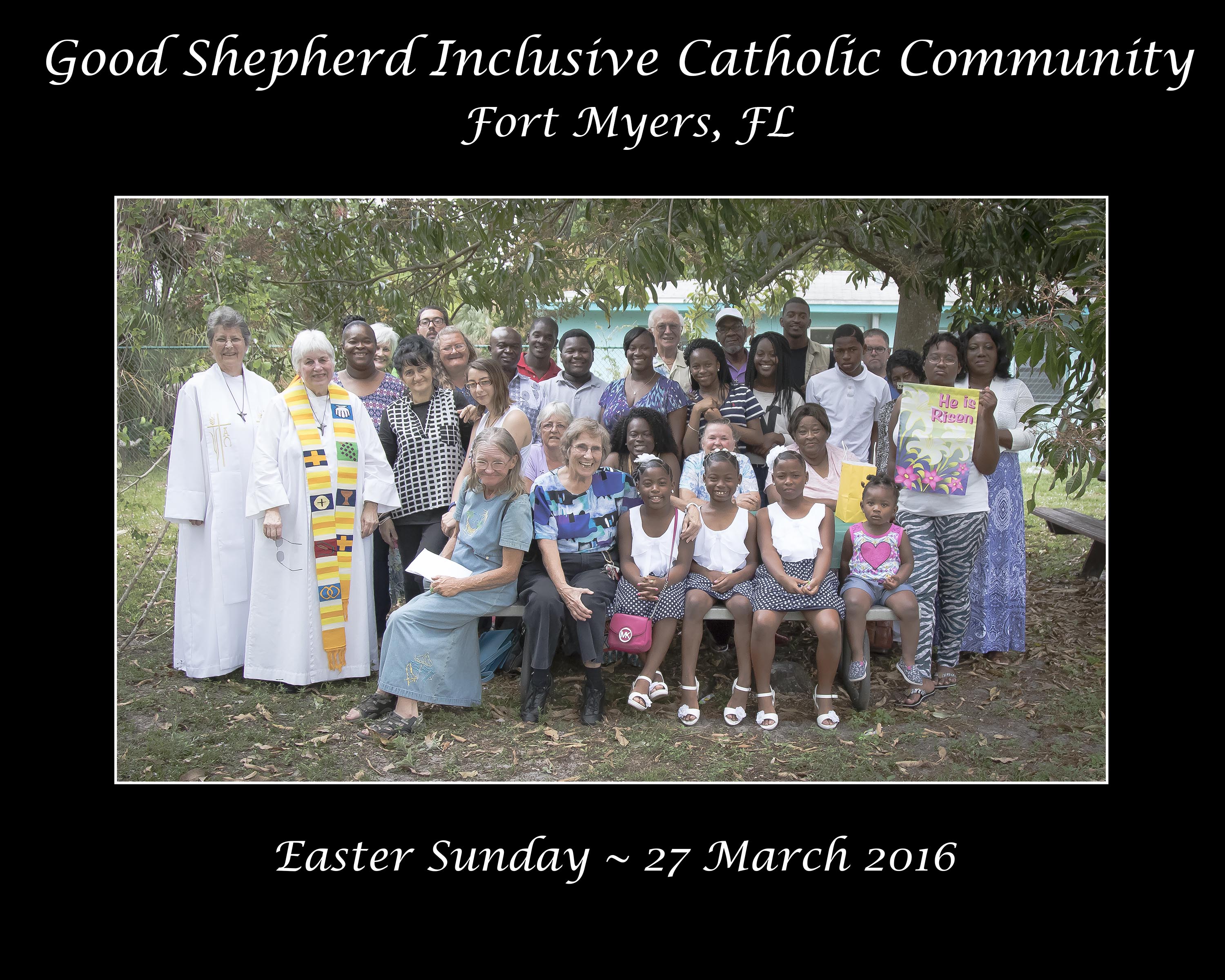
    Rev. Dr. Judy Lee, RCWP and Co-Pastor of The Good Shepherd Inclusive Catholic Community in Fort Myers, Florida

    w8x10wwritingD74A2498 (2)

    And now for the inspirational homily of Rev. Dr. Beverly Bingle ,RCWP

    That story about the debate over circumcision
    that we hear in the Acts of the Apostles
    was written sometime in the mid-90s,
    and it’s a different from the story
    from what Paul wrote to the Galatians about 40 years earlier.
    Fr. Raymond Brown says that decision
    to allow non-Jews to become Christians without circumcision
    guaranteed that Christianity
    would eventually become separate from Judaism.
    So, from the very beginning we were ecclesia semper reformanda
    —a church always re-forming, always changing,
    always searching for ways to tell the story of faith
    to the next generation.
    In the early 400s St. Augustine of Hippo wrote about it.
    In the 1960s Fr. Hans Küng wrote about it.
    Now, because of technology,
    we get almost immediate reporting of the ongoing debate
    about what we need to do to be Christian.
    How do we think about the wisdom and the glory of God?
    How do we spread the good news that Jesus taught,
    that good news that the reign of God is at hand?
    How do we express the inexpressible?
    Just like they did, we use symbols and metaphors
    and create meaningful narratives.
    Just like they did,
    we try to live what we believe.
    ___________________________________________
    It’s like today‘s passage from Revelation, for example,
    with all those visionary twelves:
    twelve angels at twelve gates
    with twelve names inscribed on them,
    and twelve courses of stone in the foundation,
    with twelve names of apostles inscribed on them.
    Those twelves meant more than twelve to the early Christians.
    Twelve to them meant complete:
    all the people of God, everyone,
    all included in God’s house,
    all that is.
    And Revelation tells us that the city doesn’t have a temple
    because all the people live in God.
    They don’t need sun and moon
    because the presence of God—God’s “glory”—
    is in them and lights up the world.
    ___________________________________________
    Another effort of early Christians to tell the good news in narratives
    shows up in today‘s gospel,
    a continuation from last week
    of Jesus’ “last will and testament,”
    created by the evangelist.
    The story is true, but it’s not, as Marcus Borg would put it,
    something that really happened.
    And the message is not written for the disciples.
    They’re not around any more.
    It’s for future generations,
    communicating in story
    Jesus’ important messages:
    first, that the Spirit will be with them to help them remember
    that Jesus lives not only with God but also with them;
    and second, that love, and the peace that love brings,
    are central to Jesus’ legacy.
    ___________________________________________
    How do we see the joy and the dedication,
    the care and the compassion,
    the love for one another,
    that Jesus learned from his Jewish tradition,
    and called on his followers to practice,
    in the midst of foreign occupation, oppression, and hardship?
    His own experience had to have taught it to him,
    had to have brought him the peace
    that comes from helping others.
    ___________________________________________
    Brain scientists looking at mob mentality found
    that people who can think about their own moral standards
    are more likely to be able to resist
    getting caught up in a vicious cycle of violence.
    They also tell us that generosity, kindness, and caring
    release oxytocin, the hormone that brings feelings of warmth,
    euphoria, and connection to others
    and causes them to give more generously
    and to feel more empathy.
    It’s the exact opposite of the vicious cycle of violence:
    people on an “oxytocin high” can jump-start a virtuous circle,
    where one person’s generous behavior triggers another’s.
    So one person does a good deed for another,
    and it inspires people who see it
    to behave with compassion later, toward different people.
    Maybe you’ve seen those TV ads for Liberty Mutual,
    where one person’s small action helps someone
    and is seen by a third,
    who goes on to do a good deed for someone else.
    That really happens.
    Brain scientists have shown how altruism spreads
    from person to person to person to person,
    how one person’s goodness
    can influence dozens or even hundreds of people,
    some of whom he or she does not know and has not met.
    ___________________________________________
    It’s been 2000 years since Jesus called us to love one another,
    2000 years since he said God’s reign is at hand,
    that he said we would have peace.
    Where is this peace in our world?
    In Michigan, 16-year-old Hunter Gandee
    found peace in the world last week
    when he carried his disabled nine-year-old brother 110½ miles
    to inspire people to embrace people with disabilities.
    In Tennessee, Jacob Weiss and Joy Teal found peace—
    and spread it, too—
    when they asked the people they invited to their wedding
    to skip the presents and donate instead
    to a fund that gives micro-grants to local nonprofits.
    In last Wednesday‘s talk on Luke’s gospel,
    Fr. Jim Bacik shared a story about UT students
    coming back from their service project in Haiti
    to tell about the happiness they had seen
    among people who lived in garbage dumps—
    people whose faith taught them to live
    with love for one another.
    In Toledo, Julie is a coupon queen,
    but she doesn’t keep her bargains for herself and her family.
    On the first of every month she delivers peace to the world
    in the form of hundreds of dollars worth
    of food and household goods
    to local efforts to help the needy among us.
    Down at Claver House, a local firefighter
    finds peace in the world every Tuesday
    when he brings a package of cookies
    to thank George for his service in the Navy.
    ___________________________________________
    There was great joy in the early Christian community.
    It brought them peace, and it was noticed, and it spread.
    They went about doing good, like Jesus had shown them,
    and they were remarkable for the way they loved one another.
    Their world was at peace.
    ___________________________________________
    We experience that same joy, that same peace,
    in this community dedicated to the Holy Spirit,
    in each of the ways we reach out as individuals
    and as a community together in our social concerns ministry.
    As theologian Elizabeth Johnson says,
    it’s the Holy Spirit,
    nothing less than God’s own loving self,
    present and active in the world,
    bringing new life to all peoples
    and the whole of creation.
    It’s truly the Holy Spirit in us.


    Holy Spirit Catholic Community
    Saturdays at 4:30 p.m./Sundays at 5:30 p.m.
    at 3925 West Central Avenue (Washington Church)

    www.holyspirittoledo.org

    Rev. Dr. Bev Bingle, Pastor


  • Courageous Roman Catholic Woman Priest Slowly Healing From Acid Attack

    This is a follow up article on our RCWP-USA-East priest,Rev. Alexandra Dyer, who was attacked with a lye like substance last August, from the New York Times, 4/28/2016 and in print in The NY Times on 4/29/2016 . Her amazing courage to take on this corruption and then to deal with the horrible aftermath of this attack is a testimony to the strength of her faith and a beacon of light to all who suffer, especially those who suffer when doing the right thing.  Please join us in prayer for Rev. Alexandra Dyer and for justice.  Rev. Dr. Judy Lee, RCWP-USA-East

    Missing Money, a Vicious Attack and Slow Healing for a Charity’s Leader

    By ANDY NEWMAN APRIL 28, 2016

    D. Alexandra Dyer outside her office at the Healing Arts Initiative in Queens, where she is executive director. Ms. Dyer was the victim of a chemical attack in August. CreditChristian Hansen for The New York Times

    D. Alexandra Dyer felt as though her face were on fire.

    She put her car into drive, but got only a couple of hundred feet before she had to pull over in searing pain and squeeze her eyes shut.

    Rescuers arrived as the caustic drain cleaner turned her face purple and dissolved her skin. As recounted later by her lawyer, she then screamed four words that they could not possibly comprehend.

    “Kim Williams did this!”

    Ms. Dyer had just left work on that hot evening last August in Long Island City, Queens. As she approached her car, parked on a deserted stretch of Skillman Avenue, a man she had never seen before was waiting for her.

    “Can I ask you a question?” he said. Before she could answer, he flung a cupof drain cleaner in her face, and fled.

    It was the terrifying climax of a three-year drama, with accusations of embezzlement, a cover-up and collusion at the last place one might expect it: a charity that brings musical performances and arts programs to New York City’s hospitalized, disabled, elderly and poor.

    Three people have been arrested. Ms. Dyer, 60, who had recently been hired as executive director of the charity, Healing Arts Initiative, has undergone multiple operations to rebuild her face.

    Among those charged is Ms. Williams, 47, the charity’s payroll manager, who is accused of stealing more than $750,000 and orchestrating the attack after Ms. Dyer questioned her about bookkeeping lapses. The defendants, including Ms. Williams, have proclaimed their innocence through their lawyers.

    The account of the attack, and the tense months leading up to it, were described by Ms. Dyer’s lawyer, Ronald G. Russo, because prosecutors have instructed Ms. Dyer not to speak publicly since she is a witness in the case.

    The fallout continues. This month, Ms. Dyer filed a lawsuit against the board of Healing Arts Initiative on behalf of the charity itself, saying board members let the thefts happen on their watch. The suit seeks their removal. (Mr. Russo, a former federal prosecutor, is Ms. Dyer’s lawyer in the suit.)

    A lawyer for Healing Arts, David G. Samuels, declined to comment on Thursday because of the continuing suit.

    Ms. Dyer, a seasoned nonprofit executive, had taken the helm of Healing Arts in July, joining one of the city’s better-established arts charities. It was started as Hospital Audiences Inc. in 1969 by a pianist named Michael Jon Spencer, after he played a recital to a rapt audience at the Manhattan State Psychiatric Center.

    Over the years, Healing Arts grew to a $5-million-a-year operation that serves 350,000 people annually, through workshops and live performances. It provides handicapped seating at Shakespeare in the Park, presents concerts by Alvin Ailey dancers and runs a gallery for artists with mental illnesses.

    But some staff members had noticed a surge of fiscal irregularities in the past couple of years, Mr. Russo said. Checks were bouncing. The credit cards that Healing Arts used to buy blocks of discount tickets for its clients were being refused.

    The organization’s debt had ballooned from under $100,000 to over $2.2 million from 2012 to 2015, even as the executive director at the time, J. David Sweeny, cut the staff to 14 employees, from 28, and reduced the rent by moving the charity’s offices from SoHo to Queens.

    At the heart of Healing Arts’ fiscal operation was Ms. Williams. She had been hired in 2011, through an agency called Professionals for Nonprofits, as a payroll clerk. Under Mr. Sweeny, she enjoyed wide latitude, especially after he got rid of the chief financial officer and did not replace her, Mr. Russo said.

    Soon, she was effectively running the fiscal operations and had several other accounting employees reporting to her.

    Ms. Williams, who had an apartment in the Kingsbridge section of the Bronx, seemed to live fairly well for someone who had started out at a yearly salary of $43,000 and had worked her way up to $60,000. She drove a late-model Mercedes, had a second home in Florida and posted about her shopping sprees on Facebook.

    office computer called Virago Inc., which sold sex toys and offered online sex seminars.


    But the real secret to Ms. Williams’s lifestyle, prosecutors and the police say, was that she stole prodigiously from Healing Arts, cutting checks to dozens of phantom employees and direct-depositing them into accounts controlled by her and her best friend, Pia Louallen.

    “That’s how the whole financial thing got to us,” Lt. Alexander Fagiolo, commanding officer of the 108th Precinct detectives, said at a news conference this month.

    From November 2012 through August 2015, according to prosecutors, Ms. Williams embezzled at least $750,000 — an average of more than $1,000 per workday. She kept $600,000 and gave the rest to Ms. Louallen, prosecutors said.

    One longtime board member, Kitty Lunn, said that while she did not suspect that Ms. Williams was raiding the till, she was concerned about the declined credit cards and the checks that did not clear. She urged fellow board members to investigate.

    In January 2015, the board hired a forensic accountant. His finding after several days of reviewing the books, according to Mr. Russo: “No improper transactions.”

    Ms. Lunn, a paraplegic dancer who has headed her own nonprofit, was incredulous. In May 2015, she quit in frustration. “I said to the board, ‘There’s something funny going on with the money, and all of you are going to be responsible,’” she recalled.

    By this time, Healing Arts was looking for a new executive director — Mr. Sweeny had left for another charity, though he remains on the Healing Arts board. (He declined to comment, referring all calls to the board president, D. Leslie Winter, who did not respond to voice mail messages.)

    Enter Ms. Dyer, with an M.B.A. from Columbia and decades of experience managing nonprofits. She also holds a master’s degree in divinity, was ordained a Roman Catholic priest by a group called Roman Catholic Womenpriests and is co-leader of a congregation in Greenwich Village.

    Concerned when her new colleagues told her about the money shortfalls and climbing debt, Ms. Dyer began digging around, Mr. Russo said. When she asked Ms. Williams for access to the accounting system, he said, Ms. Williams repeatedly stonewalled her.

    On Aug. 17, Ms. Dyer introduced Ms. Williams to a new chief financial officer she planned to hire. His name was Frank Williams (no relation to Ms. Williams) and, Ms. Dyer told her, he was an expert fraud-sniffer who would decipher Healing Arts’ imbalanced books.

    Ms. Williams suddenly came down with a toothache, Mr. Russo said, and left the office. Later that day, the police said, she bought drain cleaner at a supermarket in Queens with her credit card.

    She was absent the next day, Aug. 18, claiming that she had to go for a dental procedure. Surveillance video revealed that she had come to the office at 6 a.m. and left with boxes of files, Mr. Russo said.

    Ms. Williams never returned to work and stopped communicating with Healing Arts.

    The day after that, on Aug. 19, Ms. Dyer was attacked.

    She spent the next two months at the burn unit of NewYork-Presbyterian Hospital/Weill Cornell Medical Center. But she continued to run Healing Arts from her second day in the hospital, Mr. Russo said, meeting with forensic accountants even though her eyelids were sewn shut, and fielding calls from colleagues.

    More troubles surfaced, Mr. Russo said. Healing Arts, it turned out, was paying workers’ compensation premiums based on a payroll of $5.5 million, more than the charity’s entire budget. A company ledger showed a discrepancy of $480,000 that was noted simply as a “payment adjustment.”

    While Ms. Dyer mended, the police and the Queens district attorney’s office labored to piece together the criminal case and tracked Ms. Williams, who was spending time in Florida.

    In December, Ms. Dyer viewed a photo lineup and identified Jerry Mohammed, a 32-year-old from Troy, N.Y., with a record of drug-dealing convictions, as her assailant. Surveillance video taken the day of the attack shows him getting into a Mercedes belonging to Ms. Louallen, the police said.

    On April 4, Mr. Mohammed and Ms. Louallen were arrested.

    Ms. Williams fled, prosecutors said, but at 8:57 p.m. she was arrested behind the wheel of a white 2010 Mercedes E350 at a rest area on the New Jersey Turnpike. She was charged with two counts of first-degree assault, two counts of conspiracy, two counts of grand larceny, weapons possession, falsifying business records and 48 counts of identity theft. She is being held without bail and faces up to 25 years in prison.

    Mr. Mohammed is charged with assault, conspiracy and weapons possession and also faces up to 25 years. Ms. Louallen is charged with grand larceny and conspiracy and faces up to 15 years.

    Mr. Mohammed’s lawyer, Michael D. Siff, said on Wednesday that Ms. Dyer had picked someone other than his client at an in-person lineup in Queens on April 12. The district attorney’s office declined to comment.

    Today, Ms. Dyer’s face is a pinkened map of scar tissue. One eye is red-rimmed and runs continuously. The other opens only partially, beneath an imperfectly restored eyelid. But she is back at work.

    And Healing Arts continues its mission to bring cultural medicine to the sick and the injured. Ms. Dyer knows something of this firsthand.

    Last September, as Ms. Dyer lay in her hospital bed, a folk singer named Kathy Lord, one of Healing Arts’s contractors, entered the room.

    “I’ve seen a lot of things over the years, and that was probably just about as bad as it gets,” said Ms. Lord, who runs a nonprofit called Music That Heals.

    “I said, ‘Alexandra, here I am, Music That Heals,’” Ms. Lord recalled. Knowing of Ms. Dyer’s faith, she sang the country gospel song “One Day at a Time.”

    “One day at a time, sweet Jesus,” it goes. “That’s all I’m asking from you. / Just give me the strength / To do every day / What I have to do.”

    Tears ran down Ms. Dyer’s ravaged face.

    A version of this article appears in print on April 29, 2016, on page A1 of the New York edition with the headline: Crime and Chaos Jolt a Haven of Philanthropy. Order Reprints| Today’s Paper|Subscribe


  • ThreeWomen Ordained Roman Catholic Priests In New Jersey

    Members of the Eastern Region of RCWP- (Roman Catholic Womenpriests-)USA were  excited to travel to Morristown, New Jersey for the priestly ordination of three of our Deacons.
    We regret that we (Revs. Judy Lee, Judy Beaumont and Marina Teresa Sanchez Mejia) could not be there but we will be with the group  in October, God willing, when the group assembles again.
    We rejoice in the  priestly ordinations on Saturday, April 23rd of Jacqueline Clarys, Sharon Dickinson and Claire Gareau!
     Bishop Andrea Johnson presided. 
     Thank you for your thoughts, prayers and well wishes for the newly ordained!
    Eastern Region RCWP USA
    Rev. Dr. Judith Lee, RCWP
    Jacqueline M. Clarys's photo.


    Jacqueline Clarys says: My priestly ordination: April 23, 2016, RCWP-USA, Eastern Region. Ordained at the Church of the Redeemer, Morristown, NJ.


    Cait Finnegan -Grenier says:  Blessings on her ministry!

    Michael Keefe:  Congratulations!

    Chava Redonnet's photo.
    • April 24 at 9:48pm ·

      “About half our region of Roman Catholic Women Priests was present for yesterday’s ordinations in Morristown, NJ… and that’s just one region! Do you realize how much this movement has grown?!”

       Opening this door in this year of mercy…three Roman Catholic Womenpriests ordained this weekend in Morristown, NJ. S
    Chava Redonnet's photo.

    Catherine Farren says:  Congratulations, Sharon!! I’m so happy for you.!!!!!!

    CONGRATULATIONS JACQUELINE, SHARON AND

    ALL BLESSINGS AND LOVE TO OUR NEW PRIESTS!

  • Second African American Woman to Be Ordained a Roman Catholic Woman Priest

    Deacon Donnieau Snyder of Fresno, California to be ordained a Roman Catholic Priest on Saturday April, 30,2016.

    A slight correction to the article below from the Fresno Bee online. RCWP world-wide has over 200 ordained priests and transitional deacons.  JL

    Deacon Donnieau Snyder of Stanislaus County will be ordained as a reverend in the Roman Catholic Womenpriests movement during a ceremony at 11 a.m. Saturday, April 30 at Trinity Lutheran Church, 3973 N. Cedar Ave., Fresno. RAZI SYED rsyed@fresnobee.com

    Ordination ceremony for Donnieau Snyder of Roman Catholic Womenpriests

    Deacon Donnieau Snyder of Stanislaus County will be ordained as a reverend in the Roman Catholic Womenpriests movement during a ceremony at 11 a.m. Saturday, April 30, at Trinity Lutheran Church, 3973 N. Cedar Ave., Fresno.

    The Roman Catholic Church issued its clearest opposition to the Womenpriests in 2008 by announcing that they and the bishops who ordain them would be excommunicated. Snyder’s ordination will make her the first female priest from the region, the second black female priest and the 125th worldwide.

    “The Roman Catholic Church has yet to open their doors to women in recognizing their call,” Snyder said during a Fresno news conference April 14, “but the spirit will move regardless.”

    Donnieau Snyder
    Donnieau Snyder
    Ordained
    womandeacon 2014
    RCWP-USA
     CONGRATULATIONS

    AND

    BLESSINGS,

    DONNIEAU!

    Donnieau Snyder, PhD is a member of New Spirit Rising, an inclusive Catholic faith community located in Fresno, CA. She loves and is deeply devoted to the various facets of her ministry which includes serving her faith community, religious education, working with homeless veterans dually diagnosed with mental health needs and substance abuse issues, as well as working with homeless teens and young adults. Her ministry work stretches across California’s central valley and the San Francisco bay area. She has a deep passion for social justice which includes advocating for women’s leadership across all faiths, community outreach to assist with appropriate access to mental health services and providing education about mental health. Dr. Snyder was ordained a deacon on September 06, 2014.
  • Vatican Dialogues with Women Priests


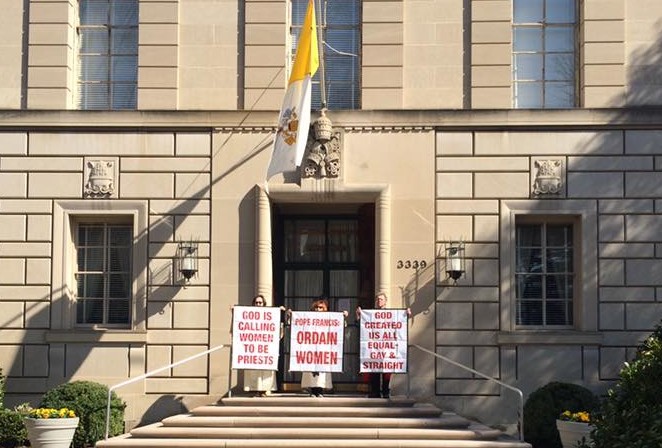
    Guest Post on the Women’s Ordination Conference Blog -The Table-By Fr. Roy Bourgeois, Rev. Jane Via and Rev. Janice Sevre-Dusynska on their Holy Thursday Witness Outside the Vatican in Washington DC, 3/24/16 when US Papal Nuncio Carlo Maria Vigano spoke with them on the steps of the Embassy.

    From Condemnation to Conversation: Vatican Dialogues with Women Priests 4/19/16. 

    From 2002 through 2016, the Vatican has condemned the ordination of women priests. Since the ordination of  “The Danube Seven” in 2002, the Vatican has tried a number of strategies to quash our movement: excommunication, silencing, shunning, firing and ignoring. Now ten years since the first U.S. ordinations on the boat in Pittsburgh, the door has been opened for the first time.

    12042642_10156649068295368_1510251452953464461_nDuring Holy Week, March 24, the feast day of Oscar Romero, in the era of Pope Francis and his Year of Mercy, a conversation — turbulent at first — began.

    Outside the Vatican Embassy on Massachusetts Avenue in Washington, D.C. on Holy Thursday, March 24th the three of us — two women priests – Jane Via and Janice Sevre-Duszynska, and one excommunicated male priest –Roy Bourgeois — washed the feet of supporters on the sidewalk in front of the embassy as cars and buses passed on the busy road.

    We prayed and shared our statement of purpose to Pope Francis and the Catholic Church calling for the full and equal inclusion of women and LGBT people.  We read from Scripture, and prayed again this time that church leaders would remember Jesus’ teaching to be servant leaders and love all disciples as Jesus had. We thanked those who gathered with us, re-read our statement of purpose lifted up our signs, and – still in albs and stoles – stepped onto Vatican property and walked toward the door. We had no idea how our action would play out.

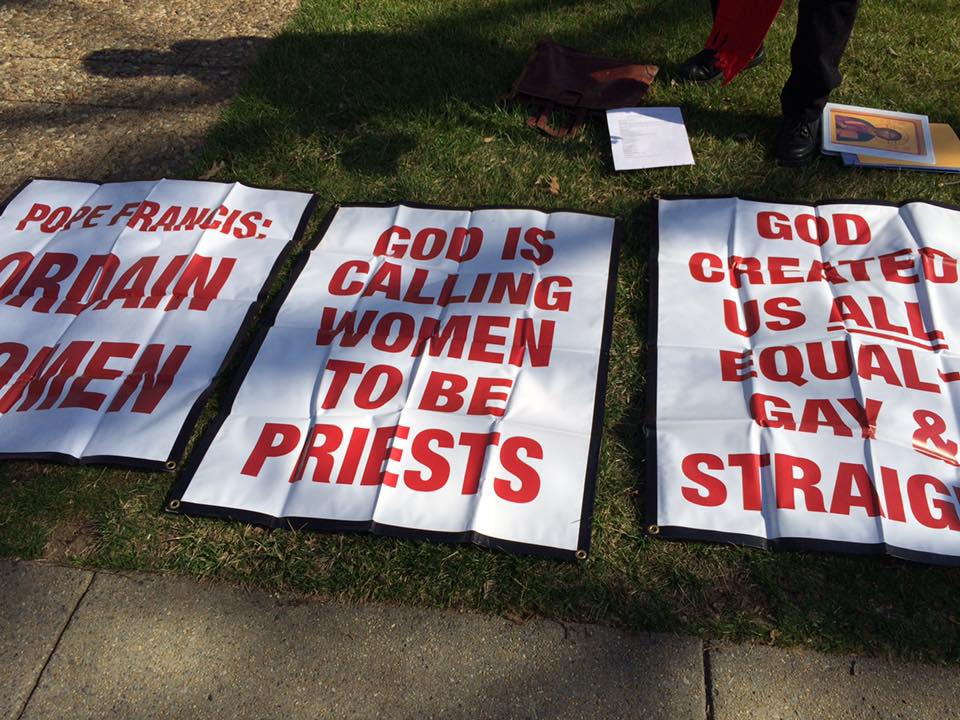
    Before we crossed the circle drive, suddenly filled with police vehicles, we were surrounded and intercepted by Secret Service officers announcing we were trespassing on private property and had to leave. We walked past and through them to the door where Roy posted our statement then rang the doorbell. To our surprise, the door opened and Roy was able to hand in a manila envelope with a signed copy of our statement asking that it be forwarded to Pope Francis. Then, we turned to face the street holding our signs for passing traffic to see. They read: Pope Francis: Ordain Women, God IS Calling Women To Be Priests and God Created US All Equal – Gay & Straight.

    10649795_10156649068380368_3534668190522680447_nThe officers began the ritual notice: “You are on private property. If you don’t leave, you will be arrested. Do you understand?” Over the next two hours, one supervisor after another, each higher than the former, arrived at the embassy and spoke with us. There were pauses for radio calls, the arrival of even higher supervisors and then the announcements would begin again. The highest authority, who arrived in a suit, announced that he was from the State Department. He threatened us with the dire state of the D.C. jail and “the very bad people” we would share space with if we were arrested.

    Intermittently, two to three officers would disappear around the side of the palace-like building to confer with the Papal Nuncio and staff. Eventually, the officers told us the Nuncio would like to meet with one of us, specifically a woman. We declined the invitation, suggesting the officer tell the Nuncio we would meet if all of us were invited. After all, we were only three people, not a crowd of protesters. Told, “That was not the invitation,” we remained silent.

    The day became hot. We were dressed too warmly in order not to be cold in jail if we were held. The sun beat down on us. Above, the Papal flag, yellow and white, fluttering in the breeze, provided occasional relief, blocking the sun.

    More negotiations between the officers and the Nuncio followed, until officers announced the Nuncio would come to us.

    He came up the steps and onto the porch alone, while his staff remained in the driveway. Officers joined him on the steps, standing on either side and behind us. Wearing a Roman collar, the man introduced himself by title and, although we asked him several times, he declined to give his name.

    524771_10156649068230368_4349012172086201206_nHe engaged Roy first, who tried to speak for LGBT people, how they suffer because of church teaching, and of God’s love for all people. The Nuncio kept interrupting him. He was arrogant, insolent in style and tone, lecturing us on church teaching, as if its truth was self-evident. The exchange became heated, raised voices talking over one another. Officers closed in on Roy, ready to restrain him if needed.  Janice intervened: “The Church’s teaching creates suffering for LGBT people and they are murdered in Africa and Latin America.” “They commit suicide,” Roy said and shared the difficulties of someone in his own family. The Nuncio replied that the church didn’t kill anyone; these people had their own consciences; they made their own decisions.

    The Nuncio then invited one of us women priests to talk with him inside the embassy. We looked at each other, then said: “No, it would have to be all three of us in solidarity.”

    Roy told him that the church was hurting women and itself by not ordaining women. The Nuncio said that issue had been a closed door since John Paul II.

    “You need to read Catholic theologians Gary Macy and Dorothy Irving,” Janice said as he looked at her intently. “Their research gives evidence of women’s leadership in early Christianity including deaconesses, presbyteras and bishops up until the 12th century.” His face revealed no hint of surprise. “The US church has lost 33 million Catholics because its leadership has refused to hear the voice of the Spirit within the people who embrace women priests and LGBTs. There is a connection,” Janice said, “between the church’s oppression of women and violence toward women and their children in the world.” He responded that the church isn’t responsible for violence in the world.

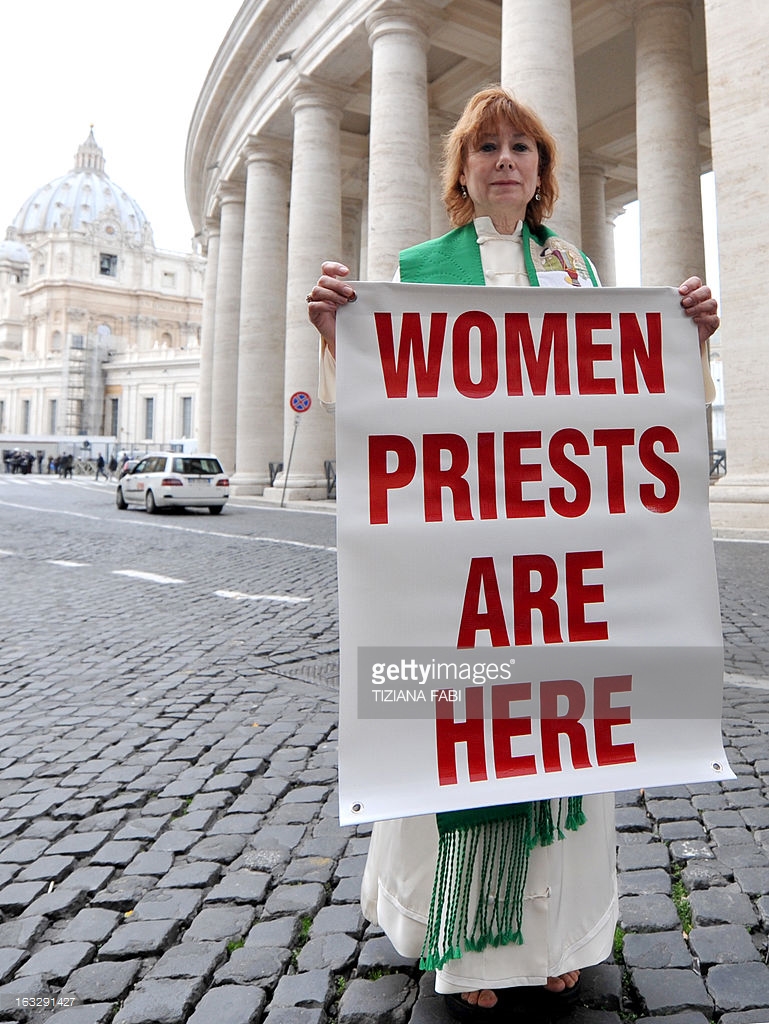
    Janice Sevre-Duszynska, 2013 Getty Image

    When the Nuncio finally approached Jane, after again refusing to give his name despite very polite inquiry, told us he had been Nuncio since 2011, disclosing his identity as Carlo Maria Vigano, the Nuncio responsible for inviting Kim Davis — who refused to follow federal law and give marriage licenses to GLBT people — to meet Pope Francis, sparking a media firestorm and public outrage that the Pope embraced Davis and encouraged her to keep up her good work. Then Vigano, in an indignant and derisive tone asked, “Where did you get those?” in reference to the alb and stole Jane was wearing. The irrelevance of the question resulted in Jane’s blank stare and his move away. His comment reminded us of the Rome police asking Janice the same question in front of St. Peter’s Square before detaining her during the March 2013 papal Conclave.

    As he was leaving, we told the Nuncio we would stay until we were assured Pope Francis received our statement of purpose. He said Francis would eventually get the statement – which he said he already read. As he neared the side of the building to return into the Embassy, he said, “You can stay as long as you like. If you need something to eat or drink let us know.”

    Shortly afterwards, officers explained that the Nuncio declined to arrest us. We could stay. Most officers departed, leaving only two vehicles, on at each side of the circular drive.

    Minutes later, we heard noise above us as we stood on the porch, holding our signs. Looking up, we saw the Papal flag disappearing into the embassy.

    It was afternoon by now. We had had nothing to eat or drink since our early, light breakfast. We were glad we were fasting, delaying the inevitable as long as possible. We talked further about our witness here on the steps of the Vatican Embassy, the Nuncio’s choice not to arrest us, and how to proceed. We decided we would “occupy” the porch and lawn of the embassy for 24 hours from the time our trespass began. We would sleep on the porch of the Vatican Embassy on Holy Thursday.

    Vatican8During the hours between 1pm and 8pm, Roy stood with his banner on the Vatican’s porch while Jane — whose arm was in a cast from her wrist to her elbow — and Janice held our signs for women priests and LGBT equality on the lawn until nightfall. We attracted the attention of thousands of drivers on busy Massachusetts Avenue, many who gave us thumbs-up or tooted their horns in approval. We also made friends with John Wojnowski, 73, who was sexually abused when he was 14 by a priest in Italy. John, who has been protesting with his huge sign – accusing the Vatican of protecting pedophiles — outside the embassy for 17 years, told us the incident changed who he was. “I’ve lived with the idea of committing suicide everyday (since),” he said.

    As night fell, the wind picked up and it grew colder. We sat on the embassy porch bundled in our light jackets as a number of police squads pulled up. A plainclothes secret serviceman told us we would be arrested on his way to talk with the Nuncio. Meanwhile, friends arrived to take Jane and Janice to a restroom and provide water and blankets. We took only one blanket each, thinking we would spend the night in jail where the activists’ rule is: have your ID and metro card only. Roy had a different perspective. Throughout the day, he repeatedly told us, “The Vatican is not going to arrest women priests.”

    Not long after our friends left, the secret serviceman announced, “The ambassador says it’s okay for you to stay overnight.” Initially too wired to sleep, we sat talking. About midnight, another friend and supporter arrived with wine and paper cups. Having had no solid food since early morning and few liquids, we drank cautiously. As the day had become night, the warmth became cold, and the wine warmed us and relaxed us.

    Eventually, we laid down in a row, our heads next to the embassy door, with one thin blanket between us and the concrete and our stoles as our pillows. We cocooned ourselves in our individual blankets, warm but not warm enough, draped our signs over our blankets, and tried to sleep.

    Friday morning, we woke to a cold but sunny morning. We left Roy to hold down the porch while we sought restrooms and coffee. Then we returned to the lawn and traffic for more witnessing.

    unspecified

    At 10:00 a.m., 24 hours after our trespass began, we prayed with one another and packed to leave. As we stood on the sidewalk, the Nuncio came down the driveway toward us. His attitude was completely different. He acknowledged our courage and thanked us for being nonviolent. He said he wanted to shake our hands before we left.  He told us that Francis knew we were there and that Francis had received our statement. Another discussion began, but this time, he allowed us to speak. Though he never showed agreement, he listened. He expressed his belief that the demise of the Protestant churches is the result of the ordination of women and that LGBT people are as they are due to some sin in them. We gave him brief condensed versions of our most basic arguments. At his request, his priest companion, who was watching our interchange, took photos of us standing together and smiling.

    As we were preparing to leave a cyclist passed us, then stopped and backed up. A young woman of about thirty, she smiled at us and asked if we were there the day before witnessing to women’s ordination. When we acknowledged we were, she thanked us and launched into a description of the theology course she was taking at Georgetown, their study of Canon 1024 (which says only a baptized male can be ordained) and her conviction that change in the church was so important. At that point, and for the first time, she looked directly at the Nuncio, the only one among us wearing a Roman collar, and said, “I hope that you decision-makers will be supportive.” With a smile and a wave, off she went. The three of us watched her go in amazement.

    At one point in the conversation, Janice turned to address the priest who introduced himself as the Nuncio’s councilor. He repeated what the Nuncio had said before:  that the Church receives its instructions from God. Janice responded that Holy Spirit Wisdom, Sophia Wisdom, works through the church, especially the people of God, and transforms our thinking; that women are in need of feminine images of God because without them there is damage to our souls; that men can be filled with hubris and arrogance from not experiencing feminine images of God; that we need women to celebrate Eucharist – as womenpriests do – with our sacred, holy, feminine bodies.  Janice asked him if he was aware of femicide in our world. “We need the Gospels interpreted from the experience of women living and dying,” she said. “God speaks through the Church,” he replied.

    Janice looked at him and smiled as a thought came through. “Didn’t St. Francis of Assisi teach the church?” she asked. His eyes lit up and he smiled. “So do women priests and the LGBT community,” she added.

    Farewells said, including handshakes and Italian kisses on the cheeks, the Nuncio left and we climbed into a cab.

    We reflected on how events had unfolded in unimaginable and remarkable ways. We think the Spirit moved all of us, in and out of the embassy, so that seeds were planted in the hearts of decision-makers; but only time will tell. For us, a night in the DC Metropolitan jail sharing a bare metal bed with herds of cockroaches, will have to wait for another day. Meanwhile, perhaps the Vatican is listening…Like the persistent widow of Luke’s gospel, we keep knocking at those decision makers’ doors.

    More photos from this witness, by Bob Cooke

    Holy Thursday Prayer Ritual, by Jane Via and Janice Sevre-Duszynska

    Bridget Mary Meehan’s Blog on the witness, including the Statement delivered to the Nuncio

  • Conservative Vigano is out as Vatican Nuncio to US-Pierre is in

    Pope Francis continues in making choices for the people and for inclusivity and compassion:

    From La Stampa Italian News-Vatican Insider, World News:

    Pope appoints French-born Christophe Pierre, as the New Nuncio to the United States

    Pope Francis has appointed Archbishop Christophe Pierre to succeed Archbishop Carlo Maria Viganò as nuncio (that is, ambassador) to the United States of America

    Archbishop Christophe Pierre

    0
    April 12,2016
    GERARD O’CONNELL
     Pope Francis has appointed the French-born Archbishop Christophe Pierre, one of the Holy See’s most distinguished and respected diplomats, as the new Apostolic Nuncio to the United States.


    The Vatican made the announcement, April 12, after the Holy See received the formal agreement from the Obama administration. He succeeds Archbishop Carlo Maria Viganò who served as nuncio to the United States since 10 October 2011. The Italian archbishop now ends his long years of service to the Holy See, and will retire to his homeland.

    At the time of his new assignment, Archbishop Pierre was nuncio to Mexico, a position he has held with considerable distinction for the past nine years, since March 22, 2007. He comes to Washington D.C as an experienced diplomat, with first-hand knowledge of the dramatic plight of migrants from Central America and Mexico to the United States, and will be able to give voice to Pope Francis’ concern for them.

    As nuncio, he will be the Holy See’s point man in relations with the US Administration and with the United States Catholic Conference of Bishops (USCCB). One of his most important roles will be the identification of candidates to be bishops in this country. Pope Francis has already outlined clearly the qualities he wants to see in future bishops, and the new Nuncio will ensure this is reflected in the names he presents to Rome.

    Archbishop Pierre, 70, is the first Frenchman to be appointed as Apostolic Nuncio to the United States. A polyglot, he speaks English and Spanish fluently. He is “a pastor”, known for his “humility and simplicity” and is “excellent on all fronts”, a source who knows him well confided. A fellow nuncio described him as “a thoughtful, hardworking man”, and “good listener” with “a great sense of fairness and balanced judgment.”

    Pope Francis got to know him well as he prepared for his recent visit to Mexico, and so liked him that he decided to assign him this highly important mission.

    Before going to Mexico, Archbishop Pierre had served with distinction as nuncio to Uganda (1999-2007) and Haiti (1995-1999). While in Uganda, John Paul II sent him to Burundi to oversee the Holy’s See’s diplomatic mission there following the assassination of the papal nuncio to that country, the Irish-born archbishop Michael Courtney, on December 29, 2004. He celebrated the funeral mass for the former nuncio at the Regina Mundi Cathedral in Bujumbura on Dec 30, attended by thousands of people. He remained in the country until the pope appointed Archbishop Paul Gallagher (now Secretary for Relations with States) as the new nuncio there.

    Gifted with a good sense of humor and a deep voice, the new nuncio can captivate an audience. According to The Vision, Uganda’s leading daily, he is a man who goes among the people, is ready to help anyone regardless of status.

    Born in Rennes, France on January 30, 1946, he spent the greater part of his childhood and early education in Africa, mainly in Madagascar, with some years in Malawi, Zimbabwe and one in Morocco. He entered the seminary of Saint-Yves in Rennes at the age of 17, but interrupted his studies to do his two-years of military service (1965-’66).

    Ordained priest for the archdiocese of Rennes in April 1970, he served as assistant priest in a parish in the diocese of Nanterre for the next three years. He subsequently gained a Master’s degree in theology from the Institute Catholique de Paris, and a doctorate in Canon Law in Rome.

    He entered the Holy See’s diplomatic service in 1977 after studying at the Pontifical Ecclesiastical Academy in Rome, where its diplomats are trained. He was subsequently assigned to serve in its diplomatic missions in New Zealand, Zimbabwe, Cuba, Brazil, and as Permanent Observer to the United Nations office in Geneva. He therefore comes to his new post with considerable experience in both bilateral and multilateral diplomacy.

    Archbishop Pierre is expected to take up his new position within two months, a Vatican source told America.

    Note: This article was first published in America Media and magazine, and is reproduced here with permission

     And about Nuncio Vigano:
    From The Washington Post:
     
    Pope Francis is reportedly appointing a new ambassador to the United States

    By Julie Zauzmer March 10
    The Vatican will appoint Archbishop Christophe Pierre to be the new ambassador to the United States, replacing an ambassador whose tenure has sparked controversy, reports say.

    The Jesuit news organization America and longtime Vatican reporter Sandro Magister said Thursday that they expect Pierre will be appointed the Apostolic Nuncio, though the Holy See has not yet announced its choice for the position.

    Pierre, 70, who was born in France, speaks fluent English and has served the Catholic Church as a diplomat all over the world, dating to 1977, America reported. His most recent job — following terms as nuncio to Uganda and Haiti — is nuncio to Mexico.

    In moving from Mexico to the United States, he might bring to Washington an emphasis on immigration issues, particularly at the U.S.-Mexico border where Pope Francis recently visited to offer a prayer.

    [Pope Francis prays for migrants at the U.S.-Mexico border]

    America said that the Vatican normally would not declare that someone has been nominated to this diplomatic position until the White House approved the Vatican’s choice of ambassador.

    The current Vatican ambassador to the U.S., Archbishop Carlo Maria Viganò, has reached the statutory retirement age, according to America.

    Viganò was in the spotlight in September, when he hosted an unexpected meeting at his D.C. residence between Pope Francis and Kim Davis, a Kentucky county clerk who refused to issue marriage licenses to same-sex couples, inflaming a nationwide debate over her decision.

    In the whirl of questions over why Francis had met Davis on his trip to the United States and who had planned the encounter, the Vatican said that Davis was “invited by the Nuncio” and referred questions about why Davis was on the guest list to Viganò’s office.

    [No one wants to talk about how the Pope Francis-Kim Davis meeting was arranged]

    Viganò was often more outspoken in his antagonism to same-sex marriage than others in the church. And before his appointment to Washington, he made enemies in the Vatican when he tried to enforce (financial) reforms while he worked for Pope Benedict XVI.

  • This Is What a Rich Businessman in Government Does Consistently

    A foreshadowing of a Donald Trump in power, Gov. Scott consistently acts against the poor and working poor:

    From Daily Kos 4/18/16

    Governor Rick Scott
    Despite unanimously passing, Florida governor vetoes bill aimed at helping poor and rural residents

    Governor Rick Scott is at it again, coming up with new ways for the residents of Florida to despise him. This time, it is denying dental care to Florida’s poor and more rural residents. He vetoed a bill to that unanimously passed both chambers of the Florida legislature:

    The bill (HB 139), filed by state Rep. Travis Cummings, had been passed unanimously by both chambers of the Legislature in the 2016 Legislative Session.

    It created a grants program aimed at dentists to serve patients in counties with a shortage of dentists or in otherwise “medically underserved areas.” The grants, anywhere from $10,000 to $100,000, were to be administered by the Department of Health.

    In his veto letter, Scott said he agreed that “maintaining good oral health is integral to the overall health of Florida families.” But he added he could not “support a program that does not place appropriate safeguards on taxpayer investments.”

    Do you know how hard it is to get unanimous support for any bill in this day and age? Harder than finding a dentist in rural Florida.

    More reaction from floridapolitics.com:

    A representative of the Florida Dental Association said the group was “disappointed” because the legislation “would have provided significant support for promoting dental care, economic development and job growth in underserved areas of Florida.”

    “The challenges of accessing routine dental care have critically impacted the health and success of Florida communities, especially in rural areas,” said Joe Anne Hart, the FDA’s Director of Governmental Affairs. “The results are repeated visits to the emergency room for preventable dental problems, missed days of school due to toothaches, and lower GPAs and graduation rates.”