Home

  • Homeless No More: Kris and Hootie Get A Home-Thanks Be To God! –

    Image

    Kris and Hootie in their new home

    Kris has been homeless for many years. When he could he worked temporary odd jobs and sustained a room in someone’s house. He was a good painter and helped paint the ministry house in 2008.  At that time he was caring for a beloved senior dog and spent most of his pay on dog food and Vet costs.  We would also assist him with this.  He was bereaved when his dog died in 2011.  After serious injuries he could no longer lift his arm to paint or to do most odd jobs. He lived on porches, or when possible, slept on someone’s floor. While sleeping on an open porch Kris met a small black kitten, one of the many feral cats surrounding this house. He shared his food with her and patiently and lovingly befriended her. He called her “Hootie” because she turned her head like an owl.

    Kris has no medical coverage and it has been hard to document his disabilities so his case is currently with a lawyer. Our church member, Doctor Teresa Sievers,MD saw him pro bono as it is her offering to Christ, and gave him a complete physical with testing for range of motion, etc. It was clear that he is disabled and that was finally documented.  With no income housing is impossible except with HUD subsidized housing like Goodwill Industries Housing for the physically disabled. Kris had been on a list for one of their Units for over four years and had forgotten that he applied.

    The miracle happened in March, his name finally was at the top of the GWI List.  He could not contain his joy when on Friday April 11th he moved into his first home, a wonderful townhouse that was handicapped accessible. One of our church members, Judy Alves supplied all of his furniture, a gift from her sainted mother who went home to God the same week. We supplied a bed and other household items.

    Image

    Kris in front of his home


    Hootie could not move right in, however, she had to be spayed and have her shots first.  On Friday April 18th our church member Linda Maybin taxied Hootie and Kris back and forth to Eastside Animal Hospital who helped us with a reduced rate. Kris could not wait for Hootie to join him in their home. His joy is complete as he describes her nestling in beside him and playing and even watching TV. This is a joy for both of them. “Now my buddy is here”, he said, adding “there is nothing like being loved” and “thank you, Good Shepherd Church and Pastors Judy and Judy”. We are delighted to house Kris and Hootie in a forever home.

    Image

    Hootie and Kris and Hootie’s special corner in the background-Thanks be to God!

    Ending homelessness in Fort Myers  one person at a time,

    Pastor Judy Lee and Pastor Judy Beaumont,

    Good Shepherd Ministries of Fort Myers, Florida

    April 23,2014


  • Scottish Bishop with the “Smell of Sheep”

    A New Scotch Bishop with the “Smell of the Sheep”

    April 16, 2014   from heraldscotland.com

    Pope Francis made major headlines when he chose not to live in the Vatican palace, but in smaller rooms at……, to carry his own luggage, and to drive a battered used car. This is fully in keeping with the Gospels and the practice of the early church – but in marked contrast to the ostentation and sumptuary of some of his predeccors, and some bishops. He has recommended similar simple lifestyles for his bishops, saying that he preferred them as shepherds of the faithful, to have on them “the smell of the sheep”.
    Not all bishops have yet taken on board this new corporate culture, but here’s one who very decidedly does – Bishop John Keenan, newly appointed to the see of Paisley, Scotland:
    New Catholic bishop chooses to live in deprived housing scheme


    AS Scotland’s newest Roman Catholic bishop he could easily have opted for the opulent residence set aside for a man in his position.
    CULTURAL SHIFT: Bishop John Keenan has said he is moving in order to be closer to the deprived and excluded members of society. Picture: Jamie Simpson
    But Bishop John Keenan, who grew up in a high-rise in Maryhill, Glasgow, has shunned the more comfortable address to move into a parish house in a housing scheme in an area of multiple deprivation.
    Explaining his decision, Bishop Keenan said the Catholic church was going through a cultural shift and would have to “adapt and change in order to be close to the people of our times”.
    His first move as the new Bishop of Paisley has seen him decline to take up the detached sandstone villa in the town, in Renfrewshire, used by his predecessors, and move instead to a church property in Greenock’s east end.
    In his first wide-ranging interview since being installed last month, Bishop Keenan has told of his concern that those in destitution have been “abandoned by society and the church”, adding he would reflect “a church out on the street not one that’s comfortable in the chapel”.
    Echoing the stamp put on Catholicism by Pope Francis, the 49-year-old said there were still structures within the church restricting its ability to reach out to those on the margins of society.
    Bishop Keenan said: “Exclusion is a scandal for a country that calls itself Christian.”
    He has also spoken of the need to strip some power and responsibility in the church away from the clergy and hand it to lay members, adding he supported the Pontiff’s call for a “new reformation” within Catholicism.


    __._,_.___
     
    Reply via web post Reply to sender Reply to group Start a New Topic Messages in this topic (1)

  • Live! Love Lives!-Rev. Judy’s Easter Homily 4/20/14

    IMG_0271LIVE! Love Lives!

    Thank God for Easter! Thank God for rolling away the stone. Thank you, Jesus for showing us how to walk the walk even unto your death. Most of all, thank you for rising again and showing us how to rise!

    This year our Good Shepherd Community celebrated Holy Thursday and Good Friday long before last week. Young and old have had major illnesses, frightening surgeries, the onset of serious limitations, the daily challenges of poverty and homelessness and caretaking for the sick and dying, and violent deaths.  We washed each other’s feet and “oh this feels good” could be heard from our hard working people. When we went through the Last Supper with Jesus and stripped the altar we remembered how our lives were stripped.  When we walked the Stations of the Cross in the community our twelve year old boy, Jakein, who was baptized last June volunteered to “be Jesus” and carry the Cross. As we found a Colombian Serape that would fit his height, worn over a man’s white shirt our Jesus stood and smiled in all his glory. And we smiled and in our hearts we cried. For the young black men of our community have the hardest road of all. We have lost so many to gangs and violence both as victims and perpetrators.  We prayed with and for this Jesus as he made his way through the streets with the community following.

    We stopped as he was sentenced in front of the church and as he fell in front of a home that offered the community some hope because Builders Care was rehabilitating it. We remembered hope every moment of his journey-even when we stopped in front of a “crack house” where two men died within two years as they sat drinking alcohol in the yard. And, when we reached the shopping center where many stores were closed and boarded up we prayed for the community. Even the Bail Bond center was closed and we prayed for those in jail, wrongly and rightly. We prayed in front of Foreclosures as Jesus fell for the third time. We prayed for all who died unjustly or as victims, especially children. We prayed to learn how to forgive. Our Jesus helped us do that.  But most of all our hearts were moved to feel a new joy as we lived Station 15, the resurrection. Our young Jesus got up and took a bow.

    Jesus is risen from the dead! That is the miracle we believe and now live. Now we too must move from death to life. We now remember the joys and life we have. We rejoice in our young people who are now in college and working despite the odds and rough road!  We rejoice in Natasha who got all A’s, will graduate from High School, and is accepted into colleges and preparing to go.  We rejoice in the joy of our community. We rejoice in the parents, grand- parents, God-parents and community members who live Christ and guide our youth. We rejoice in a community that is one with the poor and outcast, the physically and mentally ill and struggling, accepting all. We rejoice in lives turned around, homeless housed, and sick made healthy with the love of God. We rejoice in Easter Love!

    IMG_0048

    Only love gets you up in the morning and brings you to the tomb like Mary of Magdala and Mary. And only with the eyes of love will you be one of those who can see and hear and believe in the human impossibility of the resurrection. Only Love will let you know that YOU don’t have to move the stone away!  Only some folks saw Jesus after he rose-I think they were those who could see with the eyes of love   Only love will let you see that Jesus did not come forth as Lazarus did wrapped in the clothes of the dead-he came forth as a new and transformed being-fresh and new! (John 20:6-7) So take off your burial clothes. He folded that burial cloth that covered his face and left it there. His napkin was folded, he was coming back to the Table.  Jesus the Christ rose from the dead and was not going to carry death with him.

    Only love will let you see the empty Cross and let you deeply realize that Jesus the Christ is now let loose in our midst.  The loving women (Matthew 28:1-10) saw that he was not there and ran to tell the others.  Jesus met those faithful loving women on the road and commissioned them to “go and tell” to be the apostles to the other disciples, apostles to the apostles. They were the first to carry the message of his new life.  Throughout the world, and in churches where they are forbidden to serve at the altar in equal manner as priests or even altar servers, women are treated not as blessed but as second class. Symbolically the altar is Christ, it was women who tended that body in life and death and women who first testified of his life. Loving God, forgive them for they know not what they do. Let the scales fall off the eyes of the Church and all who oppress and victimize women and children, men and all who are different and outcast.  Bring Easter life back to the Church and to the world.


    IMG_0034

    Let us look at our own lives and hearts. Are we still carrying the crucifix of a dead Jesus and wearing the burial clothes of life’s losses and disappointments? Or are we becoming fresh and new with the risen Christ? Do our lives point to the crucifix or to the risen Christ-full of new life, transformed and vibrant? Oh, loving God, give us back our joy, give us the fullness of new life no matter what Good Fridays we have faced or will face. Give us the joy of the resurrection!

    IMG_0066IMG_0062IMG_0060IMG_0063 IMG_0061

    Our loving God rolls away the stone and raises us from the dead with Christ. Let us keep on keeping on, let us truly become an Easter people! Not death but resurrection is God’s final word-new life- now and forever!

    HAPPY EASTER !

    Amen!!

    Rev. Dr. Judy Lee, ARCWP

    Good Shepherd Inclusive Catholic Community, Fort Myers, Florida

  • Washing Each Other’s Feet: Reflections on Holy Thursday with Rev. Judy and Albert Butzer III

    IMG_0055 (1)


    The reflection/sermon below by author Albert Butzer III on John 13:1-17 rings true to me. I remember declining a foot washing opportunity when asked by my much loved and revered people’s priest and mentor in Hartford, Connecticut, Fr. Al Jaenicke. I am not sure of all my reasons but I would give anything if I could turn back the clock and accept that most generous offer. Fr. Al went home to his loving God a few years ago.  He is with the great cloud of witnesses and  communion of Saints that continue to lead me on. Yet, I am not good on receiving. I think I am better at giving. Jesus was good at both. Remember how he accepted having his feet anointed with expensive oil by Mary,Martha’s sister who also wiped them dry with her hair? (John 12:1-7). Although he explained her anointing as burial preparation, he was also moved by the love of Mary and Martha and Lazarus, whom he raised from the dead. He loved them. We remember that the best way to love Jesus is to love one another-indeed to give and receive love is to follow Jesus.

    My own ministry with the homeless here in Fort Myers began in the park in 2007 with washing the feet of a homeless man with diabetes whose feet were painfully swollen and ulcerated, That dear man is now thankfully housed and is still active with our ministry. And, indeed, he brings regular offerings that we graciously accept. He also serves his neighbors in many other ways. Tomorrow evening  we will wash each other’s feet at our church and all feet will be washed, including mine. Then we will share Jesus’ last supper with his disciples which represents the ultimate level of giving one’s self for one’s friends. Thank you Jesus for showing us the way.

    And thanks to Albert Butzer III for this timely reflection.

    Receiving In Order To Give

    By Albert Butzer III

    (From his book Tears of Sadness, Tears of Gladness: Gospel Sermons For Lent/Easter)

    According to the Apostle Paul, Jesus once said, “It is more blessed to give than to receive” (Acts 20:35). Not surprisingly, all across the years the Church has agreed! What is the weekly offering but an opportunity for people to give rather than to receive? What are annual stewardship drives and special offerings like One Great Hour Of Sharing but opportunities to give rather than to receive? What are invitations to sing in the choir, teach in the Sunday school, volunteer at the soup kitchen, and go off on mission trips to far–away places like Mexico but opportunities to give rather than to receive? “It is more blessed to give than to receive,” said Jesus, and all across the years the Church has nodded in agreement.

    Clearly, the reading from the thirteenth chapter of John contains a strong emphasis on giving. Jesus gets up from the table, takes off his outer robe, grabs a towel and a basin of water, and begins to wash the disciples’ feet. A moment later he says to them, “If I, your Lord and Teacher, have washed your feet, you also ought to wash one another’s feet. For I have set you an example, that you also should do as I have done to you” (John 13:14–15). So we Christians understand ourselves to be a servant people, following the example of our Teacher and Lord.

    Robert Holland, a Presbyterian minister before he died, spent his summer vacations at the Chautauqua Institute in New York State. One summer he had a neighbor who was a sculptor. “I’ve been thinking of sculpting you a figure of Jesus,” said the neighbor. “What do you think his most characteristic pose would be?” Holland thought long and hard about the question. What is the most characteristic pose of Jesus Christ? Is it theteaching Christ sitting on the slope of Mount Beatitude, the healing Christ reaching out to touch someone in need, the crucified Christ nailed to the cross of Calvary, or, maybe, the resurrected Christ standing in front of the empty tomb? Finally Holland replied, “I know what I’d like. I’d like you to carve me a statue of Christ with the towel washing the disciples’ feet. That’s the Christ I want the world to know – the serving Christ, the one who gives of himself for others.”1 “It is more blessed to give than to receive.” Don’t you agree?

    Occasionally, however, we Christians discover that receiving is just as important as giving. Yet, for many of us, receiving is much more difficult. Consider, for example, Peter Gomes, the minister to Harvard University. Early in his career while teaching at Tuskegee Institute in Alabama, he received invitations to preach from the pulpits of small, rural, black Baptist churches in Macon County. These little churches paid the visiting preacher by taking up a “love offering” immediately following the sermon, which, according to Gomes, became “something of a referendum on preacher and sermon alike”! “Early on,” he writes, “I refused these offerings on the grounds that these poor people and their poor church needed the money more than I did, since I had a decent salary from the institute, after all, and it was my pleasure to give.” But when Gomes mentioned his refusals to the dean of women at Tuskegee, she thundered, “Who are you to refuse to accept the gift of these humble people? You have given insult by refusing to let them do what they can for you.”2 Sometimes, you see, it is more difficult to receive than to give.

    Most every congregation has a handful of saints like the woman about whom I’m thinking: Active in church all her life, she was one of the most tireless and selfless members of the congregation. While many of the members drove late–model luxury cars, she zoomed around town in a nine–year–old Honda Civic. Her wardrobe was similarly out of date. But with a shrug of the shoulder she’d say, “I can think of more important things on which to spend my money.” When a couple would arrive home from the hospital with a brand new baby, she’d be the first to drop by with a casserole, a plate of cookies, and a word of advice to the nervous parents about how to change a diaper or give the baby a bath. When the church needed someone to organize a potluck supper, fold the Sunday bulletins, or even tackle the troublesome junior high Sunday school class, she – God bless her! – would be the first to volunteer.

    But then, tragically, she suffered a stroke, which left her partially paralyzed. Other church members tried to offer to help her, but she refused, fiercely independent soul that she was. “Thank you, dear,” she would say, “but I can get by just fine by myself.” Finally, in exasperation one of the deacons said, “She has been a care–giver all her life. But now she needs to learn how to receive help as well as give it.” For her, and for many of us, it is more difficult to receive than to give.

    So it was for Simon Peter, and, perhaps, for the other disciples as well. For when Jesus takes a towel and a basin of water, Peter protests. “Lord, are you going to wash my feet? You will never wash my feet” (John 13:6, 8). I have a book on my study shelf that is filled with famous paintings of biblical scenes. The book includes a thirteenth century work by an unknown French artist that shows Jesus washing Peter’s feet while the other disciples watch and reluctantly wait their turn. The two disciples to Peter’s left, knowing they are next in line, are nervously brushing the dirt from their own feet before Jesus gets to them.3 How strange, but how characteristic of human nature!

    If the truth be known, most of us don’t like to receive help, especially not from our friends, not even when that friend is Jesus. We want to succeed in life on our own. We’ve been brought up to be self–sufficient, self–reliant, and to pull ourselves up by our own bootstraps. Like Peter we prefer to stand on our own two feet. “Lord, are you going to wash my feet?” he asks. “You will never wash my feet.”

    But Jesus replies, “Unless I wash you, you have no share with me” (John 13:8). Jesus, filled with divine wisdom, understood how hard it is to be a disciple. No matter how many positive thoughts we think; no matter how many kind words we speak; no matter how many good deeds we perform, the world will eventually wear us down unless the grace we receive is as great as the grace we try to give. As the dean of women put it to Peter Gomes, “You will never be able to give, until you learn how to be a generous receiver.”4

    Near the end of The Longing For Home, Frederick Buechner observes that Saint Paul begins virtually every one of his New Testament letters with words of grace. Says Buechner:

    [Paul] points out that this grace he wishes them is “from God our Father and the Lord Jesus Christ” because he wants there to be absolutely no doubt about that. Grace is the best he can wish them because grace is the best he himself ever received.5

    No where is this grace of God and the Lord Jesus Christ more tangible than in the Upper Room on the night of Jesus’ betrayal. For during supper, Jesus got up from the table and laid down his robe, which in the opinion of eminent New Testament scholar Raymond Brown is a symbol of the way Jesus will soon lay down his life on the cross,6 and he began to wash the disciples’ feet.

    Like Peter, we continue to protest. “Lord, you will never wash our feet.” Like Peter, we want to get by in life on our own. But Jesus reminds us that whatever power we possess for Christian living is not our own. It comes from him. “Unless I wash you, you have no share with me.” “You will never be able to give,” he seems to say, “until you learn how to be a generous receiver.”

    ____________

    1. Robert Cleveland Holland, Robert Holland At Shadyside (Pittsburgh: published by Shadyside Presbyterian Church, 1985), pp. 22–23.

    2. Peter J. Gomes, The Good Book: Reading The Bible With Heart And Mind (New York: William Morrow and Company, Inc., 1996), pp. 310–311.

    3. Richard Muhlberger, ed., The Bible In Art: The New Testament (New York: Portland House, Publishers, 1990), pp. 110–111.

    4. Gomes, p. 311.

    5. Frederick Buechner, The Longing For Home (San Francisco: Harper Collins Publishers, Inc., 1996), p. 175.

    6. Raymond E. Brown, The Gospel According To John (xiii–xxi) in the Anchor Bible Series, (Garden City, New York: Doubleday & Company, Inc., 1970), p. 551.

  • Good Shepherd Inclusive Catholic Community Palm Sunday and Rev. Chava’s Reflection

    Rev. Chava’s Reflection

    On Palm Sunday I think of something Dom Helder Camara of Brazil said once,
    that he imagined himself in the Triumphal Procession into Jerusalem… and he
    was the donkey. That’s a lovely image for us as church: to be God-bearers
    for each other, bringers of love. We don’t have to be perfect, we don’t
    have to get everything right: we can be humble bearers of the love of God.
    I guess I was a God-bearer for a man I met this week who remembered the
    joy of communityfrom the past, too, because it gave him so much
    joy to learn that I was there, too. He ended his recitation of what we’d
    done on those marches, holding out his arms to me and saying joyfully, “And
    YOU were there, TOO!”Another day this week, I met a different man. This other man had cut
    himself off from everyone in his life. Everyone he was related to, he spoke
    of with anger and disgust. When I asked about God, he said, “There is no
    God!” I listened to his litany of anger and rejection, and finally said,
    “Sounds like a lonely life.” Tears filled his eyes. This man seemed to me
    like a cell without water, unable to connect with anyone around him, not
    even God. He didn’t want prayer but I told him I would send good energy his
    way. He liked that. Maybe that’s a little crack of openness to love in his
    soul. I hope so.

    Lastly, a story from our Sunday Mass at St Romero’s last week. We were a
    very small group. Just as we were about to share Communion, he left the
    room, using his telephone. I was surprised but went on, serving communion
    and praying, then just waiting for him. Finally he came back. “I just
    remembered,” he said. “Jesus said if you’re mad at someone you need to
    reconcile before you come to the altar. So I had to call someone and
    apologize before I came to communion.”

    Look for God wherever you are, this week! May we all be God-bearers for
    each other, carriers of love and hope. Have a blessed Holy Week.

    Blessings and love to all,
    Chava

    Oscar Romero Church
    An Inclusive Community of Liberation, Justice and Joy
    Worshiping in the Catholic Tradition
    Mass: Sundays, 11 am
    St Joseph’s House of Hospitality
    402 South Ave, Rochester NY 14620

    The people of Good Shepherd Community gathered outside as Pastor Judy Lee blessed the Palms and Pastor Judy Beaumont read the Gospel telling of Jesus’ triumphant ride into Jerusalem on the back of a donkey. Our elderly people waited inside and Rev. Dotty Shugrue, who was visiting us, read the Gospel to them.  

    The people waved palm branches and sang Hosanna in the Highest as they processed into the church. One man said “I would have given him my shirt to sit on”. Another said, “I would put mine on the ground for him too.”
    Inside of the church all heads were bowed as the priests venerated the altar. Then Cyrillia Rismay led us in singing “Enter Into Jerusalem” , a popular hymn in her country of St. Lucia. It begins:


    “Let us go to God’s house

    With the healthy and the sick

    The worker and the weak;

    Let us go to God”s house

    Enter into Jerusalem.


    Let us go to God’s house

    Swaying with the breeze

    With the God who reigns in peace,

    Let us go to God’s house.

    We will celebrate,

    We will celebrate,

    We will celebrate, O Israel….”

    And celebrate we did, even as we read the Passion in several parts and felt every blow and insult hurled at Jesus. This is a Congregation that has been to the Cross in every day life. For us, Jesus triumphs not only on the ride into Jerusalem but on the Cross. He cries out through the pain  that he forgives and that he completed his work. That is a wonderful thing to feel as life ends. We are blessed to know that he will rise in three days. But we can wait and be with him in his dying and burial because of the triumph of the Cross.

    When our Mass was over we celebrated the Birthday of Donnie who is one of our most joyful and most faithful members. She was elated to be remembered.


  • Shouts of Victory: Palm Sunday Homily with Rev. Judy and walking Through Holy Week with Rev. Deniray Mueller

    IMG_0028


    Rev. Judy’s Homily-Palm Sunday April 13, 2014: Shouts of Victory

    Churches all over the world will be adorned in palm branches this Sunday commemorating the joyful entry of Jesus into Jerusalem seated on the back of a donkey. In our church as in many Roman Catholic and other churches, people will gather outside in a procession to the church carrying palms and singing Hosanna, Hosanna in the Highest, as was done for the first time by the crowd welcoming Jesus into Jerusalem.

    The Gospel of Matthew (21:1-11) will be read and we will see Jesus enacting the prophecy about the coming of Zion’s ruler in Zechariah 9:9-10. “Rejoice in heart and soul….Shout with gladness daughter of Jerusalem! Look! Your ruler comes to you: victorious and triumphant, humble, riding on a donkey, on a colt, the foal of a donkey.”(TIB) The NAB translation of this verse read: “Shout for joy…See, your king shall come to you; a just savior he is, meek and riding on the foal of an ass”.   The Peshitta (Near Eastern translation from Jesus’ Aramaic) reads “…he is righteous and a Savior, lowly and riding…upon a colt, the foal of an ass”.  The fulfillment of this prophecy about the Messiah is why Jesus sent his disciples to get the colt he would ride on into Jerusalem.  To ride on a donkey in that age was more a sign of humiliation than royalty, for only the poor rode on donkeys. Royalty rode on fine horses or in transport pulled by powerful steeds.  So, here is Jesus the king of the poor and outcast, for he had loved them, healed them, taught them and won their hearts, now welcomed by them with great joy. They spread their cloaks on the ground before him and shouted “Hosanna” which means “Save” in Hebrew but is a song of praise. Matthew’s Gospel says “the whole city was stirred up” at his arrival.

    The account of Jesus triumphal entry into Jerusalem is in all four Gospels. John’s Gospel (Ch 12) adds that the people recalled the raising of Lazarus and thronged around him. “Look, the whole world has gone after him! (12:19b). In Luke’s (Ch 19) account Jesus was asked by the Pharisees to quiet his disciples. He said that if they were quiet even the stones would cry out! This was a time of acclamation and joy, the universe itself was in accord. I think that the joyful shouts of acclamation filled Jesus’ heart and even for a short while he knew that despite what lied ahead, and he had already predicted that, he had accomplished his mission, the ordinary, the poor, the sick and the outcast along with his other disciples, men and women and children, knew who he was and would carry on his work. This deep knowledge and his always close Abba, Amma God (Papa, Mama) gave him the strength to face what was ahead of him.

    And, then as he drew close to Jerusalem, Jesus wept for Jerusalem and the people as they did not accept the prophets before him, or him-“you did not recognize the time of God’s coming to you”- and destruction not peace would come to them.  The oppressors would win after all in Jerusalem and for this, he wept. Then, he entered the Temple and further enraged the authorities by throwing out the money changers and the sellers of animals, doves and others, for sacrifice. In essence, He set those birds and animals free and put the place where God was supposed to live back into God- perspective. God doesn’t want any form of animal or living sacrifice, God wants lives and hearts full of justice and love for everyone.   This is to be a house of prayer!  The ensuing parable of the tenants in the vineyard (Matt 21: 33-45) where the owner has to send his son because the others collecting the debt were killed and the son is also killed but the vineyard is given to other tenants, tells us what will happen next.

    On Palm Sunday I like to savor the victory with Jesus.  Jesus joy was short lived because his work was not done-he kept on going with his actions and his teaching. I think the strength of the Heartfelt Hosannas propelled him on. I also think that it may well have been a different crowd that shouted “crucify him” while his loyal group of lowly folks, lowly like him, were overwhelmed by the greater powerful interests of the religious establishment and the Roman Oppressors.

    The Roman Catholic Liturgy really rushes Jesus’ moments of victory as once the palms are placed down, the entire Passion is read for the Gospel. Yes, Jesus will be killed in a brutal and slow tortuous way. But even there he will make a statement of victory. When we rely on the English translations from the Greek alone we may miss this shout of victory from the Cross. In Matthew 27:46 we have Jesus saying the Aramaic words “Eli, Eli, L’mana Sabachtani.” In English that is translated “My God, My God, why hast thou forsaken me?” It is phrased as a question and is taken to mean the abandonment of God. But Aramaic scholar Rocco Errico (Let There Be Light, pp. 12-13) points out, it can also be understood as a declaration: “O God! O God To what (a purpose) You have kept me!” or “O Sustainer, O Sustainer! To what a purpose you have left me.” “Left” does not mean abandoned but it means spared to fulfill an end or destiny”. God never forsook or abandoned Jesus, and God will never forsake us.   It is a cry of “I have accomplished it” (Like the “it is finished” in other accounts). The Lamsa version of the Aramaic translates, “for this was my destiny!” In other words, in addition to the words of forgiveness and inclusion (for the thief) from the Cross we have a sense of completion of Jesus’ work -only to be topped by the resurrection! And that indeed is the conclusion of Holy week-rising from the dead!

    Amen to the Victory of Palm Sunday and the Victory of the Cross-God is with us until the end, and will raise us up! Amen!!!

    Rev. Dr. Judy Lee, ARCWP


    HAPPY HOLY WEEK  by Rev. Deniray Meuller -The Garden Community Outdoor Church ,Ohio


    This past weekend was beautiful — sunny (finally!), with bright flowers starting to pop out everywhere and little birds singing. Winter seems to have finally left, at least for a little while. A friend of mine, said to me, “You must be busy getting ready for Easter. So what’s the thing to say — do you tell people “Happy Holy Week?’”

    “Well,” I said. “You could say ‘Happy Easter,’ when it’s actually Easter day, or ‘Christ is Risen!’. But until then it’s kind of confusing: there’s a lot of different stuff going on in Holy Week.”

    Think about it. During Holy Week, we wave palms in the air and hail Jesus as king, the long-awaited messiah who’s going to save us, then we change our minds and scream that the Romans should crucify him; we share a loving last supper with Jesus and he washes our feet, then we sneak out after dinner and betray him. Jesus begs us to stay with him, we promise we will, then we don’t. We abandon him, he’s arrested and beaten; he forgives us, then we run away. Then Jesus is killed; we lay him in the tomb and weep; we go back for him, then he’s gone, then he’s back, and then — wait! — he’s not dead at all.

    We call this week before Easter Sunday ‘Holy Week’ because it was originally the time of the Feast of Passover when the Jews were saved in Egypt, and because of the miraculous things that Jesus did in the last week of His Life.

    We witness to Christ in song and story throughout Holy Week.

    On Palm Sunday we process with our palms and incense and songs. We celebrate Jesus triumphantly riding into Jerusalem on the back of a donkey. Men, women and children lined the streets yelling ‘hosanna’ and waving palm branches. They were greeting the messiah who they believed had come to save them.

    Holy Monday we remember Jesus’ throwing all the money changers and vendors out of the Temple. The Temple in Jerusalem was the center of worship for the Jews and they were required to present money and animals for sacrifice to the priests when they visited. Animal vendors, and money changers had set up booths in the court. People believed that God actually lived in ‘Most Holy of Holy Places’ the inner sanctum of the Temple. This desecration angered Jesus so much that he turned over the tables of the money changers and ran all the animal vendors out.

    On Holy Tuesday, Jesus spent most of the day on the Mount Of Olives, where he preached what we now know as the’ Sermon on The Mount’, telling crowds of people what the Kingdom would be like and how we could join Him.

    On Spy Wednesday we remember Judas Iscariot, a zealot, who thought he was doing the right thing by agreeing to betray Jesus for thirty pieces of silver. He thought that if Jesus was jailed, the people would rise up and overthrow the Romans.

    On Maundy Thursday, Jesus shared a common meal with his disciples – this has become the celebration we call Eucharist or Communion. Many churches strip their altars and cover any icons and statues on Maundy Thursday in preparation for the mourning of Jesus’ crucifixion on Good Friday. There will be no celebration of Communion until the resurrection.

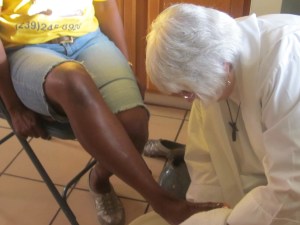
    Many other churches hold feet washings, washing each other’s feet, to commemorate that Jesus washed the feet of his disciples. Jesus reminds us that we are to love each other as he loved us.
    IMG_0055 (1)


    After the meal, Jesus went to the Garden at Gethsemane to pray. He asks the disciples to stay and pray with him, but they all fall asleep. Jesus is left to pray for strength for what is to come by himself, abandoned by his own disciples.

    Judas then identified Jesus for the Roman guards with a kiss and He was taken away by the soldiers.

    We don’t know why this Friday got the name of ‘Good Friday’ – it certainly was not a fun day. Jesus was brought before Pilate, the Roman governor, and sentenced to death. He was then forced to walk to the Hill of Golgotha, carrying the cross on which he will be crucified. There is a commemoration of this walk called the ‘Stations of the Cross’ where participants remember each of the steps to the crucifixion. Here at Trinity, we do a Stations of the Cross around the Statehouse, interweaving Jesus’ trials with social justice issues.

    It is generally accepted that Jesus was nailed to the cross around noon on Good Friday and died after three hours. Many churches, including Trinity, hold a vigil with readings and music during this three hour period. The Bible says that when Jesus died, the world turned black, which scientists think was a solar eclipse in the middle of the day.

    Jesus’ body is taken down from the cross and buried in an unused tomb.

    Holy Saturday ends the season of Lent for Easter Sunday will be a celebration of new life. Holy Saturday is a day of waiting for the resurrection on Easter Sunday. Some churches hold a twilight or midnight vigil waiting for the resurrection; others have people praying throughout the night, waiting for Easter Sunday.

    The word ‘Easter’ comes from the German ‘ostern’, meaning the direction from which the sun rises, celebrating the spring sun, when all things return to life again.

    Some churches, if they do not do an Easter Vigil, hold a sunrise service to celebrate the resurrection of Jesus as the sun comes up. This is a day of great celebration with banners and special music and great feasting. We have left the penitential season of Lent and are reveling in the fact that with the death and resurrection of Jesus, we all have new and eternal life. All our sins have been forgiven with His death and have been promised a place in Heaven for eternity.

    So this Holy Week, think about each of the days and what preparation you can make to be ready for the festive celebration of the resurrection of Jesus on Easter Sunday.

    Let us pray:

    Dear Lord, was we approach the week of the trials of your Son, let us remember our own shortcomings and vow to cleanse ourselves of those things that keep us from you. By raising Christ, your Son, you conquered the power of death and opened for us the way to eternal life. Let our celebration raise us up and renew our lives by the Spirit that is within us. Grant this through our Lord Jesus Christ, your Son, who lives and reigns with you and the Holy Spirit, one God, for ever and ever. Amen.


    The Rev deniray mueller

    Legislative Liaison

    Diocese of Southern Ohio

    ______________________________________________

    StreetChurch mailing list

  • Bishops At The Border-Rev. Chava’s Reflection-Weeping with Jesus

    Here is a beautiful reflection by Rev. Chava Redonnet, woman priest of the migrants.

    Please view the pictures through the links, I joined Chava in crying.

    In our community we had a family who came from Central America

    through Mexico to Florida where they had family and friends.

    We did all we could to help them stay.

    But they too were deported despite the many gifts they

    had to give in the community here.

    To see the Holy Eucharist served through the fence

    is a meditation for Lent and Holy Week.

    The Bishops who did this are in the steps of

    Pope Francis and in the shoes of Christ.

    There is a lot wrong with the Church, given the

    sex-abuse scandals and the

    man-made rules of the church that exclude rather than include.

    But this is what is RIGHT.

    Rev. Chava’s Reflections

    Oscar Romero Inclusive Catholic Church
    Bulletin for Sunday, April 6, 2014
    5th Sunday in Lent
    Dear friends,

    This week, an international group of bishops went where the church belongs:
    with the suffering people. They went to celebrate Mass at the border
    between Mexico and the United States, in Nogales, Arizona, where the border
    cuts the town in two. There were people on both sides of the fence, and
    folks on the Mexican side thrust their hands through the slats of the fence
    to receive communion.

    When I saw the photos, I cried. I thought of our friend who was deported in
    January, who was last heard from at the border. We don’t know where he is.
    I thought of all those in our little church, including my darling Santiago,
    who will be going to court in the coming months, who without a miracle may
    well end up on the other side of that fence. I thought of the friend who
    cannot visit her sick daughter in Mexico, the funerals people couldn’t go
    to, the grandchildren never seen. They are just a few stories out of the 11
    million undocumented people in this country, but I don’t cry for 11 million
    people. I cry for my friends.

    Then I looked down at the sermon I was trying to write, on Jesus raising
    Lazarus from the dead. “Jesus wept.” Oh. Jesus wept for his friends, too.
    He healed a lot of people, he responded with compassion, but it was for his
    friend that he wept. And I thought of what Shane Claiborne said in “The
    Irresistible Revolution,” that the world doesn’t  need more activists, it
    needs more lovers. He said that the world is desperately in need of people
    who build deep, genuine relationships and “actually know the faces of the
    people behind the issues they are concerned about.” And “allow those
    relationships to disturb and transform them.”

    Scott Peck said, “In community lies the transformation of the world.”
    Community – deep, genuine community where we know each other well enough to
    share our stories, to care about each other, to walk with each other in the
    good times and the bad. All of us can be builders of community. We can
    listen, share, know the people around us. But I think for it to be that
    transformative type of community, it needs to stretch beyond our own known
    world and into the uncomfortable world beyond. Like Gustavo Gutierrez said
    in “A Theology of Liberation,” we need to go out of the way to make people
    our neighbors.

    There is a photo from the Mass at the Border, of hands sticking through the
    fence, waiting to receive communion. You can’t see the people, only their
    hands. But there is also a photo of one of the bishops, perhaps having just
    given someone communion, clasping that person’s hand and talking to them
    through the fence. True relationship requires more than a handclasp, but
    it’s a very real start. May it be an instrument of transformation: may this
    Mass at the Border set a fire that will turn this terrible situation of
    injustice around.

    Blessings and love to all,
    Chava

    Links to several articles about the bishops’ Mass on the border:

    http://americasvoice.org/blog/photos-catholic-bishops-hold-mass-at-nogales-b
    order/

    http://ncronline.org/news/peace-justice/border-mass-bishops-call-compassion-
    immigration-reform

    http://www.washingtonpost.com/local/cardinal-omalley-immigrant-outreach-on-m
    exican-border-inspired-by-pope-francis/2014/04/01/55456b74-b91e-11e3-899e-bb
    708e3539dd_story.html

    Oscar Romero Church
    An Inclusive Community of Liberation, Justice and Joy
    Worshiping in the Catholic Tradition
    Mass: Sundays, 11 am
    St Joseph’s House of Hospitality
    402 South Ave, Rochester NY 14620

  • Time For Pope Francis to Talk to Jimmy Carter Who is For Women Priests

    Time for Pope Francis to talk to Jimmy Carter

    • Former President Jimmy Carter
     |  NCR Today

     I had the great privilege of interviewing former President Jimmy Carter for Interfaith Voices, on Tuesday, April 1. The occasion was the publication of his new book entitled A Call to Action: Women, Religion, Violence and Power

    I came away convinced that Carter and Pope Francis should meet for a serious discussion of the plight of women in the world, and that that conversation should include women’s ordination. In fact, I asked Carter directly if he would be willing to participate in such a dialogue, and he said, “Of course, I would.”    

    In fact, in the book, Jimmy Carter reveals that he had already written a letter to Pope Francis on global women’s issues and received a reply. Neither Carter’s letter, nor the Pope’s reply, touched on the question of women’s ordination (not surprisingly … Carter is a Baptist, not a Catholic), but Carter did discuss the global plight of women and urged the Pope to become active on global women’s issues. Francis answered with gratitude, indicating that there was need for a “more incisive female presence in the church.” (As usual, it’s not clear what that means.)

    However, Carter noted that, since the publication of his book, four women were among the eight people appointed to a new papal commission to deal with the sex abuse crisis. One of the women was a victim of sex abuse herself. Carter considers those appointments a sign of progress.          

    In answer to my direct question, Carter indicated that he is impressed with Francis and the freshness of his leadership. He sounded hopeful but realistic in his assessment. 

    The overall thesis of Carter’s book is this:  “… the most serious and unaddressed worldwide challenge is the deprivation and abuse of women and girls. …” As one might expect from a man with his international humanitarian expertise, he excoriates the obvious injustices seen in women’s higher poverty rate worldwide, spouse abuse, rape, honor killing, genital cutting, the genocide of girls (because of one-child policies as in China), and child marriage.   

    But he goes further — in a distinctly religious direction. He attributes the abuse of women largely to the “false interpretation of religious texts,” whether those are in the Hebrew Scriptures, the New Testament or the Quran. In the case of Christianity, he makes clear that Jesus fully embraced gender equality, and in the case of Islam, he makes a similar point with the Prophet Mohammed. He is also quite clear that some men embrace these misreadings even after the errors in their interpretations are pointed out, simply because men all too frequently like their sense of superiority, however unfounded.

    He also addressed the unequal treatment of women in religious denominations, and favors the full equality of women as pastors, preachers, priests, bishops, rabbis, imams, etc. In fact, he and his wife Rosalynn left the Southern Baptist Convention over issues about the roles of women in the year 2000 and affiliated with the more progressive Cooperative Baptist Fellowship.    

    Now, the only question that remains: how to set up that meeting between Carter and Pope Francis, and include a couple Catholic feminists to accompany Carter. I’m just sayin’. …  


  • Homily The Fifth Sunday In Lent: The Death of a Friend

    IMG_0113The Gospel account of the dying and raising of Lazarus (John 11:1-45) weaves the themes of friendship and death together in a poignant and prophetic way.  And I can think of no more important connection in the life and ministry of Jesus or in my own life and ministry. When I am in trouble, I need my friends. And my friends turn to me when trouble is near.  In addition to my lifelong and personal friends, the people I minister with and to are my friends. We turn to one another to share joy and sadness, fears and frustrations, life and death.  Pastoring is from the cradle to the grave and so is true friendship. And the “being there” of friends is all the difference.

    Just thirteen months ago I had to face major life threatening surgery.  It was so hard to function as I moved almost robotically toward that date. Two things essential to me went on “automatic pilot”- my faith and the loving relationships in my life. I called for Jesus and I called for my other friends to be there with me. They were all there. There was a great cloud of witnesses around me, those that could be seen and those whose presence I could not see but could feel.  It was their love that got me through the surgery and through a very difficult time of slow recovery. Thanks be to God, I am well and have been for many months. I could not have done this alone. I needed my friends.

    My friend and neighbor is an older woman of great faith. We visit and pray in the mornings. She told me that she is at peace in her life and when God comes for her she wants to die in her bed with someone there with her. She programmed my number in her phone so I could come if needed as her children do not live nearby. She is still full of life but I pray that I can be there for her. She in turn is there for a friend in a Nursing home and for one who has had a stroke.  Another friend, a woman who lives alone with her pets, just lost her beloved dog who made it to eighteen because of the love and care she poured into him. She is bereft. There is nothing I can say, but I am there for her.  Dying is a time for friends. So is living.  Another beloved friend of over fifty years is living in another state and facing her much loved husband’s struggles with a stage 4 cancer. I went to visit them as soon as I knew, and several times after. But, thanks be to God, he is living with cancer not dying with it and it is over two years later now. Yet we stay close and share the journey. Young or old, joys or sorrows, that’s what friends are for.

    IMG_0307

    Jesus had friends in Bethany. There was Mary and Martha and Lazarus and also Simon, the Leper. Jesus visited them and taught in their homes. It must have been a great comfort to a tired itinerant preacher and teacher to have friends who welcomed him “home” and supported his ministry. Mary is described by the author of John as being the same woman who anointed Jesus with expensive perfume and dried his feet with her tears. This event at Simon’s house is also described in Mark 14 and Matthew 26 and John 11 and 12.  In Luke 10:38 Martha opens her home and hospitality to Jesus and Mary sits at his feet the way disciples did. Clearly Jesus included women and lepers in his circle of friends. Jesus loved with a radical love.  We recall that he shared his identity as the Messiah with a Samaritan woman and in the story of Lazarus and Mary and Martha, Martha displays her great faith in him and he discloses his identity as Messiah to her. Clearly she is his disciple and his friend.  When her brother is sick she calls for her friend Jesus.

    Even choosing Bethany as a place to gather his friends and disciples may be a statement of how radical his love is. In Jesus’ Aramaic language Beth Anya means “house of misery/poverty”. There is also some historical evidence in tradition and archeology and in ancient writings like that of Eusebius and others that Bethany was a place where the Essenes had a hospice, a caring home for lepers and for other poor people.  So Bethany was associated with the care of the sick and the poor. Jesus chose Bethany and all of the world’s Bethanys to be with his friends, the poor and the marginalized. Jesus chose Bethany as the place to stay with friends and to teach. He chose it as the place to depart from on Palm Sunday.  And it was the place that he was last seen before returning home to God.  Bethany is now a West Bank Palestinian city and there is still poverty and struggle there. How blessed are we that Jesus chose to be a friend to the poor in the city of the poor and outcast.

    Now let’s establish more of a context for the story of Lazarus dying. Jesus has already been stoned in Jerusalem. He got away in the crowd but his enemies are hot after him. He healed the man born blind and exposed the blindness of the religious leaders who made laws but lacked compassion and a sense of justice.  He claimed that he was the Christ, the Anointed one, the Messiah. He had a large following.  He was now safely outside of Judea. Yet he receives word that Lazarus is dying.  He waits awhile for his own reasons that become obvious later, but he then suggests “Let’s go back to Judea” (John 11:7). The disciples try to stop him, “you were just stoned there!”  But, his friends need him, he will go back to Judea.

    Then Thomas makes his friendship with Jesus clear “Let us go with Jesus, so that we can die with him.” Jesus says in John 15:9 “Greater love has no one than this that he lay down his life for his friends….I call you friends….” Thomas and the disciples feel this kind of reciprocal love for Jesus although it will be very hard for them to live up to it. Jesus knows what lies ahead in Jerusalem, and still he responds to the call of his friends. In John 11:5 we learn that “Jesus loved these three very much”.  He gets there in time for the funeral and for the recriminations of Mary and Martha who say “He wouldn’t have died if you were here in time”. But this is the way it is in life. We all die. Jesus will die. But something else will happen here.  Jesus was deeply moved with grief, theirs and his own. He wept. “See how he loved Lazarus,” they said. He truly did. He then prays his heart out, thanks God for hearing him, and tells Lazarus to come forth from his tomb.  Lazarus comes forth wrapped in the garments of death and is set free of death. Imagine the amazement and belief of the crowd now. Jesus told Martha that he is the resurrection and the life, she believed him and now everyone can believe him. Jesus and the way of love, justice and equality he teaches can be chosen by the people.  But the authorities cannot let this happen. Jesus will have to give his life for his friends.

    Yet, like Lazarus, he will rise. And we will rise with him. We rise from the many deaths we live in our lives. The death of hope, of motivation, of physical strength and abilities, of opportunity, of our communities and families, of relationships, of loved ones, of our friends. Through Christ we rise now and forevermore. Our Friend is right there beside us.

    Even as Jesus wept for Lazarus and his other bereft friends, God must weep at the death of God’s children and friends. And God must have wept mightily at the horrifying death of God’s Beloved, Chosen One Jesus. And God raised him from the dead and he was seen by many of his friends and believers until he returned to God, sending the Holy Spirit to be with us.   Ultimately God is with us and within us, we are never separated from God.  But when life is hard and death and loss is real it is so good to have our Friend beside us to comfort us and raise us up.

    Let us live in friendship with our loving God.  Let us rise from the dead now and forever. Let us love our friends as Jesus did.  Thanks be to God.

    Amen.

  • Again, Vatican Punishes Gender Equality More Swiftly Than Sexual Abuse

    • As we approach Easter and Resurrection to new life, let us pray that the church will turn from punishing women priests and their supporters to promoting full life for all as Jesus did.
    • This is an excellent post by Patricia Miller.
    • The 76-year-old Zawada has been ordered to a “life of prayer and penance” within the Wisconsin friary of his order for saying mass with Janice Sevre-Duszynska in 2011. Sevre-Duszynska was ordained a priest in the Association of Roman Catholic Women Priests, a dissent women’s ordination movement in the Catholic Church that has ordained some 180 women as priests since 2002, when seven women were ordained in a ceremony on the Danube River.The Vatican moved aggressively to tamp down any enthusiasm for break-away women’s ordination movements after the Danube River ordination received widespread media coverage. It said that any woman who claims to be ordained is automatically excommunicated and in 2010 declared women’s ordination a grave offense on par with pedophilia.

      The Vatican’s equivocation of women’s ordination and pedophilia, and the relative speed with which it has disciplined dissenters, is ironic given its less-than-rapid response to actual pedophiles and the bishops who covered up their actions.

      In 2012 the CDF expelled Maryknoll Father Roy Bourgeois from the priesthood four years after he took part in the ordination of Sevre-Duszynska and stripped 92-year-old Jesuit Bill Brennan of his faculties as a priest three weeks after he said mass with Sevre-Duszynska at an annual protest at the School of the Americas. Bourgeois founded the School of the Americas Watch, which seeks the closure of the Western Hemisphere Institute for Security Cooperation at Fort Benning, GA, formerly known as the School of the Americas, which trained notorious dictators such as Gen. Manuel Noriega and was implicated in a number of human rights abuses in Latin America, including the murder of six Jesuits.

      In contrast to the relative alacrity with which the CDF moved against three elderly peace activists who celebrated mass with a woman, it took the Vatican 13 years to finally expel Michael Fugee from the priesthood in mid-March. Fugee admitted to fondling a 14-year-old boy in 2001 but his conviction was overturned on a technicality. Under an agreement with prosecutors, the archdiocese of Newark, NJ, agreed to supervise him and banned him from contact with children, but appointed him as chaplain of a hospital without informing the hospital of his history. Fugee continued to have contact with children, including traveling with them on retreats, until last year when a local newspaper brought his activities to light and a public outcry forced his ouster.

      The bishop who was supposed to supervise Fugee, John Myers, remains as head of the diocese of Newark despite calls for his removal. A group of Catholics in Kansas City, MO, is pressing the Vatican to remove Bishop Robert Finn, who was convicted of a misdemeanor charge in 2011 of failing to report suspected abuse after he found pornographic images of a child on a priest’s computer. Monseigneur William Lynn, who was in charge of priests’ assignments and investigating abuse for the Archdiocese of Philadelphia from 1992 to 2004, was convicted of hiding reports of abuse and sentenced to three to six years in prison for enabling “monsters in clerical garb.” He was freed on bail when a court ruled that the state’s child endangerment law didn’t apply to those who didn’t directly supervise children; the diocese paid his bail and he remains a priest in good standing.

      Polls show consistent support for women’s ordination among Catholics. A recent Pew Poll found that 68 percent of Catholics support women priests and 42 percent think the church will probably allow them in the next few decades, which is wildly optimistic given the canonical obstacles that have been erected by the two previous popes to any change to the teaching.

      When he was head of the CDF before he became Pope Benedict, Joseph Ratzinger proclaimed Pope John Paul II’s ban on women’s ordination essentially infallible, a characterization that was disputed by progressive theologians. Such a designation means that women’s ordination is considered a closed subject. Pope Francis confirmed in his first apostolic exhortation, Evangelii Gaudium, that the “reservation of the priesthood to males…is not a question open to discussion.”

      Writing in The Week, Damon Linker predicts a “mass exodus” from the Catholic Church if it doesn’t revise the “stunningly unpersuasive” ban on women’s ordination:

      American Catholics have become accustomed to worshipping in a state of cognitive dissonance, with a majority rejecting the church’s sexual teachings.…This is relatively easy to do, because these issues don’t come up very often in Mass. By contrast, the majority of Catholics who support women’s ordination are confronted on the altar with the all-male priesthood every time they go to church. At the moment, frustration about the issue is muted because Pope Francis has inspired so much good will among the faithful—and raised such high hopes for reform. That has given the church some breathing room. But it isn’t going to last….Sooner or later—and probably sooner—egalitarian-minded Catholics are going to lose their patience.

      The Vatican is hoping it can delay that day of reckoning by removing the most visible signs of dissent on the issue. But as Linker says, sooner or later Catholics are going to figure out that the change they have been waiting for isn’t coming at all.

      Correction: Thanks to Bridget Mary Meehan of the ARCWP for letting us know that rather than 160, as a previous version of this post specified, there are in fact over 180 ordained and about to be ordained women in the International Roman Catholic Women Priests movement.