
A Story About Fr. Greg Reynolds- Excommunicated for Supporting Women Priests
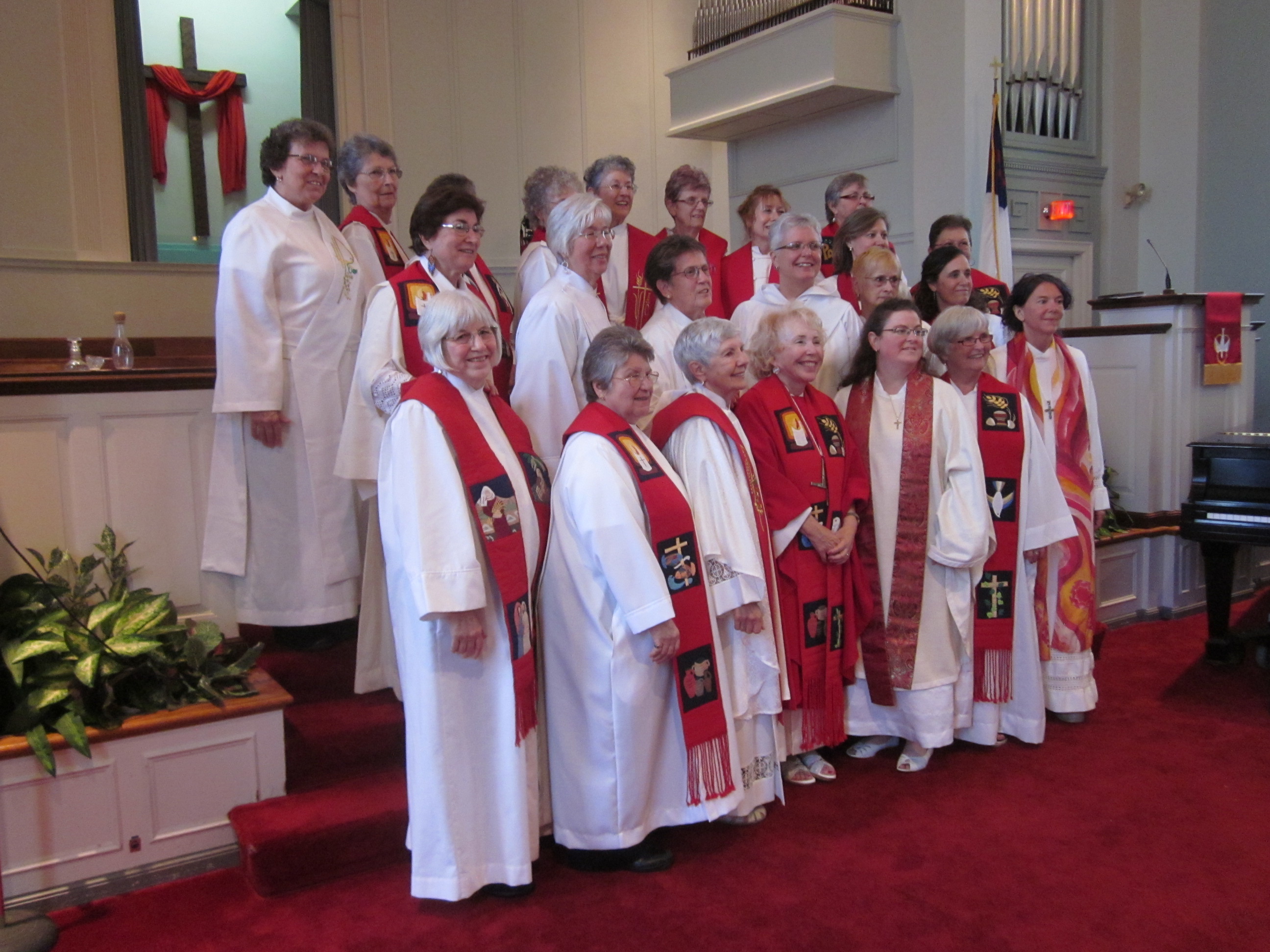 We as Roman Catholic Women Priests are moved by the plight of Australian Priest, Fr. Greg Reynolds who put himself on the line for the ordination of women priests. We now share the same fate-excommunication. But we agree that no one can separate us from the love of Christ or from the real church-the people of God. We thank him for joining Roy Bourgeois as one of the few male priests who have risked it all publicly for the equality of our calls. God calls who God calls…
We are validly ordained women, we are here, we are serving God’s people,
Thanks be to God!
This is an article about this courageous man from the blog of the Concerned Catholics of Montana, posted by Rosemary.The original article is in the North Queensland Register. It is well worth reading.
The Outsider: Father Greg Reynolds
Many of us remember Paul Harvey and his radio segment “and now for the rest of the story”. That’s what came to mind when I read this piece on recently excommunicated Father Greg Reynolds.
| by Thom Rigney | November 9, 2013 | North Queensland Register |
His support for the ordination of women and an incident over the Eucharist saw Greg Reynolds excommunicated from the Catholic Church. But as Stuart Rintoul discovers, this rogue priest is not giving up without a fight.
Not long after Greg Reynolds was born, he contracted pneumonia. The doctor did not hold out much hope and told his mother, Patricia, to send her other children away for a while and throw open the windows to the winter air. “If he’s going to survive, he’s just got to fight the elements,” the doctor said. The boy recovered, although for a long time he was weak and spindly. His mother, a devout Catholic, always believed that he had been saved by God for a purpose.
Sixty years later, Greg Reynolds sits at a kitchen table in a small rented apartment in Melbourne’s south-east, speaking quietly in a soft laconic drawl. His excommunication from the Catholic Church is on the table between us, slipped neatly into a plastic folder to keep it straight and clean.
Written in Latin, a language he never learnt, it comes from the Congregatio Pro Doctrina Fidei (Congregation for the Doctrine of the Faith, formerly known as the Supreme Sacred Congregation of the Roman and Universal Inquisition) and carries the authority of Summus Pontifex Franciscus, Papa (Pope Francis). It convicts him of heresy (Canons 751 and 1364) and blasphemy (Canon 1369), which he has been told relate to his support for the ordination of women and his celebration of the Eucharist after his priestly faculties were withdrawn, and excommunicates him in accordance with Canon 1367, which refers to a person who “throws away the consecrated species or takes or retains them for a sacrilegious purpose”, which appears to relate to a strange incident where a dog received communion.
Reynolds has been defrocked and excommunicated “for the good of the church”. He shakes his head and says he feels like an ant who has been hit by a hammer. “How can they, who are so big and so powerful, be so frightened of me?” He notes that paedophile priests have been defrocked, but not excommunicated: “How can they see this as so much more serious than that?”
Greg Reynolds’s trouble with the Catholic Church began three years ago, when he made up his mind to support the ordination of women. But his journey began in May 1953 when he was born, the third of four children, into “a pretty average Catholic family” who lived in a mile-long middle-class street in East Bentleigh, in Melbourne’s south-east.
His father, Ralph, converted to Catholicism to marry his devout wife. Greg and his two older brothers, Paul and Phillip, were altar boys and went to Catholic schools. Greg’s friend from that time, Chris White, recalls that he was always studious, gentle and kind, but says that he was surprised when Reynolds became a priest because he also liked to go to ballroom dancing to meet girls.
After completing an economics degree at Monash University, Reynolds started questioning whether there was more to life. A friend of his mother’s suggested he enter the seminary, where others were surely grappling with such questions.
“I went into the seminary not even sure that God existed,” he says. “I didn’t put a time frame on it, but it was certainly just going to be a temporary arrangement, ’til I got a few answers and then I’d get out.”
He enjoyed it and began to think that he could be a priest. “But it’s a bit awkward if you don’t believe in God,” he says laughing. “So I gave God, if She’s [sic] out there, a bit of time, saying, ‘You’re going to have to sort this out because I can’t go on here indefinitely.’ ”
One restless night, he broke down in tears of frustration. “Nothing happened, the darkened room did not light up, but, looking back, from that day the sense that there is a God began to grow.” In the months that followed, he prayed and meditated and gradually “the whole spiritual reality opened up to me, not in any dramatic way, but just that subtle but deep sense that God is out there and Jesus is the way”.
In 1977, he travelled to India and Nepal with four other seminarians and came back with a strange story. He told his family how he was waiting for a bus one day in Kathmandu when a boy came and stood beside him, begging. Reynolds brushed him aside, got on the bus, looked out the window and his eyes locked with the boy’s. “They were the eyes of Jesus looking at me,” he said to his family. “He asked me and I let him down.”
Consumed by guilt, he gave away material things. Years later, after his parents died, he gave away most of his inheritance to the needy.
Reynolds was ordained in 1979. He spent three years as a curate in Sunshine, in Melbourne’s west, working with an elderly Irish priest, then became a chaplain to the deaf for four years. For two of these, he lived at the presbytery in South Melbourne with the irascible priest Bob Maguire, who enjoyed a thorny relationship with his archbishops.
While working with the deaf, Reynolds stepped towards solitude, asking Archbishop Frank Little for permission to become a novice at Tarrawarra Abbey. One of Australia’s most closed and contemplative monasteries, Tarrawarra, in the Yarra Valley north-east of Melbourne, is home to a community of Cistercian monks, the Trappists.
He read the works of the New Zealand-American monk Thomas Merton and, after three years, went back to Little with the “hare-brained idea that I was being called to be a hermit”. Little made him a chaplain at the Mercy Hospital for two years, then relented and gave him permission to live as a hermit for a year – which became a decade.
For the first three years, he lived in a bush shack at Longwood, in central Victoria. He spent the next five in a one-room brick hut built for potato diggers at Trentham. There was no electricity, an open fireplace, tank water, single bed, desk and chair. From there, he went to a shack at Warburton, in the Yarra Ranges east of Melbourne, for two more years.
He celebrated Mass alone, read and meditated and passed more than 10 years with the grudging support of Little and his successor, George Pell, who was “extremely supportive”. “It was great, just felt right for me,” he says. “It’s a very unusual calling, but it has always been there in the history of the church.” He says he can think of nothing in his background that drew him into silent contemplation. “It seems as odd to me as to anybody else.”
On a soft autumn day in October, we return to Trentham and spend some time with Tom and Mary Walsh, the elderly parishioners who allowed him to stay there in the potato diggers’ hut. Asked what she thinks of the path Reynolds has taken and his excommunication, Mary Walsh replies, with Irish equivocation, “Well, of course we are traditional Catholics, but we have always been very fond of Greg.”
Reynolds returned to parish life a less conformist priest. At Donvale, in Melbourne’s east, he irritated traditional parishioners and delighted others by saying “in the name of the Mother” rather than “in the name of the Father” at the end of Mass. The pastoral associate there, John Lazzari, describes Reynolds as “a priest of a deep spirituality” and “a very good man” and says his excommunication is “clearly wrong”.
By 2010, Reynolds was parish priest at Western Port, on the Mornington Peninsula, and it was there that he decided to speak out in favour of the ordination of women. Friends advised him to be cautious, but he would not be persuaded. He thought, “Damn it, I’m going to say it.”
He wrote to Archbishop Denis Hart, informing him of his intention and then at three Masses across the parish said he believed it was God’s will to have women priests and that denying women the right was “obstructing the work of the Holy Spirit”.
He tells me that as “an insignificant little parish priest” he lacked the profound theological training to contradict papal teaching, “but some things you just know in your heart, in the core of your being”. At each Mass, he says, there was strong applause.
It did not extend into the Cathedral. Hart responded, by email, that he should recant or resign. Reynolds replied that he intended to do neither, but resigned nevertheless as the parish priest a year later, in August 2011.
By then, he had made up his mind to become a priest for the disaffected – those who thought of themselves as Catholic, but were at odds with the church on women’s ordination and homosexuality, as well as victims of clerical abuse and those who were divorced.
He was inspired by the outspokenness of Peter Kennedy, a priest for 40 years who was defrocked in 2009 and founded St Mary’s in Exile in south Brisbane, and had closely followed the battle of American priest Roy Bourgeois, who was laicised last year after a five-year battle over women’s ordination.
Michael Kelly, a former Franciscan seminarian and organiser of the Rainbow Sash movement -which campaigns for acceptance of homosexuals in the Catholic Church – had met Reynolds around 1998 through a network of people who were attempting to live “contemplative lives”. He regarded Reynolds as a man of “deep and simple spirituality”. When he learned Reynolds had resigned from active priesthood, he advised him to “build a community”. Reynolds established the group Inclusive Catholics.
On the first Sunday of Advent, November 27, 2011, Reynolds celebrated the group’s first illicit Mass. He said his actions were founded on justice and compassion. Conscious of the implications, he preached, “I take comfort from the words of St Thomas Aquinas: ‘I would rather be ex-communicated than forced to act outside my conscience.’ ”
Then in August last year, the consecrated bread of the Angels, the Eucharist, was given to a dog during communion. The Age religion editor Barney Zwartz reported it this way: “A first-time visitor arrived late at the Inclusive Catholics service in South Yarra with a large and well-trained German shepherd. When the consecrated bread and wine were passed around, the visitor took some bread and fed it to his dog. Apart from one stifled gasp, those present showed admirable presence of mind – but the dog was not offered the cup!”
Reynolds says he did know the man had shared the Eucharist with his dog, and he would never have given communion to a dog, but that it was “just one of those odd things that happen” and “a bit of a non-event”. He was sorry to hear that the dog died not long afterwards.
The Catholic Church did not regard it so lightly. Hart described it as an “abomination”. He demanded Reynolds cease acting publicly as a priest and disassociate himself from groups acting in defiance of Church authority. The following month, Reynolds was advised that Hart had begun the process to have him defrocked.
But conservatives demanded more. The Catholic blog Australia Incognita fulminated, “Why haven’t Fr Greg Reynolds and ‘Inclusive Catholics’ been excommunicated yet?” Criticism was directed not only at Reynolds, but also at Hart. In England, conservative priest Ray Blake said he felt angry and sick and criticised Hart for tolerating an “anti-Church” preaching heresy to dissidents. “I really cannot understand why this priest, having celebrated the sacraments whilst suspended, was not excommunicated,” he wrote.
In the middle ages, public excommunication was sometimes accompanied by a ceremony in which a bell was tolled, the Book of the Gospels was closed, and a candle snuffed out: condemned “with bell, book, and candle”. Reynolds’s excommunication was much more prosaic.
In September this year, he received a phone call from the Dean of St Patrick’s Cathedral in Melbourne, Reverend John Salvano, “inviting me to come and have a chat about some canonical issues”. They met on Wednesday September 18 at the presbytery. He expected to be defrocked.
Reynolds thought Salvano, whom he knew from seminary days, seemed uncomfortable. Salvano handed him the decree, gave him a “rough translation” of the Latin, and discussed the canonical violations. He told him he was the first priest in Melbourne to be excommunicated and that it was not sought by Hart but by unknown people who had contacted the Congregation for the Doctrine of the Faith, which requested Reynolds’s file.
Salvano said that Hart was shocked and presumed the excommunication was based on a misunderstanding of the dog and the Eucharist incident. The meeting lasted half an hour, and when they rose the two men shook hands, and Reynolds drove home. In quick time, Wikipedia added his name to a list of people excommunicated by the Roman Catholic Church that includes heretical theologians, Joan of Arc, Martin Luther, Henry VIII, Elizabeth I, Henry IV of France (who retaliated by “excommunicating” the Pope), Napoleon, Fidel Castro and Australian saint Mary MacKillop. Excommunication means Reynolds is forbidden to have a ministerial role in the celebration of any sacraments or acts of public worship, receive any sacrament, exercise any Church ministry or hold any office in the Church.
When we first speak, soon after the excommunication, Reynolds says he feels “indifferent” to it. “I just don’t take it too seriously, really,” he says, but adds that it seems “excessively heavy-handed” and that Church reformers will be concerned that it has been done under the seal of the new pope.
Bob Maguire, forced into retirement last year at age 77, is appalled by Reynolds’s excommunication, but had warned him against putting his head in the lion’s mouth. “It’s all bullshit, isn’t it?” Maguire says. “Catholic bullshit.”
He describes Reynolds as “a man of principle” and “a good bloke”, from a family that was “true-blue Roman Catholic”. Reynolds, he says, has been denied a fair hearing and drummed out of the church by an ecclesiastical “kangaroo court”. “His tour of duty, I would have thought, entitled him to better treatment. I would love to see the transcript of evidence. It is outrageously draconian. In secular society you wouldn’t get away with it.”
At Geelong’s St Mary of the Angels parish, priest Kevin Dillon, an outspoken advocate for victims of paedophile priests, says it is concerning the church’s most severe penalty has been applied in circumstances clouded by a lack of disclosure: an invisible accuser, unspecified charges, no opportunity for defence, no right of appeal. Dillon was the vocations director at the seminary when Reynolds began his journey into the priesthood and was his parish and school priest. He says while he does not agree with Reynolds on all things, he is “a fine and compassionate human being”.
At Inclusive Catholics, Irene Wilson, a “cradle Catholic” who has led the liturgy at the group’s illicit services, says that what has happened to Reynolds is “absolutely horrendous”. “He is such a good man, working for a church that we all love so much, to make it more relevant, where all are welcome and women can be ordained,” she says.
In a 500-word statement, which the Melbourne archdiocese says will be its only comment, Vicar General Monsignor Greg Bennet says the decision “by Pope Francis to dismiss Reynolds from the clerical state and to declare his automatic excommunication has been made because of his public teaching on the ordination of women contrary to the teaching of the church and the fact of his public celebration of the Eucharist when he was forbidden to do so and the manner in which the celebrations occurred”.
He says that Hart and others sought “in a spirit of pastoral and fraternal concern to encourage Greg Reynolds on repeated occasions to cease his activities contrary to the teachings of the church but without success. The possibility remains open for the excommunication to be lifted upon Reynolds manifesting through his actions and teaching a serious commitment to return to full communion with the Church.”
On a quiet Sunday afternoon, Reynolds stands at a pulpit, preaching to a congregation of Inclusive Catholics in a Protestant church hall, a green Catholic stole draped across his shoulders. There are about 150 people in the hall, more than usual. He says his excommunication is complex, but that God has a talent for turning mess into goodness.
“We are only here really because we love the Church,” he says. “It is our Church and we are not walking away from it, we are not going to abandon the Church, because we are the Church. We can’t walk away from ourselves.”
Share this:
Hallelujah Prayer for the 32nd Sunday in Ordinary Time 11/10/13 Pastor Judy Lee, ARCWP

These are some of our members,including myself, who have risen again and are still rising. On the left is our Elder and worship leader Mr. Harry L.Gary whose testimony is new every Sunday. Also Roger and Len.
In our Gospel today (Luke 20;27-38) Jesus says that God is the God of the living, all are ALIVE to God! We are assured that we can and will rise again. Hallelujah!
If you know Leonard Cohen’s song Hallelujah! hear it and sing it with this prayer.
In a few hours we will celebrate together. Our inclusive Catholic Mass is at 2PM on Sundays. No day is ordinary and we pray that all may be full of God’s life today. And now I pray as I take in the events of the day. Join me in prayer as you go through your day.
I pray as I look at our little lake with wonder. The algae blight that covered the lake this summer is now almost completely gone and the ducks and coots and egrets have returned. Hallelujah!
My neighbor Imogene is a prayer warrior who sits facing the lake with her prayers and Scripture reading every day.If you are on my prayer list she may have prayed for you too. She is getting more frail in her mid eighties but she still feeds the ducks and birds and tends her garden. The algae bloom saddened her heart as it did mine. Everyone we called said there was nothing that could be done. They spoke about fertilizer use and warm waters. She kept on praying. See her smile now that it is gone! Hallelujah!
I pray as I shepherd my rescued cats through their morning ins and outs in separate groups. “Hiss” says Potsy, the newest. “I am not ready for all these others yet.” ” Ahhh,m’row” he says as he returns to his safe room and bed. But he will not die on the streets (he is FIV Positive and stress is a killer for him, and so are attackers and cars since he would sit right in the middle of the street). He sniffs Star and Silver at the door. He will be ready soon. I pray for all beings that have to live outside when they were designed for indoor homes.Hallelujah!
I think of Len who could easily lose his home as he ignores things like paying the bills and is debating whether we can help him with this. I think of Rich mowing lawns and living in a shed. I think of Don living outside. I pray we can work together to get each of these truly housed. I think of Sally who had her “rest” in the Psychiatric Hospital, I pray that she is stable enough to get started in housing again. She is living in her car until she can face the reality that she will not own her own home but live in a small Efficiency on her income. They may all be in church today, I pray for homes and God’s abundant grace for them! Hallelujah!
I am shocked at the morning news. The news about the typhoon in Central Philippines affecting 4.3 million people and the direct hit on Tacloban City, in the Philippines is overwhelming. Possibly over ten thousand people killed in the Tacloban area. “My God!” we cry together. This must feel like the end of the world for them. Like the reading from 2 Maccabees today about horrific torture, rising to God is the only good part of the story. We pray for each one who died in this terrible natural event. It is not an act of God, but of nature and it overwhelms us like the roaring sea and wind.We pray for the loved ones of all who perished. We pray for all of the survivors, and all those whose lives and hearts are broken. We pray for quick aid. We pray and we sing Leonard Cohen’s broken and holy “Hallelujah”!
The Philippines is very dear to me as Filipina Methodist Deaconess Virginia Maniti Williams shepherded me from my youth and Filipino Pastors like Emerito Nacpil and others also served at Bethany church in Brooklyn encouraging our youth when they visited. Deaconess Virginia went home often with beloved Rev. Mel, and she returned alone after his rising to God. She helped and we did as well in the building of a new Methodist Church. She returned home to serve her people before her own illness brought her Stateside to live with her daughters, then in an Assisted Living home in California. For the health and strength of Deaconess Virginia Maniti Williams we sing a holy “Hallelujah!”
We pray too for all those wounded warriors from all walks of life who in losing limbs and sight and mental health to war have to fight to rise again. We pray for the members of the Wounded Warriors Band that appeared on CBS Sunday Morning Show this morning.With the guidance of the acclaimed Roger Waters they make beautiful and astounding music out of the wrecks of their bodies and lives. They truly rise! And we pray for those wounded soldiers who are studying music with Arthur Blum and visiting stars like YoYo Ma at the Walter Reed Hospital. We pray that each one will continue to rise. We pray for their return to full life, for their resurrection. And we pray for all wounded warriors who have not yet found a way to rise, that they will find it. Hallelujah!
We pray for Tim Donley the marvelous lead singer of the Wounded Warriors Band-that he may continue to rise! His testimony this morning was astounding. His signature song is Leonard Cohen’s melancholy and profound Hallelujah. We will quote some of it as we end our prayer. Tim said that when he lost both legs he was broken but he still had his right hand. He was okay. Then he lost the use of his right hand. He said “Every dream was broken and I didn’t know where to turn. In that place God said to me,”Do you still trust me to have what’s best for you?” It may be the best is now for me. That made me understand Leonard Cohen’s Hallelujah.”
WOW!
Amen to our brother and Amen to all who rise again and sing “Hallelujah”. I am going to get The Wounded Warriors Band rendition of Hallelujah to share with my people and all who are rising again.
This is two stanzas from Leonard Cohen’s Hallelujah! It is a story about the Hebrew King David and also about all of us who have fallen or been wiped out and need to rise again.
“…
There’s a blaze of light
in every word
it doesn’t matter what you heard
The holy or the broken Hallelujah.
Hallelujah, hallelujah (4x)
….And even though
it all went wrong
I’ll stand before the lord of song
with nothing on my tongue but hallelujah.
Hallelujah,
Hallelujah, hallelujah (8x)”.
And so we end our prayers today with a broken and a holy Hallelujah! May we all rise again. Amen and Hallelujah!
Pastor Judy
Rev. Beverly Bingle’s Homily for Sunday 11/10/13- Justice and Peace Rising
Salvation and justice are one says Rev. Bingle, Roman Catholic Woman Priest from Toledo Ohio.
Peace is what needs to be resurrected and we need to live justice for all. I am happy to present this homily here along with the one I have just published on a similar theme to spread the word. All honor and glory to our loving and living God who gives us life forever.
Rev.Dr.Judy Lee,ARCWP
This weekend’s readings point to resurrection. The scholars of the
Jesus Seminar see this passage from Luke’s Gospel as written in the
style of rabbis of a later time, though they conclude that Jesus might
have engaged in an exchange of this type. In it Jesus affirms and
strengthens what was just beginning to be accepted truth at the time
of the Maccabees family: that there is salvation, that resurrection
happens, that God is inviting us into the fullness of life. Jesus
tells the Sadduccees, “Look! Heaven is different, it’s radically
different. It’s a totally new life, living within the fullness of
God’s life. It’s here and now and for ever.”
Further on in our tradition, Pope Paul VI, in Evangelii Nuntiandi,
also described salvation as existential, now and forever. He said it
involves justice—action toward the reform of oppressive forces and
structures in society. So, to experience Jesus’ resurrection—to be
“saved”—means that the poor are lifted out of poverty, the lonely are
lifted into community, the sick are lifted to health. Resurrection
means that we raise our voices and vote our consciences until all are
lifted into justice. Resurrection means feeding the hungry, housing
the homeless, and visiting the imprisoned.
We’re closing in on the end of our liturgical year, heading for winter
in our Ohio world. We can’t help but think about endings and deaths,
salvation and resurrection. As we ponder, we are increasingly aware
of the significant shift in our understanding of the cosmos and how
that affects our understanding of God. There’s a startling newness to
it, still evolving. We could look at Teilhard, Ilia Delio, John
Haught, Kathleen Duffy and theologize about resurrection for a long
time.
Then we have the first reading from Maccabees, where confidence in
resurrection underlines the courage of the family facing torture and
death. But the story haunts us; it’s troubling.
We remember World War II and the holocaust. As the Franciscan Action
Network observes, “The evil perpetrated at Auschwitz occurred not only
because of a few very immoral and aberrant people but also because of
the many ordinary human beings who failed to question what they were
witnessing, and what they were doing, to other ordinary human beings.”
Millions died… but we were youngsters when that happened, or not even
born yet. We’re past that, we think. We’re civilized now, we think.
Are we? Our drones explode in Pakistan, Yemen, and Somalia, killing,
maiming, and traumatizing. Refugees crowd into camps around the
world—a quarter of a million Darfur refugees and 50,000 Central
African Republic refugees in Chad; 144,000 Syurians in Jordan; 12,000
Liberians in Ghana; 400,000 Somalians in Kenya. Then there are 2
million Palestinian refugees in Jordan, a million in the Gaza Strip, a
half million in Lebanaon and another half million in Syria, 200,000 on
the West Bank. Still others seek refuge from war and oppression in
Thailand, Cambodia, the Philippines, India, Iran, Lampedusa in Italy,
Lybia, Tunisia, Turkey, Malawi, and Malta. In Toledo over eleven
hundred people are homeless.
Thousands are being massacred and tortured in Mexico, Honduras and
Colombia in our “War on Drugs.” The “Western Hemisphere Institute for
Security Cooperation” is the new name given to the infamous U.S. Army
School of the Americas—the SOA. SOA graduates brutalize and terrorize
and murder in Honduras and Colombia. Our government taught them the
way.
Then there are the injustices that come from our immigration policies.
Over 2,500 people have died trying to cross the Arizona desert.
Private prisons, border fences, and electronic surveillance have
blurred the reality of our militarized foreign policy being the root
cause of people leaving their homes.
And there’s the violence of executions. We’re one of the few countries
in the world that still has a death penalty—brutal, inhuman,
dehumanizing.
The toll of our inhumanity goes on and on. We are responsible for the
death and maiming of war, uprooting peoples, torturing. Everything
that Jesus speaks to us rejects oppression and war. The way of
violence and oppression is not his way. He wants abundant life for us,
abundant joy. And it’s clear that he means that
salvation—resurrection from our old lives—is to be here and now.
If we are not part of the solution, we’re part of the problem. And
that brings us to the second reading and its prayer that our own
lives, our daily activities, be an unstoppable force for goodness.
Many of you know Kathleen and Paul. They are again heading south to
Arizona for the winter—but not as snowbirds. As volunteers with No
More Deaths, they’re heading for the border, where they’ll drop food
and water in caches to save the lives of desperate people. You know
Laurie of St. Rose Parish’s Migrant Ministry, who worships with us and
carries our contributions of rice and beans and oil and clothing to
the local migrant camps in the summer. You know Carol, who stands
vigil in prayer with the Ohioans to Stop Executions at the corner of
Adams and Erie whenever the State of Ohio murders another person in
our name. And most of you know Tom, who heads up our Holy Spirit
Community’s Social Concerns Ministry. Sunday noons will find Tom on a
street corner somewhere with the Northwest Ohio Peace Coalition. This
weekend they’re at the corner of Collingwood and Delaware, drawing
attention to our use of drones. Then there are the many folks—far too
many of you to name right now—who lift people out of poverty when you
volunteer and donate to places like Claver House, Helping hands of St.
Louis, and Padua Center. Many of you have a connection with Corpus
Christ University Parish and will gather for the prayer service there
November 21 to bless and send a delegation from Toledo to the School
of the Americas Watch at Fort Benning, Georgia. Our Holy Spirit
Catholic Community voted to contribute some of your generous donations
to a fund to help sponsor college students who want to join this
year’s SOA Watch. And we all pray, and that changes us so we can
change the world.
We are part of the solution. May we continue to find our salvation
in our daily lives.
—
Holy Spirit Catholic Community
Mass at 2086 Brookdale (Interfaith Chapel):
Saturdays at 4:30 p.m.
Sundays at 9 a.m.
Mass at 3535 Executive Parkway (Unity of Toledo)
Sundays at 5:30 p.m.
www.holyspirittoledo.org
Rev. Bev Bingle, Pastor
419-727-1774
Start Rising Now-Homily for the 32nd Sunday in Ordinary Time 11/10/13-Rev. Dr. Judy Lee,ARCWP
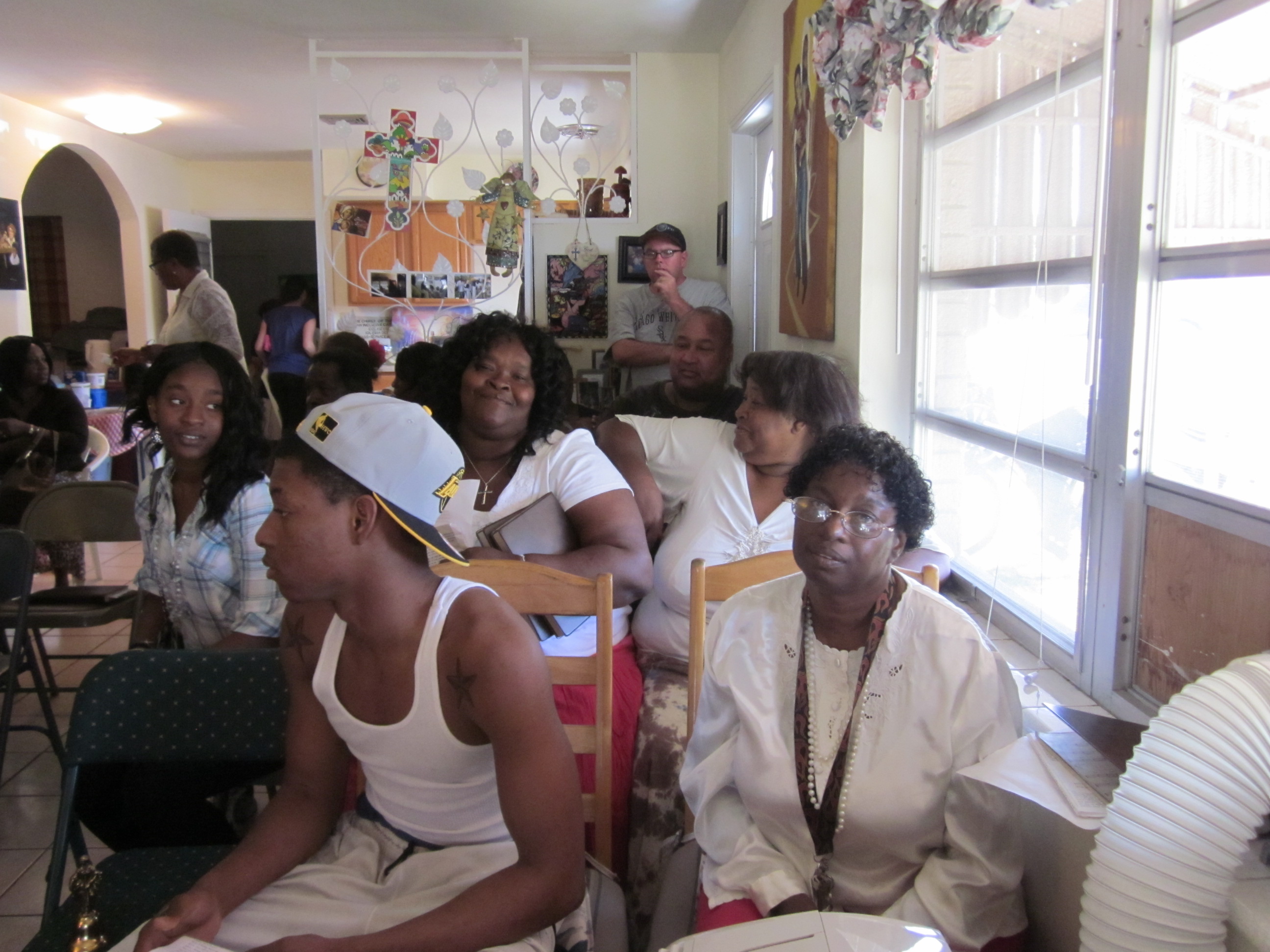
Celebrating Resurrection Faith in the Good Shepherd Community
The smiling woman in the middle is Linda Maybin. She has shared her story of turning her life around. “I thank my children and family,including my church family for showering the love on me that helped me turn my life around”.
It is love that helps us rise again.
The readings for this Sunday lead us into the heart of our faith and to the secret places of our hearts where hopes and doubts and love are stored. They are about death, and life, and rising again. They are about both consolation and hope and they are about living our faith-walking the walk no matter what the challenges are.
2 Maccabees 7:1-2, 9-14 records the horrific deaths of seven passionate and courageous brothers and their mother who were willing to die rather than break their covenant with God through the Law. The book of Second Maccabees, written about 110 BC, is a series of facts and at times commentaries and legends that emphasize the hopes and sufferings of persecuted believers under the reign of the Syrians. Jews tried hard to hold on to the Law as their lifeline while enduring the onslaught of demands for acculturation to pagan beliefs. The brothers are firm in the hope of resurrection and eternal life.
The resurrection is mentioned in the Bible for the first time here. (It is also mentioned in Daniel and the Wisdom books). Unlike Greek thinking that places the spiritual above the material and physical, the Jews did not separate the concepts of body and soul. Last Sunday’s reading from the book of Wisdom (11:22-26) tells us that all that God made God loved and lived in and kept alive. God lives in us body and soul, hence the belief in afterlife, eternal life, and bodily resurrection. Not all Jews believed in the resurrection. In Jesus’ time, the Pharisees did and the Sadducees did not.
As our Gospel for this Sunday (Luke 20:27-38) shows Jesus firmly held, and then fulfilled, the belief in resurrection. The Sadducees tried to trap Jesus by giving him a riddle that to them meant resurrection is ridiculous-about the plight of a woman who married seven brothers according to the Law-who would be her husband in heaven? Jesus deftly showed them that heaven is not a replay of life on earth but a new play-one where there is no need for marrying as life is eternal. Both men and women are the children of God and the children of the resurrection and have eternal life. He emphasizes that even according to Moses, God is the God of the living, “All are alive to God” (verse 38).
The letter of Paul to the Thessalonians is written to encourage and console this new and persecuted church made up of some Jews and many Gentiles. He urges them to live the Gospel and work to spread the good news and not sit around brooding about the end of time and hoping for the return of Christ. He assures them that God is faithful and will strengthen them.
We need to know that when times are hard for whatever reasons, God does strengthen us. When times are hard there is also a hope that someday things will be better-someday and somewhere. And yet in our hearts we long for it to be better now and not “pie in the sky bye and bye”. The hopes I hear are: someday there will be peace on earth and peace right here so drive by shootings and crazy folks with big guns stop all this killing; someday I will get a good job; someday I will be poor no more; someday I will have my own home; someday I can pay my bills; someday I can afford health care for myself and my children and someday my children will have all the opportunities that I didn’t have, and especially now- “please God, don’t let them cut food stamps”. The someday needs to be now and our work is to make this happen. The life God promises needs to start now-for ALL of God’s children.
For others, the torture faced is not because of religious persecution though that clearly exists in our global village, the torture is enduring an addiction or a horrific illness ourselves or with those we love dearly. We pray that this will end someday. And we pray that someday is now-that the cure is found, that the treatment helps, that the suffering will stop. Sometimes we pray for death to bring life and sometimes we pray for life to be restored and death conquered. And when death separates us from our loved ones we need desperately to know that they are still alive to God and that, still living, they are with us too. Jesus reassures us of this-“God is the God of the living…all are alive to God”. In dying we join our loving God in the Eternal Now.
Yet there are so many ways that we can be dead even as our bodies are technically alive. We can live in depression so deep that we might as well be dead. We can live in so much fear-of the outside world, of other people, of danger and harm and even of our own potential that we stay fixed and do not move one inch. We can give up and not try to climb up a higher rung on the ladder when we’ve gotten messages that we belong on the bottom. We need to rise. I think of the poem Still I Rise by Maya Angelou. (Excerpted here.
” You may write me down in history
With your bitter, twisted lies.
You may trod me in the very dirt
But still, like dust,
I’ll rise….
Leaving behind nights of terror and fear
I rise
Into a daybreak that’s wondrously clear
I rise
Bringing the gifts that my ancestors gave,
I rise
I am the dream and the hope of the slave.
I rise
I rise
I rise.”
Our rising now is as important as rising “someday”. What is holding us back? We can become so self- absorbed that the Other barely exists or exists for our own ends. We can live in sensory deprivation cut off from the natural world and held captive by the machines and games that seem like life to us but are a complete artificial world. We can make our worlds so small that people who are not like us in looks or beliefs are exiled. We can live only for ourselves while our neighbors are in need of our love and assistance. We can think we are alive and living the Gospel when we are only pleasing ourselves. We can open or close the door on love. We can be so lonely that we build a wall that keeps people out and loneliness, which is at least familiar, in. We can talk the talk and not know how to walk the walk. We can know how perfectly well, but not exert the energy to really walk it. There are many ways to be alive and many ways to be dead. This applies to nations and cultures and churches and faith communities as well as to individuals. We need to pinch ourselves and if we have died we need to rise again.
When I faced major surgery for a rare slow growing stomach cancer last February, I stared death in the face. I was frightened. I could not control my trembling. Lying down on the operating table, I said to God, I am in Your arms. And I rested because I was. I was so thankful to rise up off that sick bed and to live again. I was overwhelmed by the love of those all around me and knew deeply the love of God. Some things are the “new normal” for me, but I welcome life with a new zest and a new purpose to share the good news. And this is that news:the love of God in Christ lifts us up; the love of God is forever. God loves us like we’ve never been loved before, and that is for always. We are alive to God now and forever. Our deceased loved ones are alive with God in the eternal Now. When we die, we will live again, we will rise again. Jesus the Christ showed us how to love and how to live, how to die and how to rise. Let us shake off death and rise again-NOW!
Rev. Dr. Judy Lee,ARCWP Co-Pastor The Good Shepherd Inclusive Catholic Community FM,FL
Going Home-Brooklyn and New York
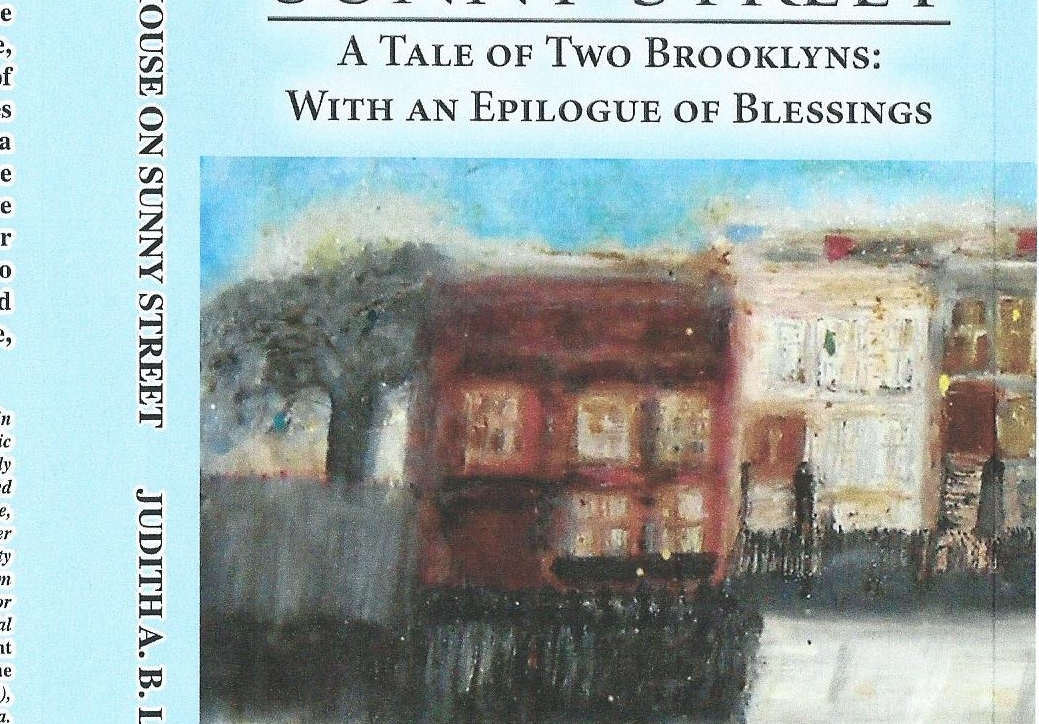 It is said that you can’t go home again. That is true for me in literal terms. If you read my book The House on Sunny Street: a Tale of Two Brooklyns (PublishAmerica.com;Amazon.com; Band N.com)- about my childhood home, you will learn that 1185 St. Mark’s Avenue in Brooklyn ,New York is now the parking lot for the 77th Police Precinct. But you will also appreciate the history of a special house,neighborhood, and family. Maybe you will laugh and cry with me and my family and friends as we come of age in Brooklyn. But you will not be able to see the house beyond what exists in pictures or on the cover of the book, a painting by my mother, Anne Marie Beach. If home were only that beloved house and place and the people who lived in the house, I would not be able to go home again. It is not there and they are not there. But home is more than that. Anchored in a place, for me Brooklyn, and New York City, Long Island and Upstate New York it is also anchored in the heart and soul and spirit. It is alive there and with such life you can always go home again,and those you love so deeply are waiting there. And I do go home whenever I can. And always I am refreshed and renewed by touching Brooklyn soil and visiting friends, family and places that shaped my life and call to serve God’s people.
Finally after a year and four months and some tough health issues I was able to make my pilgrimage to Brooklyn and New York on October 31st, 2013. I could only stay four days and I could not go everywhere important to me or see everyone, but I traveled a lifetime in those days.
We met our close friends Danielle and Laura and went to Nathan’s in Coney Island first. As a child Coney was my favorite place to visit with my Mom and she also lived there in Senior housing facing the ocean “with a million dollar view” in the last decades of her life. My cousin Jackie grew up there. There are so many special memories there. Nathan’s was damaged when Super Storm Sandy hit New York last year. One now orders inside and eats outside. It was a chilly Halloween day and the hot chowder was a welcome lunch. We were surrounded by some homeless men and treated them to chowder and Nathan’s famous hot dogs. Laura said “how they find you, I don’t know-but they know!” Laura has been my friend since 1982 when I met her at a NYC Shelter for homeless women. Living still in a residential facility she moved to in 1982, she now helps countless other homeless people. She is a faithful Jew and she explained to me that she has been praying for my health daily and with that she does a mitzvot each day so God will hear her prayers for me. I told her that she was righteous and just and a servant of our God always. Still, she said, she would do an extra mitzvot (bring someone else a blessing) for me every day. I gave her a very big hug. Laura and I are blessed with friendship.

The Amusement Park was quiet and yet I could hear the happy sounds of years past. When we visited the Board walk near West 36th Street where Mother lived, the new cement “boardwalk” was undamaged but her favorite cabanas at Seagate and some of the rocky structures dividing Seagate from Coney were now under the sea and sand. Mom would not be happy about that and I still miss the real boardwalk that splintered my feet. The sea was uneasy on this chilly day but I closed my eyes and remembered how good it felt to be in it, and to be enjoying a sunny day there with my Mom. I could see her in her chair with the little beach umbrella on it. And I could see her opening her eleventh floor window and letting the good sea breeze in. She was there. We were there together again. But the chill nipped and we decided to go to the Brooklyn Museum for the rest of the day.
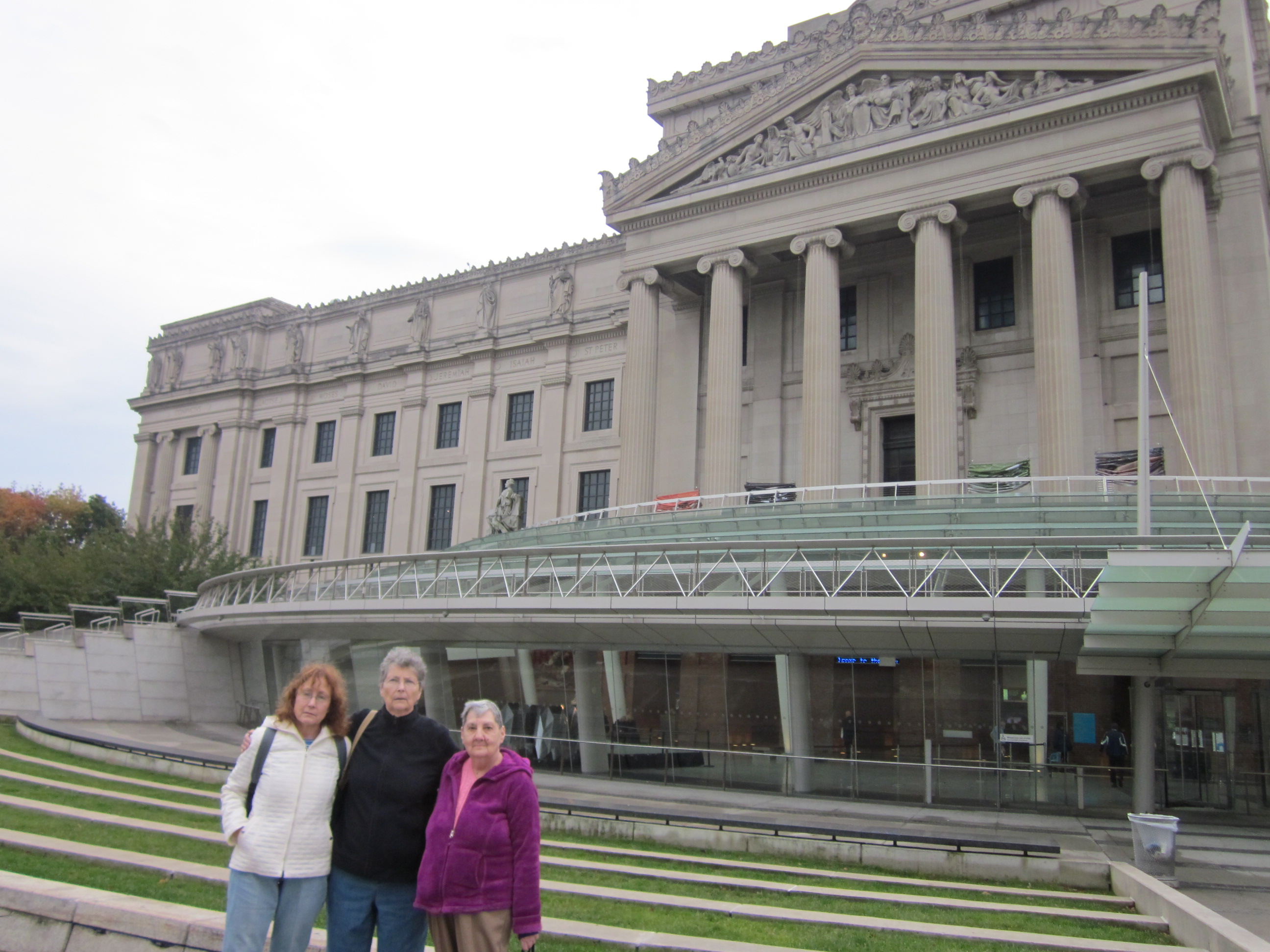
This is Judy B. and my dear friends Danielle and Laura in front of the new Brooklyn Museum. This building is a strange mixture of old and new that somehow works. I went to Prospect Heights High School just a few blocks from the Museum and it was part of my campus as were The Brooklyn Botanic Gardens, Prospect Park and the Grand Army Plaza Library. What a campus! How my friends and I loved exploring the Museum. I prefer the original building, but the additional space caused by the renovation draws one in. The floor devoted to Feminist Art was a wonderful addition. We were amazed to have Judy Chicago’s whole exhibit of the Dinner Party to ourselves. When it was there years ago, I could not even get in!
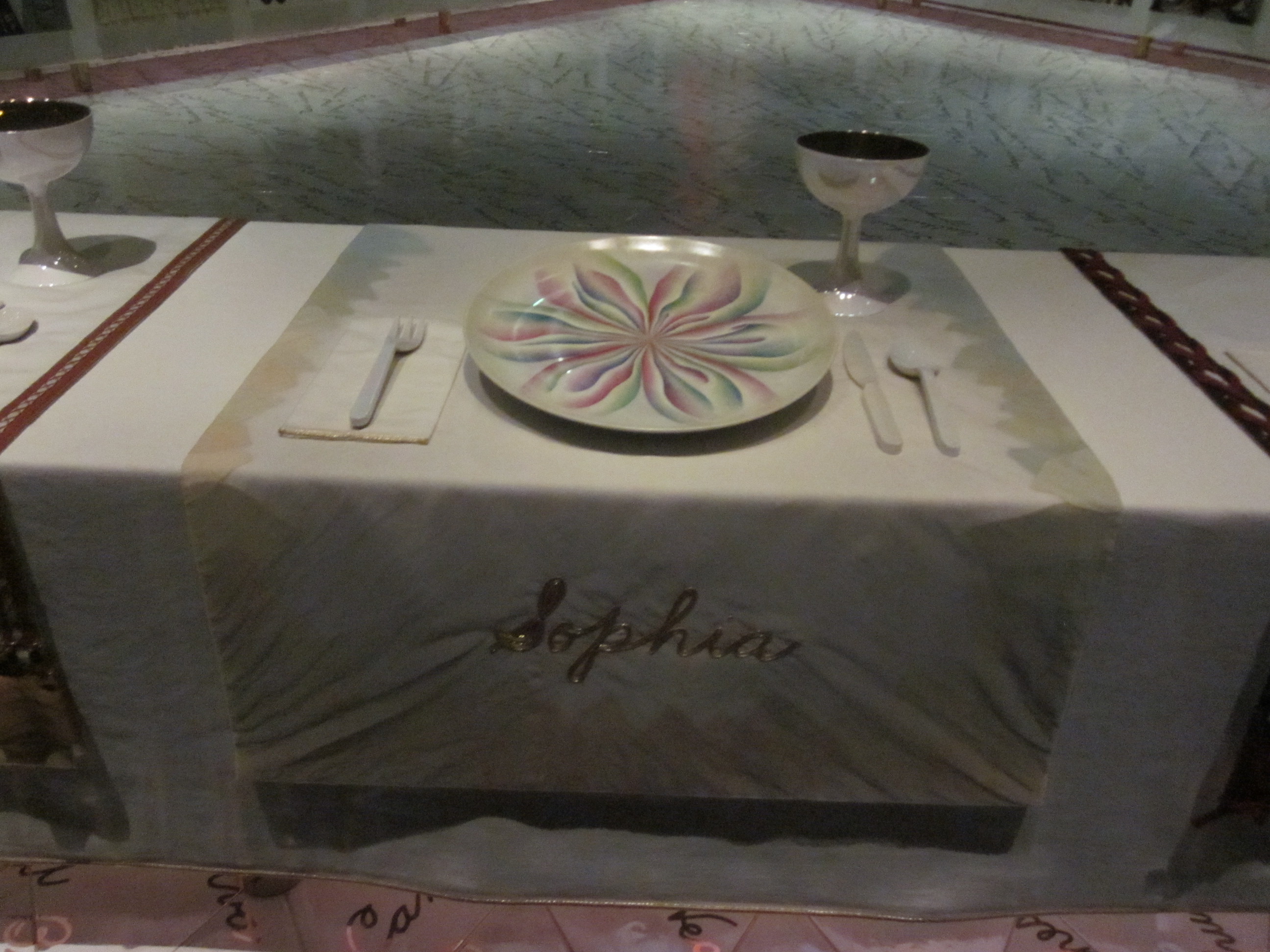
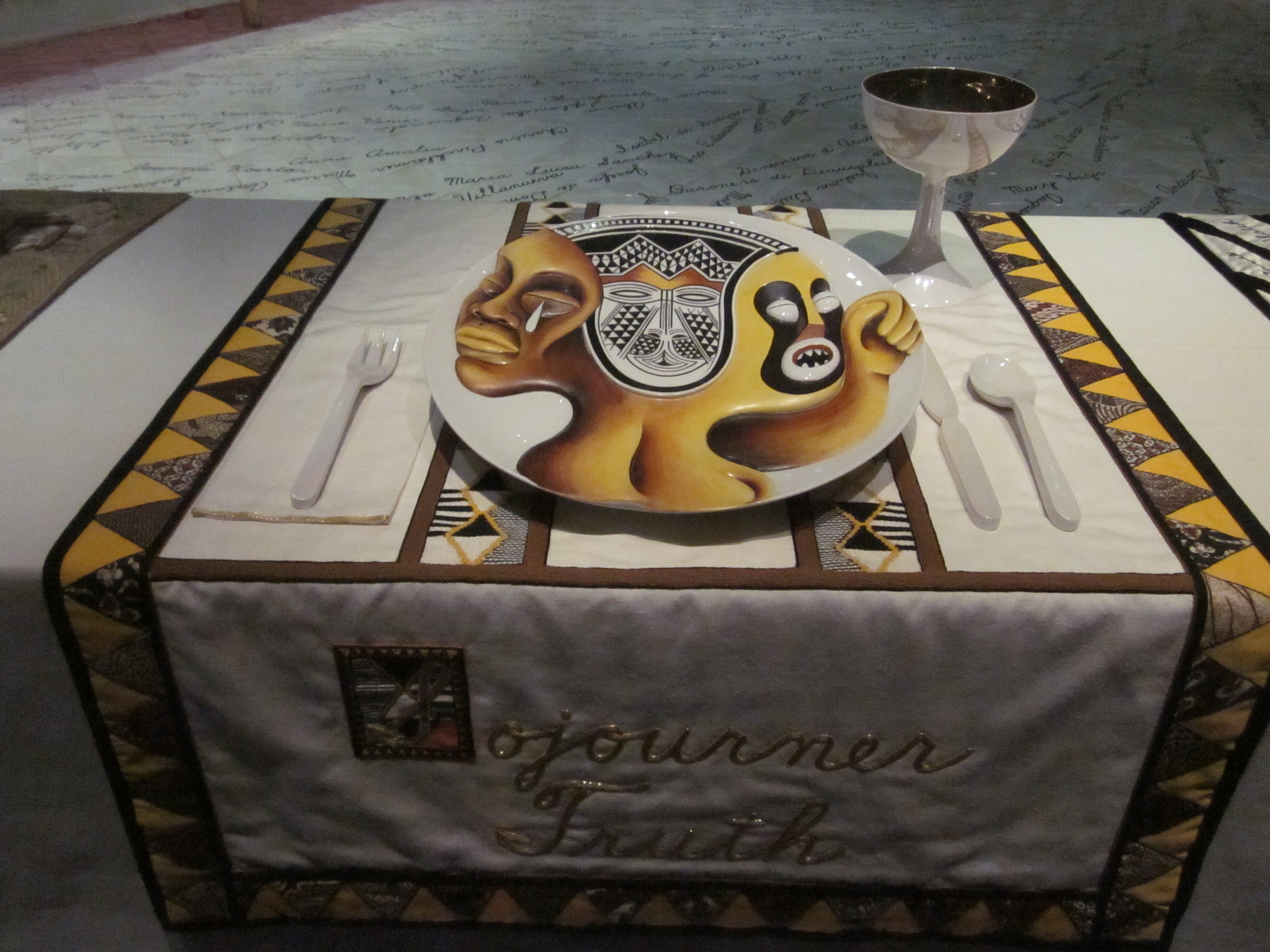 This is Sojourner Truth’s
Plate and place at the Table. Sophia’s plate and place at the Table. Sophia is Wisdom, the Feminine image of God.
How special it was to be at the Dinner Party.
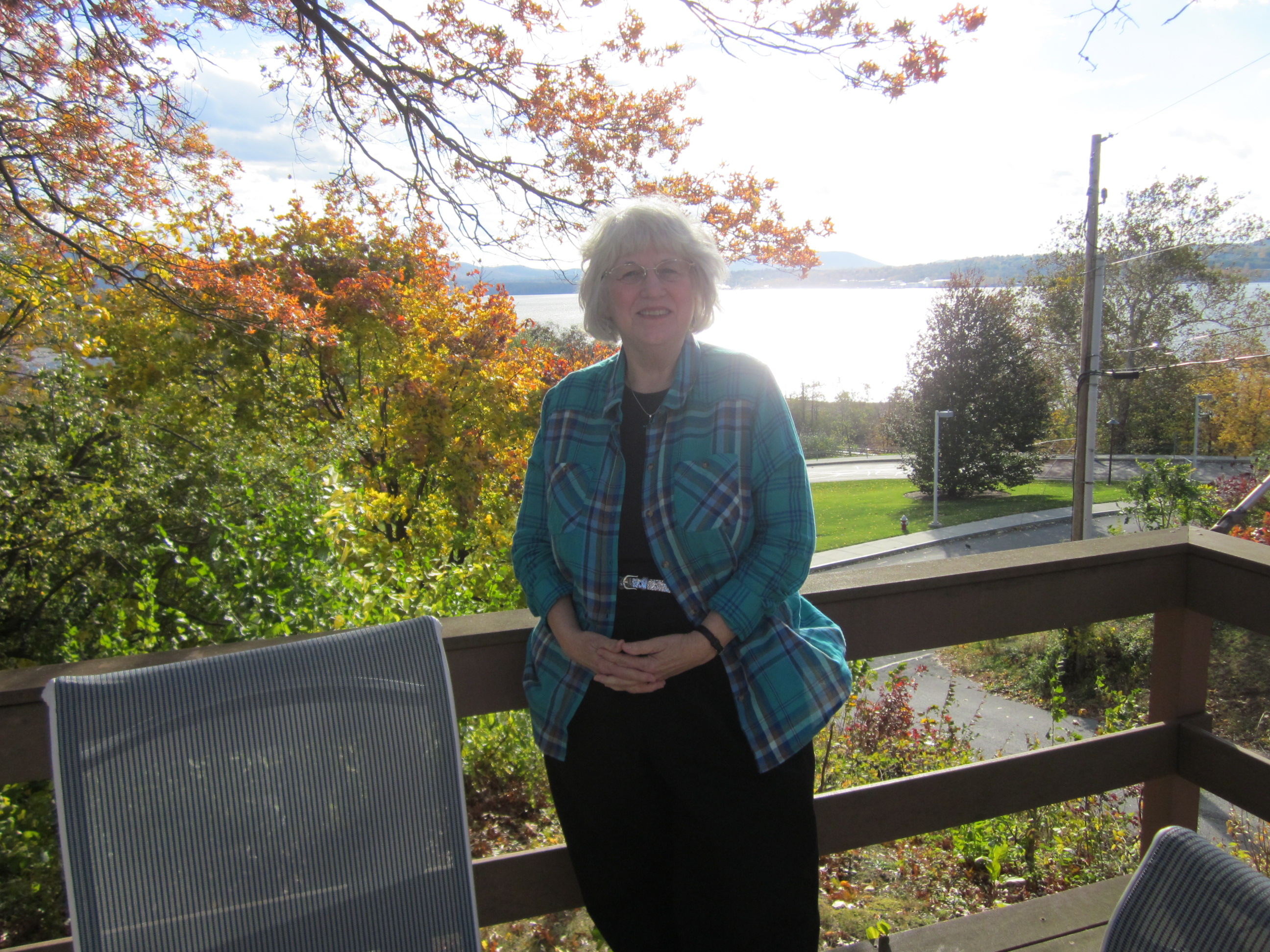
The next day Judy and I went to Grand Central Station and caught the Metroline train to Beacon,New York. There we visited with Ellie Ver Nooy. Ellie is a dear friend and the widow of Pastor Dave Ver Nooy my spiritual guide mentor and friend since childhood. Pastor Ver Nooy went home to God last December. His love and guidance remained although he could no longer speak it as the Parkinson’s took its toll. Ellie gave me his well worn Book of Worship and I was so grateful to receive it. He was there on the deck facing the river where we always sat, and right next to Ellie and his beloved dog as he always was. He was there.

In the picture on the right,Ellie is on the right and Judy B. and Dancer are sitting in David’s chair.
And finally, for the last two days of the pilgrimage home,
we went out to Long Island and visited with my family. We had a cousins reunion of three branches of the Shotwell family clan and had four generations of cousins together. We are the elders now but silently our beloved elders were standing right there with us. We met at Cousin Dorothy Shotwell Stewart’s house and went to a nearby waterfront restaurant for a seafood feast and wonderful reunion. Dorothy is now in her 92nd year. Bobby Robinson is now 78 and his lovely wife Barbara just had a birthday so we celebrated birthdays too. The younger members present are Lori (Robinson) Whitlatch Post and Kenneth Robinson. Patricia Sullivan King graciously and lovingly shepherded us for two days. Patty and her daughter- in- law Beth King who located us through her genealogy work had a wonderful brunch with us before our departure on Sunday.
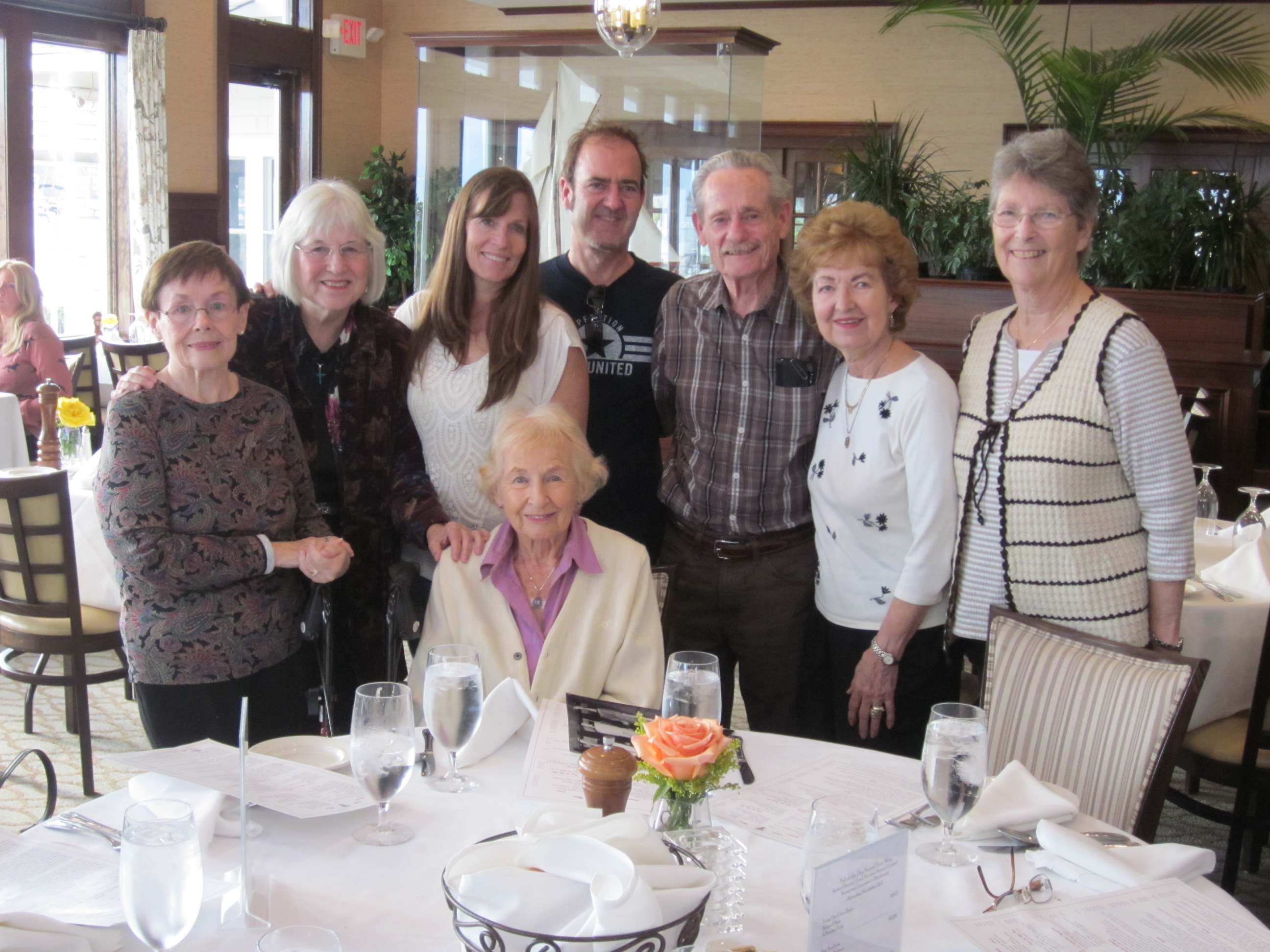 It was so good to go home again.
We are connected by love and I am renewed.
Thanks be to God.
Judy Lee
Chava Redonnet Woman Priest With MIgrants in Rochester NY Writes About Church
Chava Redonnet is a priest of the poor and the migrant workers in Rochester, New York. . Here are her reflections on what it means to be church in a community of equals and some of the history/herstory of her church, St. Romero’s. When their 501c3 application is approved donations to this ministry will be tax deductible so we wish them well in this.
Oscar Romero Inclusive Catholic Church
Bulletin for Sunday, November 10, 2013
32nd Sunday in Ordinary Time
Dear friends,
We had a milestone moment at St Romero’s this week: Librada Paz, Lynne Hamilton, Marianne Timmons, attorney Mike Tobin and I gathered in my kitchen to sign the papers for our 501 (c )3 application.
Our little church began on September 19, 2010 with Mass in the dining room at St Joe’s. Three years later, we continue to celebrate Mass each Sunday at 11 am at St Joe’s. We also continue to be a little church! But whenever I ask God for a sign as to whether or not to keep going, a sign comes. Most recently that was Oct 27, when Wally Ruehle and Tim Sigrist turned up to help give thanks that Santiago and I are alive and reasonably well following our accident. It was such a lovely moment, the table surrounded by old friends, other St Joe’s community members and a man named James, who wanted to sing “Amazing Grace” for our final hymn, so we did.
The question I carried with me through seven years of seminary was, “What is the role of a priest in a community of equals?” It was such joy when in the fall of 2007 I encountered the Roman Catholic Womenpriests, and met an entire organization of woman asking the same question! If women become priests and simply enter the hierarchy as it now exists, we will become part of the problem. The church needs to be different than it has been, to be a place where people are empowered and encouraged to realize that they are the church, where the gifts of each person are given a chance to bloom, and the message is, You beautiful child of God, you are worthy, you are whole, you are loved, you are needed.
So how is one a leader in such a church? What does it mean to be a priest in a community of equals?
When we first began celebrating the Migrant Mass in June of 2011, it was a collaborative effort. Librada and I drove around, asking people if they would be interested in a weekly Mass, until finally we found people who not only said yes, but invited us to use their space. We negotiated the date and time until we found something that worked for all of us.
One of the gifts to me in the past three summers has been learning some new answers to that question. The question of how to lead a community of equals is not the sort of question with one right answer. It’s the sort you hold , carry with you, and answer in a myriad of ways. My Spanish has been an equalizer from the start, and continues to be.Today in the nursing home as I read from a Psalm in Spanish, half a dozen voices spoke up, correcting my pronunciation of “refugio.” They patiently repeated it until I got it right. (I’m told that in the migrant community, people sometimes sit around the dinner table asking each other, “What do YOU think she meant?”!)
At the last Migrant Mass of the season, we blessed the cars of those going to Florida. Because it was raining, we stood on the porch and held our hands out towards the row of cars parked in front of the house. “Which are the cars going to Florida?” I asked. “It doesn’t matter,” someone said. “We will bless them all.”
And so, my car was blessed along with the others. All of us blessed all of the cars, and three days later when the front end of my car was demolished by a drunk driver, Santiago and I made it through with bruising and minor cuts, but probably no lasting damage. I am in awe. In a community of equals, all bless, and all are blessed. That’s a wonderful thing.
When our little church began three years ago, it was not possible to know what the future would hold. One simply listens for the call and says yes, hanging on to God’s hand and putting one foot in front of the other, day after day, walking with God in trust and love. We will continue to do that at St Romero’s. May we listen, trust, and say yes, and see where God takes us. May this little church be a blessing!
Thank you for reading this bulletin. You, too, are a part of the life of this community. May all of us grow in ways we’ve never dreamed!
An update or two:
I have heard from our friends who were deported to Mexico in August. They are “mas o menos” which in English we would probably say, “okay.”
The friends who went to Florida for the winter arrived safely, and visited family on the way.
Santiago and I continue to heal. He is still in a lot of pain so his doctor told him to take five days off from work. I am happy to tell you that the farmer said, “Tell him to take the time he needs,” when I called. It means no pay, and forced inactivity which he does not like, but hopefully it will make the difference and he will feel better before long. I have good days and bad days, but on the whole am recovering. Driving is hard but I’m “back in the saddle” except for some long or complicated driving. One day at a time.
Congratulations to Patti La Rosa and Judy Pfoltzer who will be married in Ithaca on Saturday. Much joy to you both, Patti and Judy!
Life is good, God is good, and there is so much to be grateful for. Get out and enjoy those gorgeous leaves!
Blessings and love to all,
Chava
Oscar Romero Church
An Inclusive Community of Liberation, Justice and Joy
Worshiping in the Catholic Tradition
Mass: Sundays, 11 am
St Joseph’s House of Hospitality, 402 South Ave, Rochester NY 14620
Welcome To Our Tuesday Church with Women Priests Judy Beaumont and Judy Lee
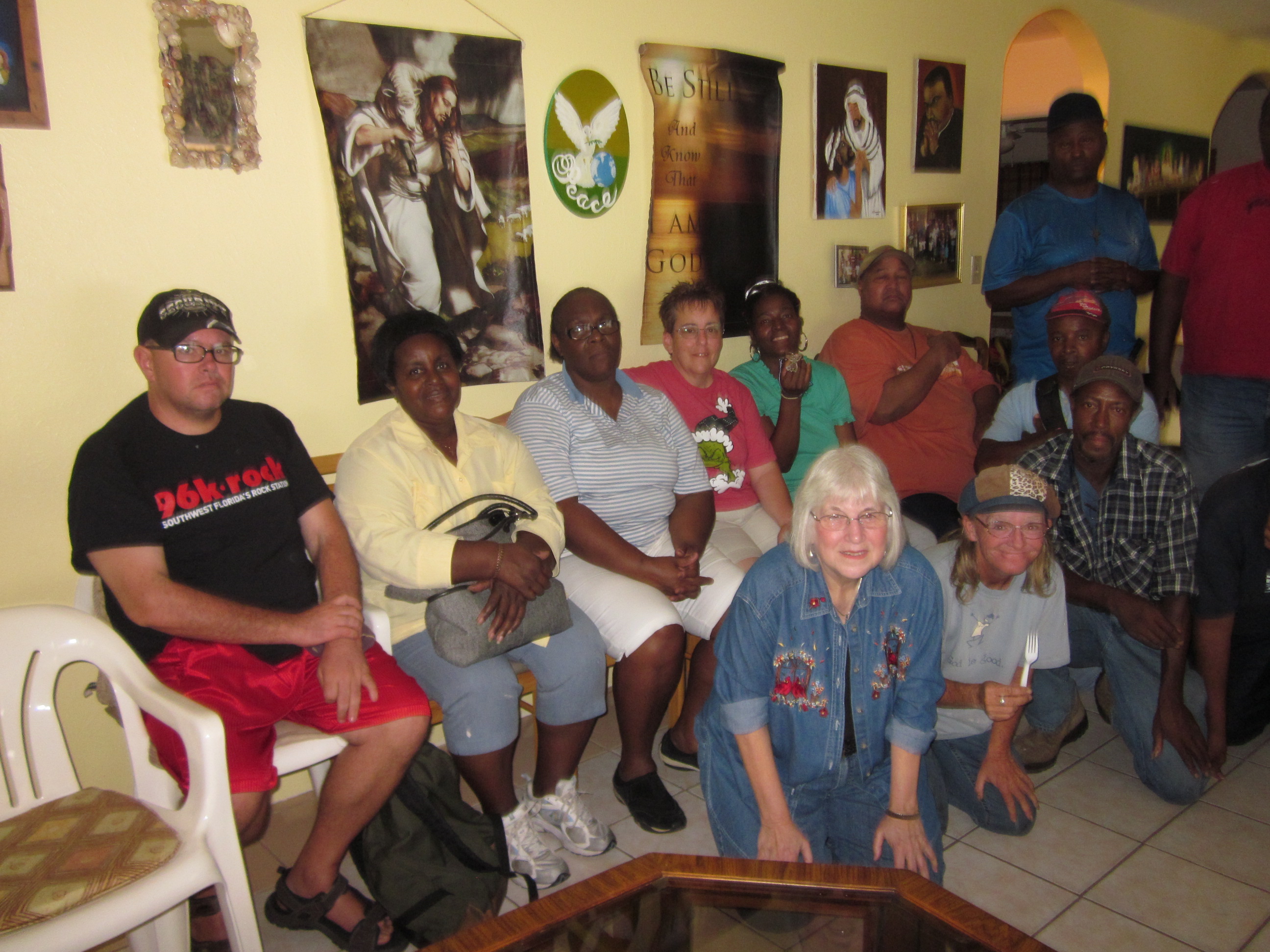
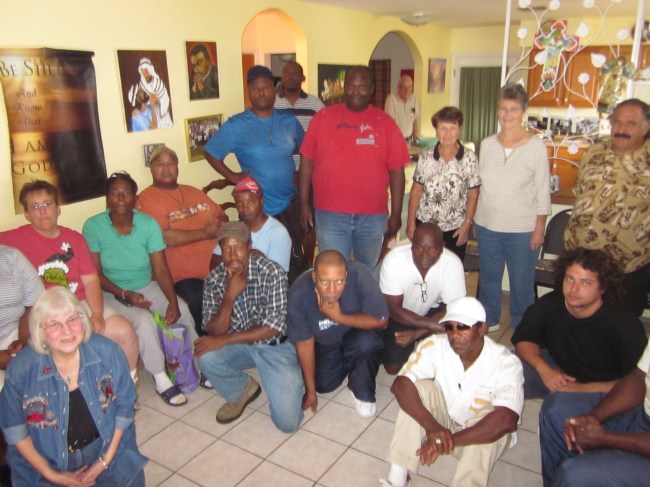
Today, 11/5/13, twenty of our people gathered to worship, discuss the Scriptures and issues in living, share a meal, shop in our free store,talk with the Pastors and enjoy an afternoon of fellowship. Ellen and Jack McNally brought and served second helpings of a delicious lasagna dinner. Dwayne prayed to bless the meal and also blessed them. They received loud and hearty applause.
Many of our Tuesday church members and the McNallys and another guest today, Evelyn Efaw, have been with us since we had Good Shepherd Church in the Park- serving a hot meal and sharing worship in nearby Lion’s Park on a Friday night from 2007-2009, ( Come By Here: Making Church with the Poor is the book I wrote in 2010 to share that wonderfully blessed mutual ministry-PublishAmerica.com;Amazon.com;BandN.com,) In 2009 we began Good Shepherd church in the house, a home we bought to function as a church and a transitional residence for people making the transition from homelessness. Twenty-four people lived at our Joshua House and while we had to expand our church space and no longer have this residence, all except two of those present with us today now enjoy their own homes. The community of love and faith has existed over time and distances. It is with great joy that this group gathers on Tuesday.
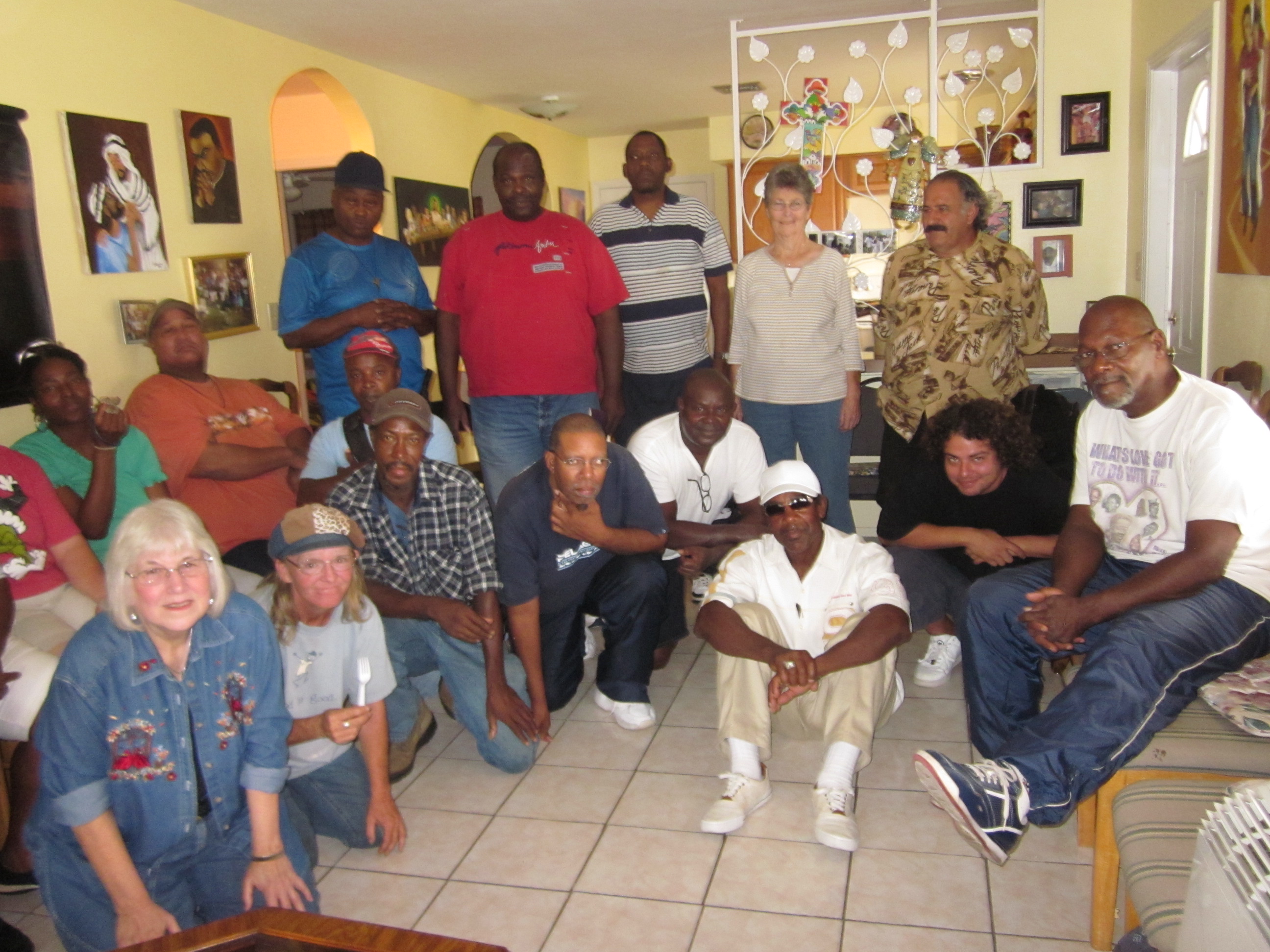
The worship and discussion time is lively as we have a room full of preachers and teachers who have lived through major troubles and are experts in helping each other. The reading from the book of Wisdom assured us that God loves all that God has made. “God don’t make junk” Nathaniel said. “And God loves us no matter what we are or have become. God looks at our hearts and at what we can and will become” said Lauretta. She also pointed out that Wisdom was written before Jesus was born and God’s love is as old as time itself. As we sang “This is Holy Ground” before the Gospel reading, they touched their own hearts and their neighbor’s shoulder to affirm that “we” are holy ground.
The reading from Luke 19 on Zacchaeus the short tax collector who climbed a tree to see Jesus brought forth laughter about Zacchaeus climbing that tree and understanding of prejudice and difference and preconceptions of people that are painful and harmful. Many had experienced such prejudice and discrimination based on outward characteristics. Phyllis said “but God looks on the heart-it didn’t matter to Jesus that Zacchaeus was so short or even if he was a cheating tax collector.” “The point is he met Jesus and he changed his ways” Mary said. “Meeting Jesus changes us if we need changing” Tim said. The reflections on feeling lost were equally sharp and poignant. Gary concluded “it is so good to be found by God-and to know you really can’t get lost.” Evelyn, our volunteer who had been through a life threatening car accident shared her story and reflected how good it was to return to this loving and welcoming group. She too was warmly welcomed and applauded. Roger and Lauretta brought special donations and were also applauded. Octavia, Mary and Nelson and Darnell and David were welcomed back after an absence. Everyone was excited to be together again. The contagious joy of this congregation is how church can and should be. It is a healing balm.
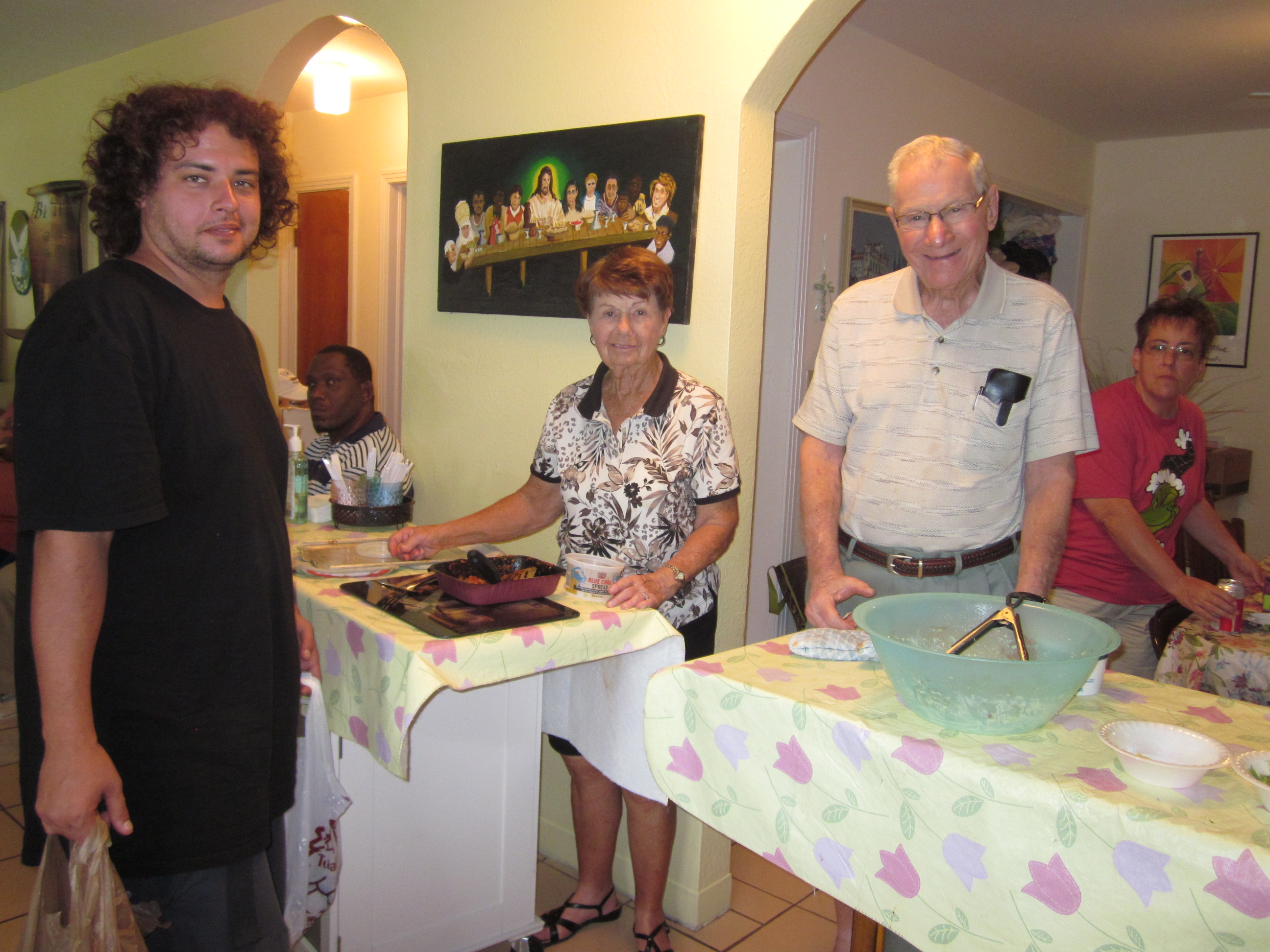
Serving one another-The Mc Nallys, Nelson, Robert and Evelyn
The issues today included unemployment, disability and ability, new housing for some and homelessness and hope for others. Reconciliation with family and part time jobs for others brought a sense of accomplishment and encouragement. One woman asked me to talk and pray with her. She recently went through a traumatic event and was feeling vulnerable and frightened. Near to a breaking point she asked Pastor Judy B and I to take her to the Emergency Psychiatric Unit at the end of the day and after my negotiation with the admitting Psychiatrist she was able to be admitted. She was so thankful and relieved to feel safe and to be where she could get help. She said that she felt safe again as soon as she got to the church and knew the answer to her troubles would be with us. She was no longer lost but found by the Jesus who seeks the lost and hangs out with the sinners and outcast. Together we all belong. Together we are church.
Amen.
 Thanks be to God!
Rev. Dr. Judith A. B.Lee
Co-Pastor Good Shepherd Inclusive Catholic Community -Fort Myers, Florida
Being A Follower of Jesus-A Poem by John Chuchman
NOTE By Pastor Judy Lee: I like this poem by John Chuchman who is a great supporter of women priests and inclusion. His website is noted after the poem.
Being A Follower of Jesus
by John Chuchman
First, for me, being a follower of Jesus means being Radical.
It’s not for people who want to immerse themselves in selfish ambition
and only break from that consensus at the margins.
It is not for those comfortable with the status quo.
It demands more of me.
It demands an extraordinary commitment to Love:
not the fleeting emotion,
but the force that transforms lives
in both simple acts and by recreating the world in which I live.
It shapes everything from the way I interact with a waitress
to how I view church politics and injustice.
It leads me to find debilitating discrimination by church hierarchy
more offensive than missing Mass on Sunday.
It inspires me to be daring and swim against the tide.
There is always resistance.
A concern for everyone, including the weak and vulnerable,
always leads to the experience of pain and suffering.
Second, I find Jesus’ way and Joy deeply connected.
Being a follower of Jesus does not mean being dour or aloof.
The way of Christ brings meaning;
it incites Passion;
it generates Joy.
A life spent trying to run away from boredom is inevitably a life of drudgery.
I find true joy, not in material things,
but in my encounter and relations with others,
in relationships rooted in Inclusiveness, Understanding and Love.
When I experience loss, conflict or failure,
I don’t entirely escape sadness,
but faith opens the possibility of Restoration, Communion, and Transformation.
In a culture where people seem obsessed with happiness
yet are constantly lured away from that destination by false paths,
the true path to joy can only be found in Love.
Third, following Jesus is 24/7 year-round.
My commitment to Jesus should permeate all my actions.
It should define who I am.
It is not an activity to be fulfilled for an hour each Sunday.
I can’t be a part-time Christian.
Most see going to Mass each Sunday
as the pre-eminent responsibility of a Catholic.
It is important to let them know that this is simply not enough.
This is not the standard for being a follower of Jesus.
Going to church no more makes me a Christian
than standing in my garage makes me a car.
So many people have already turned away from organized religion
because of the obnoxious hypocrisy they have witnessed
by the hierarchy and
from those who spend every Sunday in the pews,
spending the rest of the week acting unethically,
seemingly without any compunction.
Following Christ means embracing Joy.
It means the radical embrace of countercultural values.
It places demands on my entire existence.
Religiosity and spirituality are fused together
and inseparable when pursued authentically.
This message is critical
because people do not need to be split
between those who are “spiritual but not religious”
and those who are “religious but not spiritual.”
Finally, I strive to keep it real.
It’s about setting aside the illusory and superficial.
The message is simple,
I am my authentic self.
I am an entirely unique person with immeasurable worth and value,
not some cardboard cutout.
My real identity is shaped by my character and core,
my authentic personality,
not all the superficial things that distract me
and take us away from who I am meant to be.
My life is not shaped by the expectations and judgments of others,
but my commitment to the values I rightly hold dear.
My relationships are as authentic as I am.
Our culture despises dependency and idolizes autonomy.
The cult of individualism
makes authentic relationships difficult to achieve and sustain.
Yet these relationships allow me to experience real joy and love,
a priceless treasure that many carelessly discard or ignore.
They make me vulnerable and exposed
because they reveal my core being.
But only in this state can I connect
in the most fundamental and intimate way.
Movin’ On http://www.sacredtorch.com/?page_id=727
Two Women Priests in Dialogue-Right with God: Homily by Rev. Bingle,Ohio and Commentary by Rev. Lee, Fla

The Good Shepherd Community At Worship
For this 30th Sunday in Ordinary Time, 10/27/13 Rev. Beverly Bingle of Toledo, Ohio has given us a powerful and poetic Homily. After her homily is Rev. Lee’s Commentary. The purpose of the Commentary is to make this an interactive homily of the style many women priests use in their churches. First the Priest sets the stage and gives a brief homily or introductory thoughts and invitation, then the congregation is invited to respond and share their own thoughts on the readings and the thoughts of the Priest. Readers are invited to add their comments in our global parish.
The Readings are: Sirach 35:12-14,16-18; Psalm 34; 2 Timothy 4;6-8,17-18 AND LUKE 18;9-14
Right Relationship With God and Creation Beverly Bingle
Our weather has turned this week.
The first frost.
Last mowing of the year.
Leaves falling.
Gardeners scurrying to bring in the harvest.
And a marked increase in the number of guests at Claver House.
George, the octogenarian who usually leads us
in the Lord’s Prayer on Thursdays, was late.
I was surprised when Mitchell,
a relative newcomer to the soup kitchen,
volunteered to lead us in prayer before the meal.
He framed the Our Father in a straightforward and simple way:
Let us be grateful for life, he said,
for the food we are about to eat,
for the warm and safe shelter of this room.
Let us share this food in friendship, he prayed,
to gain strength for the day
so we can use the gifts we have been given
to make the world a better place.
_____________________________________
I bring this up not because today’s readings are about prayer—
they aren’t, even though they all use prayer as the context.
Instead, the readings are about justice
in the basic meaning of the term:
living in right relationship
with God,
with others,
with all of creation.
Mitchell’s short prayer showed an understanding of life
that revealed him to be
in right relationship with God
and other people.
______________________________________
Sirach seems to know Mitchell when he tells us that
“the prayer of the unpretentious pierces the clouds.”
That is, those who know themselves,
who do not pretend to be someone they aren’t—
they find their prayers heard.
They understand their right relationship
to God and creation and other human beings,
so they reap a harvest of justice.
They are justified.
They live in righteousness.
______________________________________
Then the psalmist tells us
that happiness belongs to those
who give thanks to God for dwelling in them.
They know who they are
and who empowers them.
______________________________________
Paul writes to Timothy
with another variation on this righteousness.
He knows he is weak,
but he also knows that it is Christ
whose action in and through him
gives him strength.
______________________________________
And in the Gospel this week we hear another parable from Jesus,
another of those that scholars believe came from him.
Through this parable, as with so many of his teachings,
Jesus reveals God to us:
a God of love, of compassion.
Jesus’ use of parables, here as elsewhere, is not meant to inform.
So he is not telling us to avoid the front pew—
though many of us Catholics seem to have picked up on that
as if it were the sole purpose of the parable.
Nor is Jesus telling us to sit in the back of the church and grovel.
No—the parables are aimed at re-tooling our minds,
giving us a new mindset
that will bring us to the experience of the kin-dom of God.
______________________________________
So we hear the Pharisee, an upstanding, law-abiding Jew,
carefully following, even exceeding, the letter of the law.
He is a good man, doing everything he is supposed to do.
He is admired in the community for his way of life.
But he does not go home justified.
His prayer is selfish and arrogant:
he sneers at the tax collector,
places himself above other people,
and prays thanks for what he himself has done
rather than thanking God
for giving him the opportunity to do good things.
The Pharisee does not go home right with God.
He does the right thing,
but he does not see God for what God is.
Nor does he see himself for what he is,
or others for who they are.
He has a long way to go,
and he’s on the wrong path.
On top of that, he doesn’t know he’s on the wrong path.
______________________________________
The tax collector is not a model, either.
His prayer reflects an understanding of who he is—a sinner—
and who God is—the Merciful One.
So he is in right relationship with God.
But his actions are not just—
his livelihood depends
on cooperating with a cruel and powerful government
to oppress his own people, his own neighbors.
He goes home right with God,
but he struggles with changing his life
so that he is also in right relationship with people.
______________________________________
This past Wednesday evening
at our discussion of Michael Morwood’s Tomorrow’s Catholic,
we talked at length about how to pray now that we have
a very different understanding of the universe
from the one held by the authors of the scriptures.
In our lifetimes we are witnessing a major shift
in our understanding of who God is.
what creation is,
and who we are.
The way we used to see God is no longer believable.
As we hear of scientific discoveries like the Higgs Boson,
as we read about the stardust at the base of all existence,
as we ponder the immensity of universes
beyond our universe,
much of the vocabulary and many of the images
that we used for God-talk
no longer make sense to us.
The Fall, redemption theology, the economy of salvation—
these understandings from our previous cosmology
are no longer real for us.
We’re theological babies again.
_____________________________________
Happily, real experience and real life remain.
As always, we start with a life experience
and we try to understand.
The gift of conscious awareness brings us a universe of ways
to experience the God in us and around us and beyond us—
always through our embodied spirits, our inspirited bodies.
We are Catholic Christians,
committed to the Way that we learn from Jesus—
reaching out, welcoming, including everyone, loving.
We meet people like Mitchell.
We listen to folks telling us
about their experiences of transcendence and immanence.
We watch the falling leaves and the full moon.
the pink sunrises and the golden sunsets.
We pet our cats and hug our children.
And in all that real life
we do theology,
and we find a mystery full of grace.
—
Holy Spirit Catholic Community
Mass at 2086 Brookdale (Interfaith Chapel):
Saturdays at 4:30 p.m.
Sundays at 9 a.m.
Mass at 3535 Executive Parkway (Unity of Toledo)
Sundays at 5:30 p.m.
www.holyspirittoledo.org
Rev. Bev Bingle, Pastor
Right with God, Right with the Poor and Humble- Judy Lee
I love Rev. Bingle’s homilies, that is why I put them in this blog. -so you can enjoy them too. And, so you can reflect on who God is and where justice and compassion fits in your relationship with God and your neighbors as she does. Her work in a soup kitchen brings her close to truly humble and unpretentious people. As she notes Mitchell’s prayer is truly beautiful and God is delighted with it. The Mitchells in my church are Nathaniel, Gary and Lauretta and Donnie, Mrs.Jolinda and others. Sirach lets us know clearly that “God listens to the prayers of the exploited”( Sirach 13b TIB-The Inclusive Bible Translation.) Sirach also asks us to give of ourselves…and that is a very different posture than the Pharisee who prays putting others down in the Gospel of Luke. But it helps put us right with God. And, even as Rev. Bingle and I and our church members do prioritize serving the poor-including the poor serving one another-we may become the answers to the prayers of those who have little of this world’s goods like the widows and orphans in the time of Sirach,Paul and Jesus. And we may learn how to pray and do justice along with our theology.
I fully empathize with Paul in his letter to Timothy-an elder encouraging a younger church leader by sharing that it is Christ who strengthen’s him so he can proclaim the Gospel even as his life is “already poured out like a libation”.
Yes, the Pharisee who bragged on himself in prayer missed the boat. As he bragged, the boat of right living with God and his neighbor sailed out of sight. He needs to catch the boat of justice and board it right now. As for the tax collector-I can empathize and I like to think that he went home and changed his cheating ,fraudulent ways after his encounter with Jesus since Jesus says “he was right with God”. I empathize with him. I have often felt like him-“Oh God, just give me the last seat in the corner of being with you for that is enough heaven for me. ”
In this prayer I am feeling that while I may be stardust and that God’s everlasting love is within me and all around me, I sometimes mess up big time. I have in the past, I do in the present, and I probably will in the future. I am very human and while I fight the good fight and keep the faith like Paul, I do not always win that fight. I get tired, angry, irritable and downright selfish at times. I do not even aspire to being “exalted” but I do aspire to being right with God and my neighbor. I am therefore happy with a theology that includes God’s forgiveness for sin-both individual and social. And social sin, that is the sin of socio-economic systems and governments and powerful folks who exploit others is the worst sin I know. I have no trouble with that word or concept-I do know what it is and have been there. Moreover, I serve people who have been there as well-yes, murderers, yes, adulterers, yes, exploiters of others, yes to breaking the laws of Loving God first and our neighbors as ourselves. So with all due respect to Michael Morwood,whom I have dialogued with, and the God within, the God who is MORE and truly beyond our understanding-might I dare say even beyond the Cosmos- is the one I often need. As one of my people said” I need the Jesus who comes to me when I am alone and scared and feeling lower than a snake’s belly”. Yes, I do understand that new Cosmic understandings make us question “old” formulations, but neither old nor new encompass the God who is MORE. I don’t feel like a babe in the new woods of understanding God, but more like a weaver who gets a hold of and weaves strands of gold and silver, rust and green together, the loving essence of the “old” and the “new” to make a chain of living strands that hold us to our loving God and instructs us in right living.
Amen,to the mystery full of grace. Amen, sister Beverly,Amen.
What do you think our sisters and brothers ?
Judy Lee, ARCWP
Co-Pastor The Good Shepherd Inclusive Catholic Community
Fort Myers, Florida
WOW! It is Ready For Ordering- The House on Sunny Street by Rev. Dr. Judy Lee-Check it out!
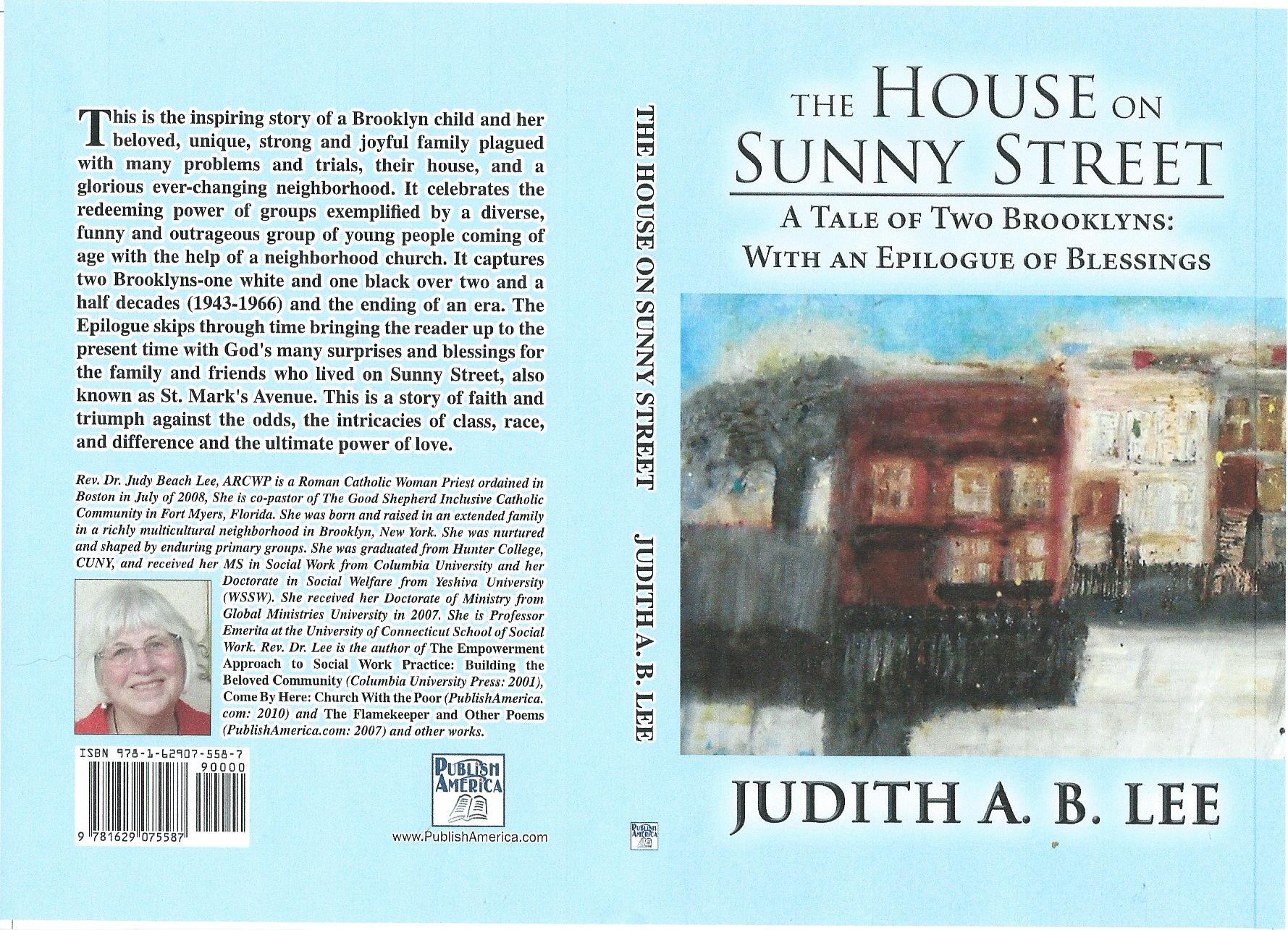
I am excited to share this autobiographical and historical novel with you. It is hot off the Presses and you can go to Publishamerica.com or Publishamerica.net/bookstore or to Amazon.com to get it. It is available in paper and electronic forms. If you have ever wondered what makes people tick, what adds up to a human life, and what contributes to the life of a woman priest this book may have some answers for you. If you like books about Brooklyn, New York, or inner city life anywhere this is your book. If you know the power of groups and the power of faith, this book is for you. If you like stories about real people who overcame some serious odds and kept on keeping on you will not be disappointed. If you like to read about complex lives written so all can “get it” and laugh, cry, and cheer with the protagonists this is for you. If you believe in inclusion, justice and love you will enjoy this read!
I hope you will check it out! If you do, please feel free to share your comments here. I welcome your responses.
Keep on believin’
Rev. Dr. Judy Lee,ARCWP
10/23/2013
 judyablfollowingSheWhoIs
Recent Comments