Guest Post on the Women’s Ordination Conference Blog -The Table-By Fr. Roy Bourgeois, Rev. Jane Via and Rev. Janice Sevre-Dusynska on their Holy Thursday Witness Outside the Vatican in Washington DC, 3/24/16 when US Papal Nuncio Carlo Maria Vigano spoke with them on the steps of the Embassy.
From Condemnation to Conversation: Vatican Dialogues with Women Priests 4/19/16.
From 2002 through 2016, the Vatican has condemned the ordination of women priests. Since the ordination of “The Danube Seven” in 2002, the Vatican has tried a number of strategies to quash our movement: excommunication, silencing, shunning, firing and ignoring. Now ten years since the first U.S. ordinations on the boat in Pittsburgh, the door has been opened for the first time.
During Holy Week, March 24, the feast day of Oscar Romero, in the era of Pope Francis and his Year of Mercy, a conversation — turbulent at first — began.
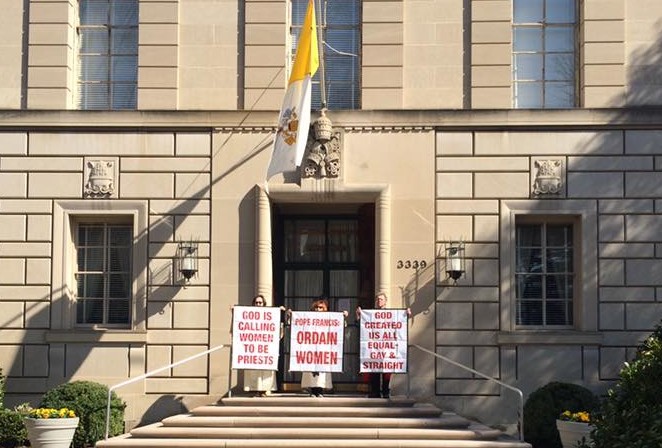
Outside the Vatican Embassy on Massachusetts Avenue in Washington, D.C. on Holy Thursday, March 24th the three of us — two women priests – Jane Via and Janice Sevre-Duszynska, and one excommunicated male priest –Roy Bourgeois — washed the feet of supporters on the sidewalk in front of the embassy as cars and buses passed on the busy road.
We prayed and shared our statement of purpose to Pope Francis and the Catholic Church calling for the full and equal inclusion of women and LGBT people. We read from Scripture, and prayed again this time that church leaders would remember Jesus’ teaching to be servant leaders and love all disciples as Jesus had. We thanked those who gathered with us, re-read our statement of purpose lifted up our signs, and – still in albs and stoles – stepped onto Vatican property and walked toward the door. We had no idea how our action would play out.
Before we crossed the circle drive, suddenly filled with police vehicles, we were surrounded and intercepted by Secret Service officers announcing we were trespassing on private property and had to leave. We walked past and through them to the door where Roy posted our statement then rang the doorbell. To our surprise, the door opened and Roy was able to hand in a manila envelope with a signed copy of our statement asking that it be forwarded to Pope Francis. Then, we turned to face the street holding our signs for passing traffic to see. They read: Pope Francis: Ordain Women, God IS Calling Women To Be Priests and God Created US All Equal – Gay & Straight.
The officers began the ritual notice: “You are on private property. If you don’t leave, you will be arrested. Do you understand?” Over the next two hours, one supervisor after another, each higher than the former, arrived at the embassy and spoke with us. There were pauses for radio calls, the arrival of even higher supervisors and then the announcements would begin again. The highest authority, who arrived in a suit, announced that he was from the State Department. He threatened us with the dire state of the D.C. jail and “the very bad people” we would share space with if we were arrested.
Intermittently, two to three officers would disappear around the side of the palace-like building to confer with the Papal Nuncio and staff. Eventually, the officers told us the Nuncio would like to meet with one of us, specifically a woman. We declined the invitation, suggesting the officer tell the Nuncio we would meet if all of us were invited. After all, we were only three people, not a crowd of protesters. Told, “That was not the invitation,” we remained silent.
The day became hot. We were dressed too warmly in order not to be cold in jail if we were held. The sun beat down on us. Above, the Papal flag, yellow and white, fluttering in the breeze, provided occasional relief, blocking the sun.
More negotiations between the officers and the Nuncio followed, until officers announced the Nuncio would come to us.
He came up the steps and onto the porch alone, while his staff remained in the driveway. Officers joined him on the steps, standing on either side and behind us. Wearing a Roman collar, the man introduced himself by title and, although we asked him several times, he declined to give his name.
He engaged Roy first, who tried to speak for LGBT people, how they suffer because of church teaching, and of God’s love for all people. The Nuncio kept interrupting him. He was arrogant, insolent in style and tone, lecturing us on church teaching, as if its truth was self-evident. The exchange became heated, raised voices talking over one another. Officers closed in on Roy, ready to restrain him if needed. Janice intervened: “The Church’s teaching creates suffering for LGBT people and they are murdered in Africa and Latin America.” “They commit suicide,” Roy said and shared the difficulties of someone in his own family. The Nuncio replied that the church didn’t kill anyone; these people had their own consciences; they made their own decisions.
The Nuncio then invited one of us women priests to talk with him inside the embassy. We looked at each other, then said: “No, it would have to be all three of us in solidarity.”
Roy told him that the church was hurting women and itself by not ordaining women. The Nuncio said that issue had been a closed door since John Paul II.
“You need to read Catholic theologians Gary Macy and Dorothy Irving,” Janice said as he looked at her intently. “Their research gives evidence of women’s leadership in early Christianity including deaconesses, presbyteras and bishops up until the 12th century.” His face revealed no hint of surprise. “The US church has lost 33 million Catholics because its leadership has refused to hear the voice of the Spirit within the people who embrace women priests and LGBTs. There is a connection,” Janice said, “between the church’s oppression of women and violence toward women and their children in the world.” He responded that the church isn’t responsible for violence in the world.
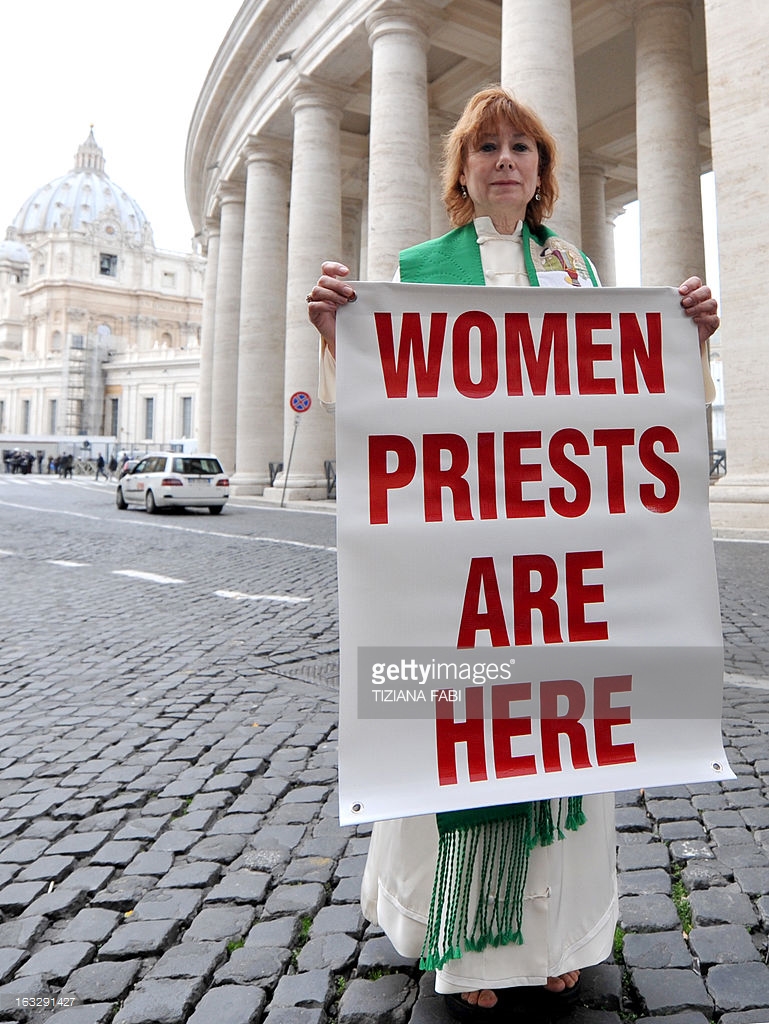
When the Nuncio finally approached Jane, after again refusing to give his name despite very polite inquiry, told us he had been Nuncio since 2011, disclosing his identity as Carlo Maria Vigano, the Nuncio responsible for inviting Kim Davis — who refused to follow federal law and give marriage licenses to GLBT people — to meet Pope Francis, sparking a media firestorm and public outrage that the Pope embraced Davis and encouraged her to keep up her good work. Then Vigano, in an indignant and derisive tone asked, “Where did you get those?” in reference to the alb and stole Jane was wearing. The irrelevance of the question resulted in Jane’s blank stare and his move away. His comment reminded us of the Rome police asking Janice the same question in front of St. Peter’s Square before detaining her during the March 2013 papal Conclave.
As he was leaving, we told the Nuncio we would stay until we were assured Pope Francis received our statement of purpose. He said Francis would eventually get the statement – which he said he already read. As he neared the side of the building to return into the Embassy, he said, “You can stay as long as you like. If you need something to eat or drink let us know.”
Shortly afterwards, officers explained that the Nuncio declined to arrest us. We could stay. Most officers departed, leaving only two vehicles, on at each side of the circular drive.
Minutes later, we heard noise above us as we stood on the porch, holding our signs. Looking up, we saw the Papal flag disappearing into the embassy.
It was afternoon by now. We had had nothing to eat or drink since our early, light breakfast. We were glad we were fasting, delaying the inevitable as long as possible. We talked further about our witness here on the steps of the Vatican Embassy, the Nuncio’s choice not to arrest us, and how to proceed. We decided we would “occupy” the porch and lawn of the embassy for 24 hours from the time our trespass began. We would sleep on the porch of the Vatican Embassy on Holy Thursday.
During the hours between 1pm and 8pm, Roy stood with his banner on the Vatican’s porch while Jane — whose arm was in a cast from her wrist to her elbow — and Janice held our signs for women priests and LGBT equality on the lawn until nightfall. We attracted the attention of thousands of drivers on busy Massachusetts Avenue, many who gave us thumbs-up or tooted their horns in approval. We also made friends with John Wojnowski, 73, who was sexually abused when he was 14 by a priest in Italy. John, who has been protesting with his huge sign – accusing the Vatican of protecting pedophiles — outside the embassy for 17 years, told us the incident changed who he was. “I’ve lived with the idea of committing suicide everyday (since),” he said.
As night fell, the wind picked up and it grew colder. We sat on the embassy porch bundled in our light jackets as a number of police squads pulled up. A plainclothes secret serviceman told us we would be arrested on his way to talk with the Nuncio. Meanwhile, friends arrived to take Jane and Janice to a restroom and provide water and blankets. We took only one blanket each, thinking we would spend the night in jail where the activists’ rule is: have your ID and metro card only. Roy had a different perspective. Throughout the day, he repeatedly told us, “The Vatican is not going to arrest women priests.”
Not long after our friends left, the secret serviceman announced, “The ambassador says it’s okay for you to stay overnight.” Initially too wired to sleep, we sat talking. About midnight, another friend and supporter arrived with wine and paper cups. Having had no solid food since early morning and few liquids, we drank cautiously. As the day had become night, the warmth became cold, and the wine warmed us and relaxed us.
Eventually, we laid down in a row, our heads next to the embassy door, with one thin blanket between us and the concrete and our stoles as our pillows. We cocooned ourselves in our individual blankets, warm but not warm enough, draped our signs over our blankets, and tried to sleep.
Friday morning, we woke to a cold but sunny morning. We left Roy to hold down the porch while we sought restrooms and coffee. Then we returned to the lawn and traffic for more witnessing.
At 10:00 a.m., 24 hours after our trespass began, we prayed with one another and packed to leave. As we stood on the sidewalk, the Nuncio came down the driveway toward us. His attitude was completely different. He acknowledged our courage and thanked us for being nonviolent. He said he wanted to shake our hands before we left. He told us that Francis knew we were there and that Francis had received our statement. Another discussion began, but this time, he allowed us to speak. Though he never showed agreement, he listened. He expressed his belief that the demise of the Protestant churches is the result of the ordination of women and that LGBT people are as they are due to some sin in them. We gave him brief condensed versions of our most basic arguments. At his request, his priest companion, who was watching our interchange, took photos of us standing together and smiling.
As we were preparing to leave a cyclist passed us, then stopped and backed up. A young woman of about thirty, she smiled at us and asked if we were there the day before witnessing to women’s ordination. When we acknowledged we were, she thanked us and launched into a description of the theology course she was taking at Georgetown, their study of Canon 1024 (which says only a baptized male can be ordained) and her conviction that change in the church was so important. At that point, and for the first time, she looked directly at the Nuncio, the only one among us wearing a Roman collar, and said, “I hope that you decision-makers will be supportive.” With a smile and a wave, off she went. The three of us watched her go in amazement.
At one point in the conversation, Janice turned to address the priest who introduced himself as the Nuncio’s councilor. He repeated what the Nuncio had said before: that the Church receives its instructions from God. Janice responded that Holy Spirit Wisdom, Sophia Wisdom, works through the church, especially the people of God, and transforms our thinking; that women are in need of feminine images of God because without them there is damage to our souls; that men can be filled with hubris and arrogance from not experiencing feminine images of God; that we need women to celebrate Eucharist – as womenpriests do – with our sacred, holy, feminine bodies. Janice asked him if he was aware of femicide in our world. “We need the Gospels interpreted from the experience of women living and dying,” she said. “God speaks through the Church,” he replied.
Janice looked at him and smiled as a thought came through. “Didn’t St. Francis of Assisi teach the church?” she asked. His eyes lit up and he smiled. “So do women priests and the LGBT community,” she added.
Farewells said, including handshakes and Italian kisses on the cheeks, the Nuncio left and we climbed into a cab.
We reflected on how events had unfolded in unimaginable and remarkable ways. We think the Spirit moved all of us, in and out of the embassy, so that seeds were planted in the hearts of decision-makers; but only time will tell. For us, a night in the DC Metropolitan jail sharing a bare metal bed with herds of cockroaches, will have to wait for another day. Meanwhile, perhaps the Vatican is listening…Like the persistent widow of Luke’s gospel, we keep knocking at those decision makers’ doors.
Pope Francis continues in making choices for the people and for inclusivity and compassion:
From La Stampa Italian News-Vatican Insider, World News:
Pope appoints French-born Christophe Pierre, as the New Nuncio to the United States
Pope Francis has appointed Archbishop Christophe Pierre to succeed Archbishop Carlo Maria Viganò as nuncio (that is, ambassador) to the United States of America
Archbishop Christophe Pierre
0
April 12,2016
GERARD O’CONNELL
Pope Francis has appointed the French-born Archbishop Christophe Pierre, one of the Holy See’s most distinguished and respected diplomats, as the new Apostolic Nuncio to the United States.
The Vatican made the announcement, April 12, after the Holy See received the formal agreement from the Obama administration. He succeeds Archbishop Carlo Maria Viganò who served as nuncio to the United States since 10 October 2011. The Italian archbishop now ends his long years of service to the Holy See, and will retire to his homeland.
At the time of his new assignment, Archbishop Pierre was nuncio to Mexico, a position he has held with considerable distinction for the past nine years, since March 22, 2007. He comes to Washington D.C as an experienced diplomat, with first-hand knowledge of the dramatic plight of migrants from Central America and Mexico to the United States, and will be able to give voice to Pope Francis’ concern for them.
As nuncio, he will be the Holy See’s point man in relations with the US Administration and with the United States Catholic Conference of Bishops (USCCB). One of his most important roles will be the identification of candidates to be bishops in this country. Pope Francis has already outlined clearly the qualities he wants to see in future bishops, and the new Nuncio will ensure this is reflected in the names he presents to Rome.
Archbishop Pierre, 70, is the first Frenchman to be appointed as Apostolic Nuncio to the United States. A polyglot, he speaks English and Spanish fluently. He is “a pastor”, known for his “humility and simplicity” and is “excellent on all fronts”, a source who knows him well confided. A fellow nuncio described him as “a thoughtful, hardworking man”, and “good listener” with “a great sense of fairness and balanced judgment.”
Pope Francis got to know him well as he prepared for his recent visit to Mexico, and so liked him that he decided to assign him this highly important mission.
Before going to Mexico, Archbishop Pierre had served with distinction as nuncio to Uganda (1999-2007) and Haiti (1995-1999). While in Uganda, John Paul II sent him to Burundi to oversee the Holy’s See’s diplomatic mission there following the assassination of the papal nuncio to that country, the Irish-born archbishop Michael Courtney, on December 29, 2004. He celebrated the funeral mass for the former nuncio at the Regina Mundi Cathedral in Bujumbura on Dec 30, attended by thousands of people. He remained in the country until the pope appointed Archbishop Paul Gallagher (now Secretary for Relations with States) as the new nuncio there.
Gifted with a good sense of humor and a deep voice, the new nuncio can captivate an audience. According to The Vision, Uganda’s leading daily, he is a man who goes among the people, is ready to help anyone regardless of status.
Born in Rennes, France on January 30, 1946, he spent the greater part of his childhood and early education in Africa, mainly in Madagascar, with some years in Malawi, Zimbabwe and one in Morocco. He entered the seminary of Saint-Yves in Rennes at the age of 17, but interrupted his studies to do his two-years of military service (1965-’66).
Ordained priest for the archdiocese of Rennes in April 1970, he served as assistant priest in a parish in the diocese of Nanterre for the next three years. He subsequently gained a Master’s degree in theology from the Institute Catholique de Paris, and a doctorate in Canon Law in Rome.
He entered the Holy See’s diplomatic service in 1977 after studying at the Pontifical Ecclesiastical Academy in Rome, where its diplomats are trained. He was subsequently assigned to serve in its diplomatic missions in New Zealand, Zimbabwe, Cuba, Brazil, and as Permanent Observer to the United Nations office in Geneva. He therefore comes to his new post with considerable experience in both bilateral and multilateral diplomacy.
Archbishop Pierre is expected to take up his new position within two months, a Vatican source told America.
Note: This article was first published in America Media and magazine, and is reproduced here with permission
And about Nuncio Vigano:
From The Washington Post:
Pope Francis is reportedly appointing a new ambassador to the United States
By Julie Zauzmer March 10
The Vatican will appoint Archbishop Christophe Pierre to be the new ambassador to the United States, replacing an ambassador whose tenure has sparked controversy, reports say.
The Jesuit news organization America and longtime Vatican reporter Sandro Magister said Thursday that they expect Pierre will be appointed the Apostolic Nuncio, though the Holy See has not yet announced its choice for the position.
Pierre, 70, who was born in France, speaks fluent English and has served the Catholic Church as a diplomat all over the world, dating to 1977, America reported. His most recent job — following terms as nuncio to Uganda and Haiti — is nuncio to Mexico.
In moving from Mexico to the United States, he might bring to Washington an emphasis on immigration issues, particularly at the U.S.-Mexico border where Pope Francis recently visited to offer a prayer.
[Pope Francis prays for migrants at the U.S.-Mexico border]
America said that the Vatican normally would not declare that someone has been nominated to this diplomatic position until the White House approved the Vatican’s choice of ambassador.
The current Vatican ambassador to the U.S., Archbishop Carlo Maria Viganò, has reached the statutory retirement age, according to America.
Viganò was in the spotlight in September, when he hosted an unexpected meeting at his D.C. residence between Pope Francis and Kim Davis, a Kentucky county clerk who refused to issue marriage licenses to same-sex couples, inflaming a nationwide debate over her decision.
In the whirl of questions over why Francis had met Davis on his trip to the United States and who had planned the encounter, the Vatican said that Davis was “invited by the Nuncio” and referred questions about why Davis was on the guest list to Viganò’s office.
[No one wants to talk about how the Pope Francis-Kim Davis meeting was arranged]
Viganò was often more outspoken in his antagonism to same-sex marriage than others in the church. And before his appointment to Washington, he made enemies in the Vatican when he tried to enforce (financial) reforms while he worked for Pope Benedict XVI.
Governor Rick Scott is at it again, coming up with new ways for the residents of Florida to despise him. This time, it is denying dental care to Florida’s poor and more rural residents. He vetoed a bill to that unanimously passed both chambers of the Florida legislature:
The bill (HB 139), filed by state Rep. Travis Cummings, had been passed unanimously by both chambers of the Legislature in the 2016 Legislative Session.
It created a grants program aimed at dentists to serve patients in counties with a shortage of dentists or in otherwise “medically underserved areas.” The grants, anywhere from $10,000 to $100,000, were to be administered by the Department of Health.
In his veto letter, Scott said he agreed that “maintaining good oral health is integral to the overall health of Florida families.” But he added he could not “support a program that does not place appropriate safeguards on taxpayer investments.”
Do you know how hard it is to get unanimous support for any bill in this day and age? Harder than finding a dentist in rural Florida.
A representative of the Florida Dental Association said the group was “disappointed” because the legislation “would have provided significant support for promoting dental care, economic development and job growth in underserved areas of Florida.”
“The challenges of accessing routine dental care have critically impacted the health and success of Florida communities, especially in rural areas,” said Joe Anne Hart, the FDA’s Director of Governmental Affairs. “The results are repeated visits to the emergency room for preventable dental problems, missed days of school due to toothaches, and lower GPAs and graduation rates.”
We are pleased to present this astute homily with an interesting comparison by Roman Catholic Woman Priest, Rev.Dr. Gloria R. Carpeneto of The Living Waters Catholic Community in Baltimore, Maryland.
Gloria R. Carpeneto, Homily
4th Sunday of Easter, Cycle C
April 17, 2016
Acts 13:14,43-52; Revelation 7:9, 14-17; John 10:27-30; Psalm 100, We are God’s people, the sheep of God’s pasture.
Way back when dinosaurs still roamed the earth, Andrea Johnson and I were ordained on the same day – she a priest, and I a deacon. Many people sitting here today were with us in Judson Memorial Church in the Village in New York on July 14, 2007 when that ordination took place.
There are lots of memories that I know we each carry of that day, not the least of which is that it was Bastille Day, July 14. And so it was that for the first time in the United States, Roman Catholic women priests emerged from the waters where our ordinations had taken place since 2002. We crawled up out of the rivers and onto land for our first ordinations on terra firma here in the United States. And, in at least a figurative sense, we promptly stormed the Bastille on that July 14.
If you remember any of your French history, it was in 1789 that the working class citizens of France had had enough of taxation and oppression by what we might call today “the 1%.” They had been emboldened by the American Revolution a few years before, and they were in rebellion. Turns out, they had plenty of guns, but little ammunition. So they stormed the Bastille where the government’s ammunition was stored.
French peasants were trying to liberate ammunition from the control of the aristocracy when they stormed the Bastille. But Roman Catholics who supported the ordination of women in our Church were trying to liberate the very life of our church from centuries of control by a monolithic hierarchical structure. French peasants in 1789 and Roman Catholic Women Priests on the Danube in 2002 – all either of us really wanted was justice. We wanted our voices to be heard and we wanted our votes to count for something
And just as Marie Antoinette, in her naïve arrogance, may have wanted the peasants to eat cake, centuries of hierarchical clericalism in our Church had left Roman Catholic women – all Roman Catholic women — with little to eat but obedience, subservience and tasteless canon law.
So there we were in 2007 – storming the Bastille, excommunicating ourselves, and (depending on which canon lawyer you talked to) maybe even dragging everyone in the church that day (and today) down with us. Bishop Patricia Fresen was our ordaining bishop. And in an act of defiance, as Patricia began her homily she placed a black sheep on the altar.
I never got a copy of Patricia’s homily. But I do remember her telling Andrea, Gabriella, Eleanora and myself that we were all black sheep … that it would be a very long time before the Church welcomed us in again … that we were taking a fateful step outside the fold … and that there would be consequences.
Now all shepherds know that in most flocks, nearly all the sheep will be white. But a recessive gene will always produce a black sheep or two. The wool of a black sheep is not as valuable as a white sheep’s wool. It’s wiry, and it’s not soft. It can’t be dyed any colors. It’s hard to weave black wool. Black sheep are anomalies. But they will always be there, and they are not without value. They are actually genetically helpful to the fold, and good shepherds always want their flocks to produce a few black sheep.
So unless I’m reading John’s Gospel today incorrectly, Jesus makes no distinction between black sheep and white sheep. He doesn’t say excommunicate the black ones, and invite the white ones to be on the faculty of Catholic University. He doesn’t say that the white ones can preside at Eucharist, but the black ones can polish the brass. Instead, Jesus says to us today, I am the Good Shepherd. My sheep hear my voice. I know them and they follow me. They belong to me — every last one, no exceptions.
In the Book of Revelation, it’s Jesus who promises to shelter his sheep forever. It’s Jesus who says that all those sheep who reside with him in eternity will never again be hungry or thirsty. The sun will never beat down on them, because Jesus is their shepherd, who will lead his flock to springs of living water, and wipe every last tear from their eye. We belong to him – every last one of us, no exceptions.
And for those of us who are the black sheep – those outside the system, like Paul and Barnabas, all of us in Judson Memorial on July 14, 2007, and all of us worshiping here as the Living Water Community today – we are assured that the Spirit of the Living God will always give us courage to storm the Bastille and share the Gospel message of justice, inclusion and equality for all. Like Paul and Barnabas, those black sheep among us may encounter jealousy, revulsion, betrayal and expulsion from our synagogues. But we know we are absolutely necessary to the life of the flock. Like Paul and Barnabas in the early church (before it turned into the Bastille), we are buoyed by the grace of God, and courageous in speaking out the message we heard proclaimed in our Gospel today. Jew and Gentile, slave and free, old and young, black and white, gay and straight, male and female — we all belong to Jesus – every last one of us, no exceptions.
Our responsorial psalm today was a beautiful one – We are God’s people, the flock of our God. So let’s remember just how good it is to be in that flock.
It’s good to be a white sheep; it’s good to love our Church, to appreciate our history and traditions, to be grounded in a sacramental / liturgical tradition that feeds us all.
But it’s also good to be a black sheep; it’s good to call our Church on the carpet when that’s needed, to speak out when there is injustice, to say something when there is hypocrisy.
We are God’s people, the sheep of the flock. And we cry out with joy every day that our God is good and loves all of us – white sheep, black sheep, inside the Bastille or out of it – every last one, absolutely no exceptions.
In today’s Gospel (John 10: 27-30) Jesus is possessive of his followers-“My sheep hear my voice; I know them, and they follow me. I give them eternal life…No one can take them out of my hand….and no one can take them out of the Father’s hand.” Well, this old sheep is comforted and challenged by this message. I rest in Jesus’ arms, and in the Father/Mother’s arms. When life hits you from every side-with the horrors of violence, and illness and many causes for anxiety, it is good to know where you belong and feel sheltered and cared for.
The metaphor of the Good Shepherd in which Jesus is claiming both “Messiah-ship” and oneness with the Father who will not let us go, works for me. I was a city kid and only knew sheep from magazines and coloring books until adulthood, but I was gifted early with a love for all animals and a sense of kinship with all of creation. Then and now I have no trouble thinking of myself as a sheep. But when Good Shepherd Sunday came a few years back one five year old raised her hand as I went on about the sheep. She had not yet learned that she can comment after the homily but not in the middle but she was so insistent that I finally asked what she wanted to say. She said” I am not a sheep, I am a girl”. An older kid answered quickly “there are girl sheep and boy sheep, and tried to explain why Christ’s followers are called sheep. She remained indignant. So I said, “okay then, Jesus is saying “MY girls and boys and women and men know my voice….and follow me-no one can take my children away….” She nodded and we could proceed.
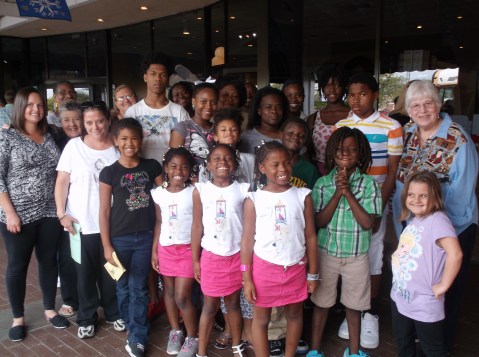
(Some of the sheep and lambs, God’s beloved children.)
(Below, Pastor Judy Lee and RCWP Candidate Maria Elena Sierra Sanchez in Colombia with goats-okay-not quite sheep..)
So if you are one who does not accept metaphoric connection to farm animals, or never saw a sheep or shepherd, accept that God is claiming you,and claiming us as God’s very own-knowing you inside and out and never letting go of you even if you are squirming away for a spell. And if you land at the edge of a precipice, God’s got your back. The earlier part of John 10 says “I lay down my life for the sheep”( 10:14), and for my other sheep “that are not of this pen”. What kind of love is this? All-inclusive love,not just “my kind” but all human kind. Love that has a claim on us, love that gives it all away for us, love from the wonderful God that we belong to forever. Wow! No matter what we have to deal with, and in our community is unspeakable grief due to violence, the murder of a mother; the drive by shooting of young people and children, the loss of children; the whispered pain and shame of the family of a shooter,( ‘pray for him he is a murderer’, she asked); a murder- suicide leaving four children without a parent though Grandma steps up; and the ravages of untreated illnesses and the struggles with difficult treatable diseases as well often compounded by the insecurity of not being able to pay the next bill and returning to homelessness. And,the feelings of helplessness many of us have as we see our loved ones living at the precipice are only mitigated by knowing that God IS there. Through it all, we are not alone, we have a safe haven and loving arms encircling us. God’s own arms,often presented in the arms of others. But sometimes, by yourself in the middle of the night God’s arms encircle,God’s voice speaks ever so gently and you know that you are not alone.
Today,4/16, Pope Francis and the Prelates of the Greek Orthodox and Eastern Ecumenical Church literally walked with and embraced and strongly advocated for the Syrian Refugees in Greece on the Island of Lesbos at the Moria Refugee Camp. Many are facing deportation from this Camp. As I watched their emotional faces on TV as they reached out to these frightened people with love and compassion, I knew the Good Shepherd was still caring for the most lost and bedraggled of the sheep. How beautiful it is when our leaders do show us the way. Pope Francis has made a home in the Vatican for three Syrian Muslim families,6 adults and 6 children. He is showing us by example not only words how to care for the sheep not of “this pen”. He is showing us how to build bridges and not walls in every aspect of this visit. I thank God for him and for the Greek Prelates who lead the way this very day.
And, I ask Pope Francis to make a bridge for his Roman Catholic Women Priests who also “smell of sheep” to meet with him in serious communication and be welcomed back home.
Thank God, thank Jesus Christ,we belong to God and life is ours now and forever-nothing can separate us from the love of Christ! Amen!
Rev Dr. Judy Lee,RCWP-Co-Pastor, The Good Shepherd Inclusive Catholic Community
“John’s gospel went through two or three editions by several authors
before it reached its current form 70 to 80 years after Jesus.
The community that developed it, known as the “Johannine Community,”
searched for its identity as a community in relation to the Hebrew
scriptures.
And it was concerned to present a narrative framework
that would support Jesus’ status as the Messiah.
As a result, today‘s passage has Jesus use
the traditional scriptural image of the shepherd and sheep
to answer a question about messiahship.
In our first reading we see Paul and Barnabas doing that same kind of
thing, too,
quoting scriptures to support their message.
And Pope Francis uses scripture
to convey his message in Amoris Laetitia, The Joy of Love,
the apostolic exhortation he issued last week.
Just as Paul and Barnabas apply scripture to the situation in Antioch,
and just as Pope Francis applies scripture to his exhortation on family,
so do we.
Whether we’re reading John’s gospel
or Luke’s Acts of the Apostles
or Pope Francis’ Amoris Laetitia,
we look at the time and the context
and listen to what it means for us in our time.
So the gospel verses about Jesus as the Messiah can speak to us;
Jesus talking about his unity with God can speak to us;
the metaphor of the sheep and the shepherd can speak to us.
___________________________________________
One of the messages that stands out in all three of today‘s readings
is that life is not perfect
for people who live a life of faith in God,
and the way is not always clear.
Paul and Barnabas meet opposition
and get thrown out of town.
They shake the dust from their feet in protest
and go on to preach in another place.
Jesus is challenged by some of his countrymen
and tries to help them see what he’s about
and what God’s about.
He meets opposition, too.
In the verses after today‘s passage,
some of the crowd pick up rocks to stone him,
so he continues trying to teach, citing scripture.
Then they try to arrest him,
but he leaves Jerusalem and heads across the Jordan.
___________________________________________
Francis’ apostolic exhortation is meeting opposition, too.
It’s not enough for the progressives,
and it’s too much for the traditionalists.
It’s easy to be critical.
Pope Francis certainly has an obvious blind spot
when it comes to women,
typical of the culture he was formed in.
And he uses exclusive patriarchal language.
___________________________________________
Still, he sees the working of the Spirit in the women’s movement,
saying that to blame feminism for today‘s problems
is invalid, false, untrue, a form of male chauvinism.
He seems to be trying to revive the spirit of Vatican II
and lead the church in a better direction,
and that gives me much hope for the future.
He sees us as a church on the way,
not a church with the right answers.
The Pope tells priests to help people use their own consciences
when they make decision,
saying they’re “capable of carrying out their own discernment
in complex situations.”
He calls for dialogue as essential to Christian life.
He practices subsidiarity, calling on the bishops
to take local customs and practices into account in a pastoral way
and not to lay down a one-size-fits-all dogmatic rule.
He celebrates diversity and encourages unity… but not uniformity.
Most of all, he returns to the way of Jesus
in calling all the faithful to discern their own situation
and exercise their own conscience.
___________________________________________
Our tradition gives us models of faithfulness:
Jesus teaching and healing in spite of the consequences,
Paul and Barnabas preaching in spite of opposition,
Francis exhorting us to prayer and discernment
as we follow our vocation…
and the members of our own community
questioning and studying and discerning the way.
___________________________________________
Francis ends his exhortation with a prayer that fits every one of us.
He says,
“May we never lose heart because of our limitations,
or ever stop seeking that fullness of love and communion
which God holds out before us.”
Amen.”
—
Holy Spirit Catholic Community
Saturdays at 4:30 p.m./Sundays at 5:30 p.m.
at 3925 West Central Avenue (Washington Church)
In today’s Gospel, John 21:1-19, we have the Risen Christ teaching us once again how to fish, and equating love and service. After Jesus’ crucifixion the disciples were lost and scared and went back to their old jobs of fishing. In order to fish for people they needed to know he was very much alive and it is not surprising that he instructs them again from the shores of Lake Genesaret, the sea of Galilee where they first met. It has always been a wonder to me that Jesus asked for Peter’s love, not his professions or allegiance or beliefs but for his love as shown in service in “feeding the sheep, ewes, and lambs” the men, women and children of the world. We cannot claim to be Christians if we are full of right words but empty of love expressed in action for healing, justice and peace. It is love that transforms us and enables us to serve, even when the going gets rough as it did for Jesus. It is Love that brings us through suffering and death into life. It is love in relation and in prophetic obedience to our God that keeps us going and gives meaning to our lives. It is love that will bring on the kindom of God here and now so that we can fulfill Christ’s Messianic mission and our own reasons for being in this world. Cast the nets and bring on the love!
Below is Rev. Beverly Bingle’s inspirational homily for today. I love her point about the 153 fish as a count of all the types of fish known at the time, hence, the call is to bring in everyone with our loving service. Bring everyone , as Revelation 5:11-14 says, to cry out blessing and honor to our God-to live lives of compassion, mercy, peace and justice.. Bring everyone to change mourning into dancing (Psalm 30). And obey no one except God in preaching and living the Gospel as the first reading in Acts(5:27-32,40-41) tells us. This is particularly so for those who have been forbidden to accept God’s call to Holy Orders because they are women. We echo Peter “We must obey God rather than men”. And being ordered to stop speaking of Jesus ,they “left the presence of the Sanhedrin, rejoicing that they had been found worthy to suffer dishonor for the sake of the name”. Rejoice! Thanks be to God!
Rev. Dr. Judy Lee, RCWP, Co-Pastor The Good Shepherd Inclusive Catholic Community in Fort Myers, Florida
And now Rev. Dr. Beverly Bingle’s Homily:
When I read that passage from the Acts of the Apostles,
my first thought is
that things haven’t changed a whole lot in 2,000 years.
Religious authorities are still telling people—
telling laypeople and theologians and clergy
and especially women—
to obey them instead of obeying God.
Fortunately, as with those first disciples,
some folks these days stay faithful to God
by keeping on:
proclaiming the word,
getting excomunicated,
and staying in the church speaking out.
Others stay faithful to God by walking away.
__________________________________________
Then I read that passage from Revelation
and hear that those voices crying out in praise are
“every creature in heaven
and on earth and under the earth and in the sea,
everything in the universe.”
But our Catholic hierarchy
continues to excommunicate the divorced who remarry
and LGBT folks who live in committed relationships.
They continue to require Mass prayers in antiquated language
unrelated to the spiritual experience of 21st century Christians.
And there’s a long list of people they have silenced
for applying Vatican II teachings
to theology and ecclesiology and spirituality.
__________________________________________
And then there’s that passage we hear from John’s Gospel.
Scripture scholars agree that this chapter, Chapter 21,
was written later and added on to John’s Gospel,
which really ended at Chapter 20.
They agree that just about every detail in this appearance story
creates difficult problems
and leads to speculative adjustments.
For example, scholars notice that this passage says
it’s Jesus’ third appearance,
but it’s really the fourth one in John’s gospel.
Some of them think the author left out
Jesus’ first appearance to Mary of Magdala
because she was a leader in the early Christian movement
and the Johannine community
was arguing for Peter as the leader.
Others think they didn’t count Mary of Magdala
because, in that culture, the witness of women didn’t count.
__________________________________________
Many scholars think that this fish story at the end of John’s gospel
comes from the same experience
as the story of the miraculous catch
at the beginning of Luke’s gospel.
In that light, it’s significant that both gospel writers
use the incident to teach about Jesus’ call to follow his way—
the call to discipleship.
__________________________________________
And scholars agree
that the meanings in this passage are deeply symbolic.
Peter decides to go fishing, and his friends go along.
They catch nothing and they’re calling it quits.
Someone on the shore calls out to them: “Catch anything?”
That’s a commonplace experience
for anyone who’s ever gone fishing.
Back home in Fremont
in the hunting-fishing-trapping family I grew up in,
we were regularly out on the water or on the ice
catching supper.
When we arrived at a spot,
we’d call out to the fishers already there, “Catch anything?”
Or we’d get there first,
and the newcomers would call out to us, “Catch anything?”
We were talking about catching fish,
but Jesus is talking about catching people,
being “fishers of men,” as the synoptic gospels put it.
And the disciples, without Jesus, catch nothing on their own.
When he tells them to throw the net on the RIGHT side of the boat,
they take in a huge catch.
Those 153 fish are symbolic, too.
Historians say that 1st century folks
believed there to be 153 species of fish.
Jesus’ way catches everybody.
__________________________________________
What follows the breakfast on the beach
is the dialogue between Jesus and Peter,
crafted to be parallel to Peter’s three denials in Chapter 18.
Peter professes his love for Jesus three times,
just as he had denied him three times.
Jesus’ response is to call Peter to discipleship:
Keep on feeding and tending my flock,
keep on following my way.
__________________________________________
The call of the disciples, like all calls—all vocations—
is a call to love.
It’s a call to keep on.
Never stop.
Keep on learning and teaching and loving and serving.
It’s like people in love—
people with a vocation to companionship and commitment.
They never stop thinking about and talking about
and caring for their beloved.
It’s like the spouse of a victim of Alzheimer’s,
willing to suffer whatever is required
for the sake of the other.
It’s like Pope Francis
and the growing mass of people
who see earth as our common home
and will not be silent about our responsibility
to change our selfish and wasteful habits.
It’s like the prophetic voices within our Catholic Church:
following the way of Jesus;
following their consciences
in holy disobedience to unjust rules;
obeying God, not humans.
It’s like us, here, a gathering of Vatican II Catholics
serious about discipleship
and living lives of commitment to peace and justice,
the way Jesus taught.
__________________________________________
We’re not alone.
Everywhere we go Jesus is with us.
Thanks be to God!
—
Holy Spirit Catholic Community
Saturdays at 4:30 p.m./Sundays at 5:30 p.m.
at 3925 West Central Avenue (Washington Church)
Our Blessings and Congratulations to Ruth Lindstedt, validly ordained a Roman Catholic priest today with Roman Catholic Women Priests in St. Cloud, Minnesota!!
Below is an excellent article by Stephanie Dickrell of the St. Cloud Times,sdickrell@stcloudtimes.com telling about Ruth and our priests in Central Minnesota. The only clarification I would offer regarding the “requirements” stated below is that a strong sense of God’s call to the priesthood and the call of the community are a given and a Masters’ degree in Divinity or its equivalent is expected of those under 55 while for those over 55 a Bachelor’s degree in Religious Studies or its equivalent is expected. In terms of history/herstory of the Movement, it began in June of 2002 with the ordination of seven well prepared women by a Roman Catholic Bishop with Apostolic Succession, on the Danube River in Passau, Germany. The Movement came to the USA in July of 2006 when several women were ordained in Pittsburgh. My own ordination was in July of 2008 in Boston and now there are over 220 of us world wide- and many in preparation. As noted below we are validly ordained but contra legem, against man made church law. We congratulate Ruth for her courage and conviction and life of service as she becomes a priest today.
Rev. Dr. Judith Lee, RCWP-USA-East
Women in the Priesthood is about equality Stephanie Dickrell
“Lesser than.
That’s how three Central Minnesota women feel the Roman Catholic Church views them.
That’s one reason Deacon Ruth Lindstedt chose to be ordained as a womanpriest Sunday.
Lindstedt, 72, joins 220 Catholic womenpriests worldwide, including the Rev. Bernie Sykora, 83, who in 2013 became the first womanpriest ordained in Central Minnesota. Both women live in Sartell.
The Roman Catholic Church has stood in staunch opposition to the ordination of women for centuries.
“They don’t know what to do with us,” said Rose Henzler, 72, of St. Cloud, who hopes to be ordained in 2017.
For these three and others, it’s an issue that goes beyond their personal call to serve. It’s a pursuit of equality.
Minnesota is one of the areas of the country that sees more support for the movement, said Jennifer O’Malley, president of Roman Catholic Womenpriests-USA. With Lindstedt, there will be five in the state.
“This isn’t just about women’s ordination, but it’s about sexism within the church,” O’Malley said. “Ordination of women is not just so that we can follow our call. … It’s a realization, that in the hierarchical church, we cannot be priests, which makes it easier to use religion as an excuse to oppress and abuse women.”
O’Malley, who lives in Long Beach, California, was ordained in 2012.
“We are both following the call from our community and our God, and breaking down that barrier that says that women are ‘less than,’ ” O’Malley said. “We’re standing up for the global justice of women throughout the world.”
For these women, the church’s position on women stands in opposition with its stated mission.
“When the church talks about welcoming the marginalized, and this whole thing on justice, I’m sorry I just can’t take it seriously, folks,” Lindstedt said.
Their ordinations are a form of peaceful protest.
“From Mandela to Thomas Jefferson to Martin Luther King, (if there) is a law that is unjust, we must try to change it. If we can’t change it, we must break it. That’s pretty much where womenpriests are coming from now, on the side of justice,” Henzler said.
They recognize that it can be difficult for people to accept. It requires a change in their worldview.
“I know that members of my family who don’t agree with me are afraid that what they believed all their life is not true, that there might be some other way of looking at something,” Sykora said.
Taking a risk
Despite their drive to serve their community and faith, these women are taking risks with their social and their spiritual lives.
Sykora’s brother, for instance, isn’t supportive. She spoke to him recently.
“I said, ‘You know I’m priest,’ and he says, ‘No, you’re not,’ ” Sykora said. “It is very hurtful. In fact, I feel hurt by the church.
Upon receiving ordination, they are automatically excommunicated from the Roman Catholic Church.
In 2008, the Vatican Congregation for the Doctrine of Faith issued a penalty of excommunication for any women ordained as priests or any clergy that ordain them. The order is automatic and takes effect at the moment of the offense.
Excommunication is the most severe penalty the church doles out, barring people from all sacraments, including communion.
While this is concerning to them, women in the movement reject it as a punishment.
“The call to priesthood, the call from God, trumps that unjust law,” O’Malley says.
In recent years, the RCWP has reached out to church organizations like U.S. Catholic Bishops to talk about the issue, but generally, they don’t get any response, she said.
Locally, Bishop Joseph Kettler of the Diocese of St. Cloud affirms the church’s stance barring women from ordination, but disagrees with assertions that women are treated as lesser than men in the eyes of the church. Kettler was not available for an interview with the Times, said Joe Towalski, director of the office of communications for the diocese. Instead, he sent this statement:
“The Roman Catholic Church reserves priesthood to men based on the example of Jesus who chose only men as his Apostles. This teaching about the priesthood has been constant and unchanging. The ordination of women who claim to be Catholic priests is not valid. This teaching about ordination, however, in no way diminishes the equal dignity that women share with men. Both women and men are called to holiness and discipleship. Both women and men bring invaluable gifts of service and leadership to their families, the Church and their communities.”
Women in the priesthood movement have not received any indication that Pope Francis would make any changes.
While the organization appreciates Francis’ tone emphasizing mercy, members will continue to challenge him to address the women’s issue in the church, O’Malley said.
“Until he does, he’s not really addressing poverty and climate change, as women are disproportionately affected by all those issues,” she said.
The Women’s Ordination Conference had an event in Philadelphia in 2015, around the time Pope Francis visited the area.
“It was important to do it close to when Pope Francis was going to be there,” O’Malley said, “to empathize the injustice, the sexism in the church.”
The church’s stance on women can have global implications, members say. The Vatican has a seat at the United Nations. It’s a very influential voice throughout the world, O’Malley said.
“We saw that with Pope Francis on the environment, the conversation that spurred and impact that it’s had. Imagine if Pope Francis said sexism in the Catholic Church is ending and … the church will be open to women,” she said.
There is support
Despite the unmoving position of church leadership, there is growing support for their cause, O’Malley said. She hears anecdotes and conversations confirming this, along with polls and surveys.
According to a 2015 Pew Research Center Survey of U.S. Catholics and Family Life, many Catholics, cultural Catholics and ex-Catholics think the Catholic church should change its position on allowing priests to marry and women to be priests. However, fewer believe these changes will actually take place in the next few decades.
“We’re also seeing a steady growth in women who are answering that call to be priests,” O’Malley said.
However, she knows that Roman Catholic Womenpriests as a movement are still relatively unknown
“As people find out about us, they’re really excited. The reaction we generally get is, ‘It’s about time,’ or ‘Why not?’ ” O’Malley said.
For younger generations, it’s almost a nonissue. They assume equality is the way the church should work.
The three local women have received support from some in their families, including children.
“My daughter didn’t quite know what to make of it,” Henzler said. “But it’s come to this point where her faith community has asked me to preach. … My nieces and nephews are just ecstatic. ‘You know grandma always wanted a priest in the family.’ ”
Lindstedt says her children are spiritual but not religious.
“What fascinates me is that now I’m taking this step … I called each one of them and said this is happening, here’s the date, and they said, ‘Oh, yes, please we’d like to be there,’ ” Lindstedt said. Her kids will travel to St. Cloud from the West Coast, just to attend the ordination.
Sykora’s sisters and children are also supportive.
A calling
The decision to seek the priesthood is not made lightly.
Women in the movement talk about it as a calling to serve God and their community. They also feel called to create equality and leave the world better than they found it.
Not every woman who’s interested in religion, religious studies or theology is called to be a priest.
“We really think that God is calling us or our spirit is calling us to be priests, and we can deny or we can accept. For me, I couldn’t deny it. I knew that this was something I must do … to be who I was called to be,” Sykora said.
And they dismiss the argument against ordination that relies on tradition.
“I don’t care what they did two decades ago. I don’t care that women weren’t priests two decades ago. Anyone who uses that as an excuse is mind boggling,” Sykora said.
“Tradition takes over instead of the possibility for true inclusion and love,” Lindstedt said.
Still, as she approached ordination, Lindstedt considered her position.
“I even wavered during the course of studies,” she said.
But it’s not all about the job. It’s about changing your perspective.
“Being a womanpriest is really quite secondary to opening up my heart to possibilities,” Sykora said. “I could not, in my right conscience, do that within the Catholic church. Talking about … up at the altar the men, the men, the men. It was too painful to go to church than to not go to church. That’s when I decided to do something about my own personal spirituality.”
Womenpriests have to reshape their thinking, she said.
“That’s one of the more difficult things, to be open to a new idea of God — not that closed concept of the creator, the male, the father, the man with the long beard and white hair. Let’s open it up and think about who God really is,” Sykora said. “Not the king, not the emperor, not the father.”
Many in the womenpriest movement see a correlation between the Roman Catholic Church treating women as inferior to men and how society treats women, Sykora said.
“That is so offensive, so sad, so hurtful to me, to think that something I have honored all of my life, and appreciated so much all of my life, now is guilty of some disrespect to a group of people,” Sykora said. And it’s such open disrespect that it validates those actions in others.
“They’re not giving an example of equality and honor and respect,” she said.
Becoming a womanpriest
The Roman Catholic Womenpriests hope to build the movement where the church is forced to deal with the issue.
“(The church) won’t be ordaining womenpriests until women are ordained,” Henzler said.
But they don’t want to stop there. They believe the whole church needs a renovation.
One way is to change the language that is used. It should be inclusive, using pronouns such as they or their, not exclusive, such as him and his.
There are also so many connotations of God as being male in scripture and tradition.
For instance, the womenpriest movement uses a different sign of the cross. Instead of: “In the name of the Father, the Son and the Holy Spirit,” they say: “In the name of God our creator, our brother Jesus and Sophia, Spirit of Wisdom and Love.”
In the Orthodox and Roman Catholic Church, Sophia, or Hagia Sophia meaning Holy Widsom, is an expression of understanding for the third person of the holy trinity. It is a feminine image.
“When you go to a church where there’s a male giving the homily … the woman experience has not often been talked about in a personal way, as it can be by those who have experienced it,” Sykora said.
For example, some of the scriptures describe God as the tender mother.
“And it’s been so ignored by our male hierarchy,” Sykora said.
As an organization too, they quite literally try to practice what they preach.
“We try as much as possible to operate as a flat organization, so that everybody’s role is honored. There are no top-down decisions,” O’Malley said. “Everybody’s voice has a value and everybody’s role is just as important as somebody else’s, ordained or not ordained.”
Their approach is based on circles of relationships, or consensus-building. There isn’t a strict hierarchy.
Yes, there are bishops, who are servants and leaders. But they’re not unquestioned decision makers, nor do they have authority in judgments, Lindstedt said.
All of this is a process, of course, one that accounts for varied viewpoints.
For instance, the movement doesn’t take a stance on particular issues.
People as individuals can decide but the group would need consensus to make a statement, which is difficult to achieve. But generally, there’s a degree of openness, Lindstedt said, on issues such as divorce and remarriage, LGBTQ, abortion and more.
“The one word that Jesus never used was ‘except,’ ” Henzler said. ” ‘Everybody’s welcome, except …’ ”
And if beliefs seem to come from a place of bigotry, hate or distrust?
Lindstedt said they are challenged to see beyond that to the individual and try to understand where it comes from.
“We need to be loving to that person,” Sykora said.
To understand that hatred is coming form someplace, Henzler said. Maybe it comes from a place of fear, hurt or an experience. There’s always a why, she says.
“I would say that I know that I am still learning about how to love more, how to listen more and allow my heart to expand more,” Lindstedt said. “So if a person is coming from a place of hate or exclusion, rather than reacting, … I need to learn more about being more loving.
Feeling fulfilled
The women find fulfillment in their service.
Sykora lives in senior housing. She doesn’t say Mass at the altar because she doesn’t have the energy for it.
“But people in the community know I’m a priest and they respect me for it. And I’m involved in the community in a different way than if I wasn’t a priest,” Sykora said.
People come to her for advice.
“It’s very rewarding. It’s a very rich experience to be that for them. And we’re so close to death in an environment like that that you get down to the nitty gritty,” Sykora said. “You’re down to the bare truth of things, the bare honesty. That is what is so beautiful.”
For Lindstedt, the symbolism of the liturgy itself is so dear to her heart.
“To be able to take a role … in convening people, to join in this celebration is really important, Lindstedt said.
The women ask each other an important question: If you were invited back to the traditional church, would you?
Lindstedt and Henzler would, but Sykora would have a hard time.
“This presumes there’s some healing in other areas as well. Not just women standing at the altar, but acceptance of the fact that there is an inclusive welcoming of all,” Lindstedt said.
Henzler would need to see drastic changes.
It’s imperative, they say, for the church, the community and individuals to grow.
“It’s a matter of a community effort growing to be something that is God-like,” Sykora said.
Sykora said while considering ordination, her age was a factor. She wondered, was it really worth it?
But she decided her ordination could be empowering to other women.
Henzler and Lindstedt agreed.
“I never thought of myself as a feminist, however I’ve come to recognize more and more, to be a woman, it’s an important contribution to the needs of the world,” Lindstedt said. “Until women are fully incorporated into all aspects of life — and I don’t care what culture we’re talking about — then we will not see further progression in terms of peace, justice,” Lindstedt said.
Complete 10 units through Roman Catholic Womenpriests, on subjects such as liturgy, counseling and the sacraments. They are online courses.
Have a mentor to help guide through the process.
Takes about two years.
Ordained as a deacon before moving toward priesthood.
It is not required that you be a woman. While the goal is to ordain women as priests, there are men that have been ordained in the womanpriest movement.
Roman Catholic Womenpriests asserts that ordinations of women are valid through apostolic succession within the Roman Catholic Church.
Apostolic succession is the uninterrupted transmission of spiritual authority from the Apostles down through successive popes and bishops. It is important in Catholicism, but not in Protestant religions.
As the first womenpriests were ordained by Roman Catholic male bishops, the group says that the ordinations are valid. Womenbishops too, have been ordained by valid Roman Catholic bishops. So anyone they ordain continues the line of succession.
2002: Seven women were ordained on the Danube River.
2003: Three womenbishops were ordained.
2008: The Vatican issues an Excommunication Decree, saying women priests and the bishops who ordain them are excommunicated latae sententiae, or sentence already passed or automatically. Womenpriests reject the penalty, because it relies on discrimination against women.
2008: The womenpriest movement comes to the U.S.
2009: Mary Magdalene, First Apostle, is formed.
June 2013: Bernie Sykora is ordained as a womanpriest.
April 10, 2016: Ruth Lindstedt is scheduled to be ordained as a womanpriest.
2017: Rose Henzler hopes to be ordained as a womanpriest.”
Here we present Pope Francis’ “The Joy of Love” which is a mix of something new and something old, of compassion, courage, holding the line and caution and three responses to it. Two are responses of Roman Catholic Women Priests and one is by Francis De Bernardo of New Ways Ministries Bondings 2.0.
VATICAN CITY – Pope Francis said Friday that Catholics should look to their own consciences rather than rely exclusively on church rules to negotiate the complexities of sex, marriage and family life, demanding the church shift emphasis from doctrine to mercy in confronting some of the thorniest issues facing the faithful.
In a major church document entitled “The Joy of Love,” Francis made no explicit change in church doctrine and upheld church teaching on the lifelong bond of marriage between a man and a woman…
While Francis frequently cited John Paul, whose papacy was characterized by a hardline insistence on doctrine and sexual morals, he did so selectively. Francis referenced certain parts of John Paul’s 1981 “Familius Consortio,” the guiding Vatican document on family life until Friday, but he omitted any reference to its most divisive paragraph 84, which explicitly forbids the sacraments for the divorced and civilly remarried.
In fact, Francis went further than mere omission and effectively rejected John Paul’s suggestion in that document for people in civil second marriages to live as brother and sister, abstaining from sex so they can still receive the sacraments. In a footnote, Francis said that many people offered such a solution by the church “point out that if certain expressions of intimacy are lacking it often happens that faithfulness is endangered and the good of children suffer.”
Similarly, in discussing the need for “responsible parenthood” and regulating the number of children, Francis made no mention of the church’s opposition to artificial contraception. He squarely rejected abortion as “horrendous” and he cited the 1968 encyclical “Humanae Vitae,” which deals with the issue.
But Francis made no mention of the “unlawful birth control methods” cited and rejected in “Humanae Vitae.” Instead he focused on the need for couples in their conscience to make responsible decisions about their family size.
Francis made a single reference to church-sanctioned family planning method of abstaining from sex during a woman’s fertile time. He said only that such practices are to be “promoted” — not that other methods are forbidden — and he insisted on the need for children to receive sex education,
Francis condemned at length the “verbal, physical and sexual violence” many women endure in marriages. He rejected their “sexual submission” to men and the “reprehensible” practice of female genital mutilation. And he said the belief that feminism was to blame for the crisis in families today is completely invalid.”
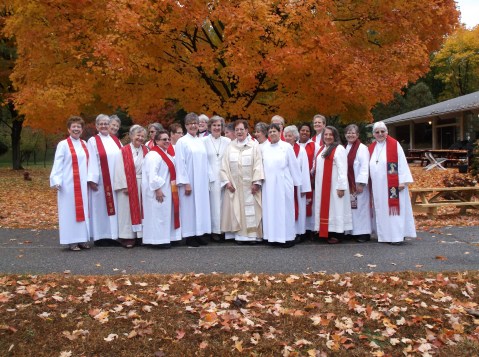
Below is Jamie Manson’s thoughtful and provoking article in today’s National Catholic Reporter: (Picture below shows ordained women of the Eastern Region of RCWP-USA. )
In meeting with Fellay, Pope Francis shows double standard in the ‘culture of encounter’
Earlier this week, NCR’s Joshua J. McElwee reported that, on April 1, Pope Francis met with Bishop Bernard Fellay, the Superior General of the Society of St. Pius X. Founded in 1970 by Archbishop Marcel Lefebvre, the Society widely rejects the teachings of the Second Vatican Council.
According to the society’s website, the “false teachings” of Vatican II include the Council’s exhortations on religious liberty, ecumenism, liturgical reforms, collegiality and what they call the “modernist” idea that “that the human conscience is the supreme arbiter of good and evil for each individual.” The society is an ardent defender of the Tridentine Mass (Fellay’s liturgical dress rivals any garb donned byCardinal Raymond Burke) and believes passionately in the supremacy of the Roman Catholic church over all other religions.
In 1988, Lefebvre decided, against orders of then-Pope John Paul II, to consecrate four new bishops. Lefebvre consecrated these men out of concern that, in the event of his death, there would be no truly orthodox bishops to ordain new priests for the society. St. John Paul II in turn excommunicated Lefebvre and his four newly minted bishops, including Fellay.
In 2009, Pope Benedict XVI lifted those excommunications in an attempt to repair relations with the group. But his efforts to bring the Society back into the fold eventually broke down.
By meeting with Fellay this past weekend, Pope Francis has taken a new step toward returning the Society of St. Pius X into full Communion with the Roman Catholic church.
According to McElwee’s report, Fellay believes that “Francis may consider his group as existing on the ‘periphery’ and thus needing to be accompanied back to the church.”
This isn’t Francis’ first overture towards the society. Back in September, the pope announced that, during the Year of Mercy, the society’s priests would have their faculties restored to offer absolution “validly and licitly” to those who come to them for confession.
“This Jubilee Year of Mercy excludes no one,” the pontiff said in September. “I trust that in the near future solutions may be found to recover full communion with the priests and superiors of the Fraternity.”
While some may admire the pope’s latest meeting with Fellay as yet another example of his commitment to a “culture of encounter,” it also demonstrates that the Year of Mercy has its double standards.
If Francis can offer a forty-minute, private meeting to a formerly excommunicated bishop who has been performing the sacraments illicitly for decades and who believes that the Catholic church is laced with false teachings, why can’t the pope also extend the same invitation to Catholic theologians, ethicists, and lay ministers who challenge the church’s teaching on women’s ordination, the use of contraception, and the full inclusion of LGBTQ persons?
If Francis truly wishes to cultivate a culture of encounter and to include everyone in the Year of Mercy, why not welcome those women and men who have been excommunicated for expressing their belief that women deserve an equal role in decision-making authority and sacramental leadership in the church?
Why not open up a dialogue with the Roman Catholic Womenpriests movement whose first priests were ordained by a valid Roman Catholic bishop? Not unlike Lefebvre, Roman Catholic Womenpriests have moved forward with consecrating their own bishops and, not unlike the society, they continue to perform the sacraments validly but not licitly. Why, then, can’t they get a hearing from the pope, too?
In the three years since his election, Pope Francis has welcomed a stunning spectrum of people to the Vatican. He has greeted everyone from actor Leonardo DiCaprio to discuss climate change, to American Evangelical leaders to discuss religious liberty and evangelization, to the founder of Twitter to discuss the power of social media.
The Pope has flown to far away places to participate in historic encounters, most recently traveling to Havana, Cuba, to chat with Fidel Castro and to sign a joint declaration with Patriarch Kirill of Moscow and all of Russia.
And, yet, like popes before him, Francis still can’t seem to find time on his dance card for the members of his own flock who seek to make the Roman Catholic church a better reflection of mercy, justice, and equality.
This is tragic, since according to a 2014 Univision Poll of Catholics on five continents, a significant number (if not substantial majorities) of Catholics in countries around the world disagree with the church’s teachings on women’s ordination, contraception, divorce and same-sex marriage. These Catholics surely exceed the slim number of those who would adhere to the society’s anachronistic beliefs.
The pope’s meeting with Fellay shows us who among “dissenting” Catholics is worthy to encounter Francis, and who is not.
Members of the Society of St. Pius X flagrantly reject the Catholic church’s rite of the Mass, its teachings on the primacy of conscience, and its respect for the truths expressed by other religions. Yet they are beckoned back into the fold.
But Catholics who (based on decades of theological and historical inquiry) challenge the church’s teachings on women’s ordination and sexual ethics are still locked outside of the doors of mercy.
One can only conclude from this situation that a spirit of welcome and dialogue are available to anyone — except Catholics who question the Vatican on issues of gender and sexuality. Until they, too, are invited to talk to the pope, the notion of a culture of encounter remains dubious.
[Jamie L. Manson is NCR books editor. She received her Master of Divinity degree from Yale Divinity School, where she studied Catholic theology and sexual ethics. Her email address is jmanson@ncronline.org.]
Here is a 4/5/16 NY Post update on the story of RCWP Alexandra Dyer, a victim of a vicious attack on August 19,2015 altering her life of service and love in so many ways. Our hearts remain with Rev. Dyer who is still recovering from this attack. In the picture below taken in August 2015 Rev. Alexandra Dyer,RCWP, in the middle, is with Rev. Eda Lorello,RCWP and Rev. Judy Beaumont, RCWP in Queens, New York.
Jerry Mohammed, 32 — who is accused of attacking ordained priest Alexandra Dyer — a member of the sect Roman Catholic Womenpriests and executive director of the Healing Arts Initiative – in August. He allegedly schemed with a former employee of the non-profit who fleeced $750,000 from the group, law enforcement sources said.
Mohammed and Kim Williams, 47 — a former accountant for the group — plotted the attack on Dyer to distract from the theft and apparently make it look as if a hardened thug had stolen the money instead of her, according to law enforcement sources.
Pia Louallen, 41, a close friend of the allegedly twisted numbers cruncher, worked with Williams and pocketed $150,000 between 2013 and 2015, law enforcement sources said.
All three were indicted for the scheme Tuesday, Queens District Attorney Richard Brown said.
“This case is troubling on so many different levels. In an atmosphere of such giving, it is disheartening to see an individual allegedly use her position of fiduciary trust to siphon off tens of thousands of dollars in funds for the personal use of herself and another,” Brown said.
On Aug. 19, Mohammed allegedly waited for Dyer to leave work then threw the acid-like liquid at her as she sat in her car — burning her face and other parts of her body.
Dyer was hospitalized and underwent surgeries as a result of the attack.
Mohammed was charged with assault, conspiracy and criminal possession of a weapon. Williams was charged with assault, grand larceny, falsifying business records and other charges.
Louallen was charged with grand larceny and conspiracy.

 During Holy Week, March 24, the feast day of Oscar Romero, in the era of Pope Francis and his Year of Mercy, a conversation — turbulent at first — began.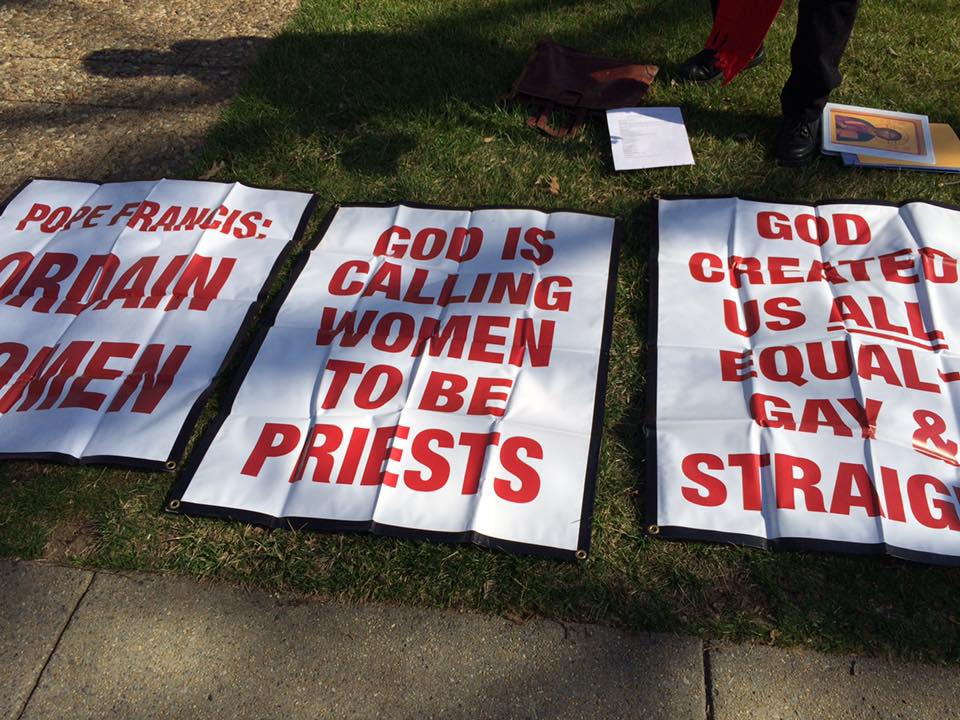


 184
184





 In meeting with Fellay, Pope Francis shows double standard in the ‘culture of encounter’
 Modal Trigger
 judyablfollowingSheWhoIs
Recent Comments