
Let The Children Come Unto Me-From Jesus

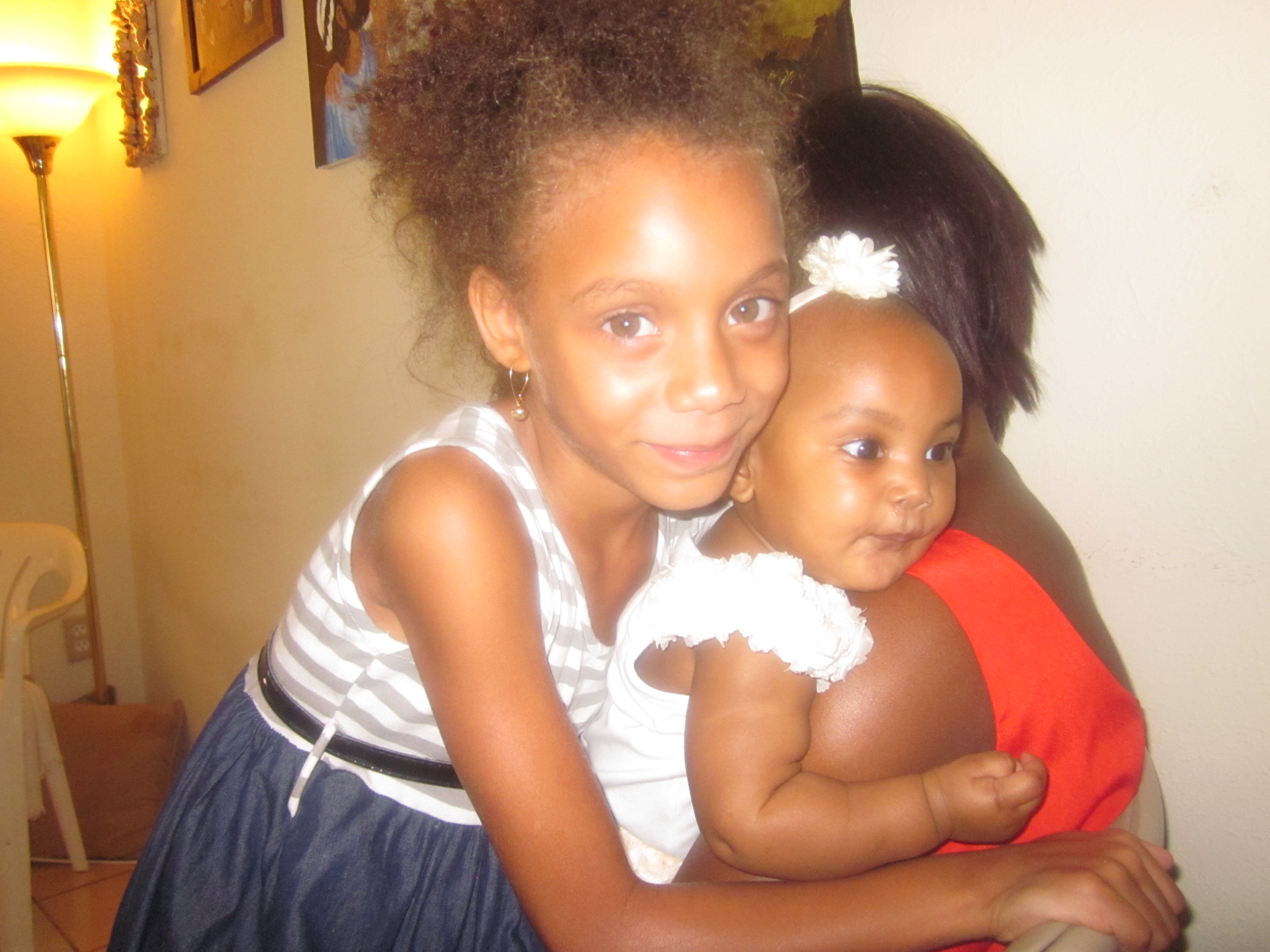 I preface this article on the baptism of the children of gay parents with the words of Jesus:
Matthew 19: 13-15 (TIB)
“Then small children were brought to Jesus so he could lay hands on them and pray for them. The disciples began to scold the parents,but Jesus said, “Let the children alone–let them come to me. The kingdom of heaven belongs to such as these.” And after laying his hands on them Jesus left that town”.
What the church should do about requests for baptism is made clear in Jesus’ words. Instead, the church finds ways to scold the parents-whether they are gay parents, or divorced parents, or parents civilly married or not married, they may well be scolded instead of welcomed. Let us remember verse, 15. “Jesus left that town”. Sometimes it seems to me that Jesus will leave the scolding church behind even as he left many towns behind, sometimes shaking the dust off his feet when he was not received. As Roman Catholic Women Priests we too are scolded by the church, but we choose to remain within it thus far, seeking with our life’s blood to renew it. We baptize all children and adults who seek baptism, we open up the sacrament freely and deny it to no one who truly wants to be part or to have their child become a member of the Body of Christ. I have baptized twenty individuals since my ordination in 2008, from babies to grandparents and all ages in between, mostly children and youth. It is my greatest joy to open the Sacraments of the church with extravagant affection, to quote the author Susan Ross.
Rev. Dr. Judith A. Lee, ARCWP
Here is the Article from RNS Religious News Service:
Could baptizing children of gay couples become a new battleground?
David Gibson | June 26, 2014
(RNS) Despite numerous controversies over dismissing gay Catholics from church posts and the U.S. hierarchy’s campaign against same-sex marriage, Catholic leaders have carefully, if quietly, avoided doing anything to block gay couples from having their children baptized.
But a move by a bishop in Wisconsin to route all such decisions through his office is raising questions about whether that neutral zone will now become another battleground, and whether the growing acceptance of gay parents will inevitably draw more attention to this practice and force church leaders to establish clearer rules.
The default position for most bishops — reiterated in a major Vatican document released on Thursday (June 26) — is that if the parents pledge to raise the child Catholic, then no girl or boy should be refused baptism.
They generally let parish priests make the final call and let them administer the sacrament, though it is usually done in a private ceremony with the biological parent — not the adoptive mother or father — listed on the baptismal certificate.
The new debate was prompted by the emergence of a memo — first reported by the Wisconsin State Journal — that was sent in early May to priests of the Madison Diocese by the top aide to Bishop Robert Morlino.
James Bartylla is Vicar General of the Diocese of Madison. Under an administrative change enacted earlier this year, his office now handles priests’ inquiries about whether to baptize children of same-sex couples. In the past, this issue was largely left up to the discretion of individuals priests.
Show caption
Monsignor James Bartylla is vicar general of the Diocese of Madison. Under an administrative change enacted earlier this year, his office now handles priests’ inquiries about whether to baptize children of same-sex couples. In the past, this issue was largely left up to the discretion of individual priests. RNS photo courtesy Brent King, Diocese of Madison
In the memo, the vicar general of the diocese, Monsignor James Bartylla, says there are “a plethora of difficulties, challenges, and considerations associated with these unnatural unions (including scandal) linked with the baptism of a child, and such considerations touch upon theology, canon law, pastoral approach, liturgical adaptation, and sacramental recording.”
Bartylla says that pastors must now coordinate any decision on baptizing the children of gay couples with his office and that “each case must be evaluated individually.”
A spokesman for the Madison Diocese, Brent King, said in an email that the new policy would not affect the church’s openness to baptizing a child if a parent or guardian “is sincere in presenting a child for baptism” and if he or she “truly intends to raise the child in the faith and all that means.”
“We want everyone to receive this most important sacrament, and we are dealing with this sensitive matter prudently, for the child’s sake and the integrity of this most sacred sacrament,” wrote King. He added that the diocese would have no further comment.
But some suspect that Morlino, one of the more outspoken conservatives in the U.S. Conference of Catholic Bishops, will use the new policy to curb baptisms that he considers problematic.
“While this process might protect couples from the negative whims of a local pastor, Bishop Morlino has such a strong record against supporting lesbian and gay people that I worry he might be more restrictive about baptizing their children than most local priests would be,” said Francis DeBernardo, head of New Ways Ministry, a leading advocacy group for gay Catholics.
If that happens, he said, it “has the potential to blow up into a pastoral disaster.”
Officials at the USCCB said these decisions are left to local church leaders, and indicated there are no plans to formulate a national directive beyond the guidance offered in a 2006 statement on ministering to gay people. That document says that baptizing the children of gay parents is “a serious pastoral concern” but that the church should not refuse them access to the sacrament.
Since the bishops passed that document, however, an ongoing wave of victories for same-sex marriage advocates has continued to push the issue into the public arena. As more gay Catholics can marry, and can be open about their relationship, more gay couples may be presenting their children for baptism.
“The question with gay couples is whether their opposition to the church’s teaching on marriage means that they do not in fact intend to raise the child in the faith,” said Rita Ferrone, the author of several books about liturgy and a consultant to U.S. dioceses on liturgical matters.
“Gay parents may or may not be ideologically opposed to church teaching, but chances are they do not merely disobey but also reject the various norms they have transgressed,” Ferrone said.
DeBernardo said the problem with a policy that focuses specifically on gay parents is that it “stigmatizes lesbian and gay couples as being more suspect than any other parents.”
“It is very likely that no parents that present a child for baptism are perfectly following all church rules,” he said. “Why single out only lesbian and gay parents for further scrutiny?”
Countering any trend to curb baptisms, however, is the long-standing presumption, in church teaching and among even conservative church leaders, that no child should be denied baptism.
That welcoming stance was given a powerful boost with the election of Pope Francis, who as an archbishop in Argentina castigated priests who refused to baptize the children of unwed mothers. “The child has absolutely no responsibility for the state of his parents’ marriage,” he also said.
As pope, Francis has continued to promote that view.
Last September he said that while the church has the right to express its opinions it cannot “interfere spiritually” in the lives of gays and lesbians. In January he personally baptized — in the Sistine Chapel — the child of a couple married civilly, not in the church. And in May he said in a homily the church should baptize little green men from Mars if they asked for it.
Some bishops are taking a cue from Francis.
In Mexico, Bishop Raul Vera Lopez personally baptized a 16-month-old raised by a lesbian couple. He did that in May, just two weeks after meeting in Rome with Francis and discussing his ministry to gay people with him.
“If I find the natural daughter of one of two women, how can I deny her baptism? If the parents seek it, it’s because there is a Christian faith,” Vera Lopez explained. “The pope has the same attitude as Christ did.”
In Argentina in April, the archbishop of Cordoba also defended the decision to baptize the child of a lesbian couple during a service in the city’s cathedral, and said he cleared it with the Vatican.
“Baptism is a right of every human person, and I think that the Holy Father as well, ever since he was archbishop of Buenos Aires, always advocated for great openness in administering these sacraments,” said Archbishop Carlos Nanez.
And just this week, a major document published by the Vatican to guide future discussions on family life stressed that almost all the world’s bishops would greet requests to baptize children living with gay couples “with the same care, tenderness and concern which is given to other children.”
YS/AMB END GIBSON
The Sower and Preparing The Fertile Ground: Homilies For the 15th Sunday by Rev. Bev and Rev. Judy
In the readings for Sunday July 13th we have the parable of the sower (Matthew 13:1-23)that is so rich with meaning. In that parable,shared with people who knew about farming,there are two main elements the sower and the soil. Who is the sower? God is and those who speak God’s word to the earth and its people. Jesus the Christ is sowing God’s word in every parable and teaching and action. And all of us who share the word with one another by word and deed as Jesus did, are also sowers. And who or what is the soil? Beyond the metaphors of actual earth where seeds may fall, it falls in us. We are the soil and we are also part of an environment where the seeds fall. And this outside environment is a given in some ways, we did not create it and it surrounds us, but we can,as children of God, also choose it and change it with the freedom God has given us.
The first reading from Isaiah 55:10-11 tells us that just as rain and snow water the earth making it fertile and fruitful and producing the seeds to be sown, God’s word goes forth and achieves the ends for which it is sent, including making us fertile and fruitful in building the kin-dom (world-wide all inclusive family of God) with God. The response in the Psalm(65) is beautiful: God has prepared the land and the grain, “softening it with showers and blessing its yield”. Even the “untilled meadows overflow with God’s bounty…They shout and sing for joy”. Below we share Rev. Beverly Bingle’s homily which focuses on the earth and the stewardship that is needed so it will indeed be able to sing for joy and not cry out in pain-so that it can be an environment for fertile growth.The second reading (Romans 8: 18-23)is in tune with Rev. Bev’s concern for our care for the earth as well: “We know that all creation is “groaning in labor pains…and we ourselves also groan within ourselves…” Paul is saying that all of creation should be freed from corruption (that which leads to death) and “would come to share in the glorious freedom of the children of God”. God wants full life for all of God’s creation, for the earth, the planet,and yes, the cosmos, and all living things including us, God’s beloved people.
The sower sows the seeds everywhere, not only on the carefully prepared ground. And yet, when the ground is well prepared the seeds grow and bear fruit in phenomenal ways. I love that the seed is strewn everywhere. I grew up in the inner-city, in Brooklyn, New York, but we loved every bit of our little front yard and back yard and looked forward each Spring to every and anything that grew there. My Grandmother also had a flower box on the window sill. Whatever Grandma grew took hold no matter what the odds, including me. (Anyone who has read my book the House on Sunny Street(Americastarbooks.com)knows that there were many odds against me but nothing could hold back my faith and my growth that was watered with love, family,church and community strength). Grandma shared cuttings of her plants with all her friends and neighbors. Once a pot of tulips,a mother’s day gift, that were ready for planting in her box fell off the stoop and landed in the cellar below. Somehow it was not picked up and it was forgotten. We never entered the cellar from the outside. After a long winter, I was playing stick ball with my friends and the ball hit the side of my stoop and bounced down our long cellar stairs. I went down to get it and found beautiful tulips blooming in the thin caked dirt and debris. Grandma helped me carefully unearth them and finally planted them in her welcoming flower box where they were the talk of the neighborhood. From that moment on I learned that wonderful things can bloom even in the shallowest of earth. And, so like the sower I cast my seeds, my God given and inspired words everywhere, knowing they can bloom even when the ground is not prepared.
But why would we as “the soil” that the word is to grow in choose not to be prepared when we can indeed help ourselves to become fruitful in building God’s kin-dom? How do we tend the roots to strengthen them? For some of us who receive the word with joy, “setbacks and persecution come” and we fall away (Matt 13: 21). We get it,sure, but we don’t want the hassle. Somehow we thought only good things would happen to us when we welcomed God’s kin-dom within us. We believed in a “gospel of prosperity” that Jesus never preached or lived. When life dealt its inevitable blows,when storms came, our fairy story religion did not hold-when it became hard to care for,when love had to exist with pain and struggle, we simply left the garden.
Our people face violence and poverty and illness. They face illness without adequate health care,or, for some, any health care. It is hard to praise God, when you hurt badly in your own body and for your family members. Yet, every Sunday my heart is lifted by people who hurt and still love and spread the word, and live the caring and sharing of the Gospel. Yes, I know who is not there, but it is those who are there that lift my heart and keep me sharing the word. Some hurt and leave. Some hurt and grow and embrace others. How beautiful they bloom.
What are those weeds and the thorns that choke out the new growth? What environments are not conducive to growth? We all get the message, but “anxieties and the lure of wealth choke off the message and it produces no fruit”(Matt 13:22). Jesus really did mean it when he told the “rich young ruler” to give away his goods to the poor and follow him. The early church shared its goods and none wanted for anything. That is hardly the church of today. Pope Francis is teaching and showing that simplicity and an even distribution of this worlds goods is necessary for Christ followers. There are many ways to do this. In the last few days people who followed Christ bought and gave entire home furnishings so that homeless women could start life again with new beds and household furnishings. We were also given a grant from The Father’s Table Foundation and ongoing donations from churches and individuals so this could happen and also so that our youth could see plays and visit educational and recreational settings-so they could avoid the streets and live. This sharing of money and goods directly with those who do not have is so beautiful. And yet as Pope Francis says it is the systemic nature of poverty(in America, Central America and everywhere) that must be challenged and changed. The church should have a major role in this change.
And finally, the people we surround ourselves with can either help the seeds of the word to grow in us or they can choke it out. With my teens, so called friends that actually work hard to pull them down, are a major concern. The gangs and drug sellers compete actively for new recruits. Our kids have to be strong to walk away. For poor kids drug money is one way to leave poverty. And early pregnancy seems a road to a certain kind of status. It does not compute that jail and addictions and the responsibility for children may also follow. For many kids who do come from homes where there is plenty, church is not “fun” and not attended. Parents seem to give up and not even try to find a church environment where their kids could thrive and grow. I thank God for our parents who bring their kids instead of sending them,and who expect and encourage a God-connection from their kids. Our particular kids have been great in dodging the bullets. But it is not easy.
In all of our lives there are those we listen to and look up to that pull us away from a life of service and compassion toward a life of taking care of number one. Maybe we can stop a moment and reflect: is my environment and my friendship group conducive to growing as a Christ follower? If not, maybe I can reach out and find a place to grow. Then my yield too can be a hundred fold- and the kin-dom of God will grow exponentially.
Amen.
Rev. Dr. Judy Lee,
Co-Pastor Good Shepherd Inclusive Catholic Community of Fort Myers

LIKE THESE FLOWERS AND OUR BEAUTIFUL YOUTH LEADER ,EFE JANE CUDJOE, LET US BLOOM AND GROW!
And now Rev. Dr. Bev. Bingle’s Homily
Today’s parable of the sower
begins the third section of Matthew’s gospel,
where he pulls together seven parables
that have to do with the “kingdom of God,”
variously translated as “heaven’s imperial rule”
or “companionship of empowerment”
or, as we are wont to say here at Holy Spirit, “kin-dom of God.”
Today’s parable was first circulated without any explanations;
they came with the second or third generation of Christians.
So, for example, the idea that Jesus’ followers
have some sort of secret understanding
is alien to Jesus but typical of gnostic influences of a later time.
___________________________________
The scholars of the Jesus Seminar voted
that Jesus would not have said most of today’s reading
but that he probably said something like verses 3 through 8:
“One day, a farmer went out sowing seed.
Some of the seed landed on a footpath,
where birds came and ate it up.
Some of the seed fell on rocky ground,
where there was little soil.
This seed sprouted at once since the soil had no depth,
but when the sun rose and scorched it,
it withered away for lack of roots.
Again, some of the seed fell among thorns,
and the thorns grew up and choked it.
And some of it landed on good soil, and yielded a crop
thirty, sixty, even a hundred times what was sown.
___________________________________
We ask who, in this parable, the sower is.
What’s the meaning of the footpath, and the rocky ground,
and the shallow soil, and the thorns?
What’s the good ground?
The Gospel writers gave explanations
that related to what was happening
in each of their communities at the time they wrote.
What does this parable of the kin-dom tell us today?
How are we to read it in light of the signs of our times?
_____________________________________
First, there’s a lesson in inclusion here.
Suppose that, in the kin-dom of God metaphor, God is the sower.
God sows the seed on all types of ground, without discrimination.
A good lesson there:
Jesus’ message that the kin-dom is within us is for everyone.
And there’s a lesson about God’s prodigal generosity.
The seed is sown everywhere, not just in some places.
Then there’s a lesson about preparation.
If the ground—would that be us?—isn’t ready, isn’t prepared,
the seed will not thrive.
If it is prepared, the seed produces bountifully.
And there’s a lesson about perseverance, too.
No matter what kind of ground, it does what it can,
according to its own makeup, its own nature and gifts—
even if it will choke the seed or let it be baked in the sun.
___________________________________
Those applications of the parable are good.
We can gain wisdom and guidance from their proverbial truth.
But there’s another application that is critically urgent,
given the signs of our times.
For decades scientists have been finding
growing environmental challenges to our home planet.
They call it global warming and climate change,
environmental pollution, degradation, and destruction.
Some “deniers” look at the increasing incidence of extremes
and say it’s nothing new.
They ignore the science, and they miss the signs of the times:
the increasingly devastating cyclones, tornadoes, typhoons,
forest fires, the extremes of heat and cold, the melting ice cap.
Looking at those signs in light of today’s parable makes it obvious
that we are literally destroying the good ground
where God’s word can take root and grow.
Rocky ground, parched land, shallow topsoil—yes,
destroyed by deforestation, drought, floods, agricultural runoff.
Our farming practices are just one part of the problem. Multinational
corporations like Monsanto
produce genetically modified seed—GMOs—
to survive the chemicals in Roundup,
the herbicide they sell that poisons the soil to kill weeds
and make mega-farming more profitable.
McDonald’s lust for profit—and our lust for cheap beef—
bring deforestation to South America
and deprive indigenous peoples of their land and livelihood. As long
ago as 1991 Lawrence Summers of the World Bank
wrote that it would be economically logical
to locate “dirty” industries in the least developed countries
because, he said, under-populated countries in Africa
are vastly under-polluted.
In 2014 it’s happening—
we are dumping our waste in the Third World,
where the people do not have the resources to protest.
Our immoral way of life is killing the earth.
___________________________________
But it’s not just corporate greed that’s doing it.
It’s our lifestyle.
We plant grass, fertilize it with chemicals,
spray it with weed killers, water it to keep it green;
then we mow it down and haul the clippings to a dump.
Just one hour of gas-powered lawn mowing
produces as much pollution as four hours of driving a car.
We use chemicals and fertilizers that run off into the river
and end up causing the algae bloom that’s killing our lake.
At a meeting I attended last week the host organization
offered water to the attendees—
a plastic bottle filled with water from
the municipal water supply of Plymouth, Michigan.
Every second 1500 water bottles
end up in landfills or in the ocean; that’s 64.8 million a day.
In the Pacific Ocean an area the size of Texas,
known as the Great Pacific Garbage Patch,
is a swirling mass of plastic trash.
We demand a comfortable lifestyle for as little money as possible—
air conditioning, heat, light, cars, stuff.
The hidden costs to the environment are passed on to the poor
in depleted environments, dangerous habitats,
and threatened health—and ultimately to our grandchildren
and all the grandchildren of the world.
___________________________________
What can we do?
In missionary work there’s an understanding
that you can’t preach the word to people
when they’re starving, sick, oppressed, naked, or wounded.
That’s the basis for Saint Francis of Assisi saying,
“Preach the Gospel at all times,
and when necessary, use words.”
Today’s Gospel can be a warning to us—
if we do not take action to protect the land,
the kin-dom of God will not take root among us.
___________________________________
A cottonwood tree volunteered itself in my yard.
I didn’t identify it right away—looked a lot like the pear nearby.
Once I realized what it was, it was already 20 feet high,
and I thought to cut it down because it wasn’t part of my plan.
But I’ve decided to keep it,
along with the locust that sprouted this year.
Those two trees will be part of what I do to “reforest” Toledo,
adding just a bit of cleaner air and cooler climate.
Along with that, I’m resolved to examine my lifestyle
for other ways that I can lighten my carbon footprint—
and my methane footprint and plastic footprint,
and all those other footprints that contribute to climate change.
___________________________________
Even more than that,
our Social Concerns Ministry is planning a video series
to raise awareness of this environmental crisis.
We’ll gather at the Big Boy after the 5:30 Mass this weekend
to begin to choose videos and to decide, among other things,
how we’ll take part in the People’s Climate March
when it goes through Toledo September 24.
It’s a global problem, and it’s a moral problem,
but it’s caused by the habits of individuals… like us.
We can make a difference.
The Gospel requires it of us.
—
Holy Spirit Catholic Community
at 3535 Executive Parkway (Unity of Toledo)
Saturdays at 4:30 p.m.
Sundays at 9 a.m.
Sundays at 5:30 p.m.
http://www.holyspirittoledo.org
Rev. Dr. Bev Bingle, Pastor
Showers of Miracles at Good Shepherd Ministries

It is summer in Florida and each day brings pouring rain, usually for a short while. We welcome it as dry lakes fill and grass is verdant green again. Fort Myers is the lightening capital of the world and our storms can be quite dramatic and sometimes scary. I rush and get all the pets in when the thunder and lightening threatens. When we are with our youth group on a trip we herd them inside quickly. I think of all the people and animals who are outside caught in the storm,not only for a short while but for those who have no safe dry homes for retreat. We work even harder in the summer to find creative solutions to homelessness- any solution is better than living outside as the lightening comes.
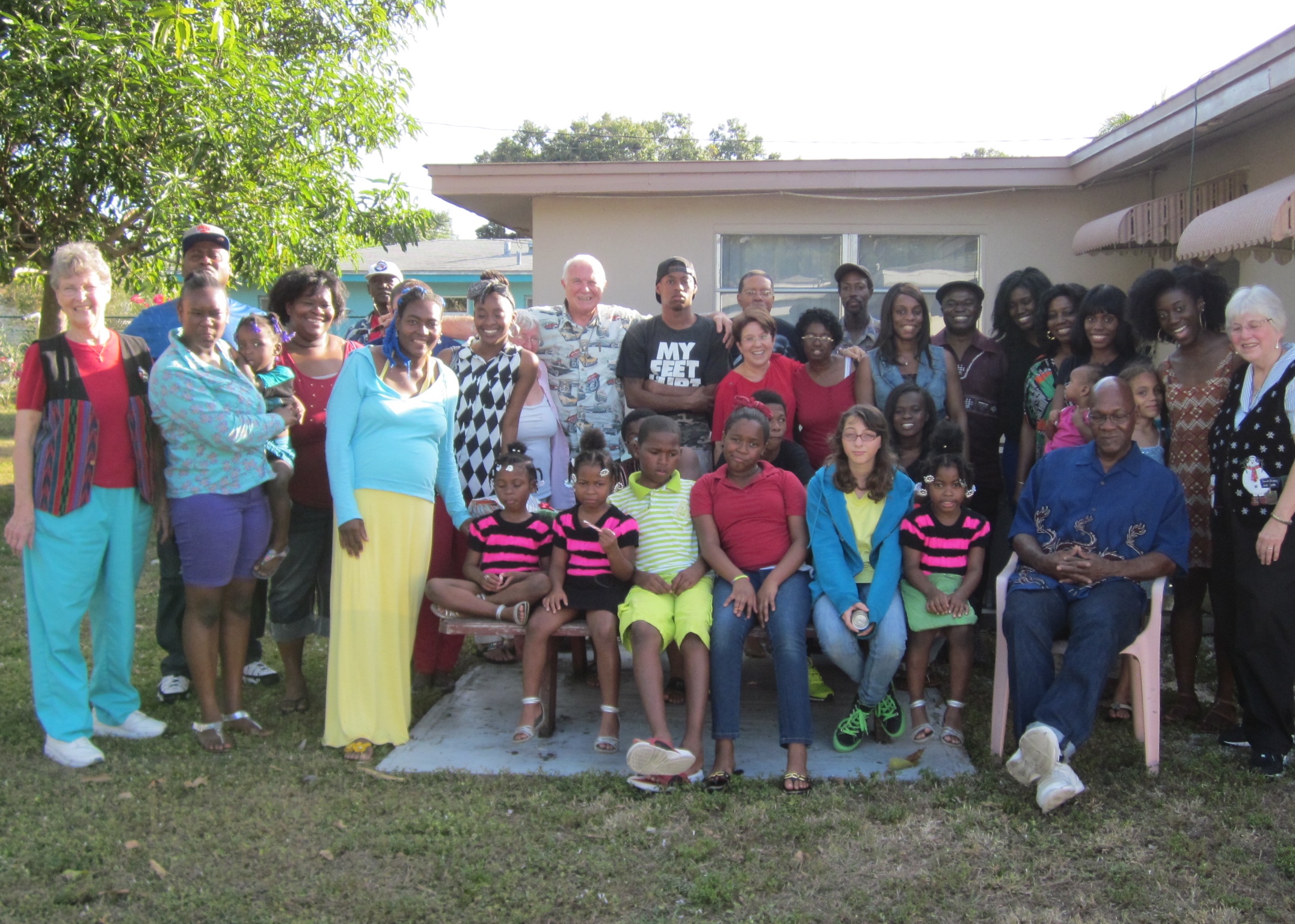
Getting into affordable housing is a process. Ruby, Kathy and Kris (in picture below) were qualified for Goodwill Industries Housing for the physically disabled in February of 2014. Kris, who had waited four years for an available Unit was housed in March. He and his kitten met while he was living on a patio. He loved the furniture that church members provided. He had not seen TV in years. They both felt safe and secure for the first time in their new home. Kris said he was so thankful for the miracle of a home. Kathy and Ruby waited until June for a new Residential complex to be approved. On June 28th Kathy was the first person who moved into this beautiful new complex with walk- in showers and features for those with mobility problems. On July 3rd Ruby who also uses a walker moved into a nearby apartment with her cat. Her friend Portia helped her to get the cat ready for approval with neutering and shots. Our ministry paid for her furniture. She said that she thought she had died and gone to heaven when she saw the apartment all ready for her. She could not believe that she could have a literally new and beautiful place to live. She recalled years on the streets and stays in almost inhabitable spaces,like a trailer with no electric or toilets working. We are so pleased for our friends to have this affordable and accessible housing. Ruby is on the left end and Kathy is in the middle. Kathy who lost her home after a difficult divorce wants to help others as she knows how it feels to be homeless. She is volunteering to help us with others who have experienced homelessness, like Diane whose story is below and who will live near Kathy.
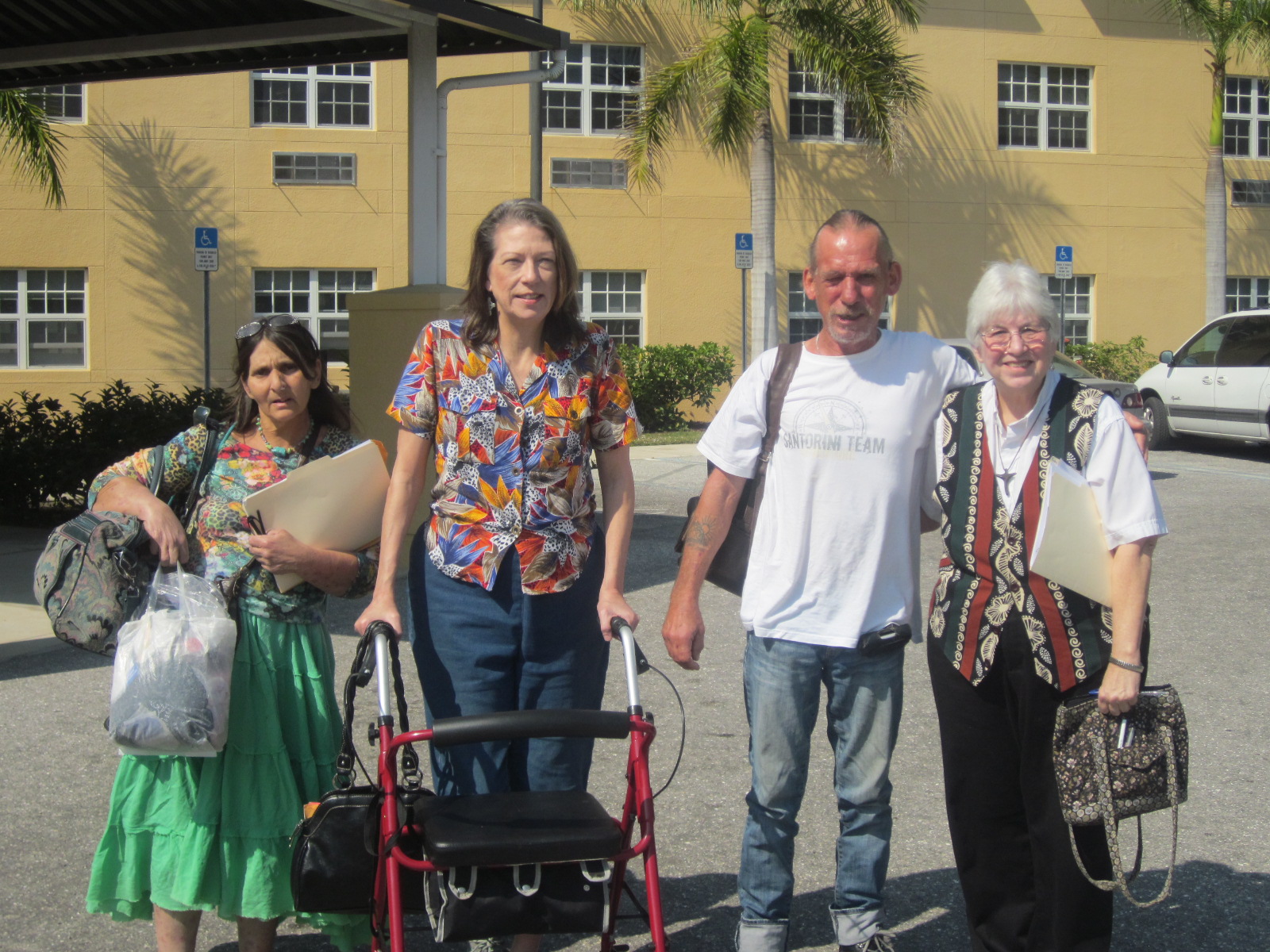
On June 10th as the skies threatened a deluge Lauretta made her way to our Tuesday Ministry. We have known Lauretta since 2007 when she lived outside without her medications and could not enter any ministry but ours due to her disruptive behavior. Lauretta has now been on her meds and housed and providing a home for her daughter for five years. She attends church with us faithfully and loves to share with and help others. Lauretta is on the right and her friend Donnie is on the left.
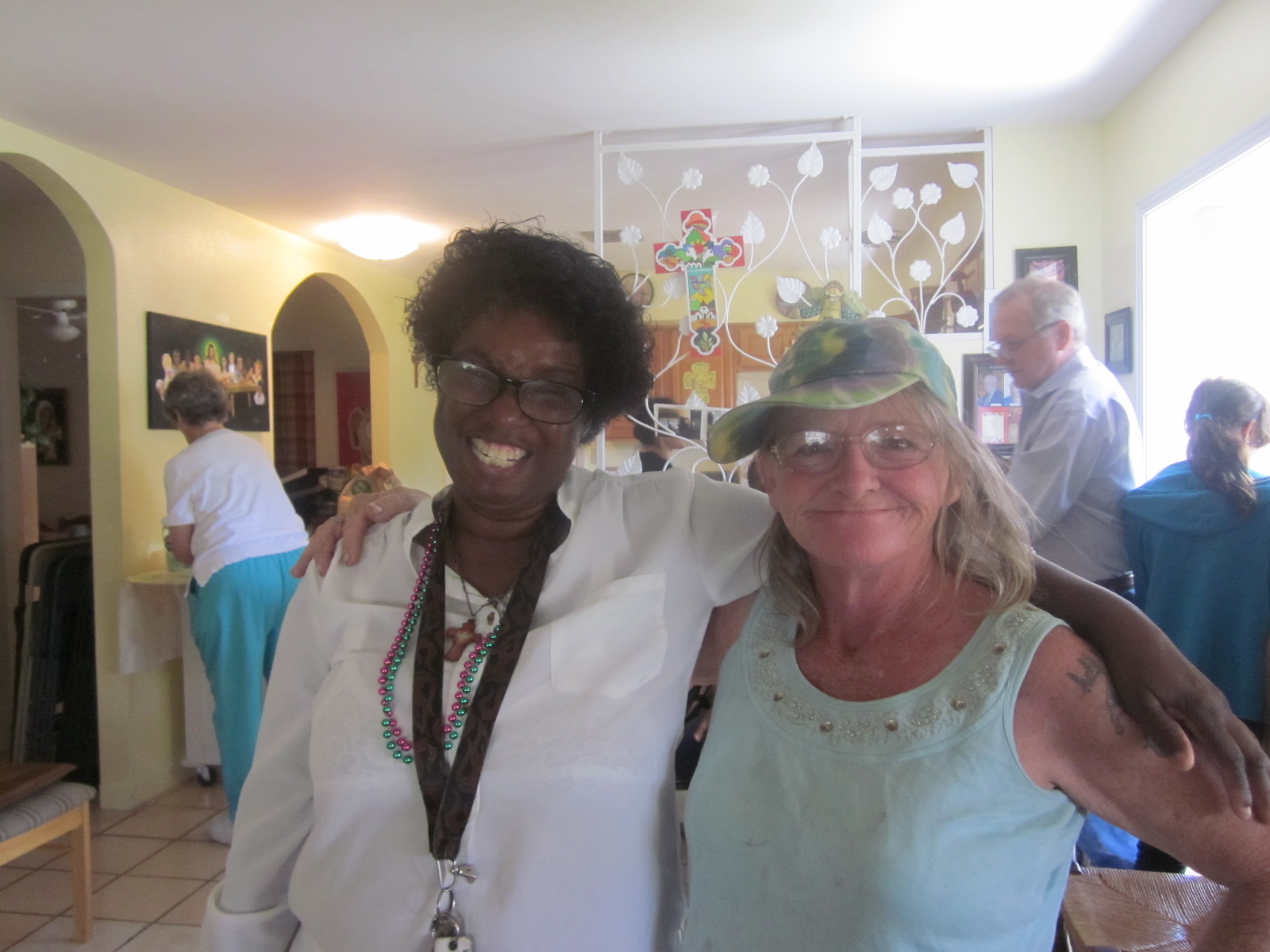
While passing through the Park where our ministry started in 2007 Lauretta met Diane. Diane, who is 60, was sitting at a table with a huge suitcase and some bags. Lauretta reached out to her and learned that Diane was homeless as her money to pay a motel had run out. She had lived in this area with her husband of many years who died over a year ago. She had returned to live with family in another state but did not feel welcomed any longer. She intended to find a small apartment here but now had no money. Lauretta brought her, bags and all, to the ministry. She cried, shared her story and was warmly welcomed by our Tuesday group members. Afterward, Pastor Judy Beaumont and I made several calls and finding no available shelter, we arranged to pay for her to stay in a Transitional Program,After The Rain, until her funds became available in July. In late June we miraculously found an apartment she could just about afford if we vouched for her.
Another miracle, a wonderful grant from The Father’s Table Foundation made it possible to vouch for her,pay her electricity deposit, and move her in with furniture supplied by this grant and other volunteers.
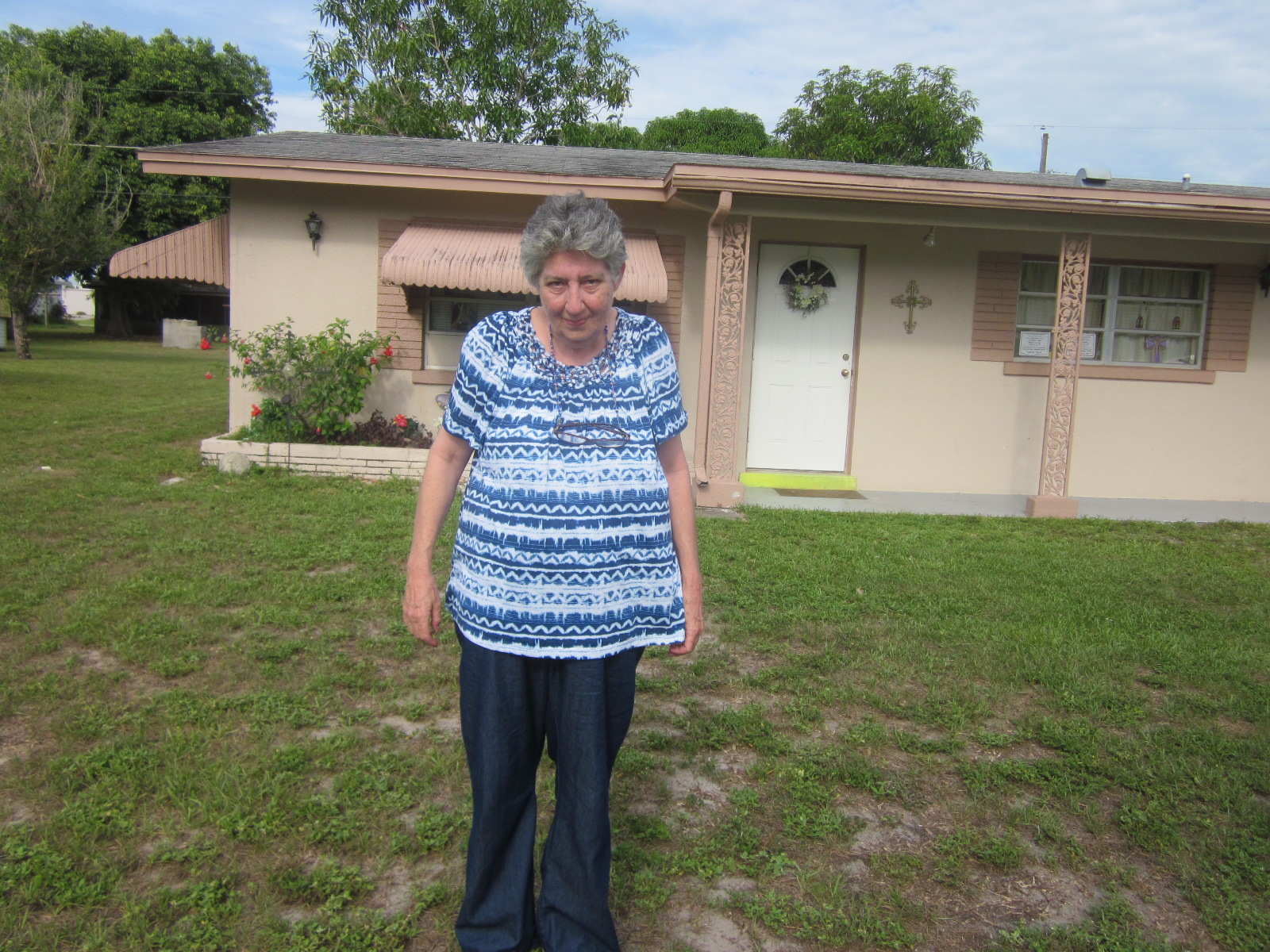 She will move in on July 8th. She is so happy as she says that Lauretta was her angel leading her to Good Shepherd and that God provided a home for her.
This is Diane outside of our Good Shepherd Church
For the three weeks without funds she was able to stay in After The Rain, a
program for women recovering from substance abuse and addiction. Although Diane never drank alcohol or used drugs, After The Rain’s Director, Miss Bev, made the decision to accomodate Diane temporarily. We were grateful as there is only one small Shelter for women in this area and it was, as it always is, full. Diane enjoyed the warmth and welcome of Miss Beverly, Miss Ruth and all of the women there.
After The Rain is appropriately named. The women who come there have lived through raging storms in their lives and find it a haven as they pursue recovery from substance abuse and addiction. We have helped sponsor women as they entered their recovery there as many cannot meet the cost of program entry. One such women is Donna and her story is another miracle. We met Donna as we picked up Kris,named above, for his new housing from a “flop house” where she cared for one of the men who was critically ill. Donna reached out to us and we developed a relationship with her. We learned that she was desperate to create a new life for herself and to leave that unhealthy environment behind. In relatively short time she became ready to seek alcohol detox, treatment and a half way house. I have accompanied many to detox but only one other sought treatment and transitional residence afterward. In what seemed to us to be a miracle, Donna was not only ready but eager to change her life. After detox, she met the Staff from After The Rain and she was accepted. We sponsored her entry into the program and she is doing an excellent job of working her recovery. She became a helpful buddy to Diane while she spent time at After The Rain.
This is Donna on the right with Miss Bev,Director of After The Rain
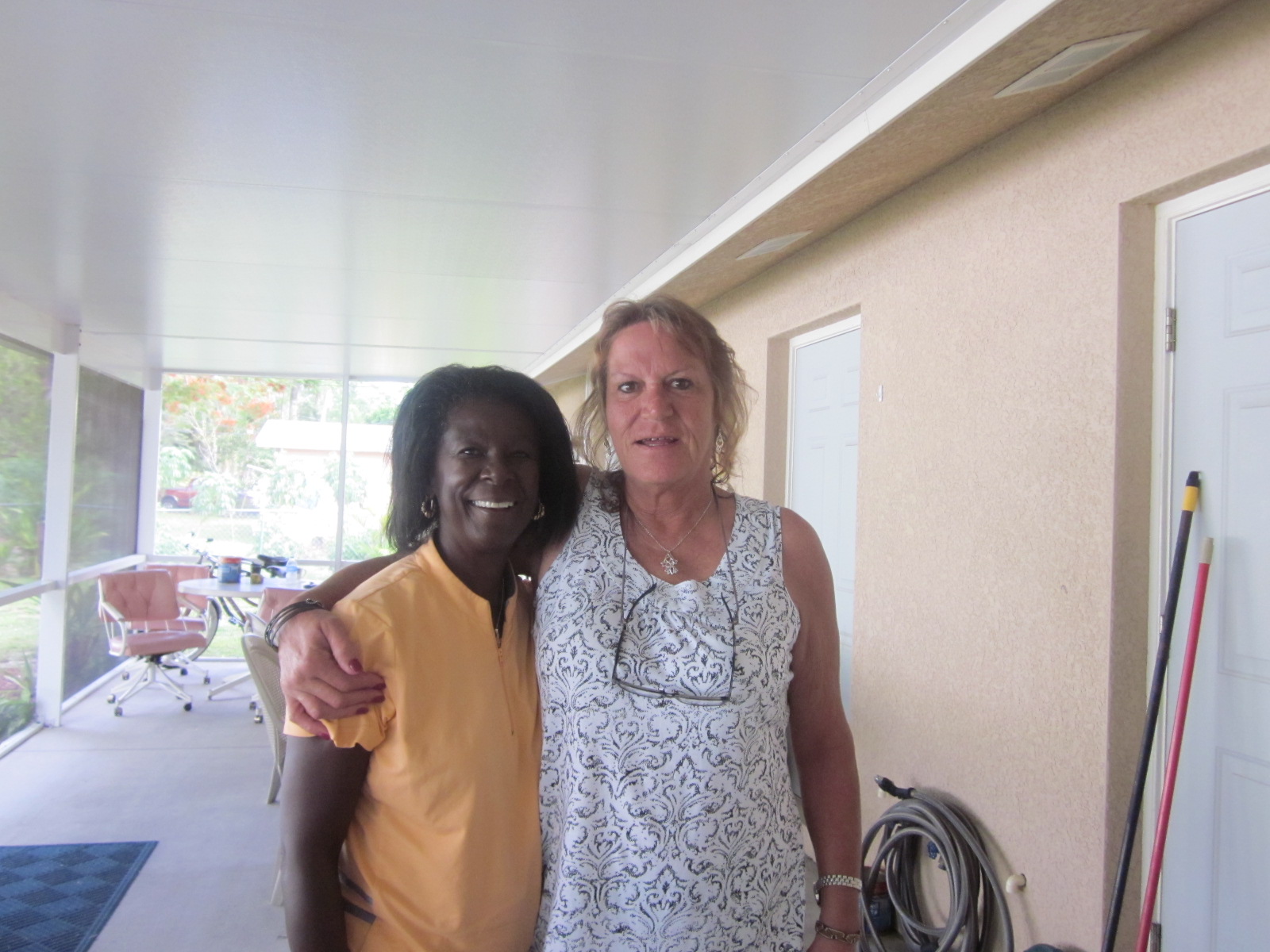
We are so thankful that Donna has this chance to turn her life around and that she is doing it day by day with the support of After The Rain.
July has become women’s month at good Shepherd Ministries as Betty will be the fourth woman we assist into affordable housing. Betty had lived tripled up in her sister’s home, sleeping on a couch, for the nine years after the death of her husband. She was a hard worker in a Restaurant and in the Ball Park seasonally until she fell on the job and injured her shoulder and back. We helped her to get her Social Security benefits and she got her first studio apartment. However, the rent for this took up four fifths of her income. She barely got by but loved her home. The rent continued to go up and she prayed that her name would finally come up for an apartment with Goodwill Housing. Finally, this month, after a three year wait, her name came up and her apartment was ready. Betty is moving into her new, and she says forever, home this week. Good Shepherd is helping her furnish her one bedroom town house. I have never seen Betty so happy-except on the day she was Confirmed in her faith on 4/26/14! Betty attends church faithfully and is so happy to affirm her faith.The picture on the left below is Betty standing in front of the Bishop, Bridget Mary Meehan, as she was confirmed.
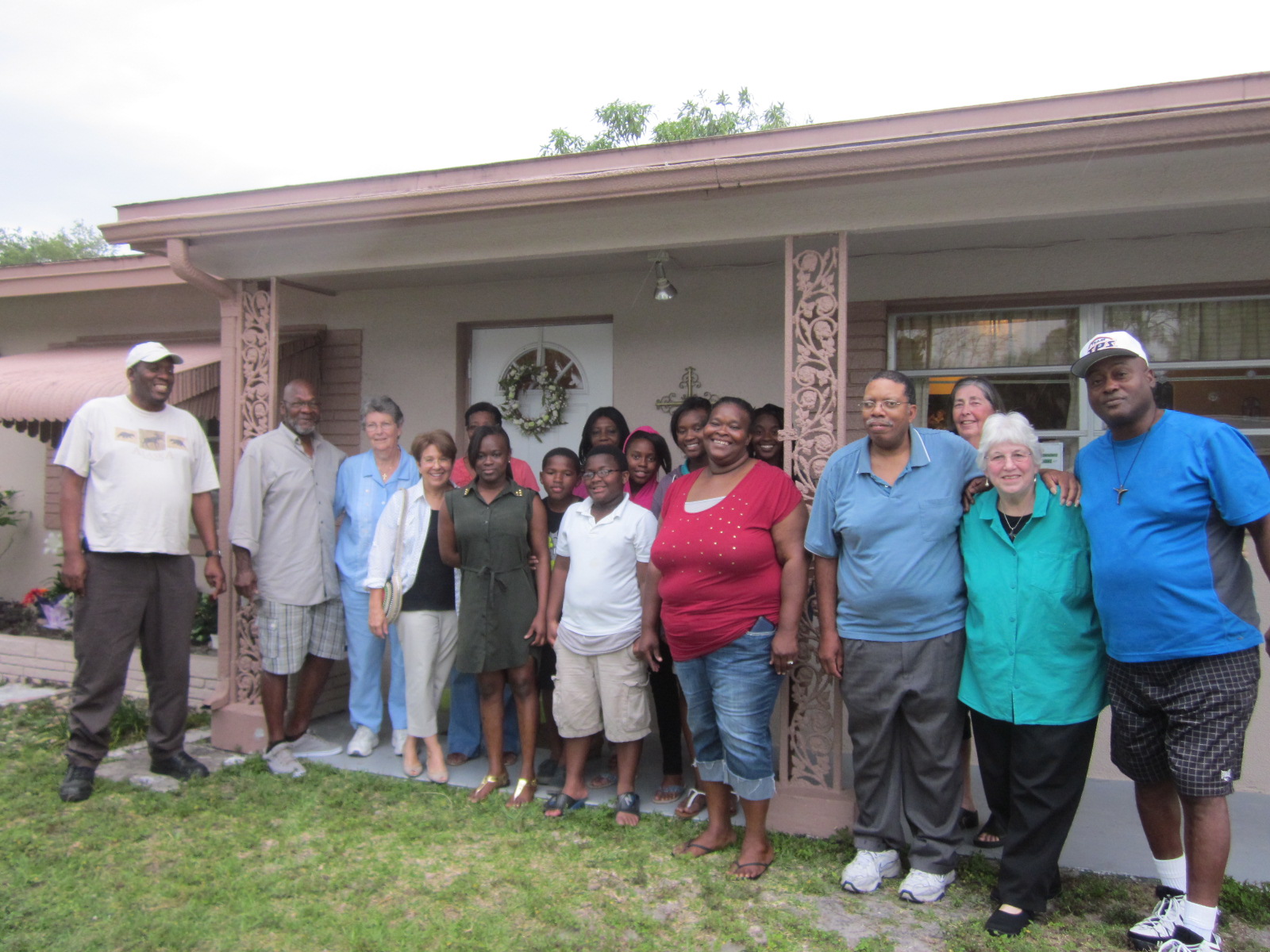
 Betty is seated on the far right with our Tuesday Fellowship members pictured below .
We are so thankful for the miracles of faith,transformation,support and housing that we have witnessed this rainy season. The sun is shining! Thank God! Amen! 
Come When You Are Overburdened: Rev. Judy’s Homily for the 14th Sunday in Ordinary Time July 6,2014
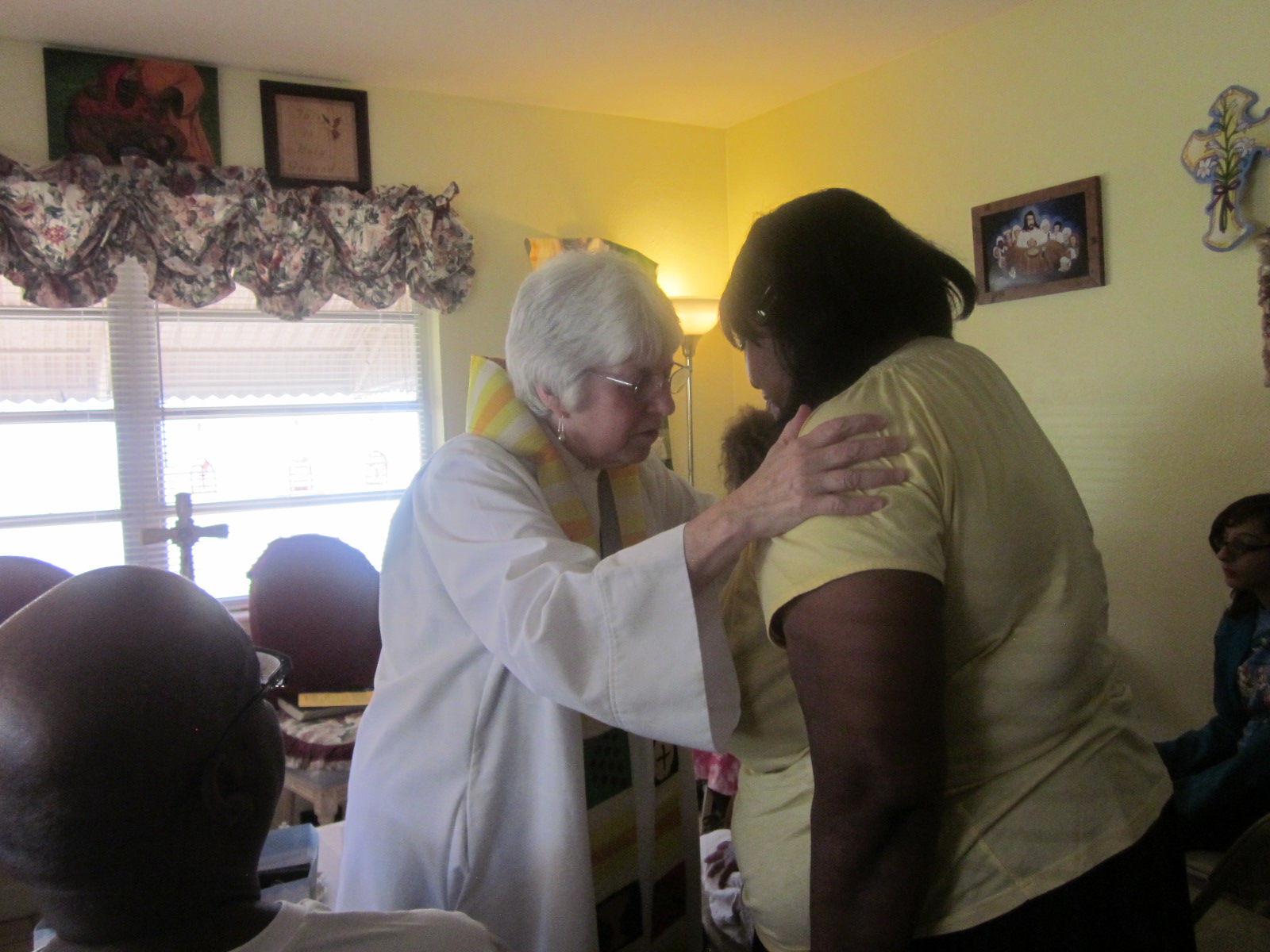 The readings for today are among the most comforting and hopeful of our Sunday readings.
They speak hope of peace in time of war( Zechariah 9: 9-10). They speak of a God of compassion who lifts up the falling (Psalm 145).They speak life while experiencing inner death( Romans 8:9,11-13). And they speak of Christ sharing the secrets of God’s ways with the simple,humble and young among us. They speak of rest for the weary and the overburdened laborer, and of Christ’s assistance in following God’s laws. They speak of rest for our very souls.(Matthew: 11:25-30). Each reading was for a very different audience in time and place, yet each speaks to us today.
The disciples of the prophet Zechariah living in a time of war and oppression under Greek domination in the 3rd or fourth Century BC (9:9) speaks of a time when peace will be proclaimed to the nations, when the Messianic Prince of Peace will come, not as an arrogant political ruler but as a just liberator, meek and riding on a donkey. The writers of the Gospels used this prophecy to describe Jesus’ ride into Jerusalem on Palm Sunday. How we still long for peace in our troubled world especially in the Near and Middle East as the very places where Jesus walked and taught are besieged by war that seems unending. And yet, the hope is clear. Perhaps we haven’t learned yet that war begets war, violence begets violence,terrorism begets more terrorism, and swords are best when beaten into plowshares. We haven’t learned how to follow the Prince of Peace when it means anti nuclear activism and courageous actions for peace like those of Sr.Megan Rice and the Plowshares Now three. We haven’t learned to be brave enough not to fight. The peace to be proclaimed is up to us.
War is a horrific way to live the way of death, but we can also live it within our daily lives and within ourselves. There are so many ways to choose death over life, every single day. Last Sunday was a day of rejoicing in our church for two reasons, one was that the congregation prayed for me and laid hands on me as I faced an exploratory procedure with a possibility of another cancer according to my symptoms. I felt their strong faith and love and their healing touch and surrounded by their prayers and so many other prayers,my worries fell away and I felt I would be okay. ( On Tuesday I learned that the culprit was not a tumor but a big jagged kidney stone doing its damage,and it was removed. I was never so happy to learn about a kidney stone in all of my days! I felt that my mortal body was brought again to life (Romans 8:11 and that the Spirit interceded for me when I didn’t even know how to pray(Romans 8:26)). Pearl Cudjoe, our wonderful sister hugged me after church and said to me”Pastor Judy, You will be fine this time”, and indeed I was. Oh, the faith of this people.
The other reason for joy last Sunday was that one of our teenagers joined a gang almost two years ago and his beautiful potential was eclipsed by guns, drugs and violence tragically affecting not only himself but his whole family. The family and our church walked a fine line of loving him and pulling him back without accepting his life threatening choices. I cannot enumerate the number of Sundays when we prayed for him. I cannot tell you how many tears his Grandmother, the family matriarch, shed. But last Sunday the door opened and he walked into our midst. He sat in the front row and when we prayed I held him in my arms and heard his prayers. We sang together “Here I am, Lord, Is it I Lord, I have heard you calling in the night. I will go Lord, if you lead me…” Our Elder who knew well the road the boy had chosen spoke lovingly and strongly to him. His family members shed tears of joy and smiled through the tears. As a congregation we rejoiced with him-as he was filled with life once again. In our older teen class we asked him “what made you return?”. He said, “I needed peace with God”. “Have you found it?” “”I have”. He knew deeply “The One who raised Jesus from the dead dwells in you….(and) will also bring (you) to life (Romans 8: 11)”. We know this is an ongoing process, but it has begun.
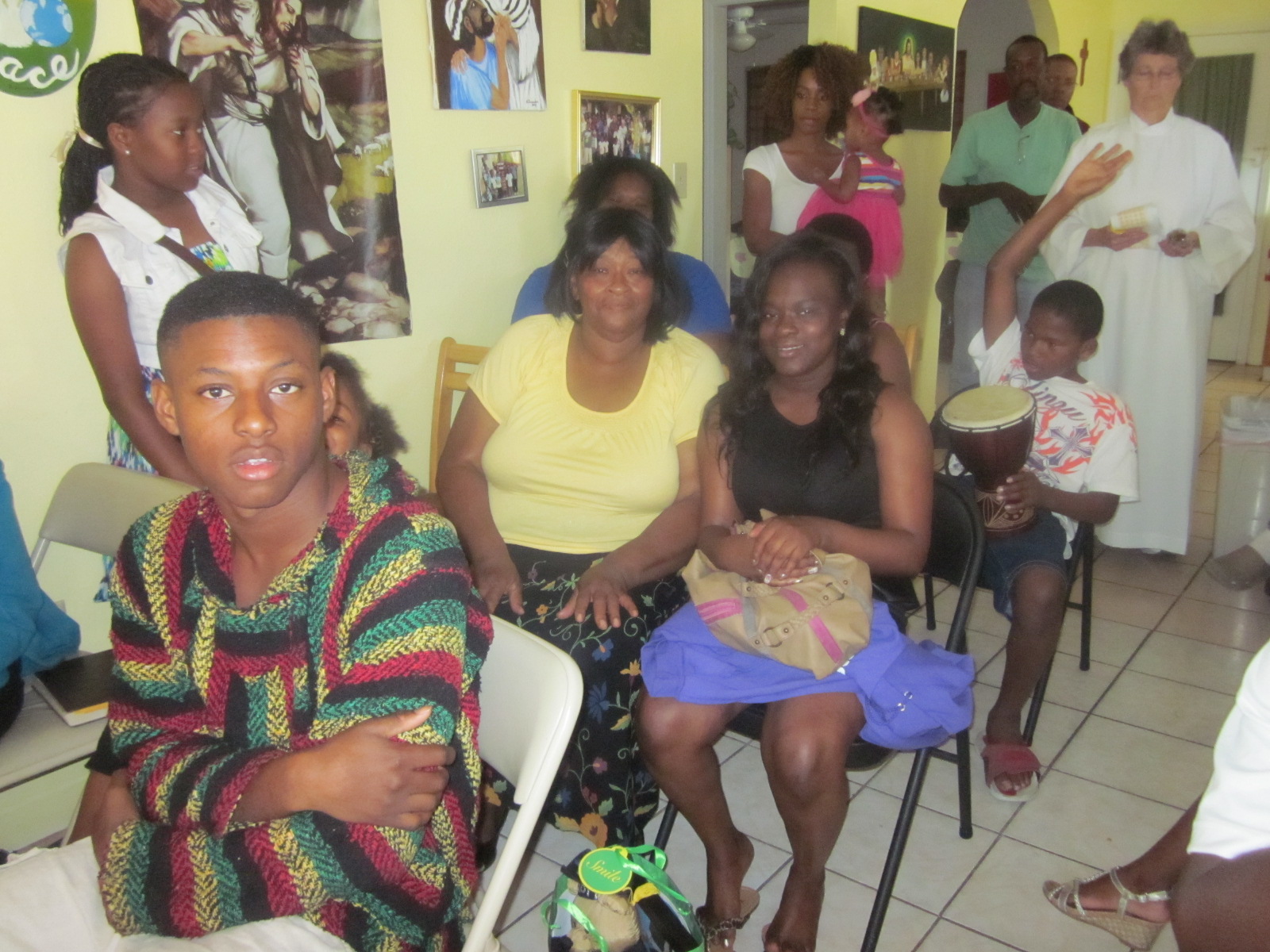
“Come unto me,all you who are weary and burdened ,and I will give you rest” (Matt 11: 28.) Oh, the weariness of those who loved this young man and worked to hold on to him lest he slip away forever. We have had several killings by gunshot to mourn already this year. This time the rest Jesus promised came in the form of a young man starting to turn his life around in our very midst. You could literally hear us breathe out and let the anxiety for his life rest in Jesus’ arms. Our people have many burdens. They work very hard and make barely minimum wage. Many perform exhausting physical labor. They are physically tired and hardly dare to hope that things will get better. They carry a range of illnesses and constant pain. They struggle with just getting by in a land of plenty where other people seem to have everything and they do not know if they can pay both the rent and the electric bill. And yet, they trust and know the rest that Jesus promises here. They know the rest for their souls that comes in relationship with a compassionate and loving God who lifts up the falling and doesn’t add extra burdens to discipleship. They seek to follow Jesus and know the yoke is light because it is Jesus the Christ who works alongside them, carrying the burden, on the other side of the yoke. They, like the rural peasants Jesus spoke with on the mountain and the plain, in the hills and in the streets of the city, are the chosen ones who know that the ‘true religion’ Jesus represents is the law of love, in relationship with the God who is Love and the love of a faith community. At the end of the Mass, Pearl spoke up and asked that we make our last hymn “I’ve got the Joy, Joy,Joy ,Joy down in my heart” because of God’s promises and the return of our young man. And so we did!
Thanks be to God. Amen.
Pastor Judy Lee, ARCWP
CO_Pastor The Good Shepherd Inclusive Catholic Community
Fort Myers, Florida
CELEBRANDO: UNA EUCARISTÍA, UN BAUTISMO Y UN MATRIMONIO EN LA DIMENSIÓN DE LA ECLESIOLOGIA. Olga Lucia Álvarez Benjumea ARCWP*
Celebrating: A Eucharist, A Baptism and a Marriage in the Context of Being Church
Our Sister ARCWP Priest, Rvda.Olga Lucia Alvarez Benjumea presides at a marriage and baptism culminating in an open Eucharistic celebration in an ecumenical gathering of the church in Colombia.
Rvda. Olga Lucia is saying here that the church is inclusive and the Sacraments are open to all. Families and friends of the couple were overjoyed to witness the marriage of Ana and Ramiro and the baptism of Samuel Esteban, the baby. At the end Rvda. Alvarez calls the church a joyful “pluraversity”-beyond being universal the church is made up of a plurality of diverse groups.
We are thankful to share this beautiful occasion via Olga Lucia’s blog-below.
CLICK and go to Olga Lucia’s Blog. You can also hit translate if you want more of a translation but the beautiful pictures are self explanatory and worth a thousand words.
We are thankful to Rvda. Olga Lucia for sharing this with us.
Rev. Dr. Judy Lee, ARCWP


Uy! Que palabra tan rara y extraña a la vista y los oídos de mucha gente; “eclesiología”, eso no se escucha sino en los seminarios y se lee en los tratados de teología. Pero, ¿qué quiere decir? ¿Por qué es importante que la conozcamos?
Dicen, que es una parte de la teología, que nos ayuda a no borrar el desarrollo histórico de la Iglesia. Aclaremos un poco para no enredarnos. Esa palabra salió del griego ekklesia (ἐκκλησία), si la pasamos al latín, tenemos ecclesia. Así ya se nos va pareciendo a una palabra más conocida: IGLESIA! Que quiere decir reunión de gente, asamblea. ¿Quiénes formamos la Iglesia? Todos los bautizados, mujeres y hombres. ¿Dónde nació la Iglesia? ¿No sabes? Te lo voy a contar. En casas de familia. En las casa de Febe, (Romanos 16:1-2), En casa de la pareja Priscila, Aquila;(Hechos 18), Junia, (Romanos 16:7) Lidia, (Romanos 16:14)…
View original post 647 more words
Celebrating Our Good Shepherd Graduates-especially Natasha Terrell
This is our High School Graduate, Natasha Terrell who was graduated from Cypress Lake High School on 5/17/14. Natasha achieved almost a 4 point average in her last year and over a 3 point overall. She is now accepted into Florida Gulf Coast University and will begin there in August of 2014. She is eagerly looking forward to her college studies and hopes to get a BS in Nursing and become a neonatal nurse someday. She says that her hope is for a career where she “can do her part to make things better”. She is an inspiration to her family and peers. Whatever her career choices may be we know that she will do well and give her best to her studies and her profession. Natasha is also working part time as a cashier at McDonalds to help with her expenses. While she will live in the dorm so she has plenty of time to study she will still be able to join us at Good Shepherd on Sundays.
Natasha says that she is thankful to God for her loving family,especially her Mom and Grandma, and for her church and all the supportive people there, like Judy Alves, Dr. Joe Cudjoe, and her Pastors. Her goals for this school year are to do well at college and to “gain a better connection with God.” For her future she prays that she will ” be able to help others, to take care of my family, and that financially and spiritually I will be able to give back”. She hopes for “peace and positivity” in her family and in the world. We join her in these wonderful prayers.
These are some things that she learned this year. She is sharing quotes from UrbanMinistries Inteen Magazine that our Older Teen Class uses: “Asking for help is not a sign of weakness, but rather a mark of wisdom”. “God makes sure we have all the people we need to help us, but it’s our own fault (and loss) if we do not rely on them”. “Focus and be the best you can be”. And, quoting Rev. Will Hall who is explaining Dr. Martin Luther King Jr’s’ book Strength To Love, “Live out love. Give life your best and take advantage of every opportunity that will make you better.Remember that love transforms people. Love is not love if there is no transformation.” Rev. Hall also suggested that teens can show love by smiling, giving sacrificially, saying kind words and assisting others in need. They can also defend someone in need, give hope, share, put pride aside, forgive and give someone a genuine compliment”. Natasha and her classmates at Good Shepherd work at putting love into practice. And here is our genuine compliment for Natasha-“Job well done”!
Natasha, May our loving God be with you in all of your next steps!
With Love and prayers for Natasha, our other graduates and all of our youth,
Rev. Dr. Judy Lee and Rev Judy Beaumont, ARCWP Good Shepherd Pastors
In this Picture she is with her little cousins Gir’riyah, Gir’Niyah and Gir’ Kiyah Battles, five year old triplets who have “graduated” from Kindergarten and will begin First Grade next year.While they did wear red caps and gowns at a ceremony, they said that when they get big like Natasha they will graduate High /school and wear a blue cap and gown! We congratulate the triplets and Natasha’s siblings and cousin, Jakein and Jakeriyah Maybin and Keion Lewis who were “graduated” from Elementary to Middle School. They too are looking forward to that blue cap and gown.

Rev. Judy and Rev. Bev: Peter,Paul and Mary-and James:Homilies for June 29,2014
Here we present two homilies of the feast day of St. Peter and St. Paul. Rev. Beverly Bingle and Rev. Judy Lee, both Roman Catholic Women Priests share their reflections on this day. With somewhat different emphasis they compliment each other in content and present a well-rounded theme for the day: we are church now!
Art Work by Mary Theresa Streck, ARCWP
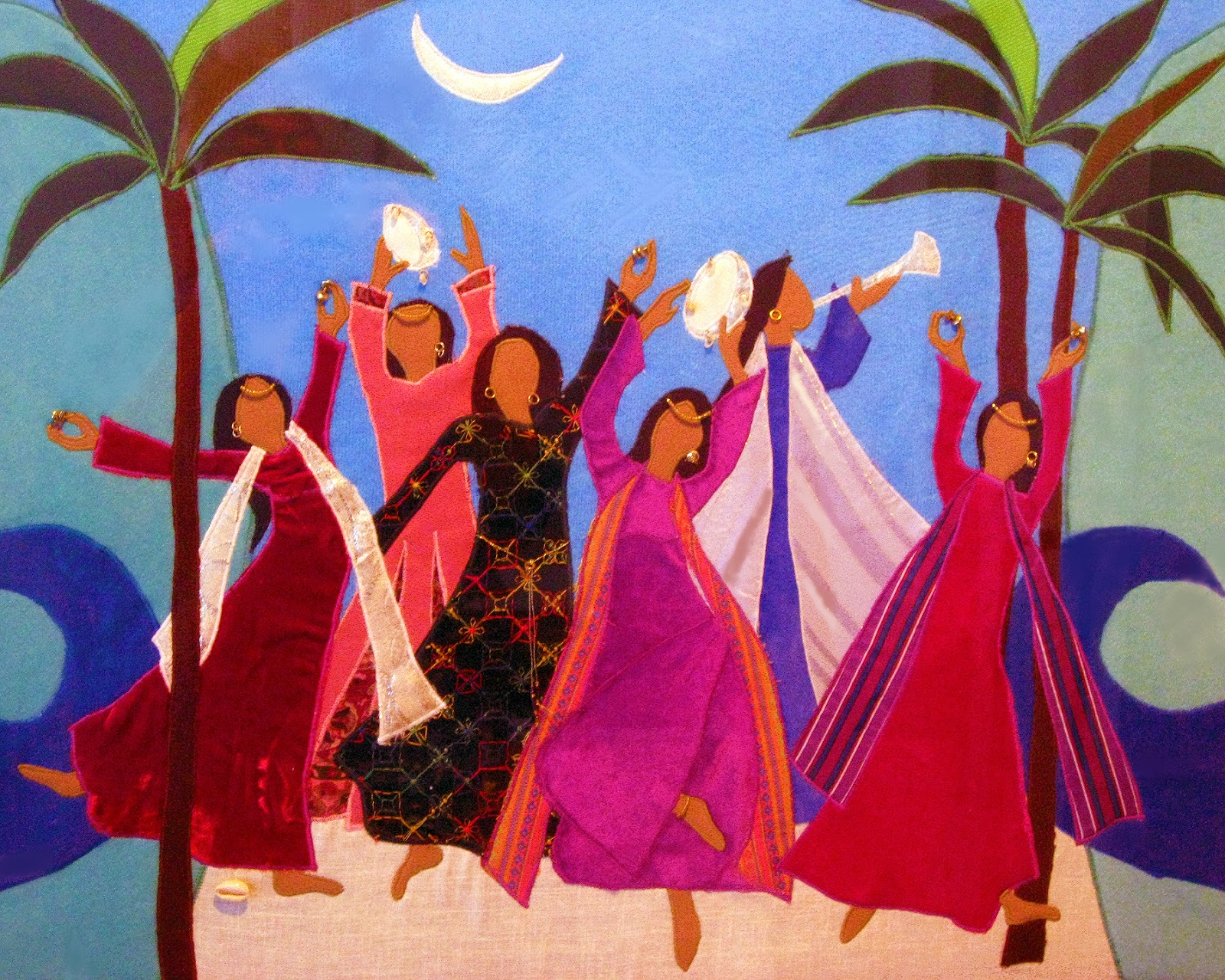
Rev. Judy Lee’s Homily: A Celebration of Peter, Paul and Mary-and James too! Sun June 29,2014
Opening Prayer–Our loving God, today we celebrate the beginnings of the church and the chief Apostles Peter, Paul and Mary of Magdala, James and others under whose leadership the church was solidly planted to grow throughout the centuries. We pray that we may give ourselves wholly to tending and growing the church that they planted, re-freshed and em-powered by Your most Holy Spirit so that the church may be living, vital and new in our time. Grant this through Jesus your Beloved who lives with you and the Holy Spirit, one God forevermore. Amen.
Acts 12:1-11 Peter is imprisoned and rescued as the people pray fervently
Psalm 34 R. O taste and see that God is good!-The poor cried out and God heard
2 Timothy 4:6-8, 17,18 Paul’s life has been poured out and he is finishing the race
ALLELUIA “Mary…Go to my brothers and sisters and tell them ‘I am returning to my Abba and your Abba, to my God and your God….and she told them…” (John20:17-18)ALLELUIA
The Gospel according to Matthew 16: 13-19 “On bedrock like this I will build my community”
A few years back there was a wonderful folk singing group called Peter, Paul and Mary. You may remember them singing “If I had a Hammer, I’d hammer out justice… I’d hammer out the love between my brothers and my sisters all over this world.” The energetic blending and harmony of the male and female voices was their hallmark. Peter and Paul were nothing without Mary. I wish the church knew this! For today again we have a feast day for Peter and Paul and not even a mention of Mary of Magdala who was every bit the leader and authority they were. Partly she is omitted because she is a woman and partly she is omitted because she taught some of Jesus’ less well known teachings that were in conflict, it seems, with the party line, the accepted doctrine of the church after the 4th century and the Council of Nicea. James, the brother of Jesus who headed the church in Jerusalem and was actually thereby senior to Peter is also not mentioned. And without him the Judaic base of Christianity is in danger of minimization and loss. We have to remember that the winners of debates, doctrinal and otherwise, write the final story. Yet, the Spirit still speaks and the story is still being written.
Today the church celebrates the Apostles who planted the seeds that grew into the living church over the centuries. We celebrate Peter, whom Jesus loved and chose for a special role despite his “thickness” and “hard-headedness”. We know that in Aramaic “Kepa” (stone) is an insulting term meaning “stupid”. (George Lamsa, Idioms in the Bible Explained…1985, pp.93-94). Jesus, in his love for Peter, turned the negative nickname into a positive by saying that Peter would be a bedrock in building the church. (We remember that Christ is the living Cornerstone that we build upon). Peter, with all of his faults gave his all, facing jail, persecution and martyrdom for the church. Paul was an equally unlikely choice of leader. He persecuted Christians, but his life was turned around when he encountered Jesus and became the church’s greatest missionary. Paul then poured out his life “like a libation” for the Gospel suffering imprisonment and martyrdom as Peter did.
Like now, there was conflict in the early church. Peter had conflicts with Paul and also with James, the brother of Jesus who headed the church in Jerusalem. James is not mentioned in our readings but we honor him and our Judaic roots this day. Nor is Mary of Magdala mentioned, but Peter and his brother Andrew struggled with Mary’s leadership and teachings while Levi defended her authority according to the Gospel of Mary written early in the second century. Esther De Boer, 2005 and Karen King, 2007 point out that scholars accept Mary as an Apostle to the Apostles and a strong church leader, prophet and teacher in the early church. Once again Christ chose an unusual leader, a woman whose name was all too easily written out of history, one who was completely transformed by Jesus and taken into his confidence. Today we honor her leadership along with that of James, Paul and Peter and all female and male leaders of the early church, especially those whose names have been written out of history while their contributions live on. We honor all women and men and youth whose love has been poured out to build the church and spread the Gospel. This includes all of us, for we now are the living stones that build today’s church. Amen.
Rev. Dr. Judy Lee, ARCWP
Pastor Good Shepherd Inclusive Catholic Community of Fort Myers, Florida
Rev. Beverly Bingle’s Homily:
Today’s readings,
and our celebration of the solemnity of Saints Peter and Paul,
show us the beginning of a long history of missing Jesus’ point.
Who is a disciple?
Who is an apostle, the one sent, the one commissioned?
Who are the Chosen?
Nearly two thousand years of history and politics
have led us to understand Matthew’s Gospel in specific ways,
and those ways are not always what Jesus had in mind.
_____________________________________
The scholars of the Jesus Seminar observe
that the conversation in Matthew that is today’s Gospel
is not a conversation that Jesus would have started.
Instead, they say, it was a common way for the early writers
to communicate a disciple’s “confessional statement”—
an individual’s assertion of belief
that served as a kind of credential of authenticity in the church.
The New Jerome Biblical Commentary—
the standard Catholic reference book—
sees Matthew 17-19 as revelatory
of the varying opinions of the early Christians
as they struggled with questions
about who held authority in the post-Easter church
and who had the commission to leadership.
Matthew’s Gospel gives the authority and commission to Peter.
Our reading today from the Acts of the Apostles
also shows authority for Peter
through the prison break story, the credential that
“God really did send an angel to rescue me,”
Our second reading from the letter to Timothy, however,
shows authority for Paul, when he claims that
“Christ stood by my side and gave me strength.
So that through me the proclamation might be completed
and all the nations might hear the Gospel.”
Using the same type of story,
the Gospel of Thomas gives authority to James,
and Galatians gives authority to Paul.
________________________________________
Two other details in the Gospel passage reflect the power struggle
that was going on among members of the early communities.
Scholars say that the pun on “petra” and rock
asserts Peter’s primary position in Matthew’s community,
not any intention by Jesus to start a church.
Scholars also point out
that the “binding” and “loosing” were rabbinical terms
that refer to the authority to pass on teaching,
not the power to forgive sin.
_____________________________________
History has developed two teachings from this Gospel
that bear closer examination:
the primacy of the Pope
and the power of the confessional.
Both of these teachings ignore other scriptures
that shed different light on what Jesus was really about.
________________________________________
First, the primacy of the Pope:
Jesus was a Jew, and he never stopped being a Jew.
He did not found a church.
The first apostles and the first disciples were also Jewish.
They did not found a church.
The Gospel of Matthew was written for Greek-speaking Jews
who followed the Way of Jesus.
Historical events, political upheavals,
and religious arguments over the centuries
brought about the assertion
that today’s Gospel references to Peter
as the “rock upon which I will build my church”
and “the keys of the kingdom”
mean that Jesus founded a church
with Peter as the first Pope.
But that’s not what Jesus said.
________________________________________
Second, the power to forgive sin in confession.
In Matthew’s Chapter 6, Jesus is wasn’t just talking to the apostles,
not just talking to the disciples.
When he says we are to forgive each other’s sins,
he’s talking to the crowds, to everyone.
In the early Christian community people forgave each other’s sins.
Over time, though, forgiveness developed into a personal
rather than social process,
and eventually the rule was laid down by the hierarchy
that only priests could administer the sacrament.
But that’s not what Jesus said.
________________________________________
Part of what makes Pope Francis so attractive is his pastoral nature
and his willingness to look at things
through the signs of the times.
In April, for example, he told the Pontifical Biblical Institute that
“There is a past and there is a present.
There are the roots of faith:
the memories of the Apostles and the Martyrs;
and there is the ecclesial ‘today,’
the current path of this Church which presides over charity,
the service of unity and universality.
All this must not be taken for granted!”
Francis is realistic.
Our Church today is where it is.
And, good as it is,
good (and bad) as it has been over the centuries,
it needs to sift through the signs of our times
and examine them in light of the bedrock of Jesus’ teachings.
_____________________________________
And what is the bedrock of Jesus’ teaching?
He didn’t say to start a church.
He said to love one another.
He didn’t say to set up rules for forgiveness.
He said to forgive one another.
And Jesus’ teaching tells us the answer
to those questions we started with:
Who is a disciple?
Who is an apostle,
the one sent, commissioned to spread the Good News?
Who are the Chosen?
It’s the crowds.
It’s the anawim, the poor and oppressed.
It’s the people at City Hall and the people at Claver House.
It’s us.
Rev. Dr. Beverly Bingle It’s us-we are church!
—
World Cup of Theologians: Colombia – Consuelo Vélez
Thanks Michael, Our women priests in Colombia are blessed to have Consuelo Velez among them. we hope to meet her when we are able to visit our ARCWP priests there!

The World Cup of Theologians is a blog series that coincides with the 2014 World Cup Tournament. Each team in the round of 16 has an entry with the biography of a noteworthy theologian or leader from that same country.
Consuelo Vélez is professor of Theology at the Pontificia Universidad Xaveriana in Bogota, Colombia. She has earned a PhD in Theology from the Pontifical Catholic University of Rio de Janeiro, Brazil, with post-doctoral studies at Boston College.
She writes about the issues facing women in the Roman Catholic Church and what Pope Francis is doing to bring awareness to this issue. Here is an excerpt from an interview with Biblioteca Amerindia, translated to English by Barefoot Voices.
In [theological] topics, the feminine face of God –so often forgotten — and God’s saving message for men and women concretely and according to their specific reality, are reclaimed. For example, it’s…
View original post 397 more words
Homily And Reflections: Sunday of the Body of Christ June 22,2014
 On this Sunday we remember Jesus’ gift of himself . Jesus gave himself in radical love. This meant long exhausting days surrounded and pursued by people in need of teaching and healing, challenging the shortcomings of established religion, and spending short nights with not enough sleep, body broken, blood poured out for all of humanity in the way he lived his life and in his death. Compassion for the poor and outcast especially moved him. He was on fire for them and against injustice. He asked the same of those who would follow him (Matthew 25). He gave it all so we could know and feel to the core of our very beings the meaning of “love one another”. Indeed on this special Sunday we are filled with thanksgiving and love for Jesus the Christ who gave it all.
In the Eucharist, the feast of thanksgiving and Holy Communion, we partake of the Body of Christ in all of its forms. We believe in the mystery of Christ- on the Table in the bread and wine, at the Table and all around the Table. Our readings of the day say that God nourished God’s people in the wilderness by providing a special substance called manna (Deuteronomy 8). God feeds God’s people on the finest wheat (Psalm 47). The Epistle reading says: “The bread that we break, is it not a participation in the body of Christ? Because the loaf of bread is one, we , though many, are one body, for we all partake of the one loaf” (I Cor. 10-16-170.) We are nourished by his real presence in the bread and wine and in the people of God. The Sacrament is on the altar, yes, but in every one of us as we are the Body of Christ-we are the Sacrament of Christ’s love in the world. Most especially as we serve the poor and broken we know exhaustion and challenge as Jesus did, and we also see the face of Christ everywhere, being served and serving with us. We know a little of what it meant to be bread for the world as Jesus was (John 6:51-58). We know how this Bread gives us life now and forever and how we can leave no one behind as we share this life giving Bread.
Some of these thoughts are from my book Come By Here: Church with the Poor, AmericaStarBooks.com,2010,now available in Spanish as well. The reason I include this citation is that the stories of the lives of those served and serving with us as we ministered to the homeless and poor outside in the streets and inside in our church house illuminate the essence of the body of Christ broken, yet whole.
Here is the Corpus Christi reflection of another street minister, Rev. James Patrick Hall an Episcopal priest serving the homeless in Tulsa, Oklahoma:
” Today is the Feast of Corpus Christi, and I would dearly love to join a Procession in the streets, attend a High Mass, with clouds of incense and deep throated choirs intoning “Humbly I adore thee, Verity unseen”….but…
Today is also the day we have our Church on the street here in Tulsa, Thursday Night Light, and as much as I love the ancient worship of our Church, I love being with my street Church even more.
So, as I thought about this, I realized there will be no conflict; Christ is most truly Present in the people gathered tonight. I will see as Colossians 1:27 says, a great mystery; Christ Present in His people gathered.
In this great Communion of the Street, I can bow before Christ and confess Ave Verum Corpus Christi (Hail True Body of Christ) !
Colossians 1:27 To them God chose to make known how great among the Gentiles are the riches of the glory of this mystery, which is Christ in you, the hope of glory.
‘Humbly I adore Thee, Verity unseen,
Who Thy glory hiddest ’neath these shadows mean;
Lo, to Thee surrendered, my whole heart is bowed…'”
Precious Body, Precious Blood, Precious Jesus, we, your people love you and remember. Grant us the strength to follow you and to be nourished by your love as we bring the Bread of Life to the world. Amen
Pastor Judy Lee, ARCWP
Good Shepherd Inclusive Catholic Community
Fort Myers, Florida
Request For Prayers For Iraq from the LCWR-Let Us Join in Prayer on Thurs 6/19 at 6PM
LET US ALL JOIN IN PRAYER WITH THEM
LCWR Joins Iraqi Sisters in a Call for Prayer
FOR IMMEDIATE RELEASE
[Silver Spring, MD] Facing imminent danger, the leader of the Dominican Sisters of St. Catherine of Sienna in Mosul, Iraq has called her sisters throughout Iraq to a time of intense prayer and retreat to beg God for the protection of the Iraqi people, especially the minority Christian community.
The Iraqi Christian community has steadily declined from approximately 1.3 million in 2003 to less than 300,000 today. Recent statements from Christian leaders have indicated that it is unlikely there are any Christians remaining in Mosul today.
The Leadership Conference of Women Religious (LCWR) in the United States calls upon people of all denominations in the world community to join the Iraqi Sisters in a moment of prayer on Thursday, June 19 at 6 PM (in your time zone) to pray for an end to the violence and the protection of minority Christians in Iraq.
“We are living in extreme times. Christianity has been present in Iraq from biblical times, but at this point Christians are in grave danger and being forced out of this land or face martyrdom. The Dominican Sisters remain committed to accompanying their people regardless of the consequences,” said LCWR president Sister Carol Zinn, SSJ.
The Iraqi Christian Sisters are all Iraqi nationals and ministers in healthcare, social services, and education. In fact, the Iraqi Dominican sisters started the first Montessori school in the country. The Sisters serve all people, Christians and Muslims, in their ministry.
As the Dominican Sisters of St. Catherine continue their days of intense prayer, they ask that people throughout the world join them on June 19, believing that this intensification of global prayer can make a difference.
“We believe that prayer has the power to change the course of events in Iraq,” Sister Carol noted. “We stand with our sisters and brothers who courageously remain with the people they serve and will join with them in prayer for as long and as often as it takes until the violence ceases.”
About LCWR: The Leadership Conference of Women Religious (LCWR) is an association of the leaders of congregations of Catholic women religious in the United States. The conference has more than 1400 members, who represent more than 80 percent of the approximately 51,600 women religious in the United States. Founded in 1956, the conference assists its members to collaboratively carry out their service of leadership to further the mission of the Gospel in today’s world.
Contact:
Sister Annmarie Sanders, IHM — LCWR Director of Communications
asanders@lcwr.org
301-588-4955 (office)
301-672-3043 (cell)
###
 judyablfollowingSheWhoIs
Recent Comments