Home

  • Rev. Judy Agreeing With Huckabee’s “The Trouble with Being The Voice For The Voiceless”

    This is a very good article by Tyler Huckabee relevantmagazine.com  that is well worth pondering. I have been struggling with these ideas for several years and from several perspectives. Several years ago (1994 and 2001) I wrote a book about the personal, interpersonal , communal and political empowerment of people and groups within a social work perspective (The Empowerment Approach to Social Work Practice: Building the Beloved Community, Columbia University Press. ) Actually it was broader than “social work” as the re-visioned Second Edition (2001) included the spiritual perspective and the direction of building the beloved community-a concept Martin Luther King, Jr. made popular but borrowed essentially from the Gospel. The beloved community is ultimately the reign of God,which we long for and work for. When I began street ministry with the poor and homeless in 2007 and was ordained a Roman Catholic Woman Priest in 2008, I continued struggling with ideas of empowerment, of people having the power on every level including being empowered by God’s Spirit to speak and moreover to act for themselves. Although we provided a meal for people in the local park weekly, what we were trying to develop was the power, including the resources needed, for people to feed themselves AND one another on every level of being. We were concerned that many religious and caring people give food and alms to the poor but few take the longer and harder road of helping people to get out of poverty and do this for themselves and others. After interviewing over 125 homeless and poor people about their views on life, on God and on the church and how it could help them, and getting to know people week after week, it was clear that they wanted us to stand by them and assist when necessary as they got the material and spiritual resources to empower themselves and one another. In the words of one person “stand by us, and help us and when we can’t go any farther,then you can go for us”. My book Come By Here: Church With the Poor, written in 2010 and published in Spanish this year as Ven Aqui: Iglesia de los Pobres (AmericaStarbooks)is a story of these very spiritual and struggling  people and their empowerment. I am happy to share this article as it reminds us well not to primarily do for but to do with. I thank Rev. Deniray Doulos for sharing this with members of Ecclesia Street Ministries.

    Rev. Dr.Judy Lee

    The Trouble With ‘Being a Voice for the Voiceless’

    Speaking out for injustice is a good thing, but how can you speak for the oppressed before you listen to them?

    By Tyler Huckabee

    October 3, 2014

    Tyler is something else. He’s a writer who loves blue jeans, camping, hamburgers and rock and roll. He’s also the managing editor at RELEVANT. You can read all about his fascinating life over at The Unbearable Lightness of Huckabeing, or read every dumb thought that comes into his brain onTwitter.

    For many teenagers raised in the church, going overseas is sort of a rite of passage—a “Global Perspective” you achieve like a challenge in a video game.

    For me, that challenge was in Japan. I made a few friends over there, but none closer than a boy about my age named Ken, who was positively giddy about the idea of freedom. He said the word “freedom” like a magic spell, and told me of the ways he felt trapped in his own native country.

    “When I go back,” I told him when we said our goodbyes, “I’ll tell people your story.”

    “Or,” he said, “I could come to America and tell my own story.”

    They Already Have a Voice

    I was too young then to grasp the importance of what Ken had told me, but recent events have brought it to my mind again. As hashtag activism has gone from an Internet oddity to a full-on force for change, we have become enamored with what what we either call “being a voice for the voiceless” or “giving a voice to the voiceless.”

    And this has often been helpful. Be it war in Africa, slavery in India, terrorism in the Middle East or even discrimination in the United States, Twitter users have made waves by empathizing with the oppressed and suffering. When news of an atrocity breaks the news, we rush to our social media platforms to sound the gong of injustice, and set our hashtags from stun to kill.

    There’s a difference between being a voice for the voiceless and giving a voice to the voiceless. They are not interchangeable. And one is far more compassionate.

    The sort of righteous anger we feel when we hear about injustices is a good thing. Bringing these issues to the world’s attention is often the first step in the right direction. There are people out there who are hurting. They need help. They need to be rescued.

    But, in reality, they don’t need a voice. Not most of them. They have a voice. What they need is for more people to really listen. They need people to carry their cries further than they can.

    There’s a difference between being a voice for the voiceless and giving a voice to the voiceless. They are not interchangeable. And one is far more compassionate.

    Being a Voice for the Voiceless

    Sharing our opinion on an issue isn’t necessarily a bad thing, but sometimes, when we are trying to be a voice for those who are suffering, we end up speaking over them, shouting our own view without first really stopping to listen to their experiences.

    Think to the NFL’s Ray Rice debacle, a mess if there ever was one. I, like any right-thinking person, was appalled at what certainly appears to be, at best, horrid mismanagement and, at worst, gross deceit and a calloused attitude towards domestic violence.

    Social media was taking aim at the NFL, so I was all too eager to join in and cry foul. But a funny thing happened when I signed on to Twitter.

    I started seeing stories of women who had come from abusive relationships. Women explaining #whyIstayed, and sharing their heartbreak, their pain and—for many of them—their newfound freedom.

    I realized that my voice was not necessary in this particular story. People were already telling their stories, and their stories came from a place of honesty and vulnerability and had the ability to create true impact. They were the real story.

    What I needed to do was listen, learn and amplify their stories instead of my own.

    When Your Voice Isn’t Needed

    When our hearts are sensitive to pain and injustice, we have a tendency to charge in. It’s easy to assume we’ve got the basic layout of the problem. Whether it’s sex trafficking or racism, it’s easy to assume we understand what the victims are going through.

    Instead of presumptuously firing our voice off into the Internet’s ether, desperately seeking to be seen as a champion for justice, take a moment to listen.

    That zeal is good, but it often takes the place of real listening. Instead of presumptuously firing our voice off into the Internet’s ether, desperately seeking to be seen as a champion for justice, take a moment to listen. Offer your ear instead of your voice. For a moment, be a student instead of a cheerleader.

    As Proverbs 18:13 tells us, “If one gives an answer before he hears, it is his folly and shame.”

    That’s not to say you shouldn’t ever speak out: Your voice is important. But it is not always the voice that is needed.

    The Least of These

    Jesus’ parable about giving the seat of honor away at the table is an interesting one. It’s often interpreted as being about humility, and it is, but humility is a tricky thing. It doesn’t always look like you think it will.

    Sometimes, it means putting your best intentions aside so that others can take the spotlight.

    Sometimes that means investing your energies in giving a platform to the marginalized instead of taking the platform yourself.

    Sometimes that just means learning more before you start speaking out.

    Eventually, Ken came to America and he did get to tell his story—and he told it better than I ever could have.

    http://www.relevantmagazine.com/reject-apathy/stop-being-voice-voiceless

    IMG_0082IMG_0026IMG_0012

    _______________________________________________

  • Loving Brother Cat: Our St. Francis Animal Rescue Ministry

    Prayer for Animals

    This beautiful poem by Benedictine Sister and prolific author Joan Chittister lifts up the place of animals in our lives and the wonderful spiritual,personal and social meanings they have for us. As she says, their faithful presence and love without reason teach us about the very love of God. And yet so often these gentle creatures are cast aside, forgotten and abandoned. We can help them directly by inviting them into our lives,making room in our homes for them, or learning how to feed feral cats (see AlleyCat.org on this). We can help indirectly by contributing to rescue organizations like the ASPCA, The Humane Society, Alley Cat, and local no-kill shelters and rescue efforts. And we can teach our children to love and care for animals in gentle and responsible ways.

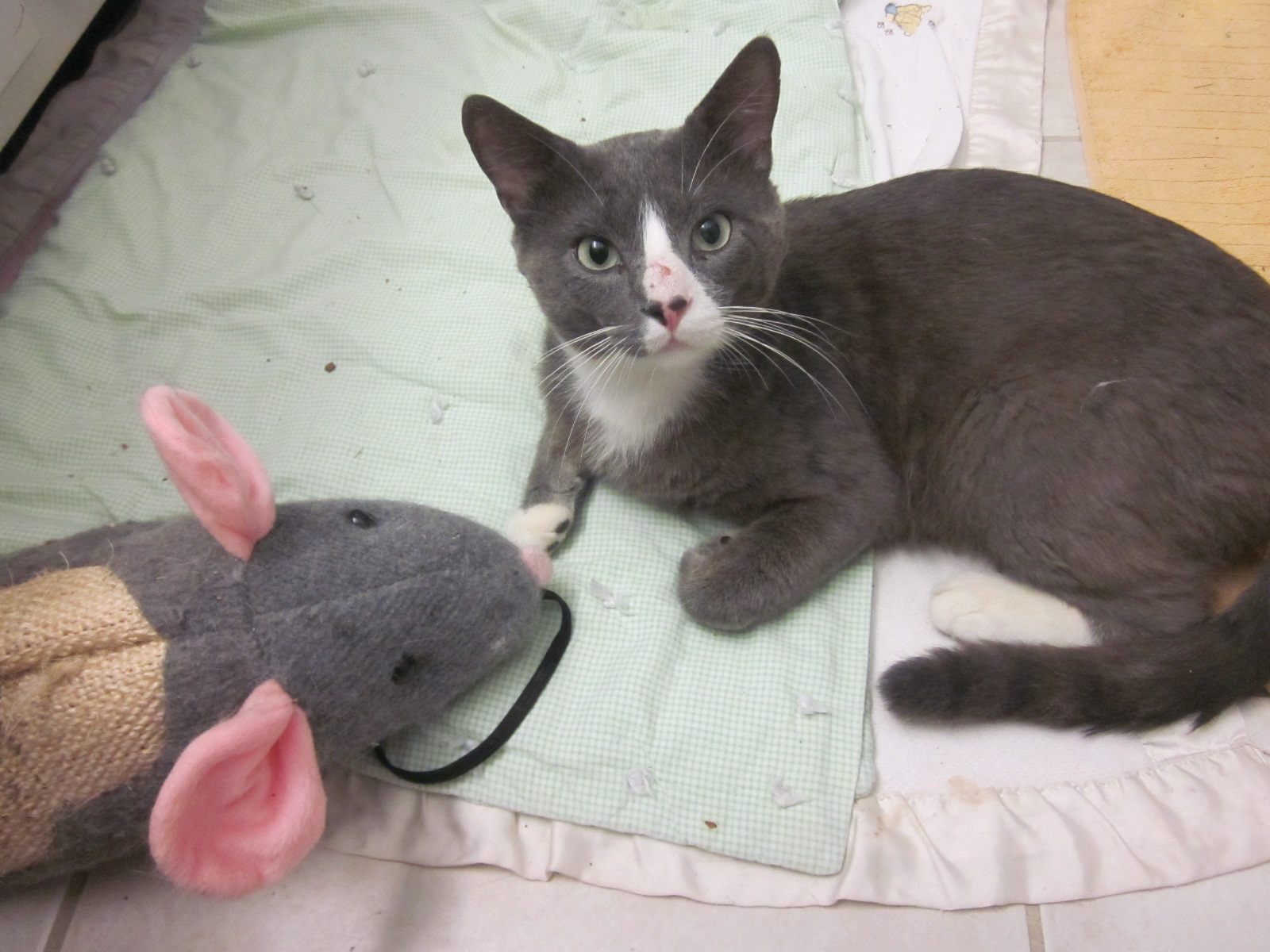
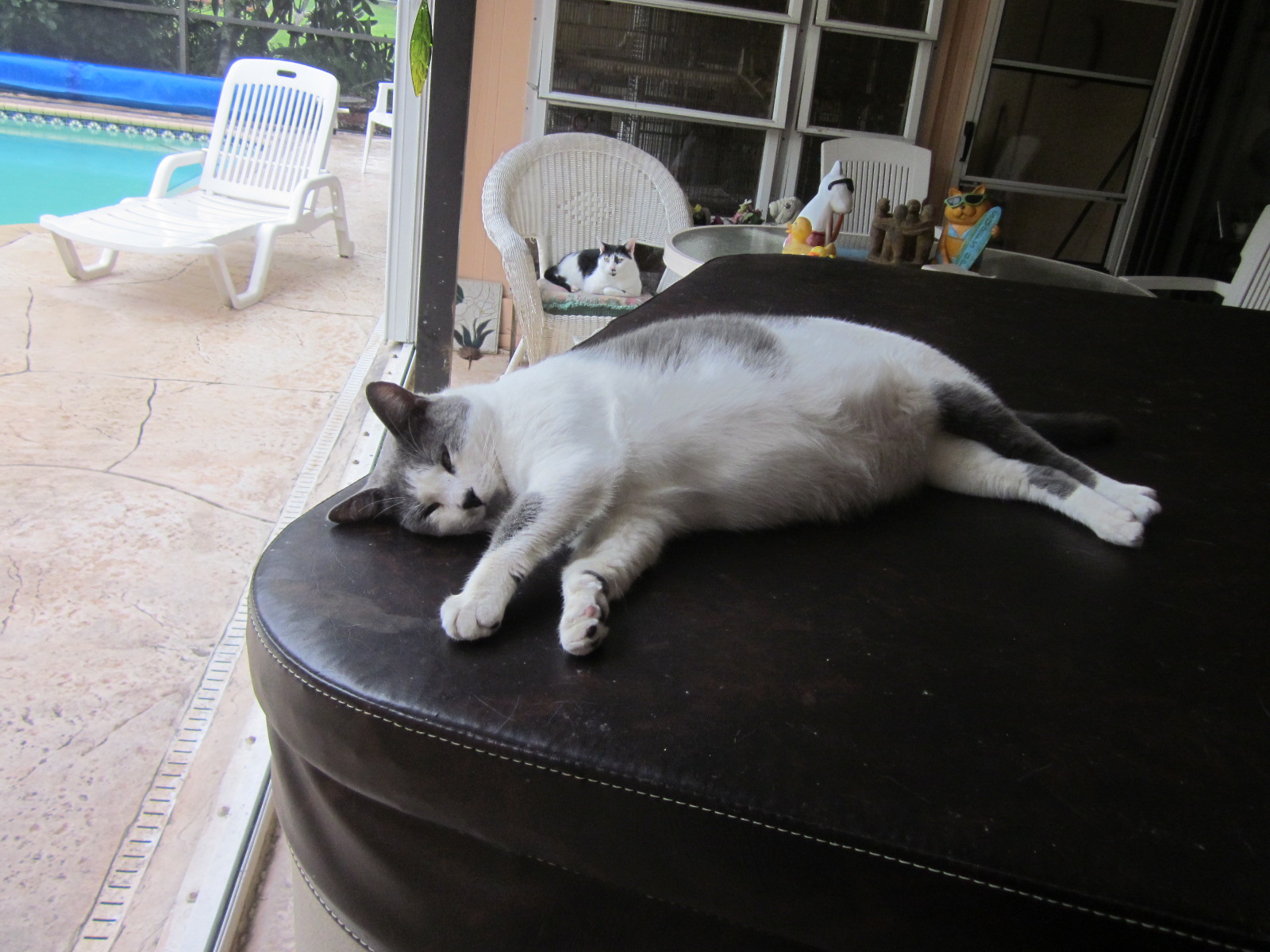
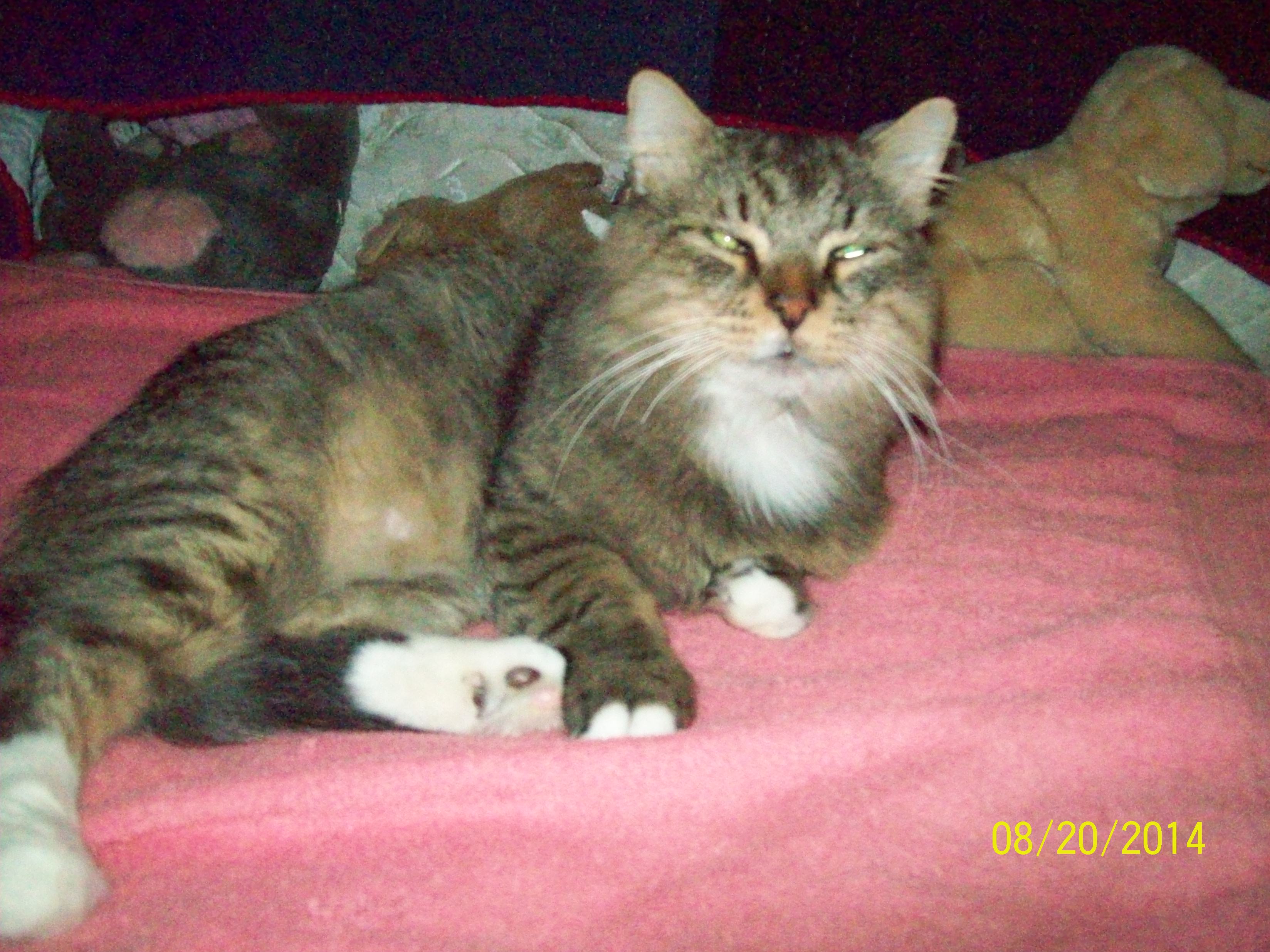
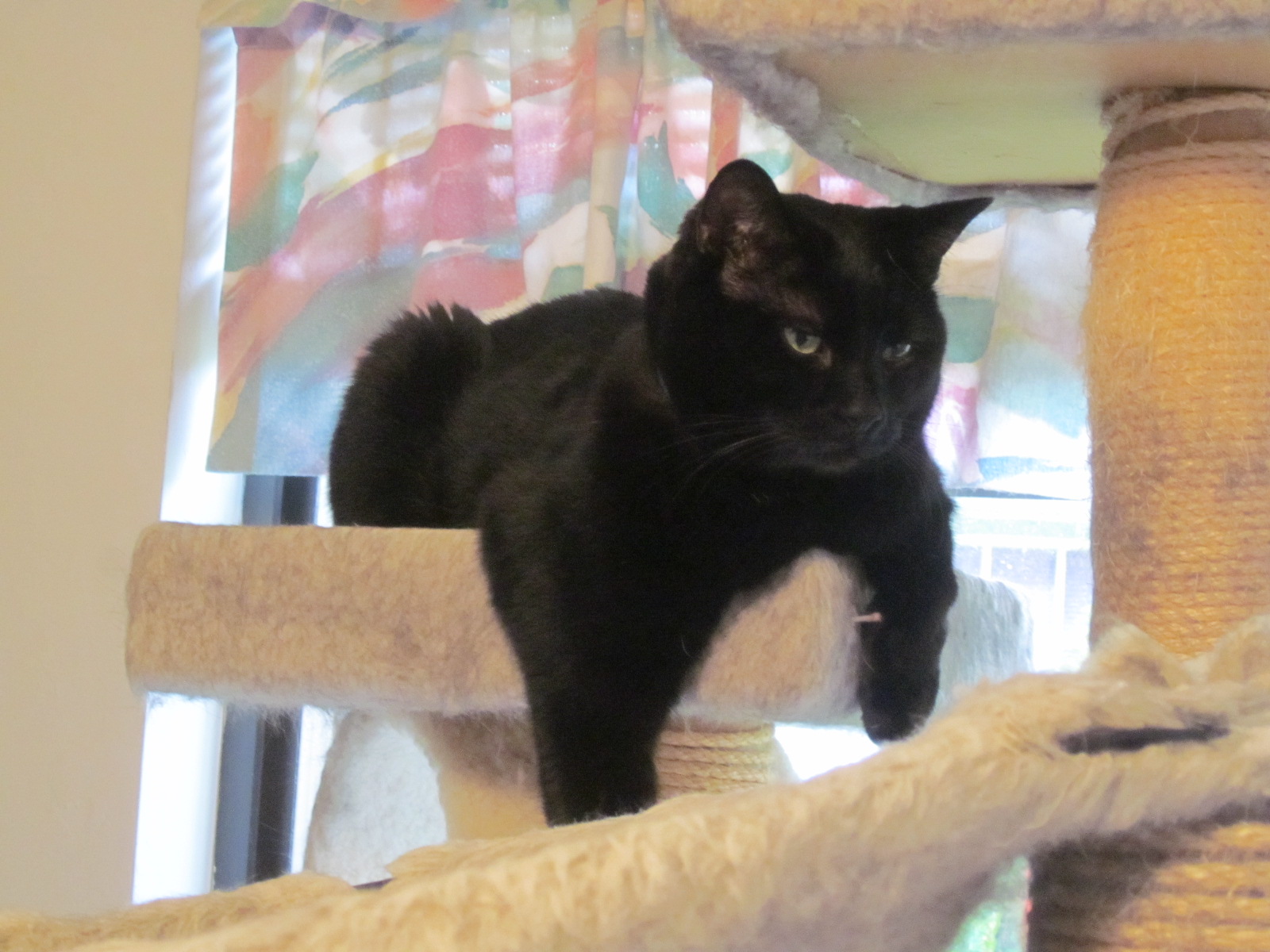
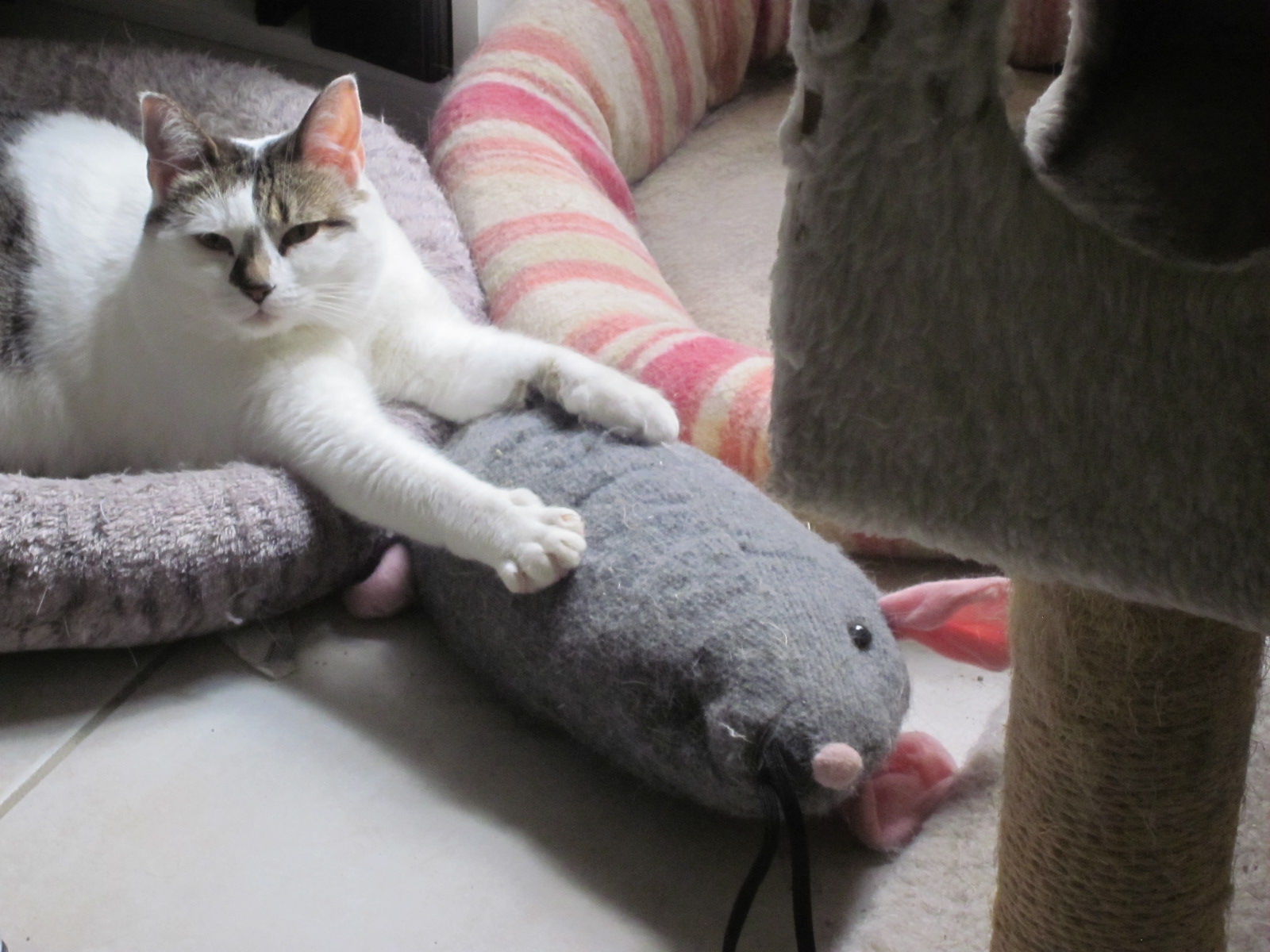
    This Saturday October 4th is ST. Francis’ Feast Day. St. Francis was attuned to all of God’s creation and he called all animals as well as all natural things “Brother and Sister”. Our Good Shepherd Ministry attends to our homeless brother and sister human beings. We count on God’s help to make sure that they are fed and housed. We are happy to share their stories in this blog. But the throwaway animals in our area are also of great concern to God and to us. So, we also work hard at feeding and finding homes for them. We call this our St.Francis Ministry and we have reported in this blog on finding homes for homeless animals and assisting homeless and poor people to be housed with their pets. It is remarkable to note that like people who must live outside, domestic animals who live outside also struggle with illnesses and violence of all sorts. This particular blog is focused on our work with cats, but we have also rescued distressed dogs,birds and turtles and one ferret who belonged to a homeless woman who could no longer keep him. I thought that I would never find a home for him, but I was wrong. This was the easiest one as one of our Vet’s Technicians knew a wealthy woman who had lost her ferret to illness. Very quickly this little guy went from eating popcorn and living on a heap of debris to a delighted owner giving the best food and a four hundred dollar condo was also purchased for him.  I will resist a comment on that except to say he was one fortunate ferret.

    This is our Veterinarian Dr. Terry Sutton and her current Vet Tech Joseph at Three Oaks Animal Hospital here in the Three Oaks Parkway area. I have written about them earlier in this blog as Joseph adopted Tiger, one of our older rescues who desperately wanted a home and someone to love him. Joseph and his wife live in the country and have turned a special barn into a home for 5-6 cats, replete with climbing posts and cat trees and individual spaces and beds. Tiger loves it there.

    Dr. Terry is our angel. She has assisted medically and supportively in almost all of the more than 30 cat rescues we have done.  Her wisdom, caring and generosity of spirit make our work possible. From spaying and neutering to preventive tests and shots and follow up care, she is there for us. Recently one of our cats,Brooklyn, had a bad kidney infection and needed a shot but the car was not available to take him there. She came and gave him the shot and also visited with our newest rescue and family member,Velcro, and an old patient Skye who met her at the door. Velcro is a lively happy older kitten who makes us laugh all the time. He also tested positive for Feline AIDS. But like our others with this, he is fine in the open population because he is not a fighter who will deeply wound and infect another. Skye is the most trusting and loving being who has forgiven much in his life. When he came to us his tail had been mangled (pulled, caught,worse?) and the necrotic tissue was creeping up toward his spine and  had to be removed. Whatever had done him this harm also paralyzed his intestines so that he needs medicine and sometimes assistance from Dr. Terry to evacuate his bowels and sometimes his urine. Due to the medicine he is holding his own now, but his condition is difficult. Yet he is the friendly ambassador greeting all who come to our home.

    In the picture below, Dr Terry is holding Lola, a cat that was rescued by Lili Randazzo four years ago and subsidized by our mission. When Lily moved into her Habitat for Humanity Home Lola got out and “disappeared” for over a month. so did another of Lily’s rescues, Timmy. Timmy had gone back to her former apartment and had to be rescued again from the woods near there. Lola returned on her own in a weakened state, but she is well now.

    IMG_0019

    These are two of our most recent “rescues”-Potsy(Peter Potter) and Velvet Velcro named because he has soft as velvet fur and sticks to us /Velly. Potsy was so scared when he came in that he had to be carried out of the bathroom where he stayed for a long while initially in a carrier to get some air and sunshine. Both are great cats who also have Feline AIDS but relate very well to our other kittys.
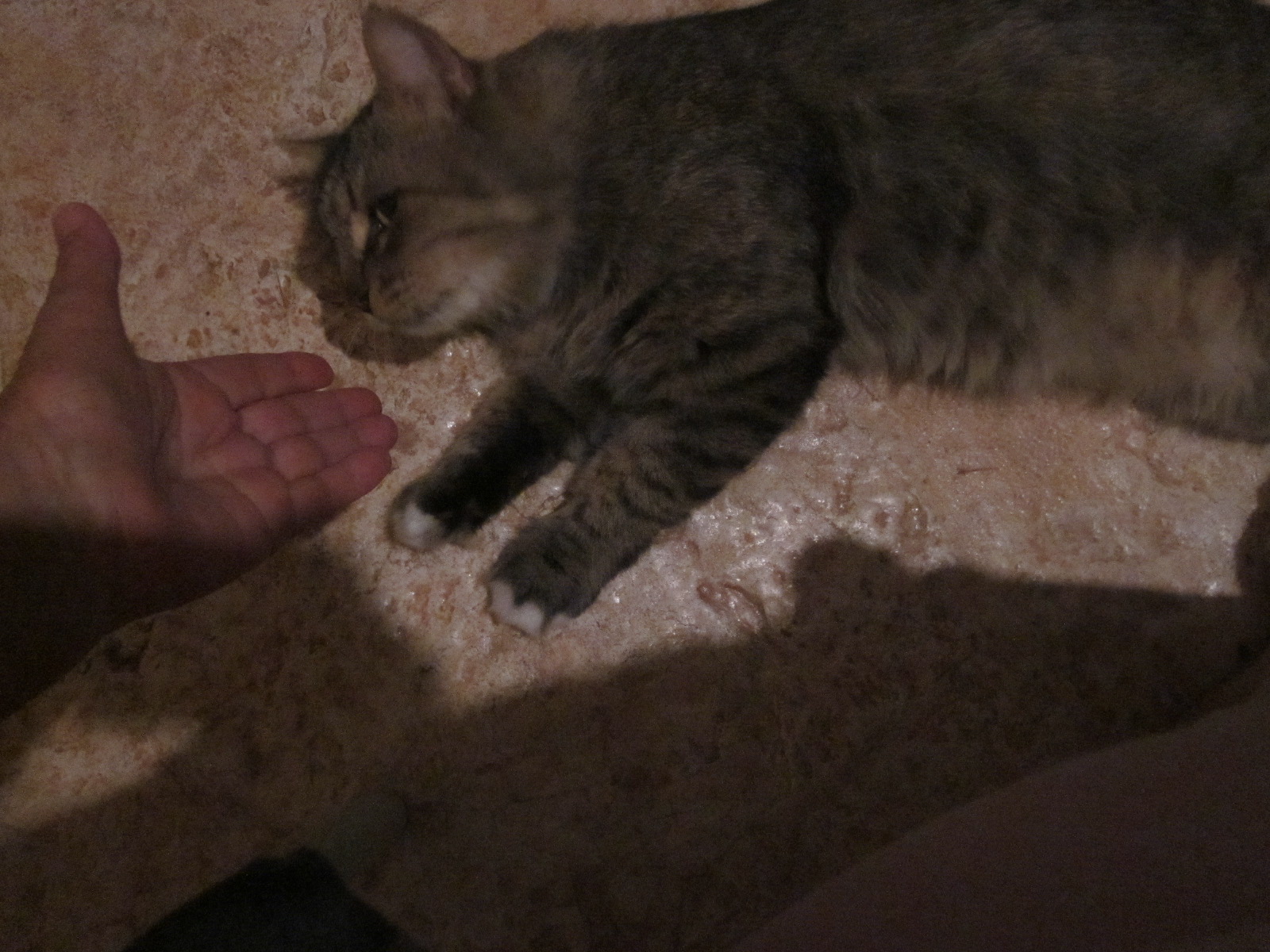
    IMG_0114IMG_0020100_4197This is Socks, a beautiful and gentle Maine Coon cat who was the most frightened of all yet came every day twice a day to eat for over six months before I could get near him. He was the only one I had to catch in a humane trap. The others could eventually be picked up and put into a carrier for their first visit to Dr. Terry. Once inside he hid under a shelf in a back garage room for almost four months. Every day three times a day I would visit and talk to the shelf. Eventually he sat on top of a wardrobe and let me  touch him  just once. He responded to my kneeling on the floor near his shelf and reaching out. That picture is below. Then one day, he walked out of that room, came up to me ,rubbed my legs and has never left my side since. He is the most affectionate cat we have now. It took a long while to build that trust and a lot of patience, But it paid off. Indeed, that was the same method used when reaching out to very frightened mentally ill homeless people when we do our street ministry. In my book The Flamekeeper and other Poems America Star Books) I wrote a poem about standing on the outside looking in, and how similar it is with people and animals who have been hurt and frightened. Ultimately, it is easier with animals for when they trust, they seem to let go of the past and live in the warmth of a better now.

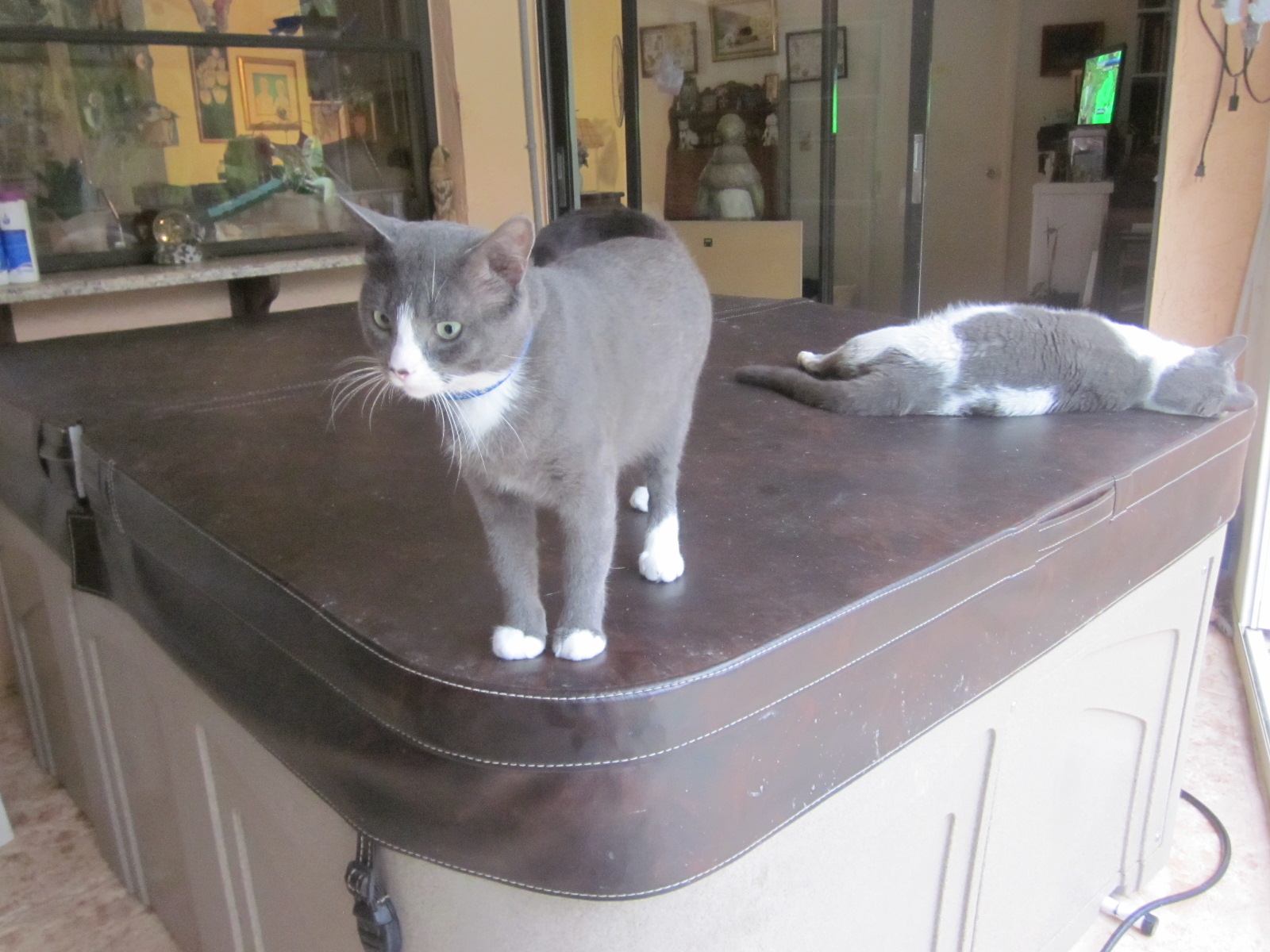
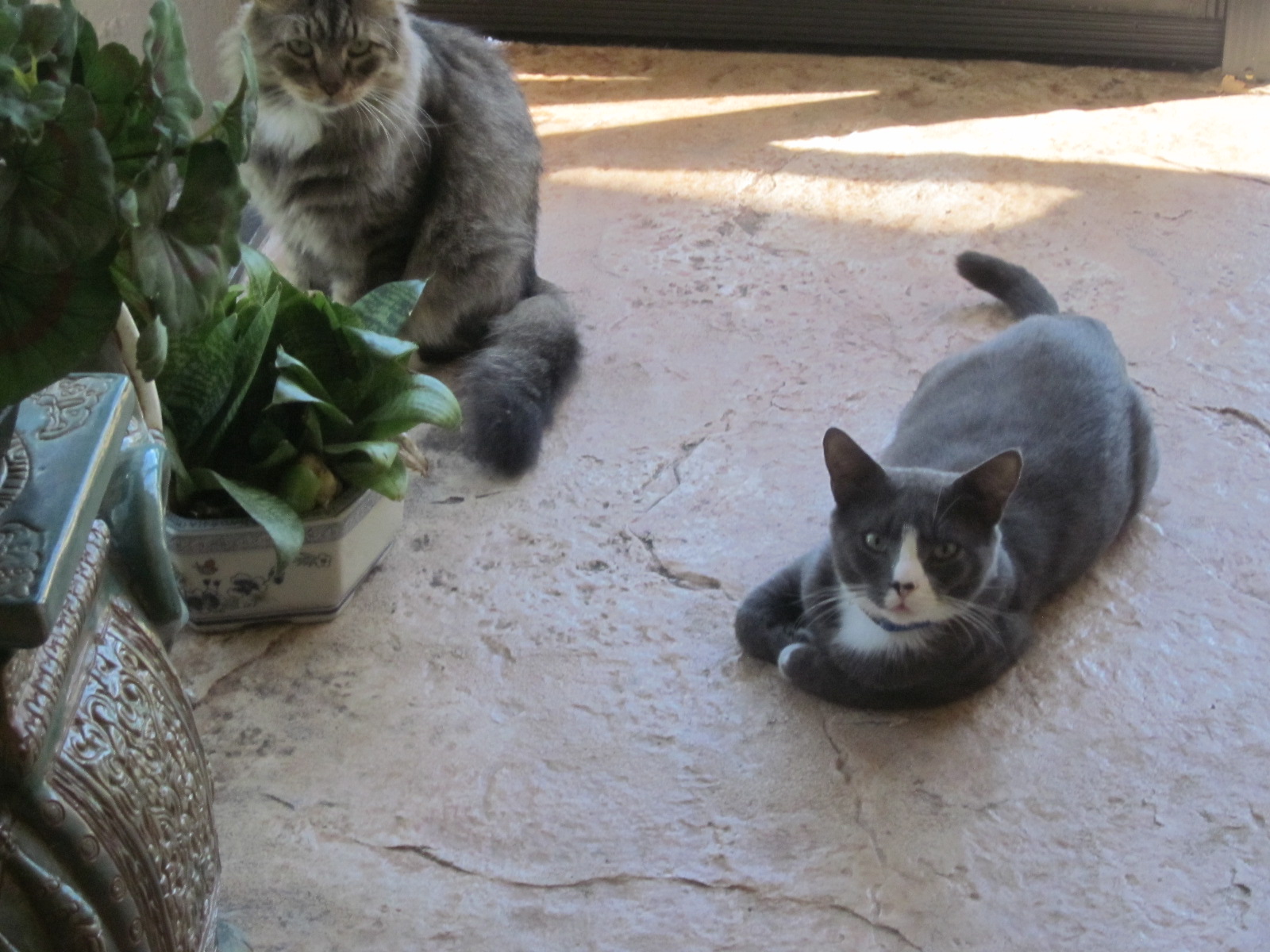
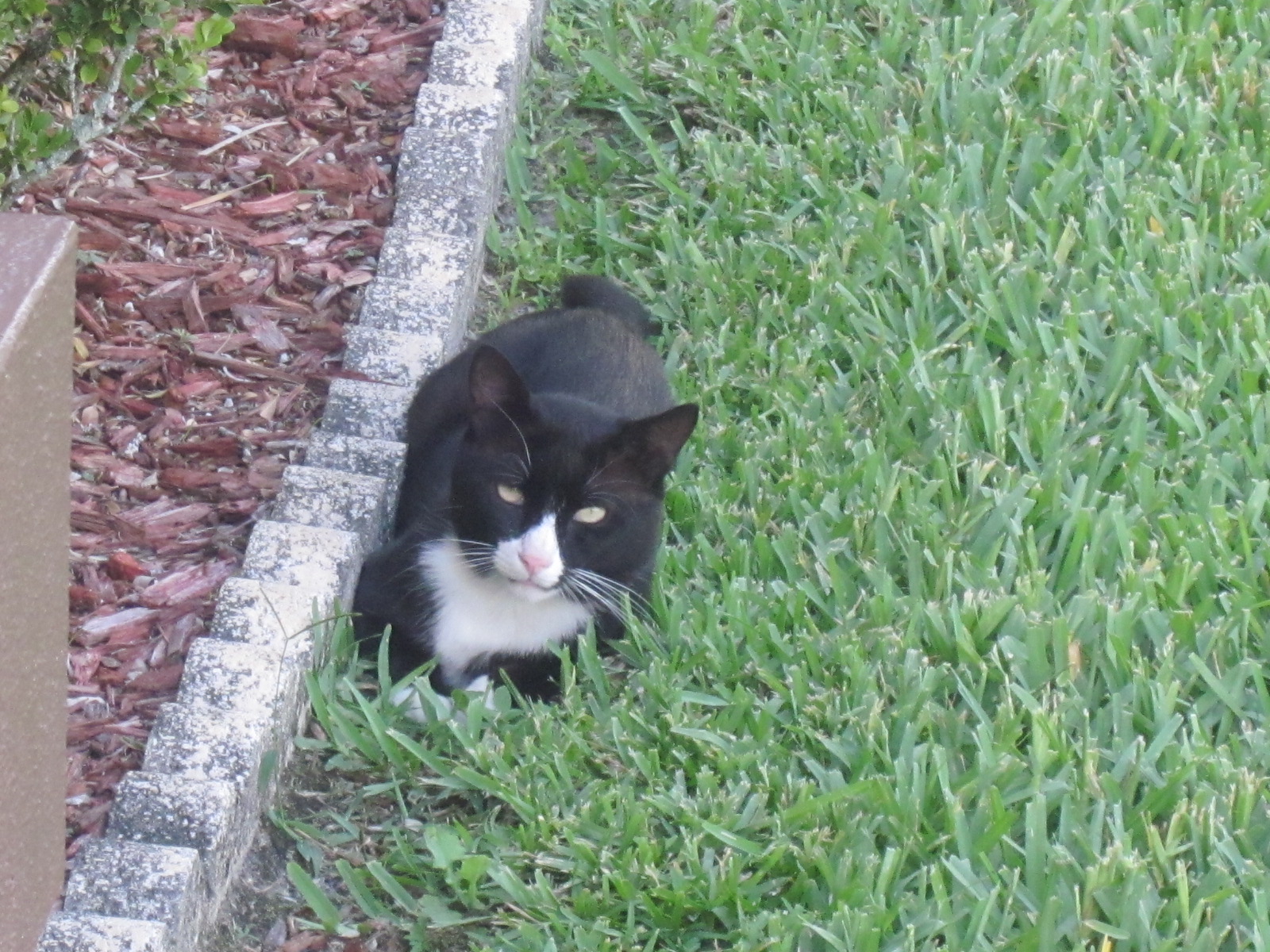
    Below are the group on the front lanai, Velcro, and Star who is a perfect loving little cat who joined us in 2009, even charming Angel, our big dog who did not like cats! Socks and Velly, who are now close friends and Henry, one of our older kittys who came to us in 2003 with his brother Timid Tim who did not show up for a photo. Then there is, Lady Guinevere and her kittens(now 5 years old) who were given to me by a homeless couple who lived in the woods and could not care for them. When I entered the woods to get them, Lady Guinevere purred and walked into the carrier with five kittens following her. It was the easiest rescue ever! They had been loved in the woods but Lady G knew a better home was waiting. It turned out that Lady G had Feline AIDS as did three of her kittens. The other two little beauties were soon placed in homes, but Lady and these three,Winter, Elana and Sir Gallahad, along with  Brother Maurus,their brother who came to us two years before are still with us. They remain together as a family on one side of our house. The pretty black and white, Sammy sitting in the grass is the next to be rescued and I am hoping that I have a home for him. We are hoping for a home for him and for two more of the brothers who come to eat morning and night. Sammy may be able to find a loving home with Diane, who was homeless and is enjoying her new home and wanting a kitty. Sammy is Velly’s brother and Velly greets him through the screen each day. He seems to be saying-trust, brother, it is good to be inside and have a home!

    And so it goes, thank you St. Francis for teaching us to love all of our little brothers and sisters.

    IMG_0027IMG_0030IMG_0033IMG_0023IMG_0061IMG_0017 IMG_0021  IMG_0051IMG_0023 IMG_0004 100_4197 100_4195 100_4200 100_4176 100_4184 100_4185 IMG_0019IMG_0013

    Skye (the last here) and all the others are saying: thanks to all the people who care enough to give us a chance. They will surely find love with us!

    Happy St. Francis Day,

    Rev. Dr. Judy Lee

  • Still In the Vineyard: God’s Cherished Plant or Wild Grapes? Rev. Judy’s Homily 27 Sun OT

    IMG_0015

    Work in the Vineyard-God’s Cherished Plant or Wild Grapes? Rev. Judy’s Homily for OT 27 10/5/14

    For the last three Sundays we have contemplated life and work in the vineyard with Jesus. God is good, deeply loving and giving to all of us, expecting only that we will tend the garden, work in the vineyard and produce the good fruits of service, compassion and justice.  According to the writer of Matthew Jesus teaches about working in the vineyard right before and after his Palm Sunday entrance into Jerusalem. His time is near and he knows it and foretells it, much the same as Moses, and prophets like Martin Luther King Jr. said that they would not be crossing over into the promised land with the people for whom they labored so hard.

    In Matthew 20, we saw that God loved and rewarded all of the workers in the vineyard generously and equally. And we saw that some of the earlier workers resented the success and rewards of the later workers and they resented the generosity of God.   The newcomers were not welcome as equals in the vineyard. Bitter fruit for God, not the yield God wanted. Then, placed after Jesus’ triumphant entry into Jerusalem on the back of the foal of a donkey, in a second parable as told by Matthew (21), we saw that the son who said that he would work in the vineyard was all talk. He never went while the one who mouthed off saying he would not go, did go and worked at producing good fruit. Jesus notes that reviled tax collectors and prostitutes were entering the reign of God before the religious (those who said they would build the reign of justice but did not). Well, it pleases God to include the outcasts who came to do the work and at least one of the disappointing sons was working in the vineyard. Once again God is including everyone in the kingdom (kin-dom) and noting also how the kin-dom is lost by the very ones who entered the covenant to build it and care for it. More bitter grapes.

    This week, we have two Vineyard stories, one from Isaiah 5:1-7 and one told by the writer of Matthew to the Jewish Christians of his community. The story in Isaiah is beautiful poetry and full of meaning. In the story Isaiah’s friend (what an appropriate theology-God as friend) has a beautiful vineyard that he cares for in every way, doing everything that can be done to make the preconditions for growing good grapes. But, alas, it is not tended and it yields wild grapes. So he, regretfully, lets it go to seed and briers and does not send rain upon it.  Then Isaiah explains:

    “The vineyard of the God of Hosts is the house of Israel,

    And the people of Judah are God’s cherished plant;

    Our God looked for justice, but found bloodshed,

    For integrity, but only a cry of distress”.

    So clearly God dearly loves God’s people who are God’s “cherished plant”. That is so for the house of Israel (and also for the followers of Christ ) who agree to work in the vineyard and produce love, justice and peace. But they rest on their laurels and do not exert themselves to do the hard work of peacemaking and of serving those in need or challenging the oppressive structures that create poverty and need. They are to produce the fruits of justice and compassion. They are to be in right relationship with God and their neighbors. Instead they lack integrity, fight, promote war, and shed blood and cry in distress.  Sounds a lot like us in the present time. The witness of the religious so often falters in peacemaking and justice making.  So, sadly, God is disappointed once again.

    It is this story that Jesus embellishes in what is often called the parable of the tenants (sharecroppers) who get greedy and kill those the owner sends to collect and distribute the profits. Now, I am usually sympathetic with those who are share croppers, they work hard and only make a small portion of the profits that they often owe back to the owner. But these tenants are downright ugly and mean-they beat, stone and kill to keep the profits. And, it becomes clear in Matthew, they even kill the son and heir who is sent to them. Not only is the work God asked not done, but those who remind the tenants of this are killed. And here, Jesus steps outside of the parable and forecasts again his own rejection and death. The stone that the builders rejected…..becomes the cornerstone.

    Let us think about rejection.  For Jesus is asking us to stand with the rejected of society, those deemed so much less than and so expendable that there is no safety net to catch them when they fall through the bottom and spiral downward without an income or a home to call their own. Jesus knows what rejection is. He went from the high of acclamation on Palm Sunday to the horror of the cross within a mere week. He knew deeply what it was like for his mission and ideas and challenges to be rejected. He knew what it was like to be caught in a political net and have all he worked for ridiculed. He knew what it was like for friends to turn their backs and look the other way as he suffered. He knew what it was like to be the excluded one. The crucified one is the stone rejected by the builders.  And in each of the excluded and crucified ones we find God, we find Christ. His experience of horrific injustice unites him with all of the cast away and excluded. And it unites us, his followers, those who love him as well. And that is the work yet to be completed in the vineyard, the work of justice and love. It is very hard work, no wonder some redefine love on a light, abstract and almost ethereal level. No wonder we speak of being star dust rather than those who die with lungs full of coal dust.  But the work of love IS the work of justice. And justice work is not what a friend of mine calls “fru,fru airy fairy love”. It is love that gives itself away even unto the cross and beyond. And yet it is there as we stand by the cross of another outcast human being or accept it for ourselves that we are lifted by the experience of Immanuel-God with us in a way that is so profound it can only be defined as Love.

    Amen.

    Rev.Dr.Judy Lee,RCWP

    Co-Pastor Good Shepherd Inclusive Catholic Community, Fort Myers

    IMG_0033 100_4175IMG_0032

  • First Roman Catholic Woman Priest Ordained in South Africa

    We are delighted to welcome Rev.Dr. Mary Ryan of South Africa as a sister priest in the Roman Catholic Women Priest Movement. She was ordained on  Sunday 9/28 in South Africa by the first priest and bishop from South Africa,  Rev. Dr.Patricia Fresen.

    with our gratitude and prayers,

    Rev. Dr.Judy Lee, RCWP

    THIS IS THE ARTICLE in the Mail and Guardian by Catherine Boulle:

    Female priest defies doctrine to follow faith

    03 OCT 2014 00:00 CATHERINE BOULLE

    Many hope the ordination of South Africa’s second female Catholic priest, Mary Ryan, signifies a new era for the church.

    Mary Ryan is the first woman to be ordained as a Catholic priest in South Africa. The ceremony was conducted by South African Patricia Fresen, who was ordained in Barcelona in 2003. (Wendy Cochrane)

    “In South Africa, in particular,” the bishop asserted in the silent, packed chapel, “we know that the only way to change an unjust law is to break it. And that is what we are doing today.”

    Last Sunday the Volmoed (“full of courage”) retreat centre in the Hemel-en-Aarde Valley outside Hermanus marked the site of an extraordinary act of religious disobedience: for the first time in South Africa, a woman was ordained a Roman Catholic priest.

    Mary Bernadette Ryan (60) became the second South African Catholic woman priest. She follows in the steps of the bishop who ordained her – Patricia Fresen – whose ordination took place in Barcelona in 2003, when support for the ordination of Catholic women in South Africa, at least publicly, was almost nonexistent. Fresen’s position was a sensitive one: she had been a Dominican sister for 45 years, and had taught at both St Augustine’s College in Johannesburg and the Catholic Seminary in Pretoria.

    As a result of her ordination, Fresen was dismissed from the Dominican Order. Having lost her job and, consequently, her home in the convent, she was forced to leave the country. “[A fellow woman priest] in Germany said I could come and live in her home,” Fresen recalls, “and I didn’t know what else to do. So I went there.” In 2005, Fresen was ordained a bishop. She returned to South Africa last week to ordain Ryan.

    Ryan and Fresen belong to Roman Catholic Women Priests (RCWP) – an international renewal movement within the Catholic Church. The movement began with the ordination of seven Catholic women priests in 2002 by Argentinian bishop Romulo Braschi, and two other bishops acting in full apostolic succession. Two of these women were subsequently ordained bishops and, since then, ordinations of women have taken place through women bishops (many of the ordinations by Fresen herself). More than 180 priests in 10 different countries have been ordained into the RCWP movement, and its reach and numbers are growing.

    Ryan is emphatic, however, that RCWP “is not solely preoccupied with women’s ordination. Women’s ordination is the vehicle for mission in our world,” she explains. “Women are equally called to mission and to leadership in that mission, and to celebrate the sacramentality of life. That’s really what this ordination is about … We believe we are gifted as equally as men to do that work.”

    Illicit ordinations
    According to the Vatican, however, Ryan’s ordination and the ordinations of the women who have preceded her are strictly against church doctrine and are therefore illicit. Canon law asserts that the sacrament of holy orders, of which priesthood forms a part, can only be conferred on a baptised male. In 1994, an apostolic letter authorised by Pope John Paul II declared: “The church has no authority whatsoever to confer priestly ordination on women.”

    Under Pope Benedict XVI, the Vatican issued a decree in 2007 stating that attempted ordination of women would result in automatic excommunication (official exclusion from the sacraments of the Catholic Church) for the woman and the bishop attempting to ordain her. And last year, Pope Francis clarified the issue: “The church has spoken and said no … That door is closed.”

    Ryan’s ordination was thus exceptional for its unlawfulness, but it was not defined by it. The mood that filled the Volmoed chapel was not one of righteous rebellion but of great joy and peace – exuded by Ryan, and reflected by her community. “It felt so calm,” Ryan noted afterwards. “I just felt such a sense of calm.”

    Indeed, for Ryan, who holds a doctorate in theology, the ordination was a long time coming – the culmination of years of theological study, prayerful preparation and discernment. “It has been my life’s journey, really,” she says. “So now is just the moment of acknowledgment.”

    The support of the community gathered for the ordination ceremony was palpable, particularly from her husband, sons and daughter-in-law – Ryan is a mother of four and has been married for 35 years. But the chapel was also filled with extended family, friends, mentors and mentees who had shared in various chapters of Ryan’s journey, many of whom participated in significant parts of the ordination.

    One such mentor was Denise Ackermann, extraordinary professor of practical theology at Stellenbosch University, who fought for many years for women’s ordination in the Anglican Church. Another was Ryan’s former teacher, a sister of Notre Dame de Namur for 50 years, who taught Ryan religious education in grade 10 and has supported her spiritual growth ever since.

    ‘No place to go’
    “There are so many women who have been hurt by the Catholic Church structures and who are outside it and have no place to go,” said the sister, who did not want to be identified. “So I’m here to support Mary, and to say I believe that this is the future. You have to do now as you want the future to be.”

    Reflecting one of the RCWP’s key principles, the ordination was distinctively inclusive. Clergy from different denominations joined hands with Ryan and Fresen at the altar, and everyone in the chapel, regardless of religion, was invited to come forward to receive communion.

    That the ceremony possessed a significance far beyond its law-breaking status for those present was nowhere more powerfully felt than in the Eucharist. The community of 100 family and friends at the Volmoed chapel witnessed, for the first time, a Catholic woman in priestly vestments standing behind the altar to lead the celebration of the Eucharist.

    And yet, Ryan’s supporters note, there was something remarkably unremarkable about the moment. The Liturgy of the Eucharist, they say, was not exceptional by virtue of Ryan’s gender, it was invested with all the sacredness of this part of the mass by virtue of her calling.

    The person responsible for communications at the Southern African Catholic Bishops’ Conference was unable to comment by the time of going to press.

  • We Have A Dream: Good Shepherd Youth Travel To Washington D.C.

    IMG_0101


    IMG_0069


    The US Capitol

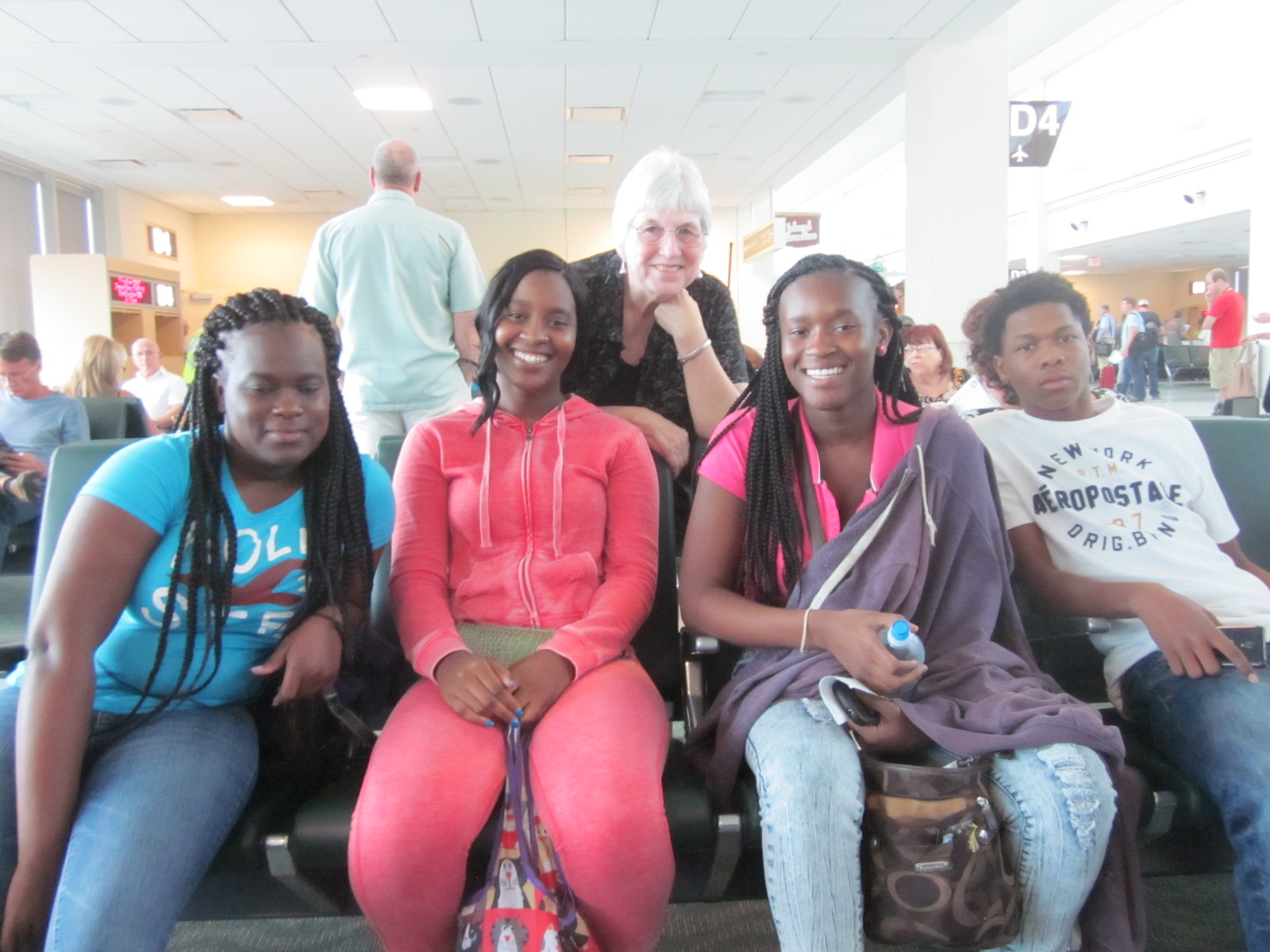
                          Waiting for the Plane


    We follow Jesus and we follow LOVE. We want to learn the history of justice making in the United States and in the world. We are part of the legacy of Jesus the Christ as manifested in many persons throughout history, like Dr. Martin Luther King Jr., Abraham Lincoln, Rosa Parks, Freedmen and women and slaves, and John F. Kennedy and the Kennedy brothers and Franklin and Eleanor Roosevelt, to name just a few. So we wanted to go to Washington DC where so much of American history and herstory and our story was made and remembered.  For us, representing the teens and young adults and all members of our Good Shepherd Inclusive Catholic Church of Fort Myers,Florida this trip was a FIRST in so many ways. Four of us were born and raised in Fort Myers and we never saw another State, or flew in a plane, or took a subway, or even a bus. We wanted to see more of the world and we got to do all of this! This is a little of what we did and saw. We are Natasha Terrell, 18 and Felice Rismay, 21, the  working and College students. And we are Jolinda Terrell, and Keeron Jones, High School Students and Keeondra Terrell, an eighth grader. Our Pastors, Roman Catholic women priests Judy Beaumont and Judy Lee were our guides for this amazing trip. Our church and The Father’s Table Foundation and individual donors made this adventure into life and justice available to us and we are so thankful.

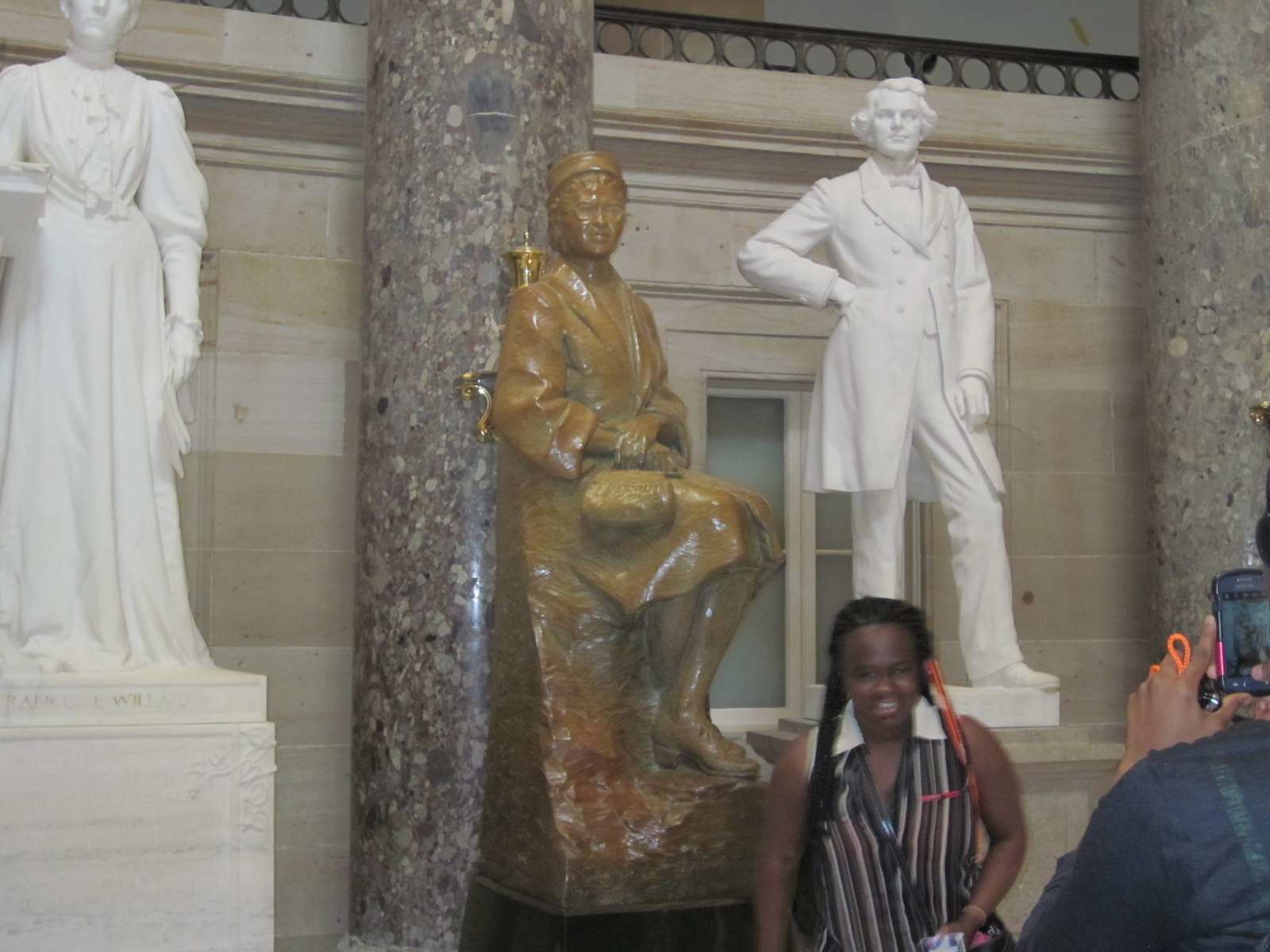
     At the Capitol Natasha Terrell stands beneath the statue of Rosa Parks sitting on the bus and sparking the Civil Rights Movement
    IMG_0151

    OUR DREAM IS TO BUILD THE BELOVED COMMUNITY OF JESUS and  DR. KING

     IMG_0183


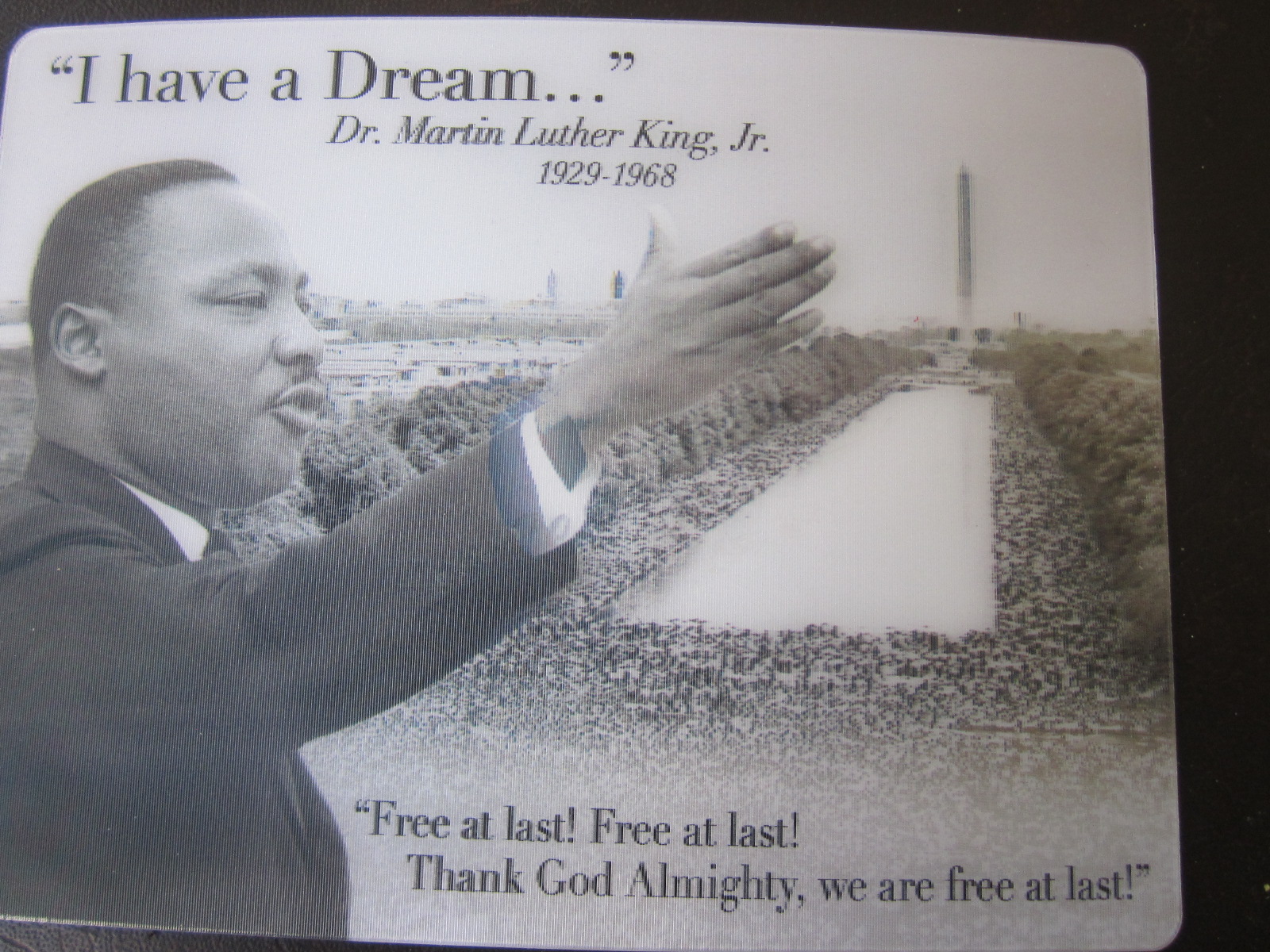
    The Lincoln Memorial where Dr. King made his I Have A Dream speech             Abraham Lincoln (At the Capitol)

    IMG_0106

    IMG_0153


    WE  WANT TO LEARN TO LIVE LOVE AND INCLUSION AND TO KNOW OUR HISTORY AS AMERICANS AND  AFRICAN_AMERICANS

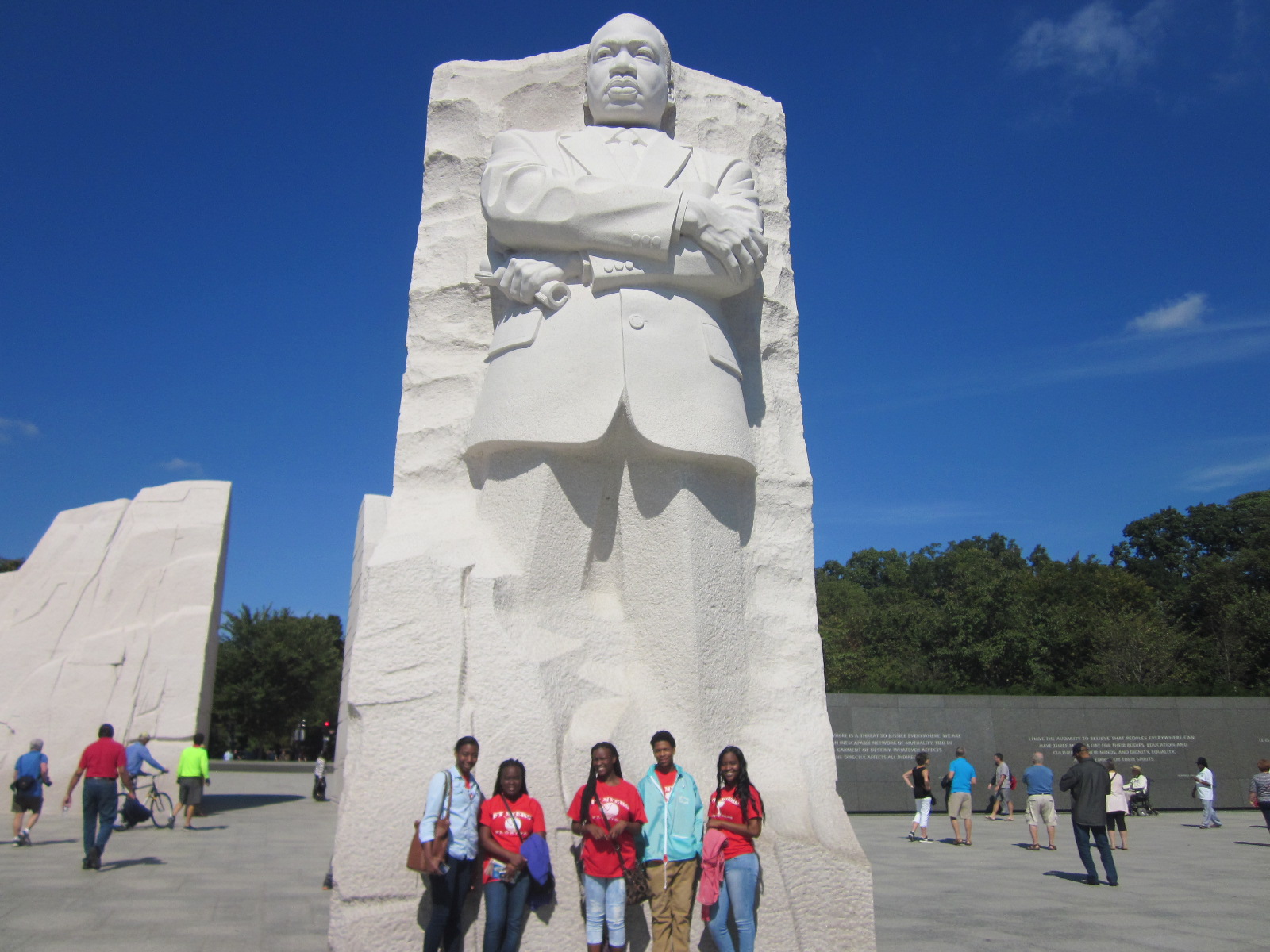
    IMG_0078At the Memorial for Dr. Martin Luther King ,JrIMG_0080


    WE WANT TO HONOR DR. KING AND ALL FREEDOM FIGHTERS

    IMG_0085

    WE STAND AT HIS FEET AND ON HIS SHOULDERS and on the shoulders of ALL who gave their lives for freedom and justice for all. 

    IMG_0099


    It was exciting to see and go to the top of the Washington Monument and understand how the United States of America came to be. 

    IMG_0103

    It was very special to go inside of the White House. We hoped to see a glimpse of President Obama or his family but they were not home.  We learned that Malia and Sasha  can go into all of the rooms that we were able to see whenever they want to. They also have their own movie theater. 

    IMG_0093


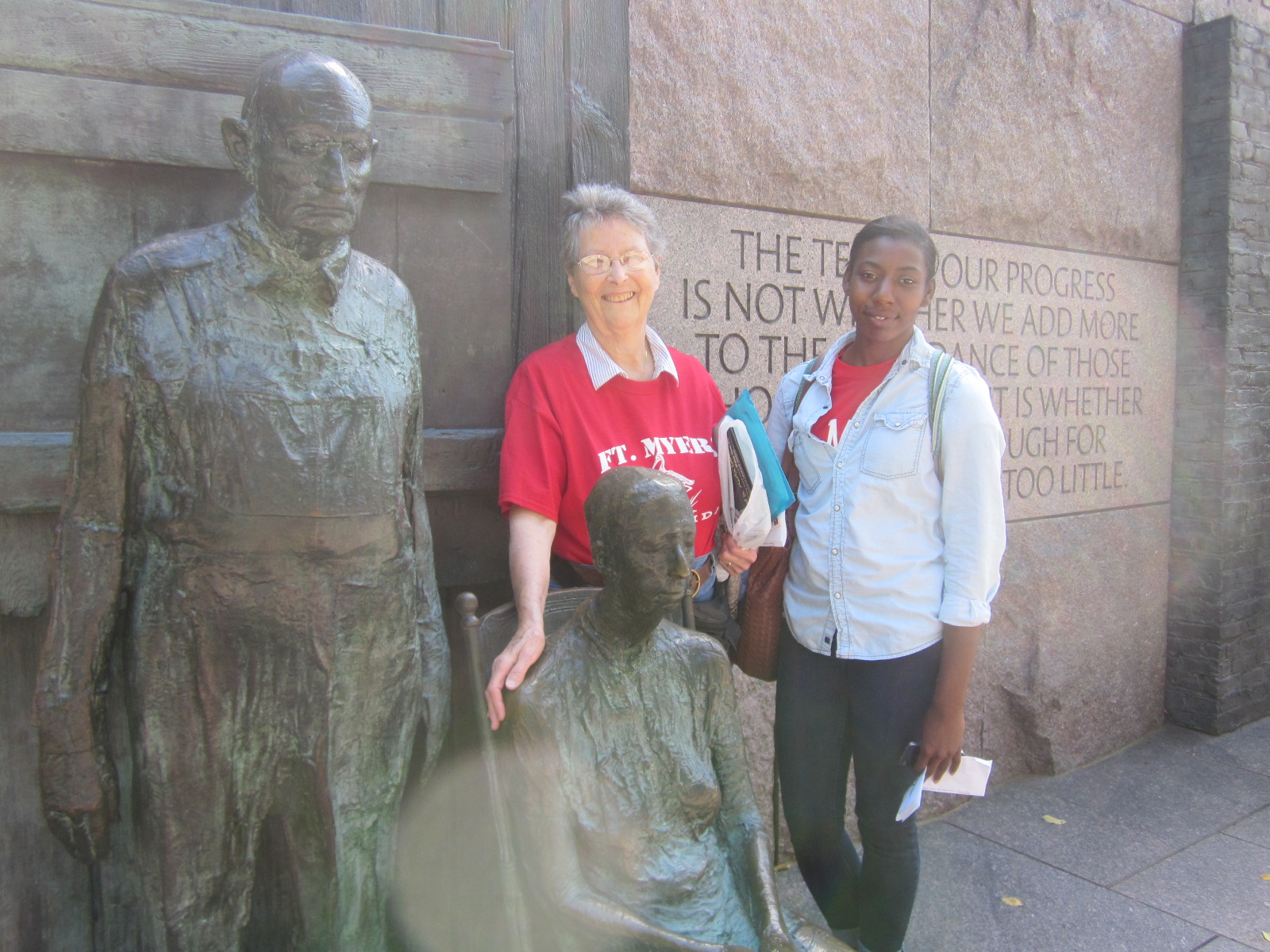
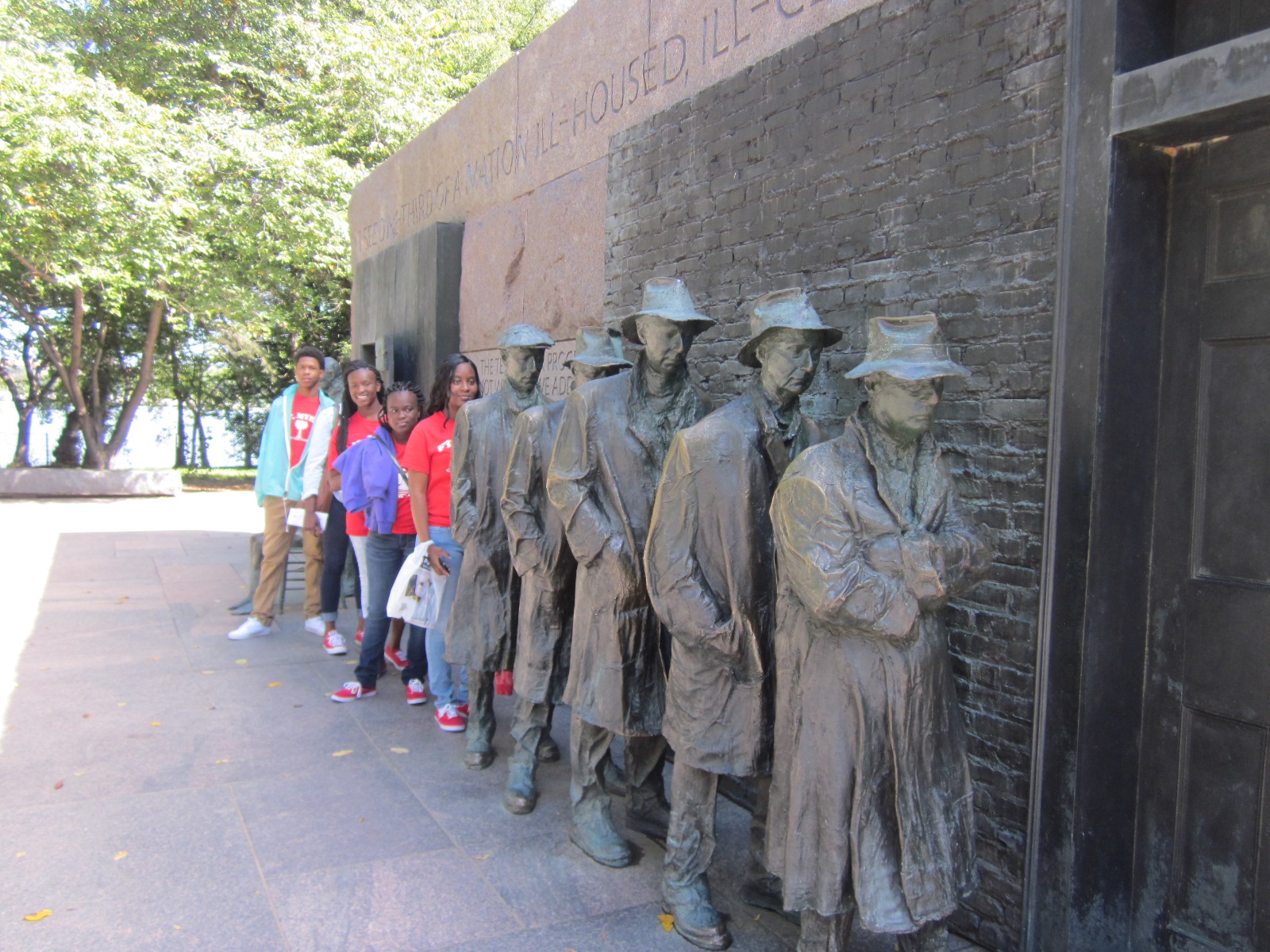
    Pastor Judy B and Felice are near the statues of a couple struggling with poverty and Felice is near the statue of one of her heroines, Eleanor Roosevelt .The group members are standing on the bread line that marked the great depression and homelessness and hunger today as well in the USA and world-wide.

    IMG_0092IMG_0096
    IMG_0089
                                                                                                                                    We too want to fight for economic equality and for PEACE. 

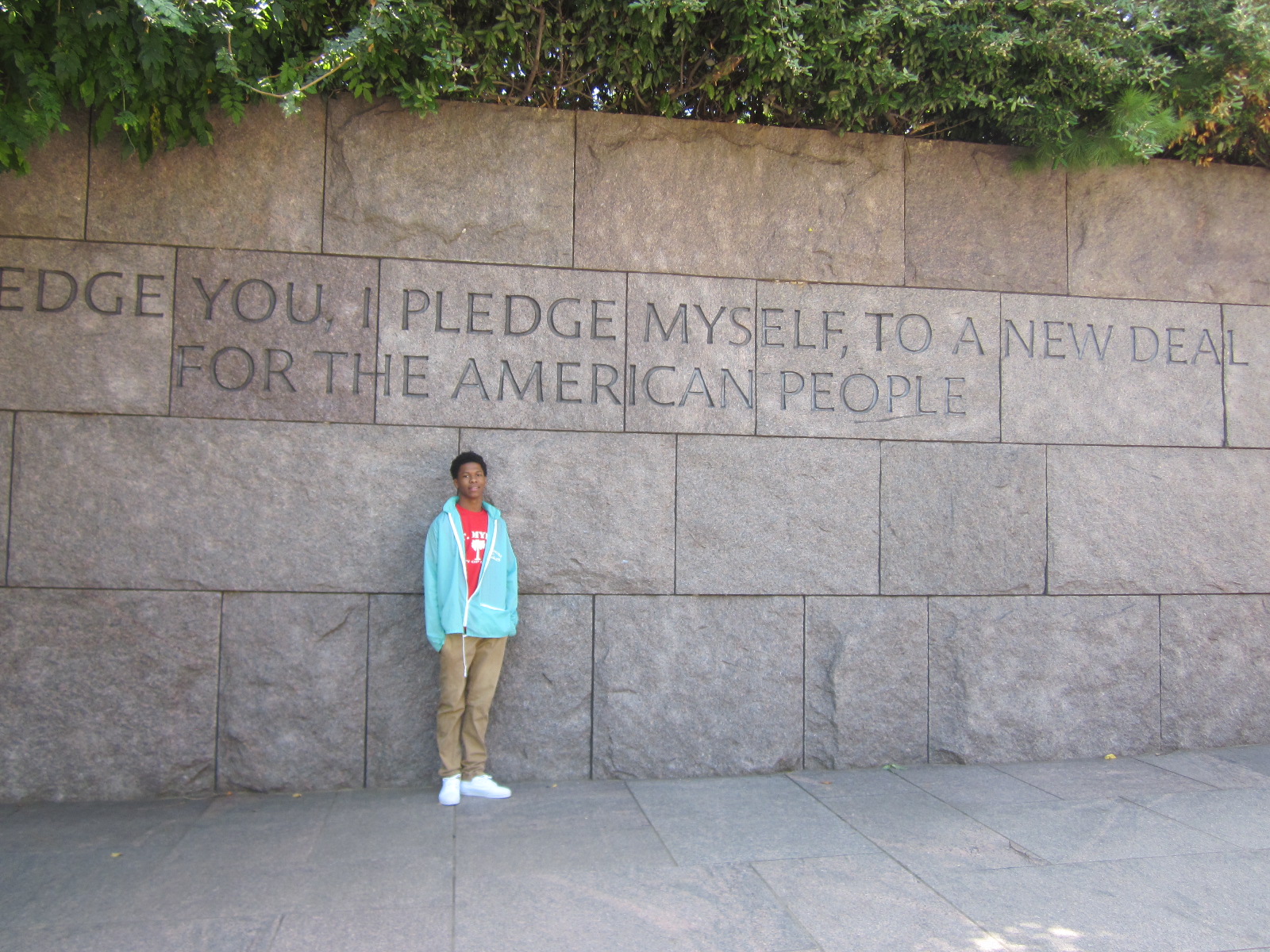
    Keeron Jones standing under FDR’s Pledge of the New Deal  that still helps people today.

    IMG_0164


    The Arlington Cemetery was a hallowed place. We prayed before going there and as we saw a funeral in progress there. We prayed at the site of the eternal light at  President John F.Kennedy’s grave and at the graves of all the Kennedys.  We tried to understand how so many members of one family gave their lives for freedom and equality.

    IMG_0167IMG_0169Jolinda is pleased that the light never goes out. 

    We also went up the hill to the “impressive” house owned by the Washington-Custis-Lee family. We were truly impressed, however, as we visited the slave quarters in the back and learned that the Washington’s personal maid was able to buy freedom for her son by sharing the story of his death with a reporter as she was with him as he died. It was difficult to witness slave history but we learned of the courage and accomplishments of the slaves. We also learned that slaves were treated better by the Washington’s than by the Robert E. Lee family. We were able to feel the reasons for the Civil War and see the bravery of those enslaved.

    IMG_0178


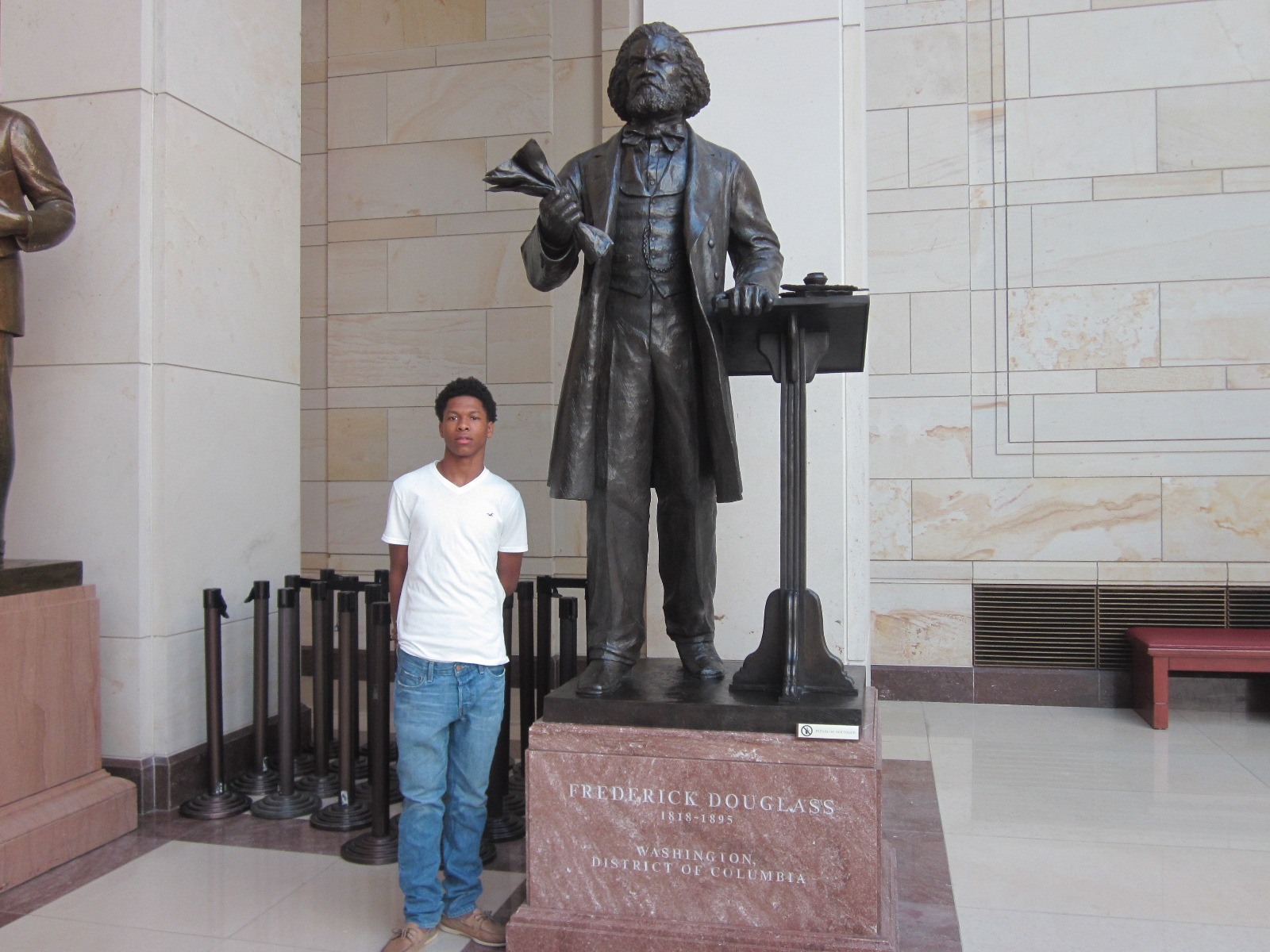
    It meant even more to understand who Frederick Douglas was after viewing this history.

    Keeron at the foot of Frederick Douglas in the Capitol IMG_0138


    We also visited The Cathedral of the Immaculate Conception, the largest Catholic Cathedral in the United States where we prayed and were amazed at the stories in the pictures.  It was overwhelming to some of the group but very beautiful. All of the paintings and the statues told the story of Christ and of God’s love for all people and for justice and equality. The paintings and statues of Mary, the Mother of Jesus with Jesus showed Mary and Jesus as Chinese, Czech, Native American, African and Mexican and dark and light and of many Nationalities.   Keeondra and Natasha were in awe while Jolinda said that she was happy that we have a much smaller church where we can all know and love one another. When we lit a candle to pray for a sick family member Keeron questioned why I put money in the box, did we have to pay to pray here? We explained that we never had to pay to pray but that was a love offering like we give in church on Sundays. Yet, his question was astute. He and Jolinda were not comfortable with all the gold and glitz, and I told him that he is in good company for neither is Pope Francis.  As we traveled in Washington we saw many homeless people. Our group members appropriately questioned why homelessness was everywhere, even in our Nation’s Capital. The Pastors were pleased to see that this moved our young people who dug in their pockets to be helpful. But once again they asked good questions. Indeed we pray that  their questions and answers may help bring the reign of God to all people here and now.

    This trip was well worth every effort that it took and we are thankful to all who helped it to take place. We will post other aspects of this journey in a separate post. Thanks be to God for these young people who follow Christ!                       Rev. Dr. Judy Lee and Rev. Judy Beaumont, Roman Catholic Women Priests and Co-Pastors of The Good Shepherd Inclusive Catholic Community in Fort Myers, Florida.

                                                                                                                         Below are the women at the Cross

    IMG_0127

    IMG_0126


  • Say What You’ll Do and Do What You Say You’ll Do:Rev.Deniray’s Sermon for Sunday 9/28/14

    I did not preach this Sunday as Pastor Judy Beaumont and I took five of our teen and young adult group members to Washington DC from Thursday 9/25-Sunday 9/28. We had a prayer service on Sunday morning then continued our meditations on the hallowed ground of Arlington Cemetery visiting not only the graves but the slave quarters of the Washington-Custis, Robert E. Lee home there.  Soon we will share the highlights of this wonderful trip with you.

    Today we received Rev. Deniray’s excellent Sunday sermon from her blog, the Deni Doulos Blog. Rev. Deniray is a member of Ecclesia Street Ministries as we are. She ministers regularly to the homeless and hungry in Columbus, Ohio. I am pleased to share her sermon here.

    SAY What You’ll Do and DO What You Say You Will Do

    by rev deniray

    “What do you think? A man had two sons; he went to the first and said, ‘Son, go and work in the vineyard today.’ He answered, ‘I will not’; but later he changed his mind and went. The father went to the second and said the same; and he answered, ‘I go, sir’; but he did not go. Which of the two did the will of his father?” They said, “The first.” Jesus said to them, “Truly I tell you, the tax collectors and the prostitutes are going into the kingdom of God ahead of you.

      (Matthew 21:28-31)

    As the old saying goes, there are three kinds of people in this world: those who watch things happen, those who make things happen and those who say, “What just happened?” This scripture from Matthew offers lessons on belief backed by action, not by preaching about things or complaining, but by doing.

    Jesus tells this parable of the two sons to illustrate how actions are significantly more important than intentions. He highlights the difference between those who pay lip service to God – and those who, having set out on the wrong track, change their minds and turn back to do as He asks.

    Jesus describes a situation that we are all familiar with. We have all met people who say they will do something – and then find they didn’t do what they said they would; those who make promises, but don’t keep them. And we have probably also met people those who start out being against an idea or refuse a request but who then think better of it, and not only fulfill the request, but go beyond what was asked and do even more.

    Jesus says if you are going to be a Christian, if you are going to follow him, then you are going to have to do something. Christianity is not about talking. Christianity is about action: the way we live and respond to people and life events; it is about growing, maturing, giving of ourselves to others and forgiving others, and loving others as ourselves.

    Jesus tells a story which is rather common: one son is asked to go to the vineyard to complete a task. He says that he will do as his father asks; we assume he will do what he says. The second son refuses to do what his father asks. One son seems to be in the right and the other in the wrong.

    However, appearances are often deceiving. The son who appears to be ‘right’, agrees to do his father’s work, but fails to go to the vineyard. He never shows up – all talk and no do. Yet the second son, who had first refused to obey and help his father, then changed his mind and went on to do his father’s work; this is, in the end, the son that did the ‘right’ thing. Because doing what is right means more than words and promises.

    Like most of Jesus’ parables, this story isn’t really about the two boys. It’s about you and me. It’s about two kinds of people in this world: those that profess faith in God, but do not do His will and work, and those who do the will of God while, perhaps, saying ‘no’ to a lot of showy, church beliefs and preaching.

    I don’t know about you, but, there have been times in my life when I’ve uttered nice, pious words about God but showed unbelief through my actions. And there was a time in my life when I wanted nothing to do with God, but tried to live my life with as much integrity and goodness as possible.

    Are we the faithful or the unfaithful son? Both lied to the father. But one changed his mind and went to work while the other never followed through. We know the answer to Jesus’ question — the son who finally did what his father asked is the hero in this parable.

    The meaning is so obvious.

    Some religious people make all kinds of grandiose promises to God but their performance doesn’t live up to their promises. The Christians promise God, “O yes, God, I will be your faithful disciple. I will live a Christian life.” But they don’t do a darn thing. They are ‘do as I say, not as I do’ Christians. So God will find some less ‘churchy people’ who actually go and do His work in this world.

    All of us would rather direct this parable to others. Lord knows we can point fingers. But this parable is addressed to you and me.

    It is about integrity, about putting your money where your mouth is.

    We must say what we will do and do what we say we will do.

    Jesus teaches that having the intentions to obey God isn’t enough. It is only those who actually obey God, whether they originally say they will or not, who are doing the will of God.

    SOMETIMES OUR ACTIONS DO NOT MATCH OUR WORDS.Intentions alone aren’t worth anything, because obedience or disobedience are actually found in what we do, more than in what we do.

    We must say what we will do and do what we say we will do.Let me leave you with an example of someone who truly lived what he believed:
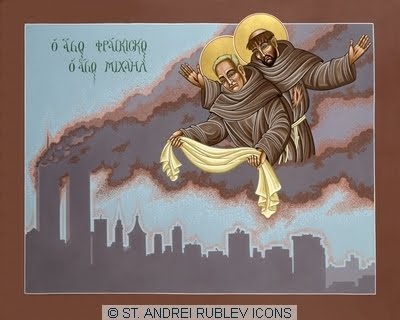
    We have passed the thirteenth-year anniversary of the attack on the World Trade Center in September. Among the thousands of victims of that attack was Father Mychal F. Judge, the fire department chaplain who, while ministering to the fire fighters working at Ground Zero, was killed by falling debris from the Towers. In Father Mychal’s pocket was this prayer that he always carried with him:

        “Lord, take me where You want me to go;
        Let me meet who You want me to meet;
        Tell me what You want me to say, and
      Keep me out of Your way.”*

    Father Mychal was a man of commitment. He understood that the vows he took before God were not a trivial matter. He is one who said, “I’ll go,” and he went.

    Amen.

    34895-mcnicholsholy_passion_bearer_mychal_judge

    Delivered at In The Garden, Trinity Episcopal Church on Capitol Square, Columbus, OH28 September 2014

  • Archdiocesan Reaction Insufficient in Philadelphia Hate Crime Against Gay Couple

    Once again we thank Bob Shine of New Ways Ministries and Bondings 2.0 blog for bringing the behavior of Archbishop Chaput of Philadelphia to our attention. While it was highly appropriate to fire the part time Catholic HS coach involved the response needed to name the crime as a hate crime against a gay couple by Catholic HS alumnae and coach. Also other incidents of anti-gay actions are sadly noted. Let us continue to shine the light on the church and the LGBT community.

    Rev. Dr. Judy Lee,RCWP

    SAINTS NOT MARTYRS !

    a741e-smallcopylogoglbtsaints200pxoriginal

    Archdiocesan Reaction Is Insufficient in Philadelphia Hate Crime

    by Bob Shine

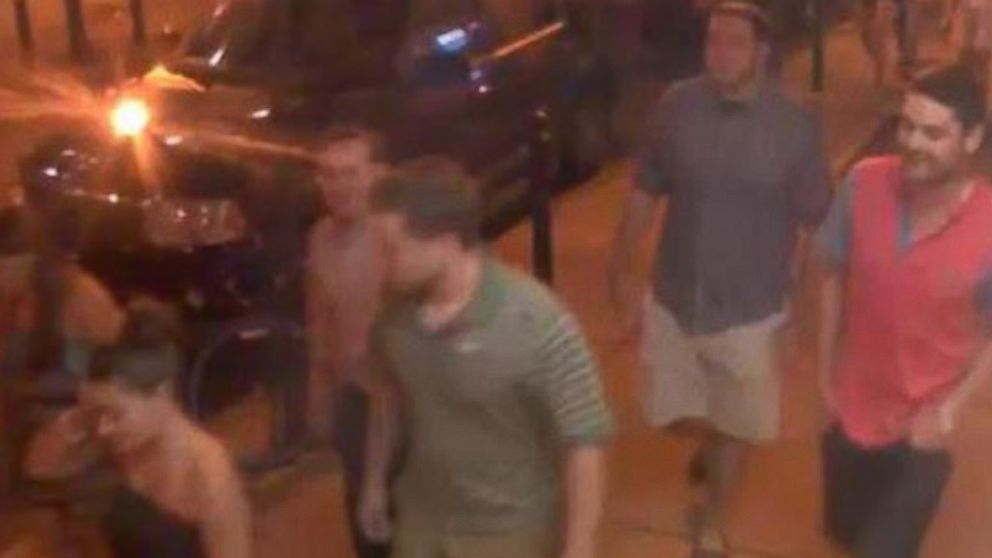
    Alumni from a Philadelphia Catholic high school were allegedly involved in a hate crime last week, accused of attacking a gay couple on the street that left one victim with a wired jaw and broken eye socket, and the other one badly bruised.

    In the aftermath, a school coach has resigned but reactions to the Archdiocese of Philadelphia’s statements are mixed. Ultimately, the response has been insufficient and this is a missed opportunity.

    Fran McGlinn coached basketball at Archbishop Wood High School, in the Philadelphia suburb of Warminster, from which several of the assailants including McGlinn had graduated. Archdiocesan spokesperson Kenneth Gavin confirmed the assistant coach’s resignation on Wednesday, saying he was further banned from employment at archdiocesan schools. The identities of McGlinn and the others became known after social media users viewed surveillance footage which was made public to find the assailants.

    In a statement reported by the Bucks County Courier Times, the Archdiocese also said:

    “This afternoon, administrators communicated with the entire Archbishop Wood school community to make it emphatically clear that the school does not, under any circumstances, tolerate or condone the violent and hateful behavior displayed by those who took part in this senseless attack.

    “Administration also stressed that Catholic schools are centers of learning where students are expected to treat each other in a Christ-like manner at all times and that everyone deserves to be treated with respect and dignity. The actions of those who took part in the attack are reprehensible and entirely unacceptable.”

     Archbishop Charles Chaput also commented on the September 11th assault, saying in astatement:

    “A key part of a Catholic education is forming students to respect the dignity of every human person whether we agree with them or not. What students do with that formation when they enter the adult world determines their own maturity and dignity, or their lack of it. Violence against anyone, simply because of who they are, is inexcusable and alien to what it means to be a Christian. A recent beating incident in Center City allegedly involved, in some way, a part-time coach at Archbishop Wood High School. After inquiries by school leadership, the coach was contacted regarding the matter and he resigned. Archbishop Wood’s handling of the matter was appropriate, and I support their efforts to ensure that Catholic convictions guide the behavior of their whole school community, including their staff.”

    First, Archbishop Wood administrators are to be commended for quickly dealing with McGlinn’s employment when his involvement in hate crime became apparent. In twenty LGBT-related employment incidents at Catholic institutions this year, this is the first resulting from a church worker’s actual failure to uphold human dignity and the common good.

    However, both Chaput and the Archdiocese’s statements fail to recognize openly the specific nature of this attack. Reports claim the assailants asked the couple if they were boyfriends and yelled homophobic remarks while beating the two men. Though Pennsylvania hate crime laws may not be LGBT-inclusive, in this incident it is essential for Catholic officials to acknowledge the homophobia seemingly at the core of the attack.

    Yet, neither the word “gay” nor any variation is used in the statements which simply condemn violence. One interesting note is that the archbishop said no one should be attacked “simply for who they are,” a possible shift from the language of same-sex attractions in vogue with American bishops back to language of sexual orientation. This, however, does not directly name what happened as a hate crime specifically targeting a gay couple and is therefore insufficient.

    Archbishop Chaput has a record of acting against LGBT people. He is known for expelling a child of a lesbian couple from Catholic school and denying Communion to LGBT advocates. Chaput recently aided efforts by the Pennsylvania Catholic Conferenceopposing a non-discrimination bill that would make sexual orientation and gender identity protected classes.

    Further, this incident is a missed opportunity for Archbishop Chaput and archdiocesan officials to make an unequivocal statement in support of LGBT people who face discrimination and violence. Though Chaput was critical of Pope Francis in the past, this incident could have provided a moment for the archbishop to change his tone and implement a more pastoral approach when dealing with the LGBT community. Catholics United has called on him to do as much when it comes to Philadelphia’s transgender community. Why not use a moment of horrendous tragedy to build a bridge and reach out with love for lesbian and gay Philadelphians as well?

    Thankfully, the story is still in the news and there is time for Archbishop Chaput and Archbishop Wood H.S. officials to make a more explicitly LGBT-focused condemnation of this attack. Let us pray they will finally feel the ‘Francis Effect’ now spreading in the USand do the right thing.

    –Bob Shine, New Ways Ministry

  • Jesus and the Workers: Rev. Judy’s Homily for the 25th Sunday in OT 9/21/14

    Pastor Judy Beaumont and some of our Good Shepherd WorkersIMG_0001

    Once again in the Gospel for this week, Matthew 20: 1-16, Jesus turns the religious and social order upside down and  shows us we cannot possibly understand the mind of God nor fathom the depth of God’s love for everyone. The prophet Isaiah addresses this theme as well: “… For my thoughts are not your thoughts, nor are your ways my ways,’ says your God´(Is 55:8). Just before this Isaiah offered God’s invitation to those who were thirsty and hungry to come and drink and eat “without money and without cost” (Is 55:1). God is again promising the same “faithful love” God promised to David and the children of David. And we read the invitation on two levels: when the prophet says “listen to me and eat what is good and your soul will delight in the richest fare” (Is 55:2) he is saying listen and LEARN what our God is teaching, RECEIVE the teaching that is good and live! This invitation is also the preface to hearing the Gospel today, this is how we find our God.  And, it is also a specific invitation to those who have no money to buy. Consistently throughout the Scriptures God provides for those who have the least of this world’s goods and is concerned about the poor and outcast, those who are usually left out.

    Jesus’ parable of the workers in the vineyard is not a treatise on labor relations for as much as I support Unions in obtaining just pay and benefits for those who work they may not approve of Jesus’ teachings here. Jesus wants to give everyone the same wages and benefits no matter the hours worked. To understand this parable we need to put ourselves in the shoes of the last to be hired, or even those who will probably not be hired at all.

    Here in Fort Myers there is a Labor Pool that assembles on a street corner at 5 AM. It is made up of men and women who want to work and have no regular job.  They want to work for the day or, preferably, for as long as possible. Many of our homeless people are part of this Labor Pool. Some ask us for work boots or boots with steel tips because the labor boss wants only those who could actually survive on a construction site. For a while when we served in the local Park we were known as the boot ministry because we would take sizes and deliver boots to these people. The saddest part of this was that the boss took only the youngest and strongest of men and older men, sickly men or women were hardly ever chosen. Yet they would go day after day as once in a while there were “easier” jobs to be given out and they just may get one. There were always many more people waiting to be hired than were actually hired. There is a similar waiting place at another place in Fort Myers and in nearby rural Immokalee where farm workers are chosen for the day.  Once again hundreds may stand there and fifty be chosen for the day. Indeed the first are chosen first unless someone younger and stronger is behind them. Some just give up and stop going. We know an older man who went every day hoping to be chosen. Once he was chosen to sweep on a site.  That was the first smile we ever saw on his face. It hurts to be overlooked and cast aside.

    Unemployment is improving in the USA with 6.2 as the current unemployment rate (Reuters.com Lucia Mutikani 8/1/14). The Obama years are comparable to the Roosevelt years in improvement of the depressed economy inherited from a previous era for the working person(Chart in Wikipedia.com article on Unemployment). This is truly remarkable but not for those who remain unemployed and in need, including those who have given up. In the world there are places with the unemployment rate nearing 50% of the population able to work. Many cannot even survive without UN and other sources of outside help.  In a country, like the USA where the upper 1% have 90% of the highest income resources many are overlooked whether in competing for a job and wages or in the esteem of others. This parable is a comment on that. It follows in fact the story of the rich young man who was asked to sell his possessions and give to the poor to have “treasure in heaven” and to follow Jesus. The young man “went away sad for he had great wealth”.  So Jesus then teaches that with him, with God, equal wages (rewards/gifts of love and money) are given to all no matter when they come to God. The not chosen and outcast deserve to be first, they have borne the burden of need and want and the stigma of the outcast.

    Jesus knew that, he deeply loved the unchosen of this world and told us before and after this parable that “the last shall be first”.  Those who are usually left out in this world will be first in the reign of God. The economically poor and those left out because of mental illness, physical difference, race, color, class, caste, national origins, sexual orientation, or any other difference judged by mainstream others to be not good enough will be first with God. The gift of life, eternal life and God’s unfathomable love will be given to all in equal measure. And that should begin now, not sometime later as now is when we are asked to be laborers in the Vineyard. The labor of Christ’s followers is our effort to bring justice, compassion and love to fruition here and now so that those waiting in the labor pool may be duly rewarded for their wait as well as their work.  This parable is also about God’s endless and overflowing generosity.  If we are stingy and not generous with our time, money, resources, and effort in working for justice and inclusion we are like the workers who were envious of other’s just wages. Justice in God’s dream means that all throughout the land and throughout the world eat and have shelter and respect, dignity and love. We may hold the secret belief that we deserve all good things but “those others” do not. God’s way is generously giving gifts that none of us merit: life, health, love, ample means, and joy- freely given to all.  That is God’s way–what is my way? What is your way? We are asked to reflect on that this week, and to be thankful for God’s boundless love. Amen!

    Rev. Dr. Judy Lee, RCWP

    Co-Pastor Good Shepherd Inclusive Catholic Community, Fort Myers, Florida

  • How Can the Christian Community Support LGBT Homeless Youth?

    Saints not Martyrs Please! a741e-smallcopylogoglbtsaints200pxoriginal

    This is a Follow-up Article by New Ways Ministry to yesterday’s very important article on homeless gay youth.

    From Bob Shine and the blog Bondings 2.0:

    How Can the Catholic Community Support LGBT Homeless Youth?

    by Bob Shine

    YesterdayBondings 2.0 highlighted the religious rejection that too often causes LGBT youth to experience homelessness, and we called on Catholics and other people of faith to participate in GLAAD’s #SpiritDay this October as a sign of love and acceptance for upwards of 400,000 LGBT youth inhabiting American streets.

    Today, we take a look at the flip side of the relationship between LGBT youth homelessness and religion, specifically Catholicism.  Examples of Catholics and those rooted in the church’s tradition confronting general homelessness abound, and it is a source of comfort for me that the church has such a fervent commitment to children in poverty. But what about LGBT youth?

    Carl Siciliano, once a Benedictine monk and Catholic Worker, left the church over homophobic remarks from New York’s Cardinal John O’Connor. But he did not leave the  practice of the works of mercy for those without homes, as Rolling Stone reports:

    “Siciliano was working at a housing program for the homeless in the Nineties when he noticed that his clientele was getting younger and younger. Until then, he says, ‘you almost never saw kids. It was Vietnam vets, alcoholics and deinstitutionalized mentally ill people.’ But not only were more kids showing up, they were also disappearing. ‘Every couple of months one of our kids would get killed…And it would always be a gay kid.’ “

    Siciliano founded the Ali Forney Center in response, a shelter in New York City devoted exclusively to LGBT kids and teens without housing. Siciliano has also become an advocate, questioning where the tax dollars are for these youth and what Pope Francis’ impact has been. The Rolling Stone articles highlights the first of these, noting a lack of government funding exacerbated by a further lack of LGBT protections to assist LGBT youth.

    Of more than $5 billion in federal funding annually funneled to address homelessness, a very small percentage targets youth. The Runaway and Homeless Youth Act (RHYA), a primary source of youth funding around this issue, does not ban LGBT discrimination and it does not look likely that such a clause will be added to a new version of the Act which expired last fall. This situation leaves the US with only 4,000 beds nightly for an estimated 1.7 million homeless youth.

    There are further complications when factoring in religious organizations. Because President George W. Bush channelled government funds to faith-based providers, LGBT youth may face further discrimination if they seek services at faith-based care providers who are not inclusive and do not provide for this population’s unique needs. Given the track record of local Catholic Charities affiliates when it comes to non-discrimination laws around adoption and the Hobby Lobby debacle earlier this year, would Catholic groups end social services to homeless youth if they were required to be LGBT inclusive?

    There is another angle, touched upon yesterday, when it comes to Catholicism’s response to this epidemic of homeless LGBT youth and that is the pastoral care that also needs to be provided. Siciliano wrote public letter to Pope Francis published in the New York Timesthis spring and pleaded for the pope to act forcefully against the causes of religious rejection afflicting LGBT youth.

    Indeed, though Pope Francis has not directly addressed this issue, I think he points the way forward for American Catholics. The pope’s emphasis on accompanying the poor as a mandate of faith needs no comment, aside from a reminder that he chose to dine with the homeless for his birthday, and the Jesuit church in Rome held a funeral for murdered transgender woman who had been homeless that respected her gender identity. Pope Francis chooses mercy over judgment, over caring for and including those on the margins, rather than rejecting them.

    What can you do?

    On a personal level, participate in #SpiritDay on October 16th to let LGBT children and teens know there are supportive people of faith in their lives in their communities. New Ways Ministry is joining with other faith-based and LGBT groups to co-sponsor #SpiritDay with GLAAD. We hope you will join us and help us spread the word! For more information, click here.

    On a parish level, begin efforts to address these LGBT youth-specific injustices. Whether this means broader education efforts about sexual orientation and gender identity or augmenting existing efforts to confront homelessness by tackling the unique needs of LGBT people experiencing poverty. Do something small to start and build upon it.

    On a state and national level, become involved with legislative efforts to meet the specific needs of homeless youth generally, including those needs of LGBT youth.

    Homelessness among LGBT youth is not simply a Catholic or faith problem, for there are a myriad of other factors influencing each person’s life. But Catholics have both a mandate from Christ to care for those least among us and a faith responsibility to combat negative religious beliefs that result in rejected youths.

    –Bob Shine, New Ways Ministry

    Bob Shine | September 19, 2014 at 1:00 am | Tags: Catholic, Gay, homeless,
  • The Pain of Difference: Homeless Lesbian and Gay Youth

    As a Pastor and individual serving the homeless and the LGBT community all of my life, I find the high figures on homeless LGBT youth shocking and tragic. I thank Bob Shine of New Ways Ministry- Bondings 2.0 Blog for bringing this to our attention. Please join me in prayer for loving Christ-like outreach to all homeless people, especially young people and LGBT teenagers who are facing the aftermath of rejection for the persons they were born to be. I am moved by the examples here and remember such rejections in my own life as I struggled to find and name myself and my orientation along the LGB spectrum in my thirties. For the young who cannot support themselves homelessness is part of the tragedy. Young brother and sister, my prayers are with you.

    Rev. Dr. Judy Lee, RCWP

    Co_Pastor Good Shepherd Inclusive Catholic Community, Fort Myers, Fl

    All may be saints but we pray there are no martyrs among our youth!

    a741e-smallcopylogoglbtsaints200pxoriginal

    Below is Bob Shine’s Article from Bondings 2.0 Blog New Ways Ministry

    Homeless LGBT Youth Need Your Support This #SpiritDay

    by Bob Shine

    In a month from now, October 16th, millions of people nationwide will don purple clothing and take to social media in what has become an annual display of love and support for LGBT youth called #SpiritDay. In past years’, Bondings 2.0 has marked this event by highlighting the bullying of LGBT youth and Catholic responses  to this problem.

    Today, we highlight the tremendous problem of LGBT youth homelessness, suicide, and related pastoral concerns in the hopes you will add your voice to #SpiritDay on October 16th. TomorrowBondings 2.0 will look at the other side of this problem–how religious social service providers are impacting LGBT youth experiencing homelessness.  #SpiritDay is sponsored by GLAAD, and you can find out how you and your company, school, church, organization can participate by clicking here.

    Rolling Stone magazine took up LGBT youth homelessness in their September 11th issue, mixing hard data with anecdotes from four LGBT youth to tell this tragic story. To set the scene, the article cites Center for American Progress numbers that between 320,000 and 400,000 LGBT youth experience homelessness in the United States and this is approximately 40 percent of the homeless youth population overall.

    The causes of LGBT youth homelessness are varied. The average coming out age has dropped to 16, when most youth are still dependent on their parents, and more youth may be coming out following legal victories for LGBT equality.

    Research also shows that almost 40 percent of LGBT youth experiencing homelessness are on the streets because of family rejection, primarily rooted in religious concerns.The Family Acceptance Project at San Francisco State published data showing a distinct correlation between highly religious parents and the rejection of their LGBT children in comparison to those parents considered less religious. Two of the four youth who shared their stories in the Rolling Stone article came from families identifying as Catholic.

    Jackie was raised in Idaho amid an upper-middle class family. She succeeded academically and socially, pushed on by traditionally Catholic parents. It took until college for Jackie to realize she was gay, coming out sophomore year over the phone to her mother. The article reports:

    “So while Jackie hoped for the best, she knew the call she was making had the potential to not end well. ‘You can’t hate me after I say this,’ she pleaded when, alarmed to be receiving a call in the middle of the night, her mom picked up the phone.

    ” ‘Oh, my God, you’re pregnant’ was her mom’s first response, before running through a litany of parental fears. ‘Are you in jail? Did you get expelled? Are you in trouble? What happened? What did you do?’ Suddenly her mom’s silence matched Jackie’s own. ‘Oh, my God,’ she murmured in disbelief. ‘Are you gay?’

    ‘Yeah,’ Jackie forced herself to say.”

    Her mother hung up after using a slur against Jackie and questioning what she, as a mother, had done “for God to have given us a [gay] as a child.” Jackie’s parents cut her off financially, kicked her out of their house, and broke contact with their daughter. They mentioned later that Jackie, who experienced homelessness while still pursuing her college education, could get their financial support if she enrolled in “ex-gay therapy.” Of this, Jackie says:

    ” ‘I wanted to be their kid, but I couldn’t change. Everyone I’d ever known my whole life cut ties with me. But this was who I am.’ “

    James was a raised in the Midwest, in a highly religious town where there was a church “on every street corner.” His mother, once Catholic, experimented with evangelically-oriented Christian traditions before returning to her original church. James, who had heard his mother rail against homosexuality, started quietly dating a co-worker. He was forced to come out after his mother found a picture of him with his boyfriend on James’ phone. Upon graduating high school, he was kicked out and, after a month of hitchhiking, ended up in Atlanta at a shelter for LGBT youth, called Lost-n-Found Youth.

    One additional note is that LGBT youth who are kicked out experience higher rates of violence, sexual assault, HIV/AIDS, and prostitution than averages for youth experiencing homelessness. These can lead or exacerbate existing substance abuse and mental health issues, and in too many cases lead to suicide.

    Jesuit Jason Welle questions the acts of Catholic parents and family members who would reject an LGBT child or sibling, commenting on its inconsistency with teachings of Jesus. He writes at The Jesuit Post:

    “And this kind of rejection is shameful and heartbreaking because, really, our faith tradition should teach us that rejecting our children is a rejection of the promises we make in Baptism, namely that when a Catholic parent has their child baptized, the priest or deacon instructs them to teach their child to keep God’s commandments as Christ taught us, by loving God and our neighbor, and then asks pointedly, ‘Do you clearly understand what you are undertaking?’

    “The thing is, before you bring a child into the world no one asks you if you know what you’re getting into. But when a Catholic parent baptizes that child, they must respond directly to this question first. It leaves me crying out: what part of throwing a gay or lesbian child out of the home shows our love of God and neighbor?”

    Beyond the family, there is still the matter of the Catholic community. San Francisco social worker Kelley Cutler wrote a blog post at Patheos with questions for this fall’s Synod of Bishops tackling marriage and family life. Cutler asks the right questions, I think, for the church at large presently faced with all of the above:

    “How can the Church follow Christ’s example? What do queer people want and need to feel welcomed and supported in the Church where they may find him? How can the Church support queer people already in the pews, let alone the many on the street? What do they hope for from the Church, and how is the Church failing those hopes, thus contributing to a sense of hopelessness?”

    Cutler points out that community and a sense of belonging, as well as spiritual care are essential components in helping marginalized communities — and what the church can offer to LGBT youth. She concludes:

    “It takes a genuine connection to make the vulnerable feel truly safe, and truly seen…if we truly want to outreach to queer people, we need to do more, starting with real dialogue. Without being defensive, we need to see queer people through Jesus’ eyes, understand why they feel like outcasts, and then ask what we as a community can do to bring them home.

    “If we listen, we will hear that we all share the same desires: for connection; for community; for hope; for love; for a place where we may safely graze.”

    Making public your support as a Catholic or person of faith for LGBT youth this #SpiritDay will let them know there is a supportive community out there. New Ways Ministry is joining with other faith-based and LGBT groups to co-sponsor #SpiritDay with GLAAD. We hope you will join us and help us spread the word! For more information, click here.

    TomorrowBondings 2.0 will follow-up this post by looking at the impact faith-based social service providers have had in confronting LGBT youth homelessness.

    –Bob Shine, New Ways Ministry