
Thanks be to God! Five Roman Catholic Women Ordained in Louisville, Ky 12/8/13
The Association of Roman Catholic Women Priests is pleased to announce the ordination of five women in Louisville, Kentucky on Sunday 12/8/2013. . The cold and snowy weather did not deter people from attending the ordination of Mary Sue Barnett as Priest and Ann Harrington, Betty Smith ,Denise Menard Davis and Mary Weber as Deacons. Over two hundred people gathered to celebrate this wonderful event with Bishop Bridget Mary Meehan presiding. The article below is from the
Courier-Journal.
Written by
Charlie White
The Courier-Journal
They had a clear message for the Vatican on Sunday, ordaining Barnett as its latest woman priest.
“The time has come for a holy shakeup that will bring new life, creativity and justice to the church and beyond,” the Rev. Bridget Mary Meehan, the ordaining bishop, said during the ceremony.
MORE | Photo gallery from the ordination
More than 200 people attended the afternoon ceremony for Barnett at Central Presbyterian Church in Old Louisville.
Four other women were ordained as deacons: Denise Menard Davis and Betty Smith of Louisville, Mary Weber of Indianapolis and Ann Harrington of Greenville, N.C.
It was the second such ceremony in Louisville in the past year.
“It’s a very natural next step for me, a joy-filled step,” Barnett, 51, said after the ceremony, adding there are “women of all ages who need to be visible and need to be heard.”
She will give her first liturgies at First Unitarian Church on Fourth Street at 5 p.m. Dec. 21.
Barnett, who is married, has two sons and lives in the Lyndon area, was born and raised in the traditional Roman Catholic Church, attending St. Athanasius, Mother of Good Counsel and Church of Epiphany in Louisville. She also has taught at Catholic institutions, including PresentationAcademy , Assumption High School, Spalding University and St. Catharine College.
There are now more than 160 women priests in the association, said Meehan, of Mother Mary of Jesus Inclusive Catholic Community in Sarasota, Fla.
The association’s first seven women were ordained as priests in 2002 on the Danube River in Europe, and a dozen more were ordained in the first U.S. ordination in Pittsburgh in 2006.
Roman Catholic Archdiocese of Louisville officials have said Catholics should not support or participate in events held by the association, maintaining it has no connection to the Roman Catholic Church.
Some association supporters who attended Sunday’s ceremony sat on the upper level to avoid having their photos taken because they said they would be excommunicated if they were seen at the ceremony.
Pope Francis, like other pontiffs before him, has rejected the idea of women priests, although he is trying to include them more in the church.
The Rev. Janice Savre-Duszynska, an association member, said priesthood “goes beyond gender.”
She’s among those who say frescoes the Vatican recently restored in the Catacomb of Priscilla — including one that appears to show a woman being ordained by a bishop — are evidence of women deacons and priests.
But the Vatican has a different interpretation.
“This is an elaboration that has no foundation in reality,” Barbara Mazzei of the Pontifical Commission on Sacred Archaeology told Reuters last month.
Reach Charlie White at (812) 949-4026 or @c_write.
Jesus helped the blind to see. It is amazing that anyone could see and then deny the presence and meanings of those frescoes interpreted by many scholars, Gary Macy and Dorothy Irvin included. Yet, thankfully, Even the Vatican cannot limit the powers of God to call whom God calls to serve as priests and deacons. Thanks be to God for those male bishops who helped to start this Movement in 2002. They were clear that this was done not for any individual woman but for the good of all the church, of all God’s people. Thanks be to God! To read the stories of early women priests, including this author, the reader may be interested in Women Find A Way edited by Meehan and McGrath, virtualbookworm.com or Amazon.com or Band N .com
Rev. Dr. Judy Lee, ARCWP
More Thoughts on Advent 2 from 3 Preachers -Bringing In the “Already-but not yet”
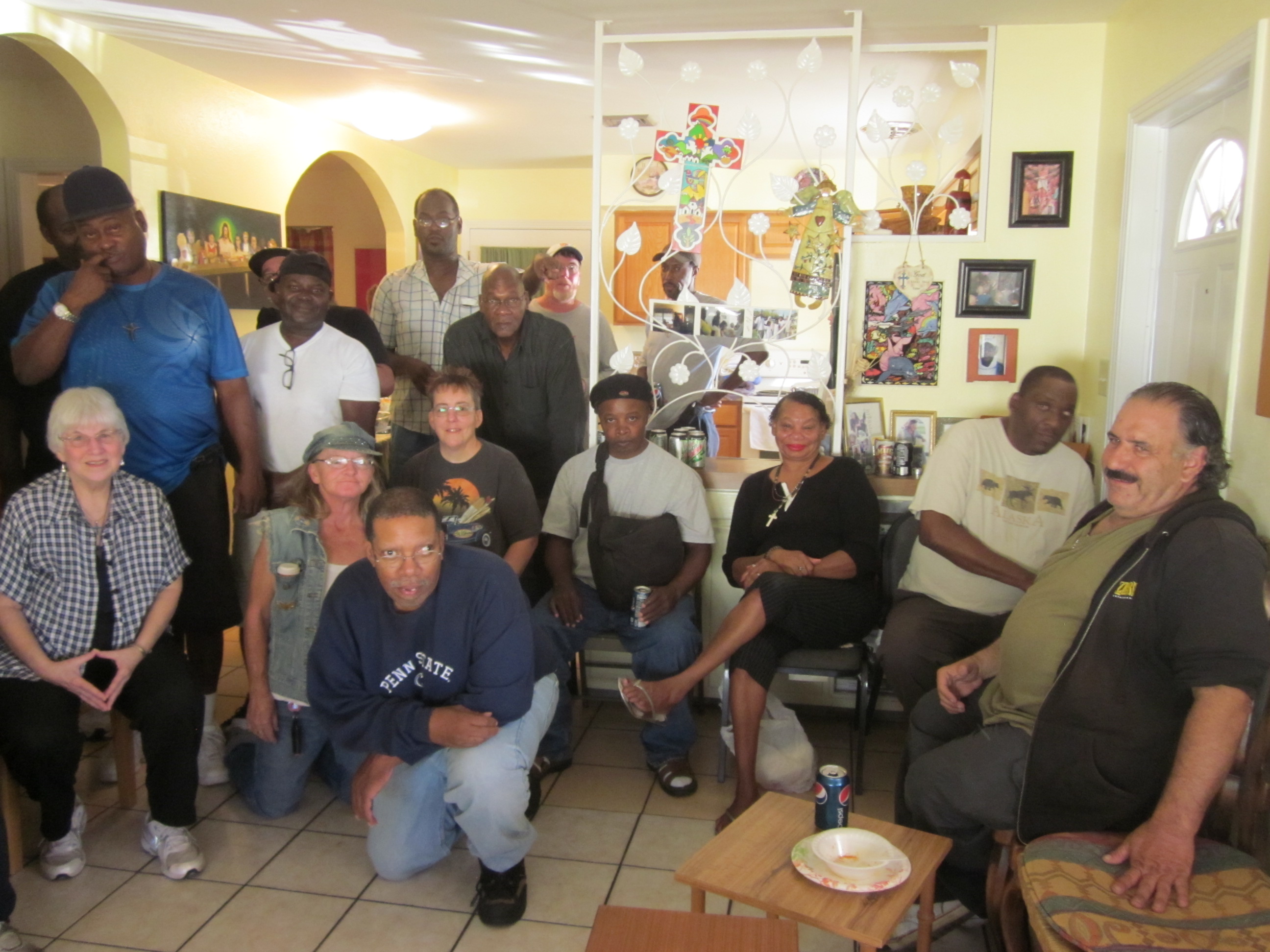
Good Shepherd Tuesday Ministry Core Group-Homeless No More And Helping Others
In my last blog I shared my homily on “Blossoming Out of a Tree Cut Down”. Many of us, including those who are homeless,like the Blossom from the cut off stump of Jesse, Jesus the Christ, sprout up, rise up, despite the treatment we have received. Advent is a time of sprouting into new life. For some as Pastor Reho says, it means moving away from our own dead center of “ME”. For others as Rev. Bingle says it means doing what they can do to serve others, to feed and clothe and encourage the homeless and others in trouble when the minimum wage is so low no one can live on it. May we also encourage those changes that bring new life to all, like raising the minimum wage to twice what it is now so people can live on it.
Here are two more preachers sharing the word for Advent 2.
Rev. James Reho of The Lamb of God Lutheran Episcopal Church in Estero, Florida
“Koans are paradoxical questions that are meant to stop our ordinary ways of thinking so that our minds (and hearts) can be opened to something more. Some famous koans include, “What was your original face before you were born?” and “What is the sound of one hand clapping?” Sitting with such paradoxes can expand us.
This season of Advent, too, is a paradox. On the one hand, it is a time of preparation and waiting; on the other, it is a call to awaken to God’s kin(g)dom which is already at hand, among us and within us (Luke 17:21). Theologians often describe this reality using the paradoxical phrase “already-but-not-yet.”
The Advent paradox of “already-but-not-yet” captures, I think, how we often experience the Holy. The more present we become to Presence here and now, the more we see new horizons unfolding into the future. The more we experience union with God, the more we are called to continual transformation into God. The more our Lamb of God community seeks and embodies God’s hopeful dreams for our world, the more we are called to faithful courage in furthering this “already-but-not-yet” kin(g)dom of God.
The more seriously we take the message of Advent, the more we become people of paradox. What does this mean? It means that we can imagine in a courageous way what our future will look like and risk making it happen, while awakening to the fact that we, already in the present, have everything we need to bring it about. It means, too, that for God’s kin(g)dom to be more fully revealed, our own kingdoms have to move over: “what I want” sometimes needs to cede to “what best serves.” Finally, it means that we learn to become suppler and less rigid through cultivating our inner prayer life and outer community life.
What are we waiting for? We wait for That which is already here.
Whom are we waiting for? We wait for Jesus Christ, who, here and now, is alive within us and among us.
What is the sound of one hand clapping? That one I’ll leave to you to figure out…! 🙂
See you in church,

James
Rev. Beverly Bingle, Roman Catholic Woman Priest in Toledo, Ohio
Last Wednesday, the temperature in Toledo was 60. This weekend the
high is 30. The forecast high for next Tuesday is 20. The Winter
Solstice—the darkest day of the year—is two weeks off. Bleak, frigid
days ahead.
Lucas County officials count over a thousand homeless people here. I
mentioned that statistic at Claver House this week, and Al, one of the
guests, estimated that there are two to three times that many because
they’re not all counted. Some live in cars. Some squat in
abandoned houses. Some go from couch to couch with family and
friends. A good number have “riverfront homes.” Some live under the
High-Level Bridge. Others under the Craig Bridge. Still others live
under the new Glass City Skyway.
A third of the homeless have a mental illness or an addiction. Some
of them are the “working poor,” not making enough money to pay minimal
expenses for food and housing. Many of them are unemployed. Many of
the women and children are fleeing from domestic violence. Some spend
their nights in one of the four homeless shelters—they’re the ones who
get counted. They walk or bike to soup kitchens and the public
library during the day while the shelters are closed. They look for
jobs without an address to put on the application, without a shower,
without clean clothes for an interview.
It’s bleak. Cold. Hard.
We gather here today, warm and safe, and hear scriptures that promise
a peaceful, happy world. We hear the Baptizer proclaim that God’s
reign is at hand. And we know that something’s wrong with this
picture. What were those words of scripture we just heard? Treat
poor people with fairness? No harm, no destruction on my holy
mountain?
Our Pope Francis describes the problem; he says: The great danger in
today’s world, pervaded as it is by consumerism, is the desolation and
anguish born of a complacent yet covetous heart, the feverish pursuit
of frivolous pleasures, and a blunted conscience. Whenever our
interior life becomes caught up in its own interests and concerns,
there is no longer room for others, no place for the poor.
John the Baptizer is more blunt about it; he shouts: You pack snakes!
Give some evidence that you mean to reform!
Glory be to God, our Holy Spirit Community can give evidence. We
consistently spend our time and our talent and our resources to, as
the Psalmist puts it, “rescue the poor when they cry out.”
Last week you brought canned goods and sweaters, cash and toys,
Christmas decorations and socks, cereal and lots of plastic bags and
containers… all donated by you for the hungry and the homeless in our
midst. During the week each of you ministers at home, at work, with
friends, among strangers. You’re at the Assumption Outreach Center,
Helping Hands of St. Louis, Hospice, Claver House, the St. Vincent de
Paul Society, Pax Christi, the Northwest Ohio Peace Coalition, Call to
Action, to name just a few. You contribute, over and above what you
give for our Community’s efforts, to causes ranging from ISOH/Impact
disaster relief to the Padua Center’s tutoring program. In two weeks,
on the 22nd we’ll address another of our five potential focuses for
systemic change to serious problems in our world, this time looking at
the systems and institutions that contribute to addiction.
We can see the problems. We are already part of the solution, and we
are working towards doing even more.
So a shoot will sprout—a branch will blossom. In the darkness of
winter, in the darkness of our world, we can walk in the light of
hope.
—
Holy Spirit Catholic Community
Mass at 2086 Brookdale (Interfaith Chapel):
Saturdays at 4:30 p.m.
Sundays at 9 a.m.
Mass at 3535 Executive Parkway (Unity of Toledo)
Sundays at 5:30 p.m.
www.holyspirittoledo.org
Rev. Bev Bingle, Pastor,
As we celebrate Advent 2, the Sunday of Peace and Preparation let us pray for the grace to work for justice in order to pursue peace. Let us join John the Baptist in giving some evidence that we mean to change our hearts and lives to serve one another and the “least” among us this Advent season.
Pastor Judy Lee,ARCWP
Good Shepherd Inclusive Catholic Community, Fort Myers, Florida
Blossoming Out of a Tree Cut Down-Homily for the Second Sunday in Advent-12/8/13
“On that day,
A shoot will sprout from the stump of Jesse;
From Jesse’s roots, a branch will blossom.
The Spirit of God will rest there…” (Is 11: 1-2a).
Have you ever felt like a tree cut down? Like a dead, sap bleeding, or dying stump instead of the flourishing tree you were before the axe of life’s events did its work? Do you know people who have been cut down before they could even grow? Or those who grew well until hard events cut them down? I know and serve such people and I know what it feels like to be a tree cut down. Poverty is a great axe that cuts new and older trees down without mercy. After almost thirty years of serving the homeless, I still wonder how anyone survives it. How physical survival is possible let alone emotional and spiritual survival. I have learned sadly that some do not survive. We have a Wall of Remembrance in our church where candle lights remind us of the lights that went out while homeless. But most do survive and I see those shoots coming forth and blossoming every day. It is a miracle of the spirit. Yet, if I do not speak and act prophetically, if we all do not cry out at the structures that continue to produce homelessness and act to remedy it, we are silently and tacitly in the tree cutting business.

And I see the fruits of racism in the lives of all I serve, black, white, brown, yellow, poor or rich. Race still can put limits on growth, interactions, and opportunities despite the ultimate great success of the Civil Rights Movement. Whole peoples and nations, whole forests can be wantonly cut down by prejudice, discrimination, oppression and exploitation. The Jewish people were cut down again and again throughout history and yet they survive and Israel lives. The prophet Isaiah and John the Baptist would say-yes, yes, live on, but continue to ACT for Justice and peace. Now, in Palestine, in the spirit of God, act now for justice, and peace.
And let us act to accept and respect difference. Difference such as gayness or facing a host of other life challenges strikes blows to the young trees that can bend and break them. Much of youth suicide is connected to being different and to being bullied about it one way or the other. I serve the “trees” cut down and I see the shoots coming forth and the fruits blossoming despite the stunting experiences endured. I rejoice at those shoots and tend them carefully. I know it in my people and I recognize it even as I know it in myself. I know it intimately, from growing up in relative poverty, from being a woman, from facing homophobia and heterosexism in its many subtle and not so subtle forms, from health challenges that change everything in one moment, from facing many losses, and from the aging process that keeps one humble.
And so I look to the root of Jesse, to the shoot that came out of the cut off tree, from the stump itself and blossomed, died and literally rose to lead us as the people grafted into the tree of Jesse, the tree of life. I look to Jesus the Christ whose birthday we celebrate at Christmas, whose presence we welcome into our lives and see in every suffering and beautiful face, and who comes again in us as we are Christ to one another and who will come back again when the job of building the kin(g)dom of God is closer to completion. I look to this Christ to know that we can all grow back beautiful and strong from the stump of a tree. The Christ who grew from the tree of cut off and restored Israel, the Christ who grew from the wood of the Cross, who knew how to suffer with the suffering and how to bring rising to new life to each and every one of us. I love this shoot sprouted from the cut off tree, from Jesse’s roots. I wait for the fullness of Christ dwelling among us. I stand with the rough clad John the Baptist in our Gospel for this day (Matt 3: 1-12) and baptize with water waiting with him for the coming of the baptism of fire and the passion for justice and peace into each life redeemed by baptism. Together we are waiting to see, watering, and nurturing the life inherent in the seed through baptism. Sometimes with John and with Christ Christ we must even be abrasively prophetic to cut away the weeds that choke out the new life.
During Advent we wait for the coming of Christ even as the ancient prophets waited for and heralded the coming of the Messiah who would bring in the reign of God-when justice and peace would wed and love would be the rule. When “the lion would lay down with the lamb” when there would be no predators or oppressors and all would dwell together in a peaceable kin(g)dom, paradise regained where there would be justice and fairness, especially for the poor and disinherited (Is 11:1-10). Isaiah wrote late in the seventh century when the Northern kingdom (the northern outskirts of Jerusalem) was annexed to Assyria and Judah lived uneasily in its shadow as a tributary. He longed for Israel (and the known world) to be a free and peaceable kingdom where the faithful could live a life of loving God and especially the poorest of their neighbors. It is said that prophets afflict the comfortable, and comfort the afflicted. In this case Isaiah is both challenging and comforting the afflicted Jewish faithful who are oppressed and perhaps emerging and reuniting from exile. God will restore the remnant of Israel. Yet the prophetic voice reaches beyond those times to the coming of the Messiah from the root of Jesse, the father of King David, the shepherd king of Israel. The writer of Matthew shows Jesus as the fulfillment of prophecy. Yeshua bar Joseph, Jesus son of Joseph, as his patriarchal lineage was then traced, was in the line of Jesse. The Epistle (Romans 15:4-9) also tells us that we are to accept one another as Christ has accepted us. Through Christ the Gentiles also have cause to “glorify God for showing mercy”, God’s praise spreads throughout the nations. How thankful we are.
I love the words of John the Baptist- don’t just count on your religious connections “Give some evidence that you mean reform!” “Produce that fruit as evidence of your repentance”! (Matthew 3:8). Act, don’t just talk. And what fruit is that? -It is the fruit of justice- preparing the way of our God is preparing the way of love-love of God, of neighbor and of justice and peace. The Psalm of the day,Psalm 72, is the hope of the poor- “For they will rescue the poor when they cry out, and the afflicted when they have no one to help them…the lives of the poor they will save”. (Psalm 72:13-14). The TIB translation broadens the “king” to the leaders. Yes, God will raise leaders to save the poor, it is the job of the Christ and it is our job. To the extent we leave it undone we need to repent and to do it! Pope Francis was caught sneaking out at night to give food to the poor-we don’t even have to sneak! Amen.
Rev. Dr. Judy Lee,ARCWP.
Co-Pastor Good Shepherd Inclusive Catholic Community
Fort Myers, Florida
Hooray! My New Book “The House on Sunny Street” Is Now on Kindle and Nook!
HERE IT IS ON NOOK AND KINDLE!

Take a look! This story is faith-full, funny, poignant, outrageous, and full of surprises. If you want to know what makes this person, priest and pastor who she is-start here! If you like stories about Brooklyn, inner city issues, coming of age, class in America, race relations, difference, faith and inspiration, or stories about making it against the odds, check it out.
Follow me through the decades and see why I am so thankful!
There is universal appeal to this story.
It is great that it is now available on Nook and Kindle so it is more affordable and at your finger tips! $9. 95 and Cyber Monday sales are on!
Pope Francis Blesses Statue of Homeless Man
- First, we share our response to this very special statue and the blessing. This figure of a homeless man as Christ sleeping on a bench is, sadly, highly realistic art. We have witnessed it for years,and we have reached out in response. But structural change is needed and changes in the minds and hearts of people will help make this happen.We have served the homeless in New York City, Hartford, CT and Fort Myers, Florida since 1982. Sadly the man(or woman or youth) is STILL on the bench there and across the relatively “affluent” USA. In our work in Guyana, South America and in Medellin, Colombia, South America people lying in the streets wrapped in plastic against the elements abound. Perhaps as our Pope of the poor, Francis, draws attention to this immoral phenomena of homeless people living and dying in our streets actions to change this in all places will spring forth. That is our prayer.
- Our Good Shepherd Ministry has served the homeless in Fort Myers, Florida since 2003 when we bought a home for a homeless family. In 2007 we started feeding the homeless and hungry in Lion’s Park with the Lamb of God Lutheran Episcopal Church ,continuing it on our own until 2009 when we bought another house for a church and transitional living facility for homeless people. We continue in this hard work and have many good volunteers to help us. But, structurally, things are bad for the homeless in SW Florida and everywhere, and they and do not easily change. May this statue of Christ as a homeless man and the Pope’s blessing help inspire change to happen so no one has to live on the streets. All blessings to the artist, Tim Schmalz.
- Here is this excellent article from CTV,Kitchener,Ontario,Canada,
Twice-rejected ‘Jesus the Homeless’ statue gets blessing from the pope

Last Updated Friday, November 29, 2013 10:08AM EST
It was a statue that couldn’t find a home: a life-sized sculpture of Jesus depicted as a homeless man sleeping on a park bench, wrapped in a blanket, with his crucifixion wounds evident on his bare feet.
But after being rejected by two renowned cathedrals – St. Michael’s in Toronto and St. Patrick’s in New York — ‘Jesus the Homeless’ finally found a fan in the Vatican: Pope Francis.
Sculptor Tim Schmalz travelled to Rome with ‘Jesus the Homeless’ last week to present the statue to the pope.
RELATED STORIES
PHOTOS

Pope Francis examines the ‘Jesus the Homeless’ sculpture in Vatican City as creator Tim Schmalz looks on in the Vatican.
“The first thing he did when he saw my sculpture was he prayed, and then he blessed the piece,” Schmalz told CTV News. “And to have Pope Francis bless your sculpture is one of the most amazing experiences possible.”
Father Terry McGuire, a retired Catholic priest living in Waterloo, Ont., isn’t surprised the statue caught the pope’s attention.
“To me it coincides with Pope Francis in terms of his care and concern for the poor,” McGuire told CTV News. “And Tim has a way of bringing out the feeling.”
Schmalz, a graduate of the Ontario College of Art and Design, lives in St. Jacobs, near Waterloo. He specializes in large-scale bronze Christian-themed works, which have been commissioned for public monuments and Christian churches.
He was inspired to create the 2.5-metre bronze statue after seeing a homeless person wrapped in a blanket in Toronto.
“Initially what I basically thought in my heart or in my head was: I just saw Jesus,” Schmalz said. “And I wanted other people to have that experience when they see homeless people or marginalized people, to see that relationship with Jesus.”
The estimated $25,000 statue, which took about eight months to create, was funded by private donors. It eventually found its way to the Jesuit School of Theology at the University of Toronto’s Regis College.
“Unlike a lot of sculptures of Jesus that have ever been represented that are meant to be put on a pedestal, this sculpture meant to be put just on a city street,” Schmalz said.
Schmalz also sent a ‘Jesus the Homeless’ replica to Chicago, where it’s awaiting a permanent home. Another copy is on its way to Perth, Australia.
And the sculptor has been working with the Vatican to find a place for the statue in Rome, where they hope to install it near St. Peter’s Square.
With reports from CTV Kichener’s Priya Mann and CTV Toronto’s Calvin Ton
Preparing the Way for Christ: Revs. Bingle, Darring and Lee Dialogue-Advent 1
How do we prepare for God’s coming into our midst? Some suggest that we establish empty and quiet places in our hearts and lives, spaces that the Christ-child may fill again on Christmas and spaces that prepare for Christ coming again to establish firmly the reign of God in peace, justice and love on this earth. The suggestion of quiet and emptiness is counter cultural as people become busier and busier in the Christmas and Holiday season. Similarly, actions that risk anything at all for peace are counter cultural. But then, Jesus is counter cultural from the start. To prepare for the coming of Christ the Scriptures for Advent 1 tell us to become people of peace and not dissension or militarism.
Our Hebrew Scriptures for the first Sunday of Advent herald an age of peace when nations shall beat their swords into plowshares and study war no more(Isaiah 2: 1-5). Nations will come to God’s house on the highest of mountains for instruction in God’s ways so that we may “walk in God’s paths”. Clearly that instruction is instruction in the ways of peace and God’s path is the path of peace. (Is 2:3b) The Epistle reading (Romans 13:11-14) tells us not to live in dissension-in quarreling and jealousy. Rather we should be clothed in Christ. To do this we have to become alert and awake from our sleep. To me, waking from sleep here means conscientization-to become aware of the injustice and lack of peace in our world, near and far. As near as our hearts and homes and as far as the corners of the world where terror and exploitation reign.
Rev. Gerard Darring ( http://liturgy.slu.edu/1AdvA120113/main.html ) in discussing the day’s readings from the Perspective of Justice, suggests: Since Christ is coming at a time least expected, what if Jesus the Christ returned in 1994 when there were still nearly two and a half billion people living in countries where the annual per capita income is less than $400 or less? Or when 40,000 people died every day from hunger? Or when one fifth of the human race still do not have adequate housing? Or when billions do not have adequate medical care? Or when the neglect of the earth produced death of all sorts? What if Christ returned now ? Would we be found unprepared for the coming of the Promised One? What do we have to do to bring the kin(g)dom of justice and peace to earth right now?
Rev. Beverly Bingle has some thoughts on being prepared:
“Over at Claver House this week the conversation turned to basketball,
and one of the guests, Matt, was talking about LeBron James of the
Miami Heat, the 6’8” kid from Akron, Ohio. On the off season, Matt
told us, LeBron works hard. He trains by running uphill in the snow.
He spends his vacation time studying every play to figure out how he
could have done better. He practices. A lot. That’s why he’s ready
when the season starts, why he’s been the NBA’s Most Valuable Player
four times. There’s a lesson there for us.
In today’s Gospel Jesus tells parables about being prepared. People
are going about their daily business. Some of them focus so much on
the details that they are not alert, not aware, not ready. Not ready
for the flood. Side by side, folks are at work, out in the fields, or
inside, grinding grain. We know it’s not the end times—some are left
behind. Jesus tells his disciples—and us—to be vigilant, be
prepared. We don’t know when salvation is coming to us. But we can
be sure we’ll miss it if we’re not ready.
We know how to be prepared in everyday life. In school we think about
the subject before class even starts; we do the homework on time; we
read extra materials when we’re on break. When the test comes—even a
pop quiz—we’re ready. We don’t just hop in a car with a Highway
Patrol officer and take the road test on our 16th birthday. We spend
time learning the rules, taking the class, practicing with a licensed
driver. Or when there’s a baby coming. We read the baby books. Talk
with family and friends who’ve been through it. We get diapers ready.
Lots of them. When the baby comes, we’re not taken by surprise.
It’s like the parable of the 10 women waiting with lamps for the
wedding feast. We know that we need to have oil in our lamps. Once
the wedding party gets there, it’s too late.
During Advent we have time to make sure it won’t be too late for each
of us. The season invites us to practice so we can be ready for
Christ to be born in us, ready for the reign of God in our world here
and now.
How did Jesus get ready for the crowds, the healing, the mission? He
went off and prayed. He watched what was going on, and thought about
it, and took action. He listened, and he even changed his mind,
putting justice and compassion ahead of his own ethnic prejudices,
like when he listened to the Syrophoenician woman pleading for healing for
her daughter, and he yielded to her pleas. That’s how we can do it:
we know the way—Jesus has shown us. We just have to practice.
Now it’s true that LeBron James is a multimillionaire. He donates a
lot of money to the Boys & Girls Club and the Children’s Defense Fund.
He established the LeBron James Family Foundation, that holds
bike-a-thon in Akron every year to raise money for various causes. He
does a lot of good.
But we don’t have to be athletes, or public figures, or even wealthy
people to do good. LeBron is doing basketball right, and he’s doing
philanthropy right, but that’s not our job. Our job is getting
Christianity right. And our impact can be even greater. Our actions
can bring the reign of God to life, here and now, for everyone we
meet. We can change the world.
So let’s get ready. This Advent, let’s each of us pick one thing to
practice our Christianity on. Like setting aside some extra prayer
time. Like actively listening to someone. Like smiling at strangers.
Even smiling at friends and family, which can be a lot harder.
In the next four weeks, we’ll be putting together the decorations and
the gifts and the tree and the feast. We’ll be getting ready for
Christmas. As we do that—that everyday stuff, that holiday stuff—we
can practice being Christian—welcoming Emmanuel—God-with-us—in
everything we do and everyone we meet”.
We’ll be ready.
—
Holy Spirit Catholic Community
Rev. Bev Bingle, Pastor
And, I add, there are some of us who have the courage to be activists for peace-who take the swords into plowshares scriptures more literally. Rev. Daniel Berrigan and his brother Philip were the sainted leaders of the Plowshares Movement for non-violent action for peace. In the early 1980’s now ARCWP woman priest Judy Beaumont then a Benedictine Sister, participated in a “Plowshares Action” called Trident Nein” to demonstrate the immorality of Trident submarines. The price of one of those could wipe out poverty in large sections of the USA or the world. She was imprisoned for several months for this crime. During her time in prison she worked on prison reform for women. Later she wrote”Prison Witness: Exposing the Injustice” in Swords into Plowshares: Non Violent Direct Action For Disarmament” edited by Arthur J. Laffin and Anne Montgomery (Harper and Row,Publishers, 1987). Currently there are several wonderful activists, including ARCWP woman priest Janice Sevre-Dusynska,(support person) who participate in Plowshares Now and have risked breaking laws and standing trial for peace. They stand for peace and against activities like drone warfare where, in the name of all of us in the USA many thousands of innocents are killed. Rev.Janice is currently on a year’s probation in which she cannot participate in another “illegal” action for peace. This is a hard sentence for those who get it, something like bridling John the Baptist. Others who have courageously acted against nuclear stockpiling with Plowshares Now here in the USA at the Oakdale Nuclear Reservation in Tennessee including elderly Religious Sister Megan Rice and Michael Walli and Greg Boertje-Obed await trial and probably severe prison sentences. It is not easy to take this kind of stand for peace, and we are thankful for those who are doing so and keep them in our prayers especially during Advent.
For ourselves, we can study how our nation is currently making war and support those candidates and leaders who truly are peacemakers. In our own lives we can be peacemakers, turning away from malicious gossip and tensions that divide families and communities and the people of God and those who serve the people of God. We can support Pope Francis in his pleas for peace and for priority on the poor while turning away from the ways in which those in power in the church and in the governments represent the interests of the rich and powerful, and embody them. We can embody peace, tolerance and radical love in all that we do and say. That is enough challenge for this advent season. Even so, Come Christ Jesus, Come. As Rev. Bingle says “we will be ready”.
Pastor Judy Lee, ARCW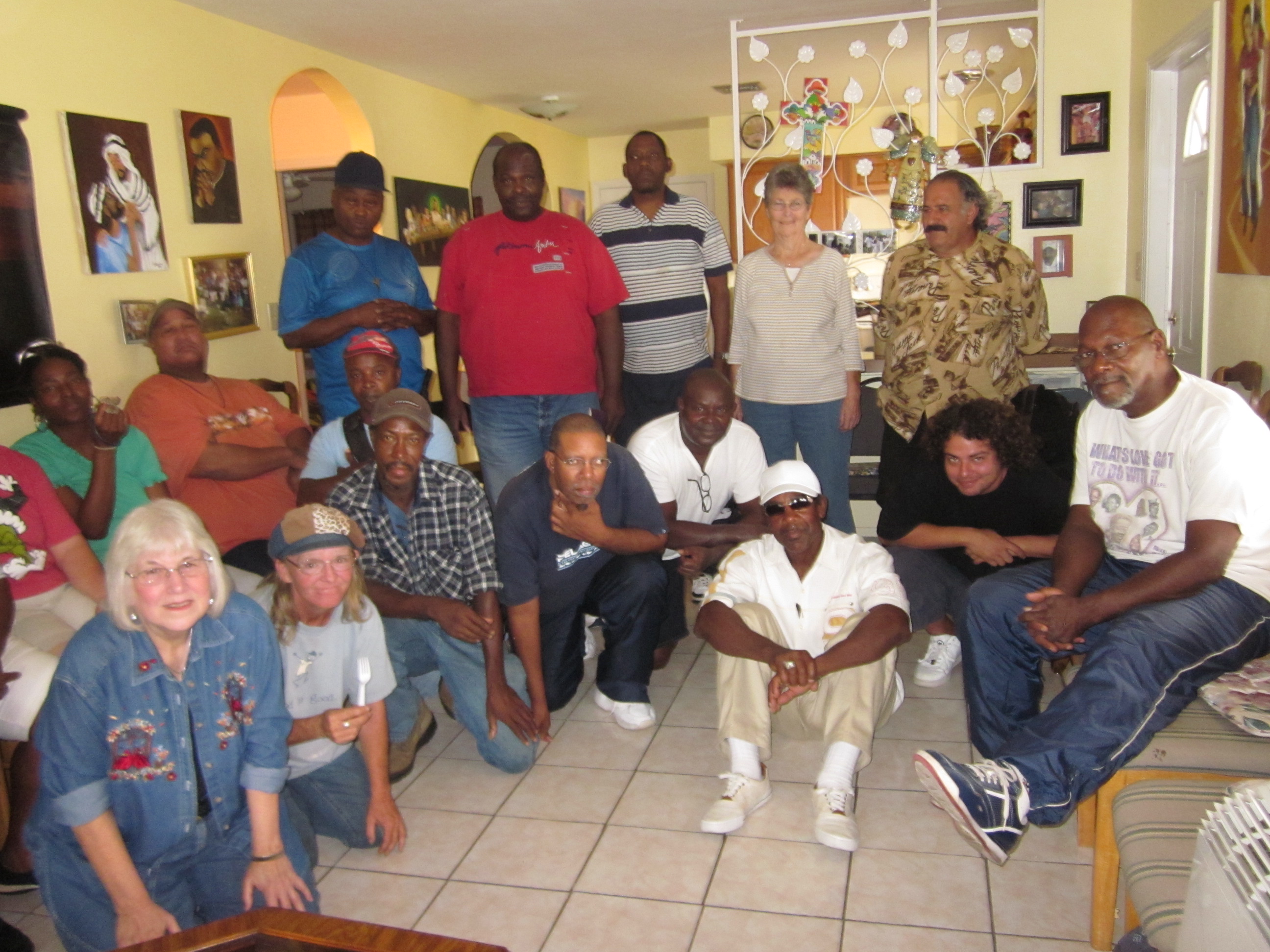 P
P
What It’s All About-Living the Sacraments with the Living Sacrament of God’s People
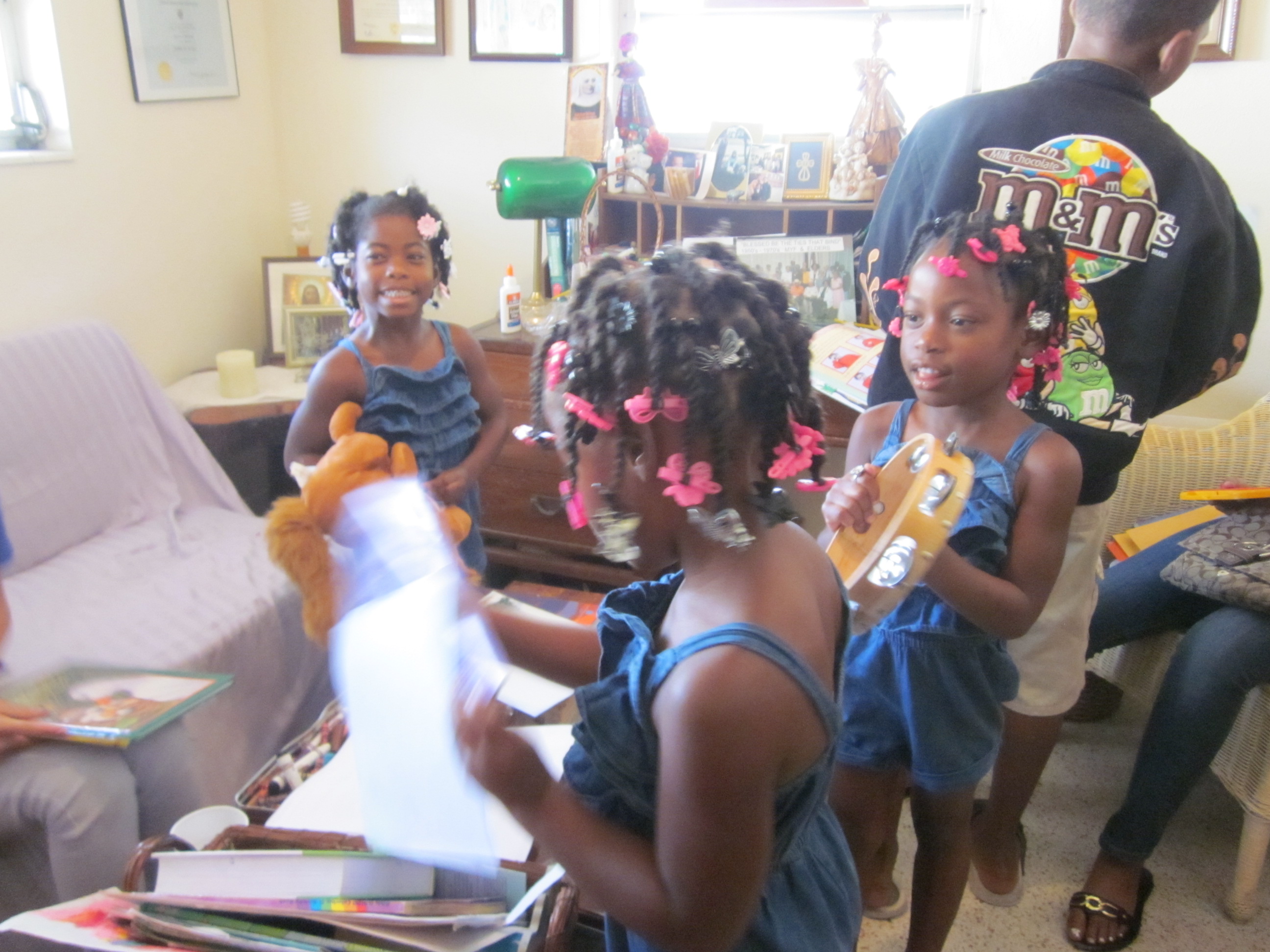
Some of Our Children Gathering For Church-Happy To Be In God’s House
The children hurried in to the church. They were early and after greeting us warmly asked me “Pastor, can you come into the room with us?” “The room” is their Sunday School room and as we had a little time, I went. Each one grabbed her favorite item,tambourine included, and started singing: “Jesus Loves Me”. I sang with them and told them they were right,Jesus did love them very much and I do too! They asked help to start little art projects and settled down freeing me to vest. Well, almost. Donnie ran up to me and hugged me with her usual joy, she told me about a fall she had and asked prayers for herself and her husband who was recently hospitalized. Another mother arrived with her family and we talked quietly about her grief for a hospitalized and seriously ill young adult child. She asked me to meet with the family after church and join them at the bedside later. Tania arrived smiling broadly and thanked Pastor Judy B and me for shepherding her all day Friday. We signed her out of the psychiatric hospital where she had spent over ten days “getting herself back”, as she said, with the help of medications. We were with her until, surmounting many problems almost miraculously, she got an apartment, with her electricity turned on and a bed top sleep on. She wanted to tell the church that God did not abandon her and will not abandon them. Nancy came with the baby we baptized now walking and everyone was so glad to see her. Our member Judy Alves, a retired lawyer arrived with the hot meal and got it ready for serving after church. Dr. Joe Cudjoe helped her, and his wife Pearl and I talked about her Junior class. Some of our old friends returned today. Hank Tessandori began the hymn as we vested. The 40 or so chairs were soon filled and we were ready to begin, Several new homeless people joined us and were warmly welcomed.
The sacrament of the church, the people of God, prepared to meet the sacrament of Christ with us, the body of Christ becoming the body of Christ. They came in joy and sorrow, in exhaustion and in expectation. And we, the priests, the pastors, the women God has called for this job were once again humbled beyond words and in awe of Christ with us. The songs were sung with enthusiasm. The prayers were said and the readings were proclaimed. Our High School senior, Natasha, has become an excellent lector. The homily was given with time for the people to join in. Mr. Gary, our elder, had lost a son to violence last week and shared how his faith was what got him through this. For him, and for Tania and Tim and Nate who spoke Christ is not only their shepherd king who showed us how to serve one another, but a best friend who is always there with and for them. Our time of intercession included prayers that wrenched from the hearts of those who were hurting and sprang from the lips of the faithful. Our hearts stirred as our six year old Joelle prayed fervently for a sick relative and as Nate prayed “to God, our Mother and Father” for Mr. Gary’s grieving family and all of our sick members. Dr. Joe prayed for peace in the troubled places of the world and Hank prayed for the healing of the church.
As Pastor Judy B. prepared us for the Eucharist she welcomed each one there to the Table and explained the significance of the water, ourselves, in the wine-one with Christ. Once again as we served communion we were in awe of the transformation of ourselves and our people through and into the body and blood of Christ in service to one another and the world. I cannot describe the holiness of these moments, experienced at each Eucharist. And the people sang with all their hearts, “Thank you , God, thank you God, we just want to than you God. Eucharist!
After the final hymn we asked our teens Keeron and Keeondra and also Robert an older gentleman to stand for a birthday blessing and to receive gifts from the congregation. Shy but delighted they beamed as we sang “May the good Lord bless you…”.

Then the church was transformed into a dining room and our second eucharistic meal was served and gratefully received.
As the meal was served about ten other homeless and hungry individuals joined us. And here we had the miracle of the loaves and fishes. We would not have had enough food for the last ten people but Judy Alves’ husband, Jim Pelstring ,saw the need and hurried to buy enough to meet the need. All were fed and there were leftovers to take away!

I mingled with our members and with several more new guests arriving.
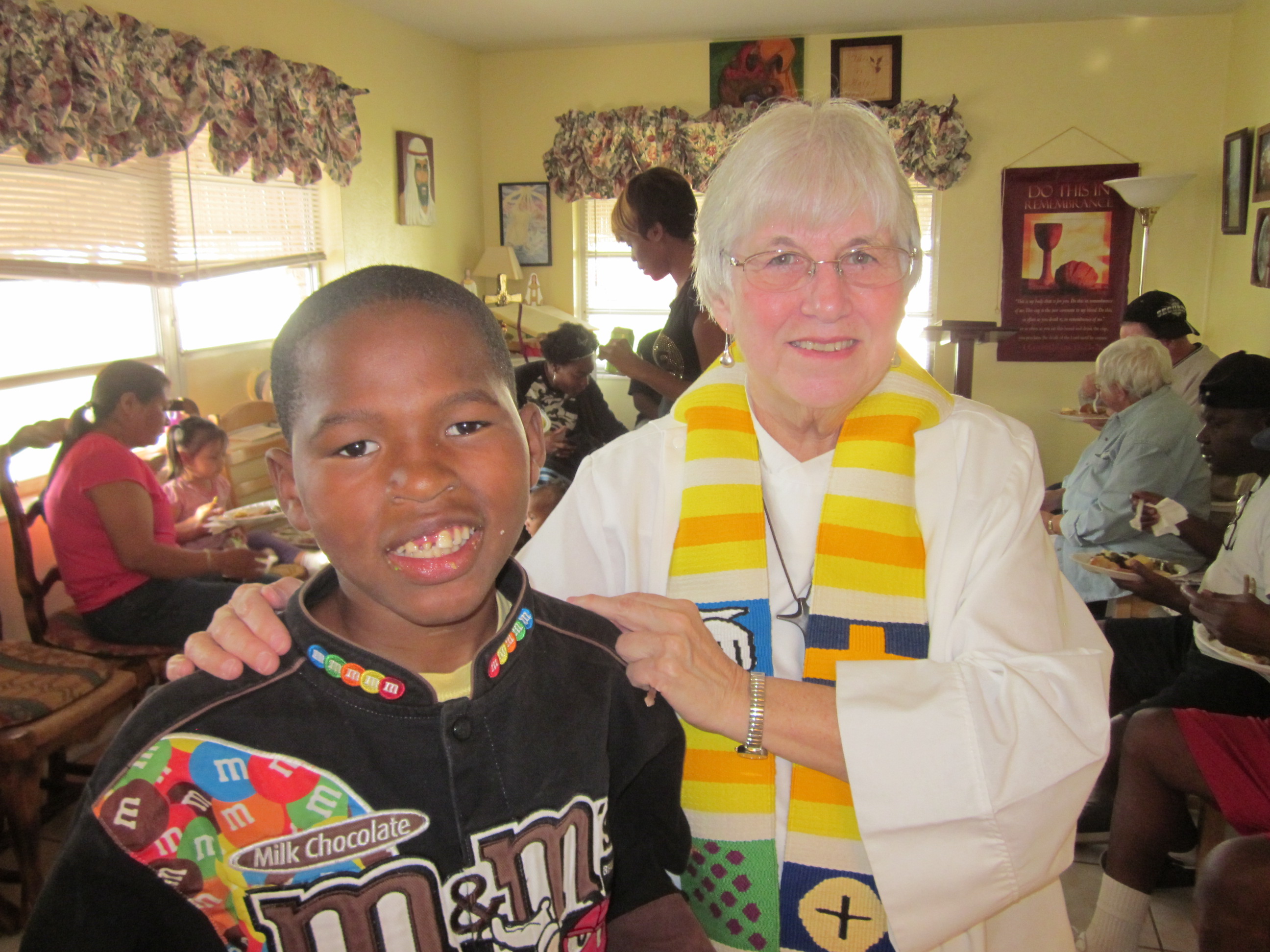

Old friends and new friends
After Sunday School I met with our dear family who faced the critical illness of their young member. We talked and shared feelings that had been pent up. We held hands and prayed. Later we joined them at the bedside in the hospital where seven family members gathered. All prayed as we anointed with blessed oil and prayed with this young person who rallied with this healing rite, and love. As there was already a baptism scheduled and missed because of illness, we all decided to go ahead and baptize then and there. All present took part. I cannot describe for you the peace and joy that supplanted the fear, anxiety and grief-words are not sufficient. The gloom was literally lifted like a dark cloud rising and light and joy replaced it. We sang, “Take Me To The River To Be Baptized” adding a stanza-“This one is the righteous and shall see God!” We ended with “Oh Happy Day” and much closeness and love.
Three Sacraments in one Sunday-Eucharist and eucharist; the healing rite and baptism. No, five, the sacrament of the church, the people of God, and the sacrament of love included. How blessed are we. How amazed and moved we are to be called to this priesthood, the priesthood of all believers. How thankful Judy B and I are for the privilege of serving God’s holy people. Thanks be to God! Happy Thanksgiving to all.
Pastor Judy Lee, ARCWP
Good Shepherd Inclusive Catholic Community,
Fort Myers, Florida
Women Priests Bingle and Lee Dialogue on Christ The King – Homilies Nov 24,2013
Introduction:
This Sunday the church celebrates Christ the King. In our post-modern era we know little about kings and value democracy and participatory forms of government. There are examples of ‘good kings’, but for us ‘kings’ are synonomous with dictators. But when Jesus was born corrupt kings and puppet kings like King Herod were alive and well. The Hebrew people wanted a king to conquer Herod and the Romans and restore Israel.
What kind of King was Jesus, the Christ? Did he accept kingship as his mission? Our gospel today is from the cross where Jesus suffers greatly, is crowned with thorns, and still tells the thief who recognized his power beyond death ” “today you shall be with me in paradise”. (Luke 23;43) This is the king with the power of life, including eternal life and every encounter with Jesus is life-giving, now and forever. Paradise, according to George Lamsa, (Idioms in the Bible Explained… p.59) is a Persian word for a beautiful garden; a place of harmony and tranquility”. The kingdom or kin-dom (family) of God on earth and forever is a place of harmony-a peaceful kingdom. The old adage, if you want peace work for justice applies. The operative word is “WORK” for the reign of God to come. As Samuel anointed David a king to shepherd God’s people, Jesus teaches us by word and deed what a good shepherd is and does, and what a shepherd king does.
On Palm Sunday Jesus fulfilled the prophecy of Zephaniah 9:9 “Look here your King comes to you; he is just and a savior,meek and riding upon an ass, upon a coal, the foal of an ass”. Only the poorest of people in the Near East would ride on a donkey-never a prince or nobleman as an ass usually signified disgrace, rejection and humiliation. Jesus chose to ride the colt because he represented the old ideas of the Israelite rulers who lived among the people in meekness and humility not as overlords”. (Rocco Errico “…And There Was Light, pp. 133-135). He would not fulfill the hopes of some for political victory or military might but he would fulfill his destiny in showing the way of truth, no matter what it cost him. (John 18 37 a). In John’s Gospel he says that his kingdom is not “of this world”,not political or military, but it is the peaceable kingdom coming into the world through radical love and justice for the poor, exploited, outcast and left out. What a wonderful leader,our servant king.
Rev. Bingle and I agree that Jesus is not a king of domination but a king of serving one another. In the women priest movement we rarely use the word “Lord” because of the connotation of “lording it over” that goes with it and Jesus was never one to “lord it over” anyone, as. Rev. Bingle says he became upset with his disciples when they wanted power for him and for themselves. He was not about power but he was about transformation of people and nations. That took a whole different kind of power. The power of radical love.
Rev. Beverly Bingle’s Homily:
” If there’s one thing that history teaches us for sure, it’s that it’s
easy to stray from Jesus’ message. While he was still walking among
them, even his closest disciples gave him problems. They struggled
with who he was. His way was outside their understanding—above all
they had even dared to think, beyond anything they had ever hoped. He
showed them God’s presence. It was a heady experience.
They saw him feed 5,000 people by sharing five loaves and two fish.
They wanted to make him king. Jesus said no—I’m not a king and don’t
want to be—and he went into hiding.
Peter suggested kingship, and Jesus called him a devil for suggesting
that Jesus would want to be exalted to use power and force over
people.
James and John wanted seats at the right and left hand of power, and
Jesus was disturbed at them. He told them it couldn’t be that way
with them because those in power who don’t know God try to lord it
over others. He told them that the one who leads has to be the
servant of all.
Jesus taught jubilee justice—a “year of favor” that comes when we
share what we have, reach out to heal and comfort, befriend the weak
and forgotten, lift up the poor. In the Sermon on the Mount he
praised the peacemakers and applauded the folks who work for justice.
His message was clear: Jesus preached the dignity and worth of every
person, and that threatened the powerful in church and state. Those
rulers had to be #1. They wanted to be on top, and they would do
anything to stay there. Jesus was too much for them. So they arrested
him and executed him. After he died, the disciples continued to
experience his presence still with them, to remember what he had said
and done. They re-told the story, trying to describe this
extraordinary man who showed them the way to a place of peace and
justice on earth. Their experience of Jesus was beyond words, but
they had to use words to describe it. Ironically, from the very
beginning they chose the word that Jesus himself had rejected: king.
People are still alive who remember when this Solemnity of Christ the
King was set in stone, back in 1924, at the end of World War I, to a
people devastated by the killing of millions by the violent powers of
states around the world, by a Pope living in the midst of kings and
carnage. It was a statement that called for allegiance to God and
turning away from the violence of that war and the earthly kings who
had caused it. The Church was trying to make clear that the world
that counts is God’s world, the power that counts is God’s power. Not
land. Not stockpiles of oil or corn or gold. Not Wall Street. Not
Main Street. Not the power of guns and bombs. That kind of
domination leadership—the kingship of oppression—is still with us.
“Watch out for good ol’ number one,” we hear. “Take care of yourself;
nobody else will.” Like the disciples, we miss the point.
Last month the Eagles football team at Olivet Middle School in
Michigan chose to use their power the way Jesus did. Unknown to their
coach, the 8th graders put their heads together and came up with a
play that gently nudged their Downs Syndrome teammate into the end
zone for a touchdown. Not only did the team’s action lift Keith Orr,
it helped them, too. As one of the team members said, “I kind of went
from being somebody who mostly cared about myself and my friends to
caring about everyone and trying to make everyone’s day and everyone’s
life.” They gave up their glory and used their power for someone
else’s good.
We have that kind of power. Some of us have political power—to write
to Congress, to cast a vote for the common good. Some of us have
economic power—to hire help, to spare a couple of bucks. Some of us
have personal power—to smile, to say hi, to phone a friend, to visit a
hospitalized neighbor, to take a welcome cake to a new neighbor.
Every time we send the price of a pizza to a charity—every time we
stand aside and open a door for someone—we use our power for good.
When we do that—when we love and serve others—we get Jesus’ message
straight.”
—
Holy Spirit Catholic Community
Mass at 2086 Brookdale (Interfaith Chapel):
Saturdays at 4:30 p.m.
Sundays at 9 a.m.
Mass at 3535 Executive Parkway (Unity of Toledo)
Sundays at 5:30 p.m.
www.holyspirittoledo.org
Rev. Bev Bingle, Pastor
****************************************************************************************
Following King Jesus Pastor Judy Lee
Following Jesus means to imitate Jesus, and that is hard to do.
Like the disciples, we often misunderstand what Jesus said and did. He hung out with sinners and outcast people, he accepted women as equals, he reversed the order of things-the last shall be first- and he put the poor and oppressed, the outcast and the stranger and foreigner ahead of the religious and arrogant folks of the times. As Rev. Bingle said he threatened the powers that be and they nailed him to the cross. Yet, death could not hold him.
For most of us, there is little persecution and no threat of death, but it is still necessary and often difficult to put serving God’s people first and to put the poorest among us, justice and peace above self-interest. The story of Oscar Romero is an inspiration to us as we try, as he did, to imitate the life of Christ. Romero lives again not only in the Salvadorian people but in all who work and risk for the kindom of God to come on earth, the kindom of love and justice for all, the “peaceable kingdom.”
This is by Brother David who is quoting from a book by Robert Ellsberg cited at the bottom. With Archbishop Romero may we believe in and strengthen “the church of God, the people” so it will rise again from the ashes and never die.
URL http://www.gratefulness.org/giftpeople/romero.htm
“At the same time he (Romero) seemed to draw strength and courage from the poor campesinos, who embraced him with affection and understanding. “With this people,” he said, “it is not hard to be a good shepherd.”
“When you hear the voice of the man commanding you to kill, remember instead the voice of God. Thou Shalt Not Kill”
The social contradictions in El Salvador were rapidly reaching the point of explosion. Coups, countercoups, and fraudulent elections brought forth a succession of governments, each promising reform, while leaving the military and the death squads free to suppress the popular demand for justice. As avenues for peaceful change were systematically thwarted, full-scale civil war became inevitable. In 1980, weeks before his death, Romero sent a letter to President Jimmy Carter appealing for a halt to further U.S. military assistance to the junta, “thus avoiding greater bloodshed in this suffering country.” On March 23, 1980, the day before his death, he appealed directly to the members of the military, calling on them to refuse illegal orders:
“We are your people. The peasants you kill are your own brothers and sisters. When you hear the voice of the man commanding you to kill, remember instead the voice of God. Thou Shalt Not Kill….In the name of God, in the name of our tormented people whose cries rise up to heaven, I beseech you, I beg you, I command you, stop the repression.”
The next day, as he was saying Mass in the chapel of the Carmelite Sisters’ cancer hospital where he lived, a single rifle shot was fired from the rear of the chapel. Romero was struck in the heart and died within minutes.
 Romero was immediately acclaimed by the people of El Salvador, and indeed by the poor throughout Latin America, as a true martyr and saint. For Romero, who clearly anticipated his fate, there was never any doubt as to the meaning of such a death. In an interview two weeks before his assassination, he said:
“I have frequently been threatened with death. I must say that, as a Christian, I do not believe in death but in the resurrection. If they kill me, I shall rise again in the Salvadoran people.
“Martyrdom is a great gift from God that I do not believe I have earned. But if God accepts the sacrifice of my life then may my blood be the seed of liberty, and a sign of the hope that will soon become a reality… A bishop will die, but the church of God – the people – will never die.” “
Sincere thanks to Robert Ellsberg
for permission to use this chapter from his book All Saints: Daily Reflections on Saints, Prophets, and Witnesses From Our Time. “Since soon after it came out; I have used this book for daily spiritual reading and still find it inspiring.” —Br. David
______________________________________________________
Blessings to all as we celebrate Christ the Servant King’
Pastor Judy Lee,ARCWP
Shadowing The Ministry Of Healing and Presence with Pastors Lee and Beaumont
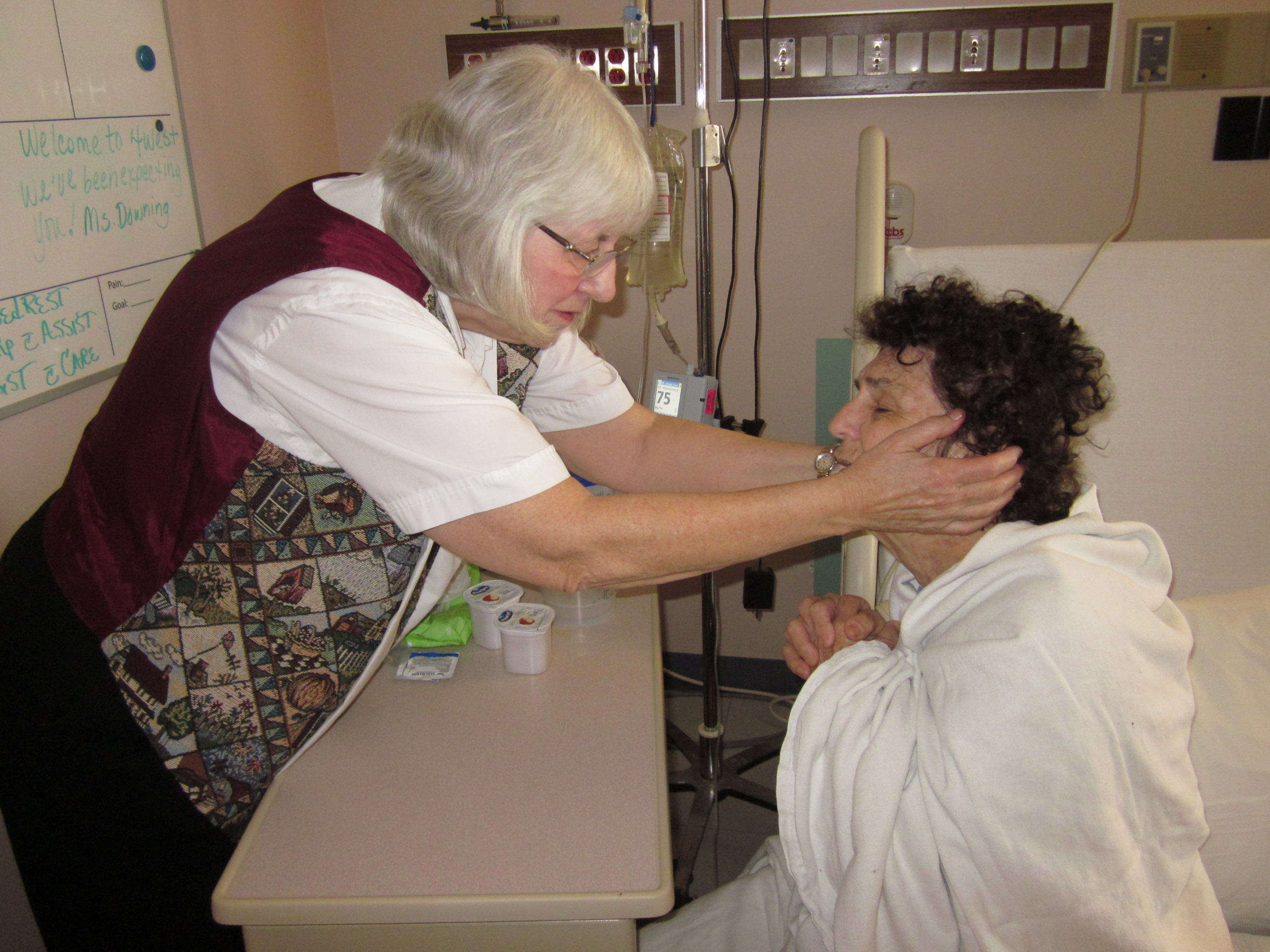
This is Pastor Judy Lee with Joann in the Hospital on Thurs. 11/13/13-The laying on of hands
Sometimes illness hits hard and we are unprepared. How can we ever be prepared for that which is unknown and perhaps life threatening? At that times it is so good to call upon those who can pray with us and simply be with us. When I get those calls these days, after my own bout with a rare slow growing stomach cancer and thankfully successful surgery in February of this year, I respond empathically from the deepest level within me. I respond in the Spirit of our loving God. Pastor Judy B. who has gone through, and thankfully through, three cancers responds from the same place. Perhaps that was gift that God has given us as we struggled and overcame with our own illnesses,
Our first call on Thursday was from Joann, nearly 80, who has suffered with many illnesses. We have ministered to and with her and her family for almost fifteen years. We stood together in this same hospital just a few years ago when her beloved husband said good-bye to her and embraced life forever with God. Depleted and dehydrated she was admitted to the Hospital for hydration and study. She is frightened but a woman of strong abiding faith.We visited and discussed her condition and her concerns. We anointed her with the rite of the Church and this brought her great comfort. In the profound quiet of silent prayer in the laying on of hands there is a power beyond description. The above noted picture captures but a bit of it. There is a being with that surpasses any words. Anxiety turned to peace before our eyes.
The reading from the book of James (Chapter 5: 14-15) is shared at the beginning of the rite of anointing. It is such a good one to guide us in this: “Are any of you sick? Then call for the presbyters(translated elders or priests) of the church,and have them pray over those who are sick and anoint them with oil in the name of Christ. And this prayer offered in faith will make them well,and Christ will raise them up…” It is Christ that raises up the sick and all of us.
Our second hospital call was a difficult one as a young person was involved, one we had known since she was twelve years old and I ministered in the Middle schools. She is now 22 and recently diagnosed with HIV+. She and her family are overwhelmed by this news. And while people now live with HIV+ like a chronic but treatable disease, this young woman has become very ill and is already symptomatic. The adults in the family are in mourning and some are in denial. The young people and children are anxious and worried although the whole family shares a strong faith. We prayed and maintained presence with this brave young woman although she could hardly speak. We took the family in our arms and prayed with them. Prayer and presence makes the difference in hope and despair. May each one feel our loving God with them every moment of the day.
Before we went on to our last visit in another hospital we stopped to visit with some of our children. Maintaining loving presence with our children is a priority with us. “Then small children were brought to Jesus so he could lay hands on them and pray for them.The disciples began to scold the parents but Jesus said, let the children come to me and do not hinder them, the kindom of God belongs to such as these. And after laying hands on them,Jesus left that town” ” (Matt. 19: 13-15). Again, we see and feel the power of the laying on of hands and prayer. The triplets have just had their fifth birthday and were excited to see us. Keion was resting after school but his smile made our day!

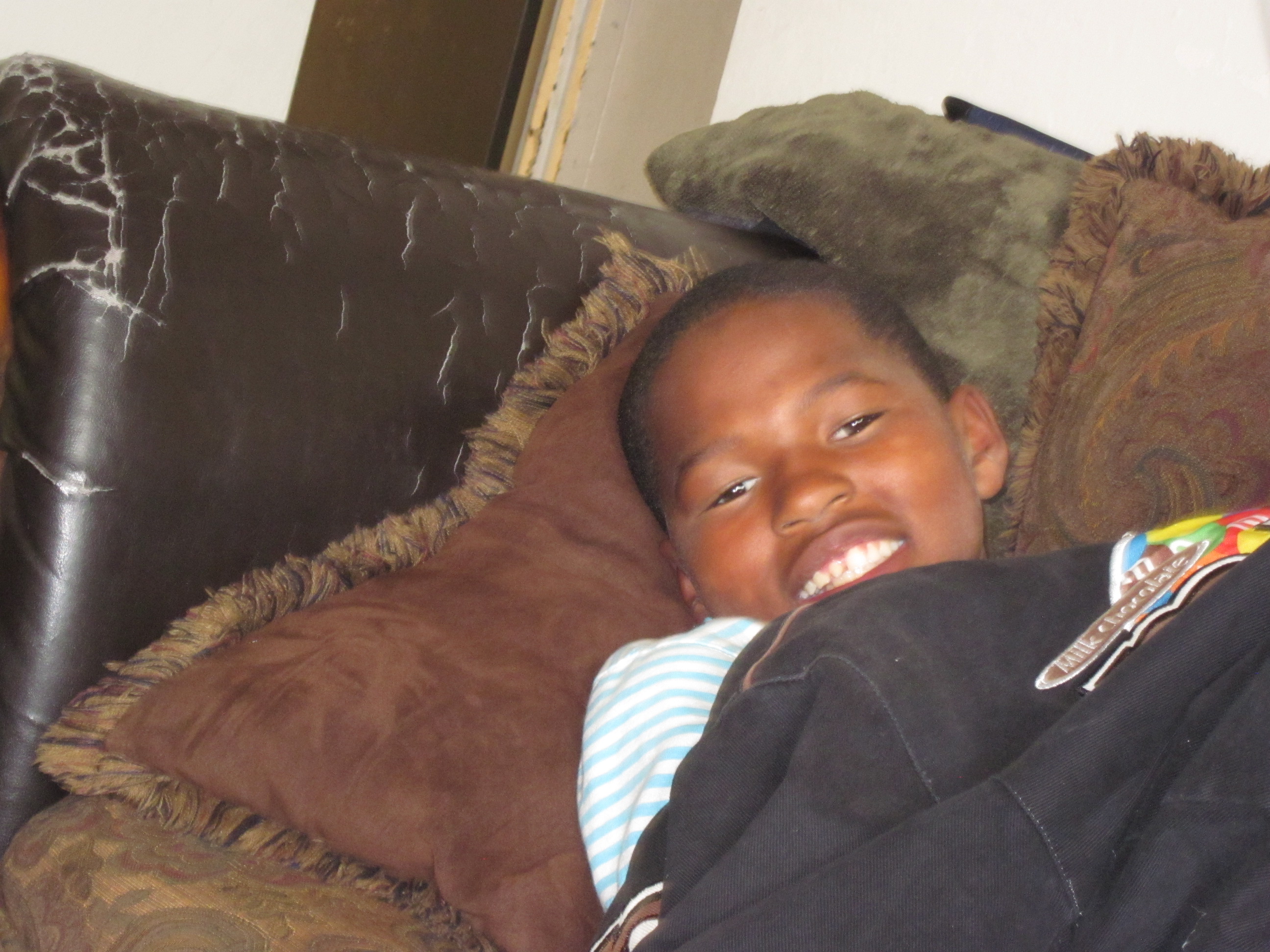
Our last visit was to Tania in the Psychiatric Hospital. Last Tuesday we helped her in her admission there and we now followed up with her possible discharge planning. She is now homeless and has nowhere to go and and was also struggling with accepting her medications again. After we prayed she felt happiness and peace. She took her medicine to the relief of Staff and we involved the Discharge planner in discussing her options. We are hopeful that she will accept and enjoy the housing we have found for her.
Prayer and presence, being with and raising up. Thanks be to God!
Pastor Judy Lee, ARCWP
11/14/13
Colombian Theologian Consuelo Velez Discusses Women in the Church- True Service Not Servitude

This is Colombian woman Priest Olga Lucia Alvarez (second from left) with Priests Judy Lee and Barbara Duff and Bishop Bridget Mary Meehan at a gathering of the Association of Roman Catholic Women Priests
Acclaimed Latin American Theologian Consuelo Velez has written a very good article about women in the church related to the hopes of Pope Francis to find another level of service and not servitude for women in the church. She points out that the Pope is aware of theology of women and the efforts of women theologians. The only lack in this fine article is that she seems unaware of the existence of Roman Catholic women priests. As there are already two in her own country of Colombia, and more on the way, we would hope to dialogue with her and let her know that the hope for the ordination of women who are called and prepared has already happened, and is continually happening.And, perhaps of equal importance. ordained women are renewing the church, sharing with the priesthood of all believers and serving the poor and outcast as Jesus did. Inclusivity is what we learn from Jesus. The established Roman Catholic Church in later centuries moved away from what Jesus did and taught toward exclusivity and our renewal is critical to church survival and evangelism.
The article is shared by our ARCWP Priest in Colombia Olga Lucia Alvarez and from the blog of the Barefoot Church/ Iglesia Descalza
The Presence of Women in the Church
Posted: 12 Nov 2013 10:24 AM PST
Biblioteca Amerindia
November 9, 2013
Among the many “different” things Pope Francis has said are his references to women. He said that it pains him that often women’s role in the Church is “servitude” and not “service” and he has stated the need to do a “theology of women” so that the latter can hold more significant posts within the Church since “the Virgin Mary was more important than the apostles, bishops, deacons and priests, and women are more important than bishops and priests.” (interview granted on the flight back to Rome after WYD-Rio) He has also highlighted the role of women as mothers and the feminine dimension of the Church, but he has said the role of women is not reduced to their maternity, although they must not renounce it in favor of getting other roles in society.
It’s good that the Pope is talking about this because it confirms that when we women refer to the situation of women in the church, we are right and it also gives us more freedom to talk about it in the face of some of the voices in the Church who get “irritated” or think it’s unnecessary to address these issues.
How do we make it possible for women’s role in the Church to be their rightful one? For the time being, it would be very important for women’s theological work to be better known, studied, and evaluated. It’s not that there is no theology of women. There’s a lot of it and it’s very good. It’s possible that there isn’t a theology of women that is accepted by the Vatican that promotes more substantive changes and that must be what the Pope meant when he stated the need for a theology of women. In fact, when he was Archbishop of Buenos Aires, he endorsed the holding of the First Congress of Latin American and German Women Theologians in 2008 and, undoubtedly, he knows about many other events and publications along that line.
But what is this theology of the woman that is already being done? We should highlight the Biblical work that has reclaimed the presence of women in the Bible and their role in the constitution of the early Christian communities. But there’s also work in other fields of theology such as theological anthropology, Christology, ecclesiology, sacraments etc… In these topics, the feminine face of God –so often forgotten — and God’s saving message for men and women concretely and according to their specific reality, are reclaimed. For example, it’s not the same to speak of gift and sacrifice to women as to men. In a patriarchal society such as the one that still persists, that argument has led some women to the “servitude” that Pope Francis is criticizing, denying their dignity and suffering the tragedy of domestic violence, among others. Women’s theology works to regain the dignity of women so often denied by patriarchal society and supported in some ways by a “distorted” religious view, and it substantiates that this is not God’s will but that, on the contrary, God’s plan of salvation proposes a “community of equals” where gender differences would not be the reason for the subordination of either of the genders to the other one.
Although all this seems obvious, it’s still not a reality in Church practice. It’s enough to see the ministers of Holy Communion giving out the Eucharist. There, one notices that the faithful prefer to receive the Eucharist first from the priests, then from laymen, and often, the line for the woman [minister of Holy Communion] is empty. Thus they reproduce the clerical style that impedes a Church of communion. And though many more women than men go to Church and they lead catechism and apostolic groups, their words and initiative are often not acknowledged by the ordained ministers, and real parochial councils, where the priest recognizes the voice of the laity — and women, of course — in the journey of the ecclesial community, aren’t promoted.
It has always been said that change comes from the grassroots. But in this case it seems that the roots of the Church are very passive and that it’s the will of a leader — the Pope — that is raising awareness and making us see that things could be different. In any case, change will come from working together and that’s why we have to be responsible in the face of these challenges and ask ourselves sincerely: What is the effective participation of women in decision-making positions in our local communities? How much credibility are they granted? Are the theological works of women taught in the seminaries and schools of theology? Is there enough humility to acknowledge the difference between what ought to be and the reality of women in the Church? Will we review our praxis and correct the mistakes?
This is a task we have pending in this Church we love and that needs to be renewed according to the will of God, in this specific case, seeking to make effective that in Christ Jesus “there is neither Jew nor Greek, slave nor free person, there is not male and female.”(Gal 3: 28)
Consuelo Vélez has a PhD in Theology from the Pontifical Catholic University of Rio de Janeiro, Brazil, with post-doctoral studies at Boston College. She is professor of Theology at the Pontificia Universidad Xaveriana in Bogota, Colombia.
Judy Lee, ARCWP
 judyablfollowingSheWhoIs
Recent Comments