Home

  • Breaking News! Women Priests and Male Priest Fast and Occupy Steps of Vatican Embassy

    Breaking News! Women Priests and Male Priest Fast and Occupy Steps of Vatican Embassy in Washington DC

    Roman Catholic Women Priests: (left to right)
     Jane Via, Janice Sevre Duszynska, and former Maryknoll Priest Roy Bourgeois occupy steps of Vatican Embassy on Holy Thursday to protest Vatican policy on women priests.

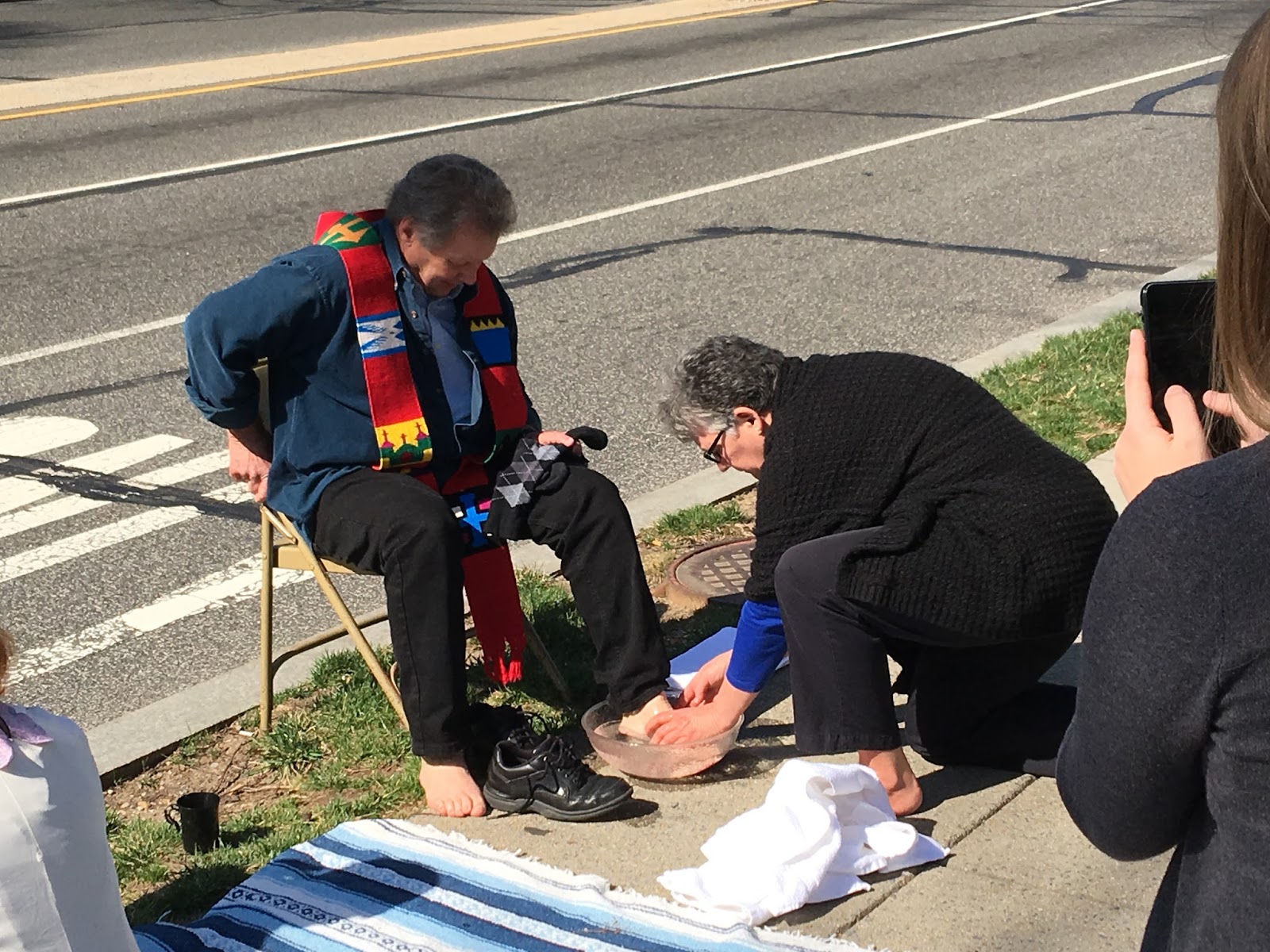
    From right to left: Roy Bourgeois,  Janice Sevre Duszynska ARCWP and Jane Via RCWP wash feet in remembrance of Jesus call to service at Last Supper. 


    On Holy Thursday, March 24th at 10 a.m., people from around the country gathered for a foot washing ceremony and protest in front of the Vatican Embassy, 3339 Massachusetts Ave. NW in Washington, D.C.

    After a Holy Thursday foot washing ceremony, three Roman Catholic  priests Janice Sevre Duszynska, ARCWP, Jane Via, RCWP and Roy Bourgeois delivered a statement to the Papal Nuncio for Pope Francis calling for women’s ordination and justice for women and gays in the Roman Catholic Church. They are fasting and occupying the steps of the Vatican Embassy in Washington, DC. until they get a response from Pope Francis. See the attached statement below: 

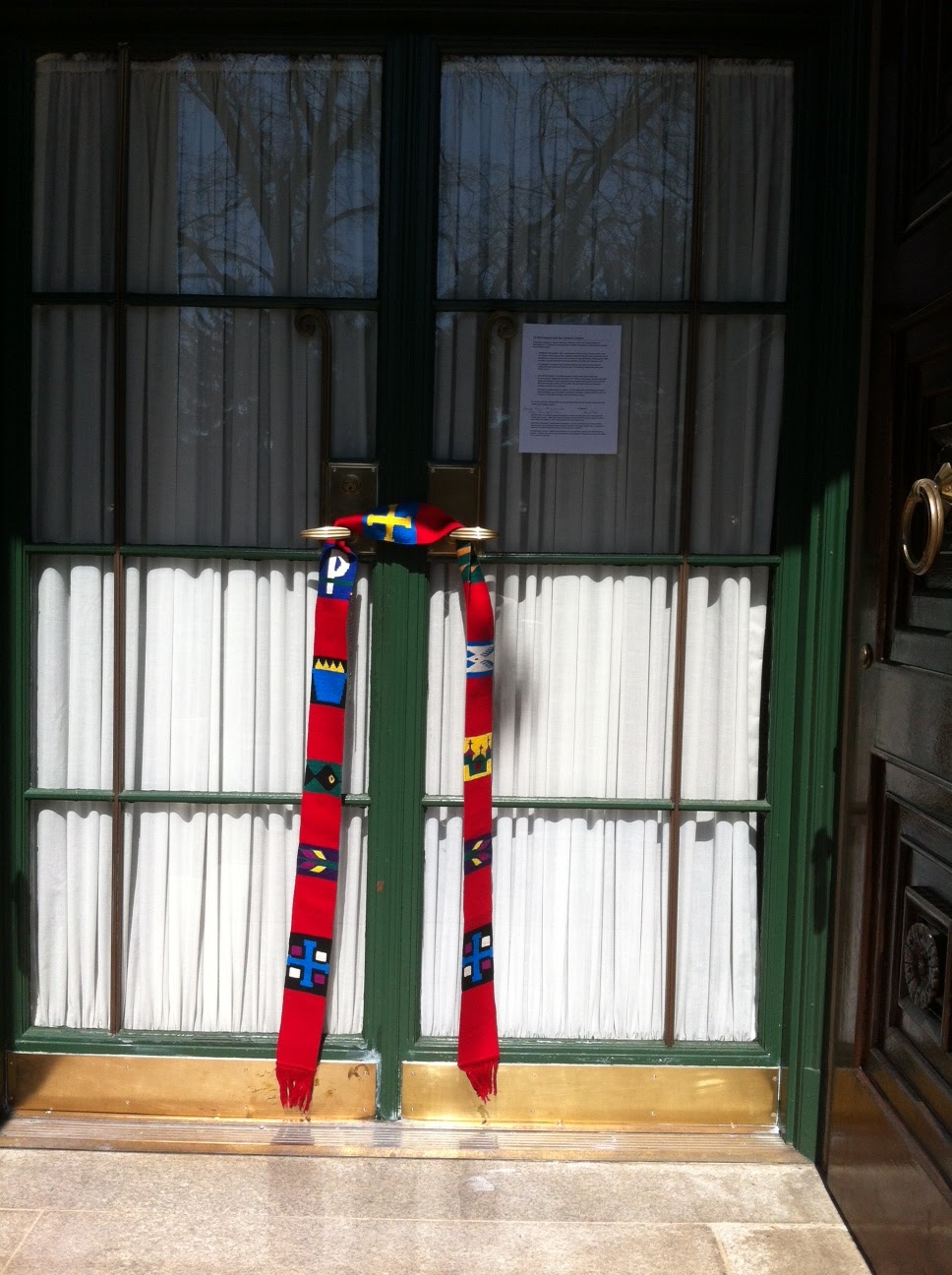
    Stole and Statement placed on Vatican Embassy Door by Roman Catholic Priests
    Read statement below to Pope Francis


    On Holy Thursday, March 24th at 10 a.m., people from around the country gathered for a foot washing ceremony and protest in front of the Vatican Embassy, 3339 Massachusetts Ave. NW in Washington, D.C.

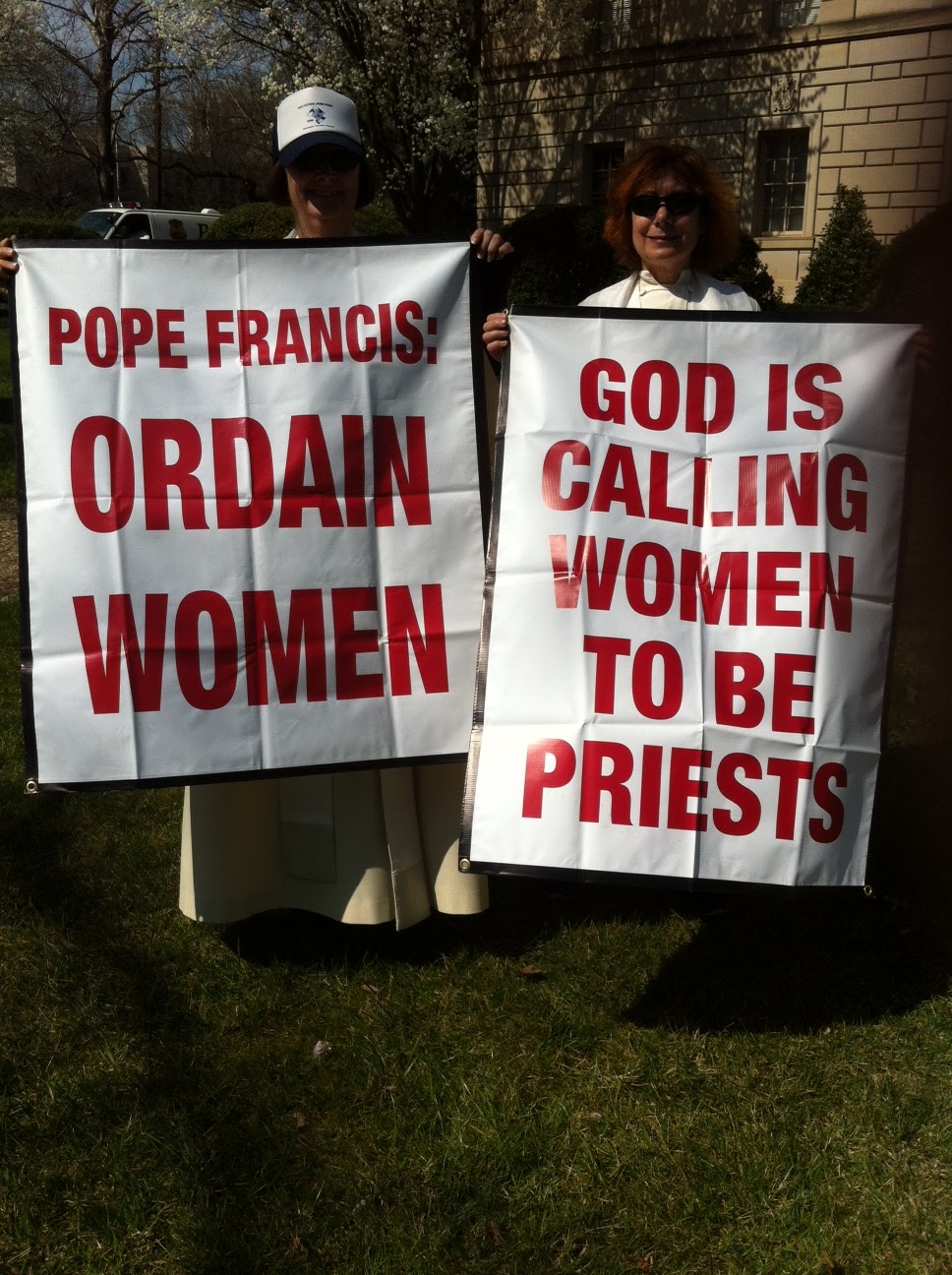
    Janice Sevre Duszynska, ARCWP in front of Vatican Embassy on Holy Thursday, March 24, 2016

    TO POPE FRANCIS AND THE CATHOLIC CHURCH:

    “Where there is injustice, silence is complicity. We have come to the Vatican Embassy in Washington, D.C., to speak out against the grave injustice being done to women and gay people by the Catholic Church.

    1. WOMEN IN THE CHURCH: God created women and men equal: ‘There is neither male nor female. In Christ you are one.’ (Galatians 3:28) God calls both men and women to the priesthood, but Catholic women who are called are rejected because of their gender. Who are men to say that their call from God is authentic, but God’s call to women is not?

    The ordination of women is not a problem with God, but with an all-male clerical culture that views women as inferior to men. The problem is sexism and sexism, like racism, is a sin.

    2. GAYS IN THE CHURCH: The official teaching of the Catholic Church states that homosexuals are ‘objectively disordered.’ For millions of gay people, this teaching instills shame and self-hatred. It has contributed to gay people being rejected by their families, fired from their jobs, bullied and even killed. This teaching has also contributed to suicides, especially among teenagers.

    God does not make mistakes in creation. Our all-loving God created everyone of equal worth and dignity: gay and straight. Our Church’s teaching on homosexuality is cruel and is based on a theology inconsistent with the teaching of Jesus. 

    We are here today to call upon Pope Francis and the Catholic Church to ordain women and start treating LGBT people as equals.”

    Jane Via, Ph.D., J.D. is a former professor of theology, a retired county prosecutor and an ordained Roman Catholic Woman Priest. In 2005, she founded an independent Catholic parish in the Roman Catholic tradition which thrives in San Diego, CA. She is married and has two adult, feminist sons.”

    Janice Sevre-Duszynska, D.Min., a retired teacher and journalist, is an activist priest in the Association of Roman Catholic Women Priests and an international leader for women’s equality in the Roman Catholic Church. Her journey is explored in the award-winning documentary, “Pink Smoke Over the Vatican.”

    Roy Bourgeois served as a Catholic priest for 40 years. He is a Purple Heart recipient and a Nobel Peace Prize nominee. In 2012, he was expelled from the priesthood and the Maryknoll Fathers because of his public support for the ordination of women.

    For decades the Roman Catholic Church only washed men’s feet on Holy Thursday, Pope Francis has ordered a change in the law. However, Pope Francis must go further, the full equality of women including ordination is the will of God because women are created in God’s image, Jesus called women and men to be disciples and equals and the church ordained women during the first 1200 years of its history. 
     Bridget Mary Meehan, 
    bishop of the Association of Roman Catholic Women Priests, email sofiabmm@aol.com
    Bridgetmarysblog.com
  • Holy Thursday: The Bread of Life, The Bread of Our Lives

    IMG_0055 (1)

    Francis DeBernardo, Editor's avatarBondings 2.0

    Last Supper by Brother Mickey McGrath, OSFS (20th-21st century)

    In each of our lives Jesus comes as the Bread of Life–to be eaten, to be consumed by us. This is how He loves us.

    Then Jesus comes in our human life as the hungry one, the other, hoping to be fed with the Bread of our life, our hearts by loving, and our hands by serving.

    In loving and serving, we prove that we have been created in the likeness of God, for God is Love and when we love we are like God.

    –Blessed Mother Teresa of Calcutta, “Jesus Christ: He Wants to Love With Our Hearts and Serve With Our Hands,”  1997.

    View original post

  • Rejoice! Blessed is the One who comes…Two Roman Catholic Women Priests reflect on Palm Sunday

    IMG_0178

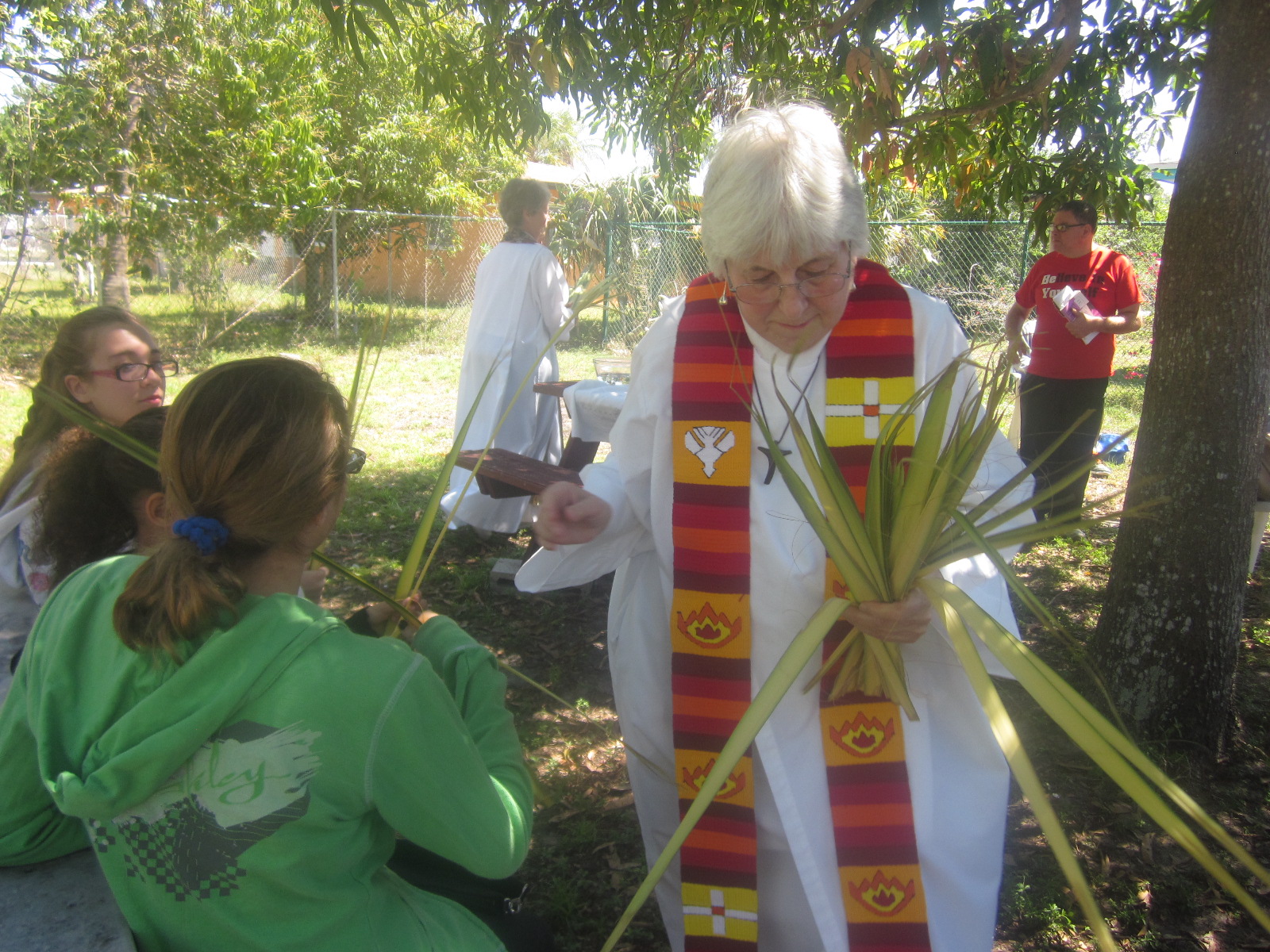
    Churches all over the world will be adorned in palm branches this Sunday commemorating the joyful entry of Jesus into Jerusalem seated on the back of a donkey. In our church as in many Roman Catholic and other churches, people will gather,carrying palms and singing Hosanna, Hosanna in the Highest, as was done for the first time by the crowd welcoming Jesus into Jerusalem. Here we present my Palm Sunday reflections along with that of Rev. Chava Redonnet of Oscar Romero Mission Church in Rochester, New York.

    This year the Gospel of Luke 19:28-40  will be read and we will see Jesus enacting the prophecy about the coming of Zion’s ruler in Zechariah 9:9-10. “Rejoice in heart and soul….Shout with gladness daughter of Jerusalem! Look! Your ruler comes to you: victorious and triumphant, humble, riding on a donkey, on a colt, the foal of a donkey.”(TIB) The NAB translation of this verse read: “Shout for joy…See, your king shall come to you; a just savior he is, meek and riding on the foal of an ass”.   The Peshitta (Near Eastern translation from Jesus’ Aramaic) reads “…he is righteous and a Savior, lowly and riding…upon a colt, the foal of an ass”.  The fulfillment of this prophecy about the Messiah is why Jesus sent his disciples to get the colt he would ride on into Jerusalem.  To ride on a donkey in that age was more a sign of humiliation than royalty, for only the poor rode on donkeys. Royalty rode on fine horses or in transport pulled by powerful steeds.  So, here is Jesus the king of the poor and outcast, for he had loved them, healed them, taught them and won their hearts, now welcomed by them with great joy. They spread their cloaks on the ground before him and the “whole multitude of his disciples”praised God for the mighty things they had seen. They  shouted “Hosanna” which means “Save” in Hebrew but is a song of praise. Matthew’s Gospel says “the whole city was stirred up” at his arrival.

    The account of Jesus triumphal entry into Jerusalem is in all four Gospels. John’s Gospel (Ch 12) adds that the people recalled the raising of Lazarus and thronged around him. “Look, the whole world has gone after him! (12:19b). In Luke’s (Ch 19) account Jesus was asked by the Pharisees to quiet his disciples. He said that if they were quiet even the stones would cry out! This was a time of acclamation and joy, the universe itself was in accord. I think that the joyful shouts of acclamation filled Jesus’ heart and even for a short while he knew that despite what lied ahead, and he had already predicted that, he had accomplished his mission- the ordinary, the poor, the sick and the outcast along with his other disciples, men and women and children, knew who he was and would carry on his work. This deep knowledge and his always close Abba, Amma God (Papa, Mama) gave him the strength to face what was ahead of him.

    And, then as he drew close to Jerusalem , Jesus wept for Jerusalem(Luke 19:41) and the people as they did not accept the prophets before him, or him-“you did not recognize the time of God’s coming to you”- and destruction not peace would come to them.  The oppressors would win after all in Jerusalem and for this, he wept. Then, he entered the Temple and further enraged the authorities by throwing out the money changers and the sellers of animals, doves and others, for sacrifice. In essence, He set those birds and animals free and put the place where God was supposed to live back into God-perspective. God doesn’t want any form of animal or living sacrifice, God wants lives and hearts full of justice and love for everyone.   This is to be a house of prayer!  The ensuing parable of the tenants in the vineyard ( Luke 20:1-19) where the owner has to send his son because the others collecting the debt were killed and the son is also killed tells us what will happen next.

    On Palm Sunday I like to stop a while and savor the victory with Jesus.  Let us take time with Jesus to deeply feel the affirmations of those we have come to serve and of those who love us. Take time to feel the love. Take time to feel the joy of the moment when we too fulfill what we have come to do and when all is well. Do not rush ahead to when the price we pay for living the Gospel and the inevitable troubles of life weigh heavy on us. Jesus’entire ministry is about loving relationship as he shares his loving Abba/Amma God with all around him in his every action and word that says ‘all are welcome, come closer’.

    Jesus’ joy was short- lived because his work was not done-he got off that little donkey and kept on going with his actions and his teaching that angered the establishment. I think the strength of the heartfelt Hosannas propelled him on. I also think that it may well have been a different crowd that shouted “crucify him” while his loyal group of lowly folks, lowly like him, lowly like we are, were overwhelmed by the greater powerful interests of the religious establishment and the Roman Oppressors.

    The Roman Catholic Liturgy for Palm Sunday really rushes Jesus’ moments of victory as once the palms are placed down, the entire Passion is read for the Gospel (this year Luke 22:14-23;56). Some have explained that because so many of the”faithful” will not attend the events of Holy Week but will return on Easter, this is the only chance to share the events of “Holy Week” that precede Easter with them.  How sad, but how human to choose to miss the events of self-emptying on Holy Thursday and the Passion of Christ on Good Friday. How like us to want the joy of Palm Sunday and Easter without a reminder of the inevitable suffering that life has for Jesus, and yes, for all of us. For those of us stricken with major illness or life altering loss this year, and that is real once again for me, and for many in our congregation, and those who work tirelessly for justice and peace when it is so slow to come,  the Jesus who weeps for the people and who loves and forgives even from the cross (Luke 23: 34 and 43) is the Jesus who knows and abides with us in suffering. We are not alone, no matter how sad, frightened or frustrated we may become.  To me, the rising from the dead makes no sense without the anguish of service and suffering. It is anguish and suffering we rise from , not only after death, but in all of the small deaths that life may bring us. The life given us is blessed by God as good and beautiful from its inception and from our birth. But for so many there is so much difficulty as we proceed to live in the worlds and skins we have been born in. We need a Christ who can understand and be with us in the real world.

    Yes, Jesus will be killed in a brutal and slow tortuous way. But even there he will make a statement of victory. When we rely on the English translations from the Greek alone we may miss this shout of victory from the Cross. In Matthew 27:46 we have Jesus saying the Aramaic words “Eli, Eli, L’mana Sabachtani.” In English that is translated “My God, My God, why hast thou forsaken me?” It is phrased as a question and is taken to mean the abandonment of God. But Aramaic scholar Rocco Errico (Let There Be Light, pp. 12-13) points out, it can also be understood as a declaration: “O God! O God To what (a purpose) You have kept me!” or “O Sustainer, O Sustainer! To what a purpose you have left me.” “Left” does not mean abandoned but it means spared to fulfill an end or destiny”. God never forsook or abandoned Jesus, and God will never forsake us.   It is a cry of “I have accomplished it” (Like the “it is finished” in other accounts). The Lamsa version of the Aramaic translates, “for this was my destiny!” In other words, in addition to the words of forgiveness and inclusion (for the thief) from the Cross we have a sense of completion of Jesus’ work -only to be topped by the resurrection! And that indeed is the conclusion of Holy Week and of the holy weeks of our lives-rising from the dead!

    Amen to the Victory of Palm Sunday and the Victory of the Cross-God is with us until the end, and will raise us up! Amen!!!

    Rev. Dr. Judy Lee, RCWP

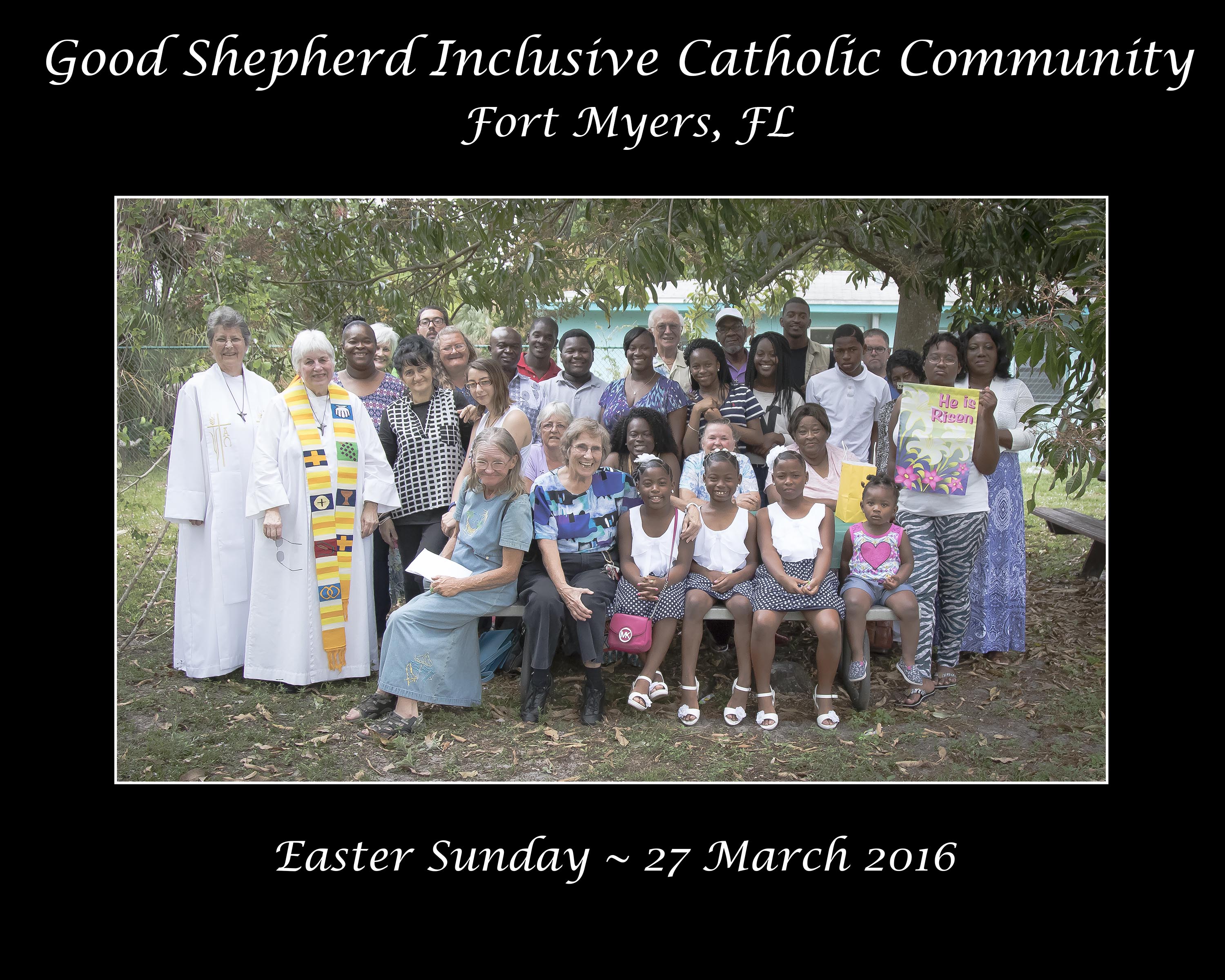
    Co-Pastor Good Shepherd Inclusive Catholic Community, Fort Myers, Florida

    http://www.goodshepmin.org

    And now we present Rev. Chava Redonnet’s 2014, Reflection on Palm Sunday. 

    On Palm Sunday I think of something Dom Helder Camara of Brazil said once,

    that he imagined himself in the Triumphal Procession into Jerusalem… and he
    was the donkey. That’s a lovely image for us as church: to be God-bearers
    for each other, bringers of love. We don’t have to be perfect, we don’t
    have to get everything right: we can be humble bearers of the love of God.
    I guess I was a God-bearer for a man I met this week who remembered the
    joy of communityfrom the past, too, because it gave him so much
    joy to learn that I was there, too. He ended his recitation of what we’d
    done on those marches, holding out his arms to me and saying joyfully, “And
    YOU were there, TOO!”Another day this week, I met a different man. This other man had cut
    himself off from everyone in his life. Everyone he was related to, he spoke
    of with anger and disgust. When I asked about God, he said, “There is no
    God!” I listened to his litany of anger and rejection, and finally said,
    “Sounds like a lonely life.” Tears filled his eyes. This man seemed to me
    like a cell without water,unable to connect with anyone around him, not
    even God. He didn’t want prayer but I told him I would send good energy his
    way. He liked that. Maybe that’s a little crack of openness to love in his
    soul. I hope so.Lastly, a story from our Sunday Mass at St Romero’s last week. We were a
    very small group. Just as we were about to share Communion, he left the
    room, using his telephone. I was surprised but went on,serving communion
    and praying, then just waiting for him. Finally he came back. “I just
    remembered,” he said. “Jesus said if you’re mad at someone you need to
    reconcile before you come to the altar. So I had to call someone and
    apologize before I came to communion.”Look for God wherever you are, this week! May we all be God-bearers for
    each other, carriers of love and hope. Have a blessed Holy Week.Blessings and love to all,
    ChavaOscar Romero Church
    An Inclusive Community of Liberation, Justice and Joy
    Worshiping in the Catholic Tradition
    Mass: Sundays, 11 am
    St Joseph’s House of Hospitality
    402 South Ave, Rochester NY 14620HAVE A BLESSED PALM SUNDAY!

    Last year, Cyrillia Rismay led us in singing “Enter Into Jerusalem” , a popular hymn in her country of St. Lucia. She plans to do it again this year. It begins:“Let us go to God’s house

    With the healthy and the sick

    The worker and the weak;

    Let us go to God’s house

    Enter into Jerusalem.

    Let us go to God’s house

    Swaying with the breeze

    With the God who reigns in peace,

    Let us go to God’s house.

    We will celebrate,

    We will celebrate,

    We will celebrate, O Israel….”

    And celebrate we did, even as we read the Passion in several parts and felt every blow and insult hurled at Jesus. This is a Congregation that has been to the Cross in every day life. For us, Jesus triumphs not only on the ride into Jerusalem but on the Cross. He cries out through the pain  that he forgives and that he completed his work. That is a wonderful thing to feel as life ends. We are blessed to know that he will rise in three days. But we can wait and be with him in his dying and burial because of the triumph of the Cross.


  • “I Am Doing Something New”:Two RCWP’s Reflections and Homilies for 5th Sunday of Lent

    God is doing something new according to the reading from the Hebrew Scriptures for this Sunday (Isaiah 43:19) and in the Gospel we see Jesus doing something new, something that enacts compassion, justice and mercy toward women and those with the cards stacked against them.  Today we present Rev. Beverly Bingle’s challenging homily that asks us to consider the judgments that we must make now in this time of political cacaphony in the United States when many say they want something new but fall back on fears and hatreds as old as time.   And then I reflect on the texts as well. And so we have the homilies of two women who are validly ordained Roman Catholic priests but banned by unjust church traditions/man-made laws from enacting God’s call to the priesthood. In thus presenting I challenge the Church and the world to dare to really do something new in our times: to allow the female half of the human race (and all those who are oppressed and exploited) to respond to God’s call to the fullness of life, whatever that may be for each one. And, to enact justice and compassion and mercy where it is sorely lacking.

    Rev. Dr. Beverly Bingle’s Homily

    Today’s Gospel is not about adultery.
    It’s about how to judge.
    Jesus’ message is not that we should not judge
    but that we must make considered moral decisions
    when we do judge.
    We must form opinions through wise and careful discernment,
    with reason and common sense
    and most of all, with heart.
    It’s about good judgment and bad judgment,
    about judging others and judging ourselves.
    It’s about merciful forgiveness.
    ________________________________________
    The scribes and Pharisees are all riled up…
    at the woman… and at Jesus.
    And he puts the brakes on their anger
    and their self-righteousness at her
    and their wily attempts to use her to trap him.
    He stops and considers.
    Then he gives them a response
    that reminds them of a passage in Deuteronomy
    about casting the first stone.
    They think about it
    and change their minds about stoning the woman
    and they leave off their attempt to trap him.
    ________________________________________
    Tuesday is primary election day here in Ohio,
    and we all have some judging to do.
    How will we decide
    about whether to vote for or against a tax increase?
    How will we decide
    about who to nominate to run in November
    for County Commissioner or District Court or U.S. Senator…
    or President?
    Jesus has a lot to say about how to judge.
    In this Gospel passage, Jesus says,
    “Let the one among you who is without sin
    be the first to throw a stone.”
    In Matthew’s Sermon on the Mount
    he teaches to “stop judging.”
    Earlier in John’s Gospel, in Chapter 5,
    he teaches that what makes a judgment just
    is first to listen to the facts and opinions and witnesses
    and then to follow God’s will, not our own.
    That doesn’t mean we are to imitate the terrorists in the Middle East
    who murder people who don’t agree with them
    and claim to be Muslims doing God’s will.
    Nor does it mean we are to imitate
    the demagogues in our own country
    who denigrate people who disagree with them
    and claim to be Christians doing God’s will.
    ________________________________________
    The Presidential race has been headline news for months,
    accusations from all sides
    tweeted around like sparrows on steroids.
    But we have to judge.
    It’s our responsibility as human beings and as citizens…
    and it’s our responsibility as Christians.
    We are called to exercise faithful citizenship,
    to enter into a process of conscientious discernment
    for justice and the common good.
    In our discernment process
    we are blessed with the long tradition
    of the principles we call Catholic Social Teaching,
    yardsticks to help us judge rightly,
    all based on the right and dignity of the human person.
    ________________________________________
    So we listen to how each candidate talks
    about the economics and law and policy
    that affect human rights and human dignity.
    We listen for the impact that candidates’ ideas have
    on the common good and the well-being of all,
    whether they will help or harm the poor and vulnerable.
    We listen to what they say
    to find out if their policies will protect human rights.
    We pay attention to whether a candidate’s platform on the economy
    will serve people,
    and not the other way around.
    We want to see that they respect basic rights to productive work,
    to decent and fair wages, to unionize, to a safe workplace.
    And we look at candidate positions
    to see if they reflect the fact
    that we are our brothers’ and sisters’ keepers,
    one human family regardless of national, racial, ethnic,
    economic, religious, gender, or ideological differences.
    We check out each candidate’s policies
    on caring for our common home.
    ________________________________________
    And then, this coming Tuesday, and again in November,
    we will judge.
    We’ll make serious choices,
    keeping in mind that every person is precious,
    that people are more important than things,
    and that the measure of our society
    and of our own soul
    is whether we choose to threaten or to enhance
    the life and dignity of every human person
    and the earth we call home.
    Glory be to God, this is a holy business we’re about!


    Holy Spirit Catholic Community
    Saturdays at 4:30 p.m./Sundays at 5:30 p.m.
    Holy Thursday, March 24, 5:30 p.m.
    Holy Saturday, March 26, 5:30 p.m.
    at 3925 West Central Avenue (Washington Church)

    www.holyspirittoledo.org

    Rev. Dr. Bev Bingle, Pastor
    Mailing address: 3156 Doyle Street, Toledo, OH 43608-2006
    419-727-1774

    I Am Doing Something New-Rev Dr. Judy Lee’s Homily

    Did you ever wonder where the man who was also caught in the act of committing adultery was when the religious leaders of Jesus’ time hauled the woman off to Jesus to trap him in his knowledge of the law? The Law is pretty clear (In Leviticus 20 and Deuteronomy 22-24), that most instances of adultery demand a strong response to both the man and the woman.  Could this have been the rare case where only the woman was to be punished,that is killed, or were the leaders remiss in their own understanding of the law? Or, most likely, could it be that in their patriarchal society that women were punished much more than men, no matter what the Law said or intended? That is truly the case in many societies today as the recent documentary short “A Girl In The River: The Price of Forgiveness”, Oscar winning Short film by Pakistani producer Sharmeen Obaid-Chinoy, demonstrates. I will comment on this excellent film in a moment.

    For this 5th Sunday in Lent we see the religious establishment of Jesus’ time enforcing laws on sexual behavior and trying to trap Jesus in his understanding of the Law  (John 8:1-11). We see a woman “caught in adultery” brought before Jesus and a community armed culturally and religiously to stone her. Now,  There is something wrong with law when it does not provide justice and there is something wrong with those who enforce laws when they act unjustly. The plaintive cry”black lives matter” addresses a level of  that injustice in the USA. It is the job of the prophet to call us on it when either of these things happen. According to the prophet Isaiah, in the first reading, God is asking God’s people not to dwell in the past but to see that God is “doing something new”!( Isaiah 43:16-21). And, what we see in today’s Gospel Jesus is doing something new.  If one reads Leviticus 20:10 and Deuteronomy 22-24 we see the complexity of the Torah/Halakah on matters of sexual behavior and infidelity. While the law is clearly stacked against the woman in this patriarchy there is some sense of fairness. In most cases both the man and women are to be punished. Yet, in this event only the woman is brought before Jesus.  The religious leaders are angry at Jesus for doing something new-in this case, for being inclusive of women in his ministry and in his healing and teachings. Not only did they blame Jesus for hanging out with sinners and even hated tax collectors, but for hanging out with lowly women as well! Luke 8:1-3 names several women who followed Jesus along with the male disciples,including Mary of Magdala who was the first to see Jesus after his resurrection, and to tell of his resurrection thereby becoming the apostle to the apostles. The meaning of this Gospel is, as Rev. Beverly Bingle  so wisely,says beyond adultery to learning how to judge, but it is also about the injustice toward women perpetuated by both the Law and society that Jesus, in his every action prophetically exposed,challenged and and changed. He allowed Mary to anoint his feet, that is to actually touch him,(it was forbidden to women to touch a man and a rabbi at that), he healed a woman with endless menstrual flow(“ritually unclean”), talked with a Samaritan woman who then preached the good news, and he was friends with Mary and Martha and Mary of Magdala among others. I bet the religious leaders very much wanted to get him to participate in the stoning of a woman!!! This would help put women back in their place, and it would make a teacher of nonviolence participate in violence at the same time. They thought they really had him this time! And yet he would remind them of the spirit of the Law, of the Torah, with its fair, though by our standards, harsh, intent. “Let the one among you  who has not sinned, cast the first stone!” Some of the ancient manuscripts said that what Jesus wrote on the ground was the sins of each one there who held a stone.  There was no one left to condemn her and, advising her not to sin again, he did not condemn her. She was free. what an upset to the world that was so eager to stone her.

    In the Oscar winning  Documentary “A Girl in the River:The Price of Forgiveness”, a young Pakistani girl named Saba, from a small village runs away to marry a young man that she loves. As only the father is to arrange marriages, this girl has broken the law (both Quranic and local) and has sinned big time. It is noted that the Quran has many more complexities and fair intents than the local law. The family and the village justifies the father and brother killing the girl and dumping her in the river. (Every year over a thousand girls in Pakistan are killed for the honor of the family when they refuse the marriage contracts the father wants to arrange).  Miraculously, however, Saba, though scarred, lives and is able to start a life with her husband and her in-laws. The father and brother are jailed but to get them out with no further punishment and to make peace between the families the girl is asked by village elders (all male) and both families to forgive them.  She is initially advised by lawyers who believe in justice for women and want then punished. But her lawyer is changed by the elders.  She is pressured on all sides to forgive them and does so with words but not within her heart. Injustice, letting the men and the society off “Scot-free”  is seen as the price of forgiveness although reconciliation with her mother is a precious gain for her especially as she expects her first child. She bravely hopes it is a girl who will be able to be free. This moving and insightful expose of today’s injustice to women under religious and societal laws was well deserving af an award. But it leaves us with questions about the meaning of forgiveness and the place of women all over the world in the 21st Century. The story of Malala Yousefi , the girl who was shot for championing education for girls is another case in point. Malala, Saba and Sharmeen Obaid-Chinoy are prophets in their own time. The courage they display is amazing. Even as the courage Jesus displayed in taking on the religious and political establishments of his time was amazing and indeed dangerous. Thank God for doing something new -something that sorely needs to be done. Thank God for Jesus who treated women equally as his friends and followers.  Thank God for showing us the path to justice, compassion and mercy. May we, including our religious establishments, try harder to live it.

    Rev. Dr. Judy Lee,RCWP

    http://www.goodshepmin.org

    DSCF1546


    DSCF1231DSCF1514

  • Welcome Home: Roman Catholic Women Priests Reflect on The Prodigal Child For Lent 4

    “Then let us celebrate with a feast, because this child of mine was dead ,and has come to life again;was lost and has been found…” Luke 15:23-24

    This parable of our loving God’s parental love and forgiveness is a favorite with our Good Shepherd Inclusive Catholic Church in Fort Myers, Florida.  Our resident artist Hank Tessandori has two paintings adorning our walls showing the welcome home.  All of us from preacher down to smallest child resonate with that loving welcome. We are a congregation of sinners and outcast people who celebrate our return home and redemption. Our people have hit bottom in so many ways, living without financial resources, homeless, outside, and desperate. Some have experienced addictions and others mental illness; some have experienced and some have perpetrated failed relationships, abuse, violence and the loss of children. Some have tried so hard to work and enter the mainstream only to be met with serious illness, aging and the lack of work. Some live with being different as members of the LGBTQ community and  and know well that human families and some churches  are often not as welcoming as our loving God is.  Some have lost all that meant anything to them and have their own version of wallowing with the pigs.  And yet,for most, the experience of returning home to be welcomed without reservation is the cause for daily celebration. Ours is a church of welcome home.  Week after week there is testimony to what inclusion finally feels like, and it feels like coming home. Brenda and Pat, Roger and Gary and Nate and so many others still weep and thank God that they now have a home; yes, they mean a place to live of their very own, but they also mean a church home. Our people, young and old, poor and well off, mainstream and outcast call us,  simply, ‘home’. And so it is that today’s Lucan Gospel lifts us up and gives us courage to continue on. We thank God for coming alive again and for our welcome home, for finding and being found, for love and inclusion, no matter what.

    Rev. Dr. Judy Lee, RCWP,

    C-Pastor Good Shepherd Inclusive Catholic Community, Fort Myers, Florida

    http://www.goodshepherdmin.org

    DSCF1746IMG_0053

    Below we read the Parable of the Prodigal Daughter by Rev. Morag Liebert, a Roman Catholic Woman Priest in Scotland.   It is exciting to change the prodigal son into the prodigal daughter and to join Morag in dreaming of such welcome.  It also reminds us that this parable is sometimes called the parable of the Prodigal Father, who is repenting of whatever he has done to alienate his child and waiting for the opportunity to welcome the child home and do things differently. 

    The Parable of the Prodigal Daughter Lk 15: 11-32

     I am sure you have all heard sermons on the Parable of the Prodigal Son many times, but have you ever thought about the Parable of the Prodigal Daughter?

    A man had a son and a daughter.  The son worked with his father on the family farm.  Certainly he worked very hard, but he shared in the making of decisions about the running of the farm, its buildings, and the people, who lived and worked there.  He also shared in the teaching of the farm workers and household servants.    The daughter also worked very hard on her father’s farm.  She cleaned, cooked and served meals, made clothes and did the mending, cared for the old, and the ill, and sometimes also worked in the fields.  But she had no say in any of the decisions that were made! Indeed she was rarely consulted about anything!  Her father and brother, and sometimes her mother too, simply took her for granted.  She rarely complained, or protested, but if they ever did pay any attention to her, it was only to denigrate her and make the situation worse.

    One day she decided, she had had enough!  She asked her father for her share of the inheritance.  Her father was extremely annoyed and anxious about her request, but she insisted, so he gave his daughter her share of his property.  The daughter promptly packed her possessions and left home.  She travelled to a great city and spent her money studying with the best scholars and Rabbis.  She worked very hard and became a respected, knowledgeable scholar.  Eventually she was consecrated as a priest in a synagogue of the Diaspora and people came to hear her preach and teach.

    Meanwhile, there were more problems on the family farm.  Her mother had died, her brother’s wife had divorced him for domestic abuse and finally the housemaids had left to work for the farmer across the road, who was much more ethical and considerate in his attitudes.  He paid them decent wages and treated them much better.   The farmhouse was now in a state of crisis! The kitchen was in chaos and there was no food in the pantry.  What was worse, everyone far and wide was talking about them! And needless to say, news of the daughter’s academic and professional success had reached the farm.  Eventually, the father and brother came to realise that they would simply have to change their attitudes and take drastic action.

    So the father packed the saddlebags of a donkey with what he needed for the journey and travelled to the town where his daughter lived.  On the way he contemplated about what he would say to her, and decided that he would say, “Daughter, I have sinned against heaven and before you.  I am no longer worthy to be called your father:  treat me like one of your students.”  However, the daughter saw him in the distance and ran to greet him.  The father made his confession and she flung her arms around him and kissed him.  The daughter forgave him and agreed to return home with him.

    After they arrived at the farmhouse, all the farm workers and neighbours gathered in its great kitchen and prepared a feast to celebrate the daughter’s home coming.  Her father presented her with a set of the best priestly vestments and sat her beside him at the head of the table, where she presided over the Passover feast and the local people asked her to be the priest at their synagogue, which had not had a rabbi or a priest for several years.  So they spent the evening feasting and rejoicing, because the daughter, who had been oppressed and rejected, had been brought home and given dignity and equality.

    Morag Liebert  7/9/10, Edinburgh, Scotland

    And here is an excerpted and pointed variation on the theme of the Prodigal Daughter by Rev. Annie Watson, ARCWP (From Bridgetmary’sblogspot)

    “….It’s one thing to celebrate grace given to a wealthy young man, a person of privilege in every culture in every time and place. It’s rarer to celebrate grace given to women, that half of the human race that has rarely enjoyed such things as grace, forgiveness, compassion, and, of course, fairness and equality.

    Personally, I have experienced this inequality of grace in my involvement in the Roman Catholic Women’s Priest movement. We all know how the men have been treated in the Church’s hierarchy and priesthood.

    The robe, ring, sandals, and fatted calves are readily available in the church for any male who hears the call of God to the priesthood. None of that is available for women who receive the same call in their lives.

    Furthermore, we know that the men can fall into “dissolute living” in all sorts of ways—the pedophile scandal being just one example—and the male bishops will meet them while they are still far off with hugs and kisses. Women, on the other hand, who aspire to be priests, are considered worse than pedophiles because we are excommunicated and the male priests are not. 

    Again, it is appropriate to celebrate the father’s love, compassion, and forgiveness in Jesus’ parable of the prodigal son. And yet, when will we be able to tell the same stories about women? 

    Rev. Annie Watson

    DSCF1076

    And here is the insightful homily of Rev. Dr. Beverly Bingle of Toledo,Ohio.      

    You may have noticed that today‘s Gospel reading

    starts with three verses at the beginning of Chapter 15

    and then skips a ways
    to pick up at verse 11 with the parable of the prodigal son.
    Luke frames the whole chapter
    as Jesus’ response to the Pharisees and scribes
    who are complaining because he eats with sinners,
    and today‘s passage
    is one of three very familiar parables there.
    In addition to the prodigal son story,
    Luke has Jesus tell the story of the shepherd
    leaving the flock of 99
    and going in search of that one wandering sheep,
    and then the story of the woman searching all over the house
    until she finds that one coin of the ten that she had lost.
    In each of these three stories what was lost is restored,
    what was out of place is back where it belongs,
    whether it’s through a shepherd’s care,
    a woman’s perseverance,
    or a parent’s love.
    Even though Luke puts these parables together
    in order to further his narrative,
    scholars are fairly certain that all three go back to Jesus,
    just as they have little doubt
    that Jesus was criticized
    for sharing meals with outcasts and the poor.
    __________________________________________
    When people get to be as old as I am,
    we can look back over our lives and find ourselves
    in every character in today‘s Gospel parable.
    Been there, done that.
    I’ve been the one who pointed a finger
    at the kind of people someone chose as friends,
    like those Pharisees and scribes did.
    I’ve been the ungrateful child,
    like the younger son.
    I’ve been the despairing worker,
    scrabbling to make a pittance at a job I hated,
    wishing I could go back home again.
    And I’ve been the one
    who was hurt and angry
    about the favorable treatment
    of those who didn’t work as hard as I did,
    like the older son.
    __________________________________________
    On the other hand,
    from time to time I’ve tried to be the one who forgives,
    no matter what,
    like the loving father in that parable.
    But not very often.
    And I’ve even tried to be the one who points out injustice,
    like Jesus did.
    But again, not very often, and not often enough.
    __________________________________________
    St. Paul reminds us, in that second reading,
    that we who are in Christ
    are called to be ambassadors of reconciliation.
    I find the etymology of that word ambassador noteworthy.
    It comes to us from Middle English through Old French,
    based on two Latin usages meaning mission and servant.
    Literally, we who are ambassadors of Christ
    are servants sent on a mission
    with a message of love and mercy.
    We are called to welcome the wayward
    just as the prodigal son is welcomed.
    __________________________________________
    Sometimes we are able to do that.
    But, we know, sometimes it’s just not possible,
    as in trying to reconcile a relationship with an abusive partner
    who will not admit the problem or seek help.
    When we are able to reach out in mercy and love,
    we become, as Paul puts it,
    messengers of God’s own righteousness,
    of God’s own justice.
    That’s when we carry the very holiness of God to the world.
    __________________________________________
    It’s a big job,
    but we aren’t alone.
    Just as the ancient Israelites
    walked through the desert nourished by manna from God,
    so do we walk through each week
    surrounded by, uplifted by,
    God’s presence in our world.
    Sometimes we travel through a desert,
    subsisting on the promise that God is with us
    even though we feel alone and abandoned.
    Sometimes we find ourselves resting in that promise,
    surrounded by all the gracious gifts of God.
    And on the weekends
    we gather to celebrate the very holiness of our lives.
    Through it all—
    whether we’ve been stumbling through in a desert
    or renewing ourselves in an oasis—
    we walk in communion with God and with each other.
    Thanks be to God!


    Holy Spirit Catholic Community
    Saturdays at 4:30 p.m./Sundays at 5:30 p.m.
    Holy Thursday, March 24, 5:30 p.m.
    Holy Saturday, March 26, 5:30 p.m.
    at 3925 West Central Avenue (Washington Church)

    www.holyspirittoledo.org

    Rev. Dr. Bev Bingle, Pastor
    Mailing address: 3156 Doyle Street, Toledo, OH 43608-2006                

    THANKS BE TO GOD FOR WELCOMING US ALL HOME !

  • Let Women Not Be Silent….

    Let women not be silent in churches, say Catholic scholars

    Mike Theiler/Reuters
    Demonstrators calling for the Catholic Church to include women priests gather prior to the arrival of Pope Francis at the Cathedral of St Matthew the Apostle, for a prayer service and meeting with US bishops, in Washington last September.

    Women should be allowed to preach at Roman Catholic Mass, according to a series of articles in the Vatican newspaper L’Osservatore Romano.

    One of the articles was written by French Dominican nun, Sister Catherine Aubin, of the Pontifical University in Rome. She argued that the society in which Jesus lived and moved was structured on a patriarchal model where women were socially invisible and that Jesus himself challenged this exclusion.

    “An overview of the history of Christianity leads us to consider the female figures, prophetic and charismatic, who with their authority, in rough centuries, have helped to evangelise a world,” she said.

    They included saints such as Joan of Arc, Hildegard of Bingen and Catherine of Siena.

    Women are already preaching, guiding retreats and giving conferences, she added. “Let us sincerely ask a question: then why can’t women preach in front of everyone during a celebration?”

    Christ made all men and all women he met along his path, witnesses, messengers and apostles, she said. To include women in the pulpit would make the Church “even more lively and attractive”.

    Another of those cited, Enzo Bianchi, who heads an ecumenical community in Italy, said many voices were being raised to ask for the role of women in the Church to be enhanced. This would “constitute a fundamental change” in Church life.

    He referred to past centuries when, in the Middle Ages, lay people were allowed to preach, including some women. This was banned by Gregory IX in 1228.

    The ignorance of some preachers at the time had led to heresy and confusion rather than building up the Church.

    In 1973, experimental permission was given to some lay people involved in pastoral work to preach for eight years. This included some women. Women are also allowed even today to preach at Masses for children.

    “Do not forget that Jesus preached in the synagogues of Nazareth and other cities without being either a priest or an ordained rabbi, but he did it for prophetic charism and because it was commissioned by the heads of the various synagogues,” said Bianchi.

    Pope Francis is among those who have called for women to have a greater role in the Church.

    He recently decreed that women can and should be part of Holy Thursday foot washing ceremonies. Women’s Ordination Worldwide said in response to that announcement: “We commend Pope Francis for moving our Church one step closer to the inclusiveness modelled by Jesus. This may seem like a small move forward because women have already been included in this rite for many years in some churches.

    “The fact that it is still prohibited by some parish priests around the world betrays the reality of the challenge women face at a local level, with many Church officials refusing to include women in the Last Supper commemoration.”

  • Strange Fruit: Two RC Women Priest Homilies for the 3rd Week in Lent

    If you have ever heard the great Blues singer Billie Holiday, Lady Day, sing “Strange Fruit” the melody and the words will haunt you. It is one of the earliest songs of the horrors of injustice and racism.  It is about the lynching of blacks in this country.   The body of a black man is the “strange fruit hanging from the poplar tree”, the fruit of a “strange and bitter crop”.  The racism (and other horrific isms) of our 21st century is still the strange fruit of those who claim to love God and those who claim to follow Christ. It is the bad fruit growing on the sick vine. When Pope Francis recently said that those who build walls instead of bridges cannot be Christian he was reacting as Jesus did in Sunday’s Gospel (Luke 13: 1-9) where Jesus is reacting with a call to repentance to the horrible injustice of the death of Galileans at the hands of Pilate and the Roman occupiers who “mixed their blood with their sacrifices”.  The Galilean Jews were killed as they followed the Law and then their bodies and souls were desecrated as their blood was mixed with the blood of animals.  Jesus clarifies that it was not their sin that “earned them” this fate, nor were those who had a tower fall on them more sinful than all the rest. In a time of untimely tornadoes and tsunamis and earthquakes and viral plagues, mass murders and terrorism, it is important to know that God is there with us not causing our horrific troubles.  In a different slant than is sometimes taken on this Gospel, I think Jesus was reacting to the  blatant evil and injustice of murderous oppression and to the capriciousness of those who blame people for the horrors that befall them-and he was strongly saying “turn it around!”. (Jesus also clarified in another place(John 9:3) that, contrary to popular belief,(and indeed contrary to some of the words of Paul to the Corinthians in I Cor 10: 1-6) a blind man was not blind because of his sins,(and God does not bring evil upon people who grumble and turn from God). But Jesus also said that “no good tree can bear bad fruit” a tree is recognized by its fruit (Luke 6:43;Matt 7: 15-20). Jesus calls strongly for repentance, he cannot tolerate such injustice and hatred. But he also wants to help us learn how to truly love our neighbors before we cut ourselves off from God. 

    As in the Hebrew Scriptures’ reading for Sunday, (Exodus 3:1-8,13-15)  our compassionate God hears “the cry of those oppressed, the complaint against their slave drivers”, and God knows well the suffering of God’s people. God has come to rescue the people and lead them to a “land of milk and honey”.  Moses is struck with the literally awesome holiness of God, and God clarifies that God’s love and compassion is part of this holiness,and he calls Moses to deliver his people.  We see here that the God of Moses, the Great I AM, and Jesus, the Christ of God, can not tolerate the downright evil and injustice of oppression. Jesus, goes on to say that repentance is called for in the face of evil and injustice. That is, we are called to turn ourselves around when we perpetuate or tolerate the hatred, murder,indifference and injustice of our times. To God the lives of the oppressed,all those who suffer while others prosper, matter so much that God calls for repentance as well as deliverance. To “enter the kingdom of God, we must do the will of God”-we must put the words of God, and the words of God’s Chosen One, into practice or the world falls down around us and we are “away” from God (Matthew 7: 21-28). 

    In the parable of the fig tree in our Gospel today we see the frustration of an owner of a vineyard that has a tree that bears no fruit- he is ready to cut it down after three years of waiting for the fruit. But the gardener who tends the trees, pleas, as it were, for the life of the tree. “Sir, leave it for this year also, and I shall cultivate the ground around it and fertilize it; it may bear fruit in the future. If not you can cut it down”(Luke 13:8-9). In this parable Jesus is not the owner of the vineyard but the gardener who will give the sorry tree another chance. He will cultivate and fertilize it, he will take care of it and give it every chance to bear fruit.  Jesus recognizes that we are not always fruitful, and although he calls strongly for repentance, for turning it around and practicing the laws of love and compassion and justice toward our neighbors, all of them, he is also willing to tend our growth so that we can indeed bear this fruit. What a relief that is for those who have trouble with the laws of compassion, what a relief that is for us.  


    The Responsorial Psalm (103) for this Sunday says it so well: Our God  “pardons all your inequities, heals all your ills, redeems your life from destruction, crowns you with kindness and compassion”  Our God “secures justice and the rights of all oppressed…Merciful and gracious is  our God, slow to anger and abounding in kindness…” AMEN!  

    Let us then examine our lives and turn away from injustice and hatred in every form, and enact mercy and kindness like our God.Let us, in the Spirit of Christ, tend to the sorry trees and help them to grow good fruit. Let us turn it all around in ourselves, and in our world. 

    Rev. Dr. Judy Lee, RCWP

    Co-Pastor Good Shepherd Inclusive Catholic Community of Fort Myers

    http://www.goodshepmin.org

    And From Rev. Dr. Beverly Bingle of Toledo, Ohio:

    In today‘s reading from the book of Exodus,
    Moses spots a flame in a bush,
    and when he checks it out,
    he finds that it’s a messenger from God.
    And then, when he gets nearer, he hears God’s name—
    I AM WHO AM.
    God IS.
    Moses learns the nature of God, and of all that is:
    the ground he stands on is holy;
    the people of God are holy;
    all creation is on fire with God’s love.
    The bush is burning.
    From the stardust of creation
    to this very day,
    every bush is burning.
    God’s name is written in all that is,
    and it is to be remembered forever.
    _______________________________________
    Nearly 1500 years later, Jesus looks around
    and sees that people are not remembering the name of God.
    They are not remembering that the ground is holy.
    They do not see that all creation is on fire with the love of God.
    So he tells people about it.
    _______________________________________
    In the passage just before today‘s Gospel,
    he tells the crowds that they know
    how to interpret signs of the earth and the sky
    but not the signs of the time.
    He asks them why they don’t judge for themselves what is right.
    Then he tells them that, if they don’t change their ways,
    they will all perish,
    and he follows that
    with the parable of the fig that isn’t bearing fruit.
    The owner wants to cut it down,
    but the gardener pleads for time
    to try some routine horticultural practices
    for just one more year to bring it into fruit.
    _______________________________________
    Now, it takes three to five years for a fig tree to fruit,
    and the planter of the tree expects fruit in the fourth year.
    The gardener knows that it should mature and bear fruit
    by the next year, its fifth year.
    If there’s no change, it will be destroyed.
    The crowd recognizes the fig tree
    as a typical metaphor for the Israelite people.
    They understand that Jesus is saying
    that the center of their culture—
    the Temple in Jerusalem and its cult of Roman collaborators—
    is unfruitful.
    And the crowd clearly understands his message:
    unless they change, unless the Temple changes,
    all will perish.
    _______________________________________
    Now, 2000 years after Jesus, and 3500 years after Moses,
    we hear the same message,
    this time aimed at us.
    In Pope Francis’ encyclical Laudatio Si’
    we hear that the center of our culture is unproductive;
    unless we change, we will perish.
    We hear Francis calling us to heed the signs of our times.
    There’s lead in Flint’s water, microcystin in ours.
    Record heat and record cold.
    Record earthquakes and cyclones and tornadoes.
    Violence in Kalamazoo and on our streets in Toledo
    and around the world.
    Zika virus.
    Air pollution, water pollution, land pollution, extinction of species.
    They’re all around us, the signs of our times,
    calling us to change our ways,
    or we will perish.
    _______________________________________
    It’s inspiring to see so many Toledoans,
    especially our Holy Spirit Community,
    changing their personal lifestyle habits
    to become more and more responsive
    to Francis’ call to care for creation.
    Some folks carpool, or bike to work, even in winter.
    Some turn down the thermostat and put on a sweater.
    More are buying local food at local businesses.
    Some are researching candidates’ environmental positions
    so they can vote their consciences in the March 15 primary.
    And all of us are trying to get a few trees planted.
    Big things and little things,
    each of them part of the effort to take better care of our planet.
    _______________________________________
    Inspiring as all these good works are,
    we know we have to do more.
    God’s name is written in all that is,
    and human selfishness and greed are destroying it.
    That’s why we’re spending time this Lent fine-tuning our lives,
    eager to follow ever more closely the lesson Jesus teaches.
    We must read the signs of the times.
    We must judge what is right and act on it.
    We must care for creation
    as an act of love for God and neighbor
    and a work of justice for all.
    Amen.


    Holy Spirit Catholic Community
    Saturdays at 4:30 p.m./Sundays at 5:30 p.m.
    Holy Thursday, March 24, 5:30 p.m.
    Holy Saturday, March 26, 5:30 p.m.
    at 3925 West Central Avenue (Washington Church)

    www.holyspirittoledo.org

    Rev. Dr. Bev Bingle, Pastor
    Mailing address: 3156 Doyle Street, Toledo, OH 43608-

    AMEN! 

  • Look, Listen and Be Transformed! A RC Woman Priest Homily for the Second Sunday in Lent

    As I write this homily Pope Francis, in the spirit of Lent and living the year of Mercy,  is visiting the prisoners in a “Social Rehabilitation Center”/Prison in  Juarez, Mexico on the Border of Texas and Mexico. First he greets and hugs women and men who approach him individually. Many are crying. Then he addresses them and their faces say that they are hanging on every word he says.  He tells them that they are precious to God and can turn their lives around and the test of this will be on the outside.  He prays that sentences may not be for whole life as those who turn their lives around will be powerful messengers of God in society. As he closes, he asks them to pray and to ask that their hearts may grow to include the forgiveness of  society. He then blesses them and many are weeping openly. As he passes by the band and musicians they come forward to touch his hand and pray. Some kneel and still holding onto his hands weep uncontrollably. This is the spirit of God working powerfully in them, transforming their hearts. I believe this visit will transform many lives. May it be so for each one of us as we continue to walk our Lenten journey. May our touch and words transform lives and may we too be transformed.

    Our first reading for this Sunday is Genesis 15:5-12 and 17-18 where we see God making a Covenant with Abram who is asked to look up and see the endless number of stars in the dark night sky, promising him that his descendants will be as many as the stars of the sky and the land will be theirs. Abram was transformed from Abram to Abraham, meaning father of his people as he looked, listened and loved God, and trusted and believed God’s promise.  Indeed adherents of the three faiths springing from Abrahamic roots are “like the stars in the sky”. Looking and seeing and having faith in God’s promises transforms the believer from hopelessness to hopeful. As we live with hope our lives touch and can help transform other lives.

    Many things happen in life and ministry that transform us. Both things experienced as negative and as positive can do this, perhaps equally so. In the last few weeks I have experienced both. We had to leave a large family in God’s hands as we had done all we could to help them. We could continue with them in prayer and emotional support but we could not make all things better for them, too many things were wrong, including possible drug addiction and the inability of the parents to listen and hear beyond what they already knew and wanted. It was beyond our ability to do any more. Another agency is finally offering shelter and trying to help.  We learned to gently place them in God’s hands. This was transforming as we have felt that we had to do it all ourselves and that we could. Learning that we could not, but God could, strangely gave another kind of peace. IMG_0004.JPG

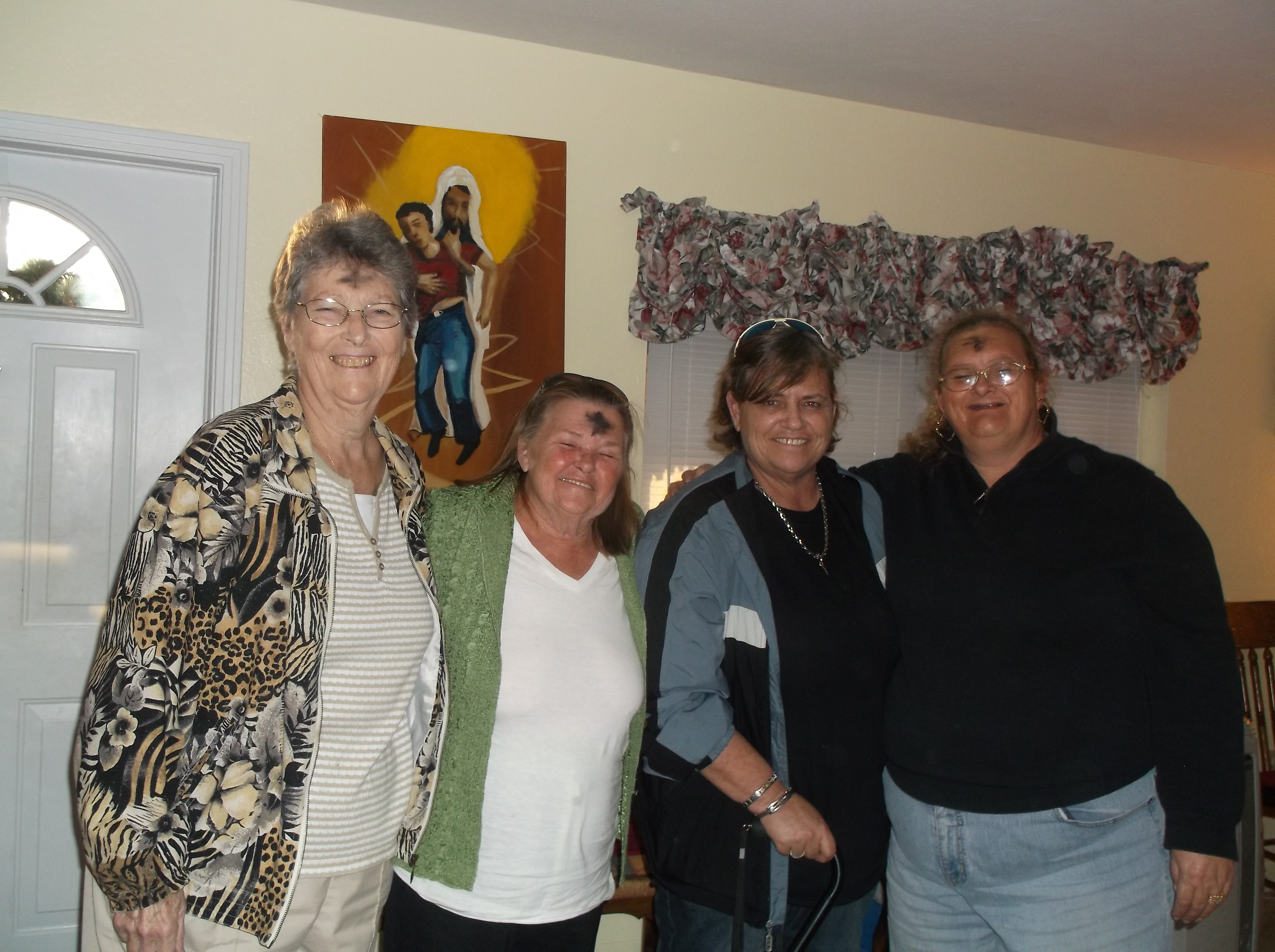
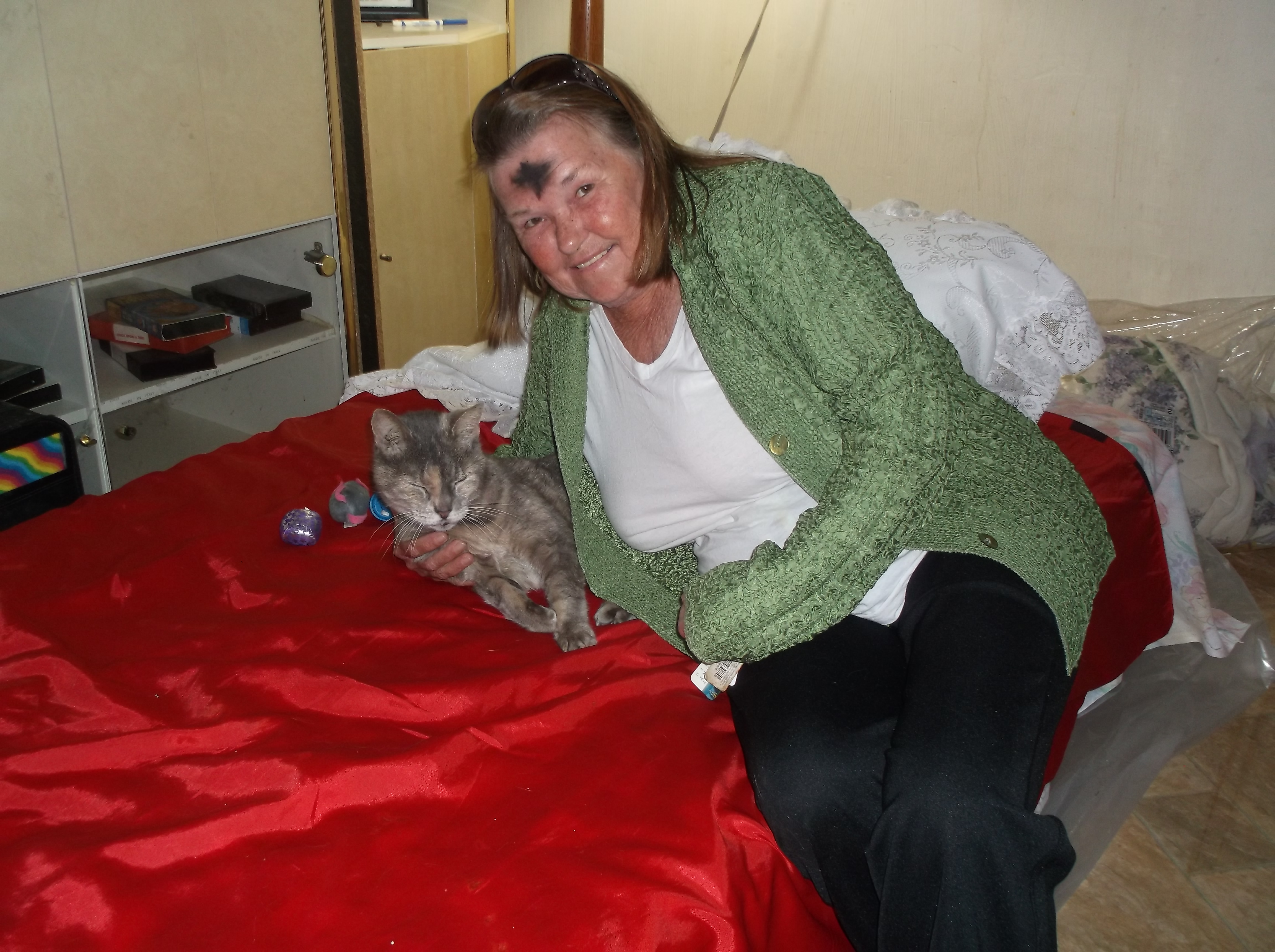
    The positive experience was experiencing the Spirit intervene in the life of an older woman who was living in the woods for almost ten months with her cat. Often it takes many months to help such a person come “inside”. But this time there was a readiness and our resources matched the need. This woman, “Peg” was praying every day for God’s help. She was increasingly frightened in the woods although many nice people helped her in little but important ways. The unpredictable weather, the sound of the newly arrived coyotes and men in the woods nearby made nights very hard.  The help came when she sought help for her cat and our Veterinarian brought her to our attention and when a man who lived in our hospitality space was simultaneously ready to move on to his own place. As soon as Peg understood that we could accommodate her dear cat with her and that we would also help her apply for Senior living but she could stay with us until her name came up on the list, she was ready to move.  In less than a week she was able to move inside and her gratitude and appreciation was evident as she attended church with us. She cried and cried and whispered “I am home at last”. She had also prayed for a way back to God and to church. She told us and anyone who would listen that God heard both of her prayers and gave her a home AND a church home at the same time! Her joy transformed us from seeing so much of what we could not do and affirmed what we could do with God’s help.  She was also able to help us care for a dog that the large family had to leave behind. Peg’s faith and joy touches all around her. (Below-Peg ,in green jacket on Ash Wednesday, with new friends Brenda and Nancy, and kitty ,Sarah. )

    DSCF1746DSCF1747


    Psalm 27 then asks us to see the goodness of God in the land of the living . God is our light and our salvation now, and forever. Of whom or of what should we be afraid? But it is often harder to see God’s goodness here and now in the midst of daily struggles and not just hope for it in eternity. Seeing God’s goodness here and now is transforming.

    Just as reasons for greater fear entered Peg’s camp site, God provided an inside home. WOW-whom shall we fear! I also had another cause to fear in the last few weeks. A routine mammogram revealed a mass that was not palpable. I had to have a biopsy that turned out to be a difficult procedure, and then settled in to await the results. The memory of my first cancer, this same time of year three years ago, a stomach cancer,sarcoma, called a GIST, flooded my memory and struck my heart with fear. Was it to be another major surgery? That cancer was taken away with surgery but I live with its aftermath, having very little stomach left, daily. Yet,  after the first shock and deep recognition of mortality, I was thankful to be alive and able to continue with life and ministry. Now, for a while, I returned to fear. Friends and our church members prayed and supported. Mary, one of our church members who just had a mastectomy shared her journey with me on another level realizing I was facing what she has just faced. We prayed together in  a new way. We truly understood each other’s pain, though mine may be less than hers. She told me “Pastor, you paid your dues with the first cancer, this one should be only a little one”. I hoped so too.  Yet as I lived with it, I realized that God still “had my back”. Once again I am relieved,  that while it is cancer it is contained and “the little one” Mary hoped  for. I will lose at least the mass and surrounding tissue, I will not lose my life. Once again I am to be spared. And I am so thankful.  I found myself at peace today and no longer anxious or frightened. I will be okay. Of what should I be afraid?  I will see the goodness of God in the land of the living. 

    In the Epistle of Paul to the Philippians (3:17-4:1) Paul challenges Christ’s followers to stand firm in Christ Jesus, and not to let their bellies become their Gods, as some have. Paul is moved to tears as he thinks of those who say “Yes” to following Christ but actually transform nothing in their lives, keeping their own desires as most important. He is encouraging them to allow themselves to be transformed by Christ. As Pastors we are most often moved and heartened as we see our people grow in Christ and in the giving of themselves to others. Sometimes, though,we are disheartened as bickering and anger and selfishness breaks up families and relationships, and self interest looms much larger than community interest. We want them to be transformed. But that takes time and so we pray for our patience and for ways to teach without words. If I am honest, I must say, I am more frustrated with myself than with others as I do not transform so easily either! And so we pray.  

    In the Gospel of Luke (9:28-36) we see Jesus transformed/”transfigured”/appearing in a new way, on a high mountain top with James and Peter. Jesus often went to the mountains to pray and to commune with Abba God. He also preached in the hills and mountains. All three synoptic Gospels record Jesus taking Peter, James and John up the Mountain where they experienced who he was and saw his divinity in a new way. The other sources are Matt 17:1-9 and Mark 9:1-9)

    In the Gospel  Jesus is presented in divine light and connected to Moses and Elijah who suffered greatly even as they led God’s people. Jesus is seen on par with them and as the fulfillment of the Law and the prophets.  He looks different.  His very appearance is radiant/dazzling white including his clothing, indicating their perception of his divinity. The disciples are amazed and frightened. Then in the cover of the misty mountain cloud they hear God’s voice affirming Jesus as also happened in Jesus’ baptism:  “This is my beloved, my Own, My Chosen One, Listen to him.” Now there is divine authority to do what Jesus asks, to follow him. To be transformed we are asked to listen to Jesus. We are also asked by the intent of the text to look around us and see God and  things and people and ourselves in a new way. See the light of God in everyone and in everything. And where it seems not to be, look the hardest and listen with your “third ear” the ear of compassion and understanding, of empathy.  We are asked to be transformed with Jesus, the Christ.

     In his   Angelus talk on the 2nd Sunday of Lent, March 16, 2014 this is what Pope Francis said about the Transfiguration/ the transformation on the mountain top: 

    “We need to go to a place of retreat, to climb the mountain and go to a place of silence, to find ourselves and better perceive the voice of the Lord. We cannot stay there, however. The encounter with God in prayer again pushes us to come down from the mountain and back down into the plain, where we meet many brothers and sisters weighed down by fatigue, injustice, and both material and spiritual poverty.”

    We who are transformed by looking and listening and trusting God can transform the world. And toward that end, this is our prayer:

    “Our loving God, Help us to see You and hear You. Your words come in many ways. Teach us to see and listen to the gentle breeze and the Gulf winds as well as the howl of the storms of upheaval; to the birds chattering and the babies, to the children and the old folks, to those who have little and to those who have much, to the teacher and the preacher, and to all of Your creation. Help us to trust You and Your promises when we read them for ourselves in the Scriptures or hear them read, or shared by the testimonies of others or experienced in our own lives. We believe, help our unbelief and thereby transform us. Amen.”

    Love and blessings,

    Rev. Dr. Judith A.B. Lee, RCWP

    Co-Pastor Good Shepherd Inclusive Catholic Ministries, Fort Myers, Florida

    IMG_0002

    IMG_0011

     DSCF1218

  • First Sunday in Lent:Reflections of Women Priests and Pastors

    We present three Lenten Reflections/homilies here: two by women who are Roman Catholic Priests: Rev. Dr. Beverly Bingle,RCWP of Toledo, Ohio and myself, Rev. Dr. Judy Lee,RCWP of Fort Myers, Florida; and one by a renowned Methodist Minister and Author Rev. Jan Richardson. Rev. Beverly is focused on the First Reading from Deuteronomy while Rev. Richardson and I consider the Gospel. As I am very much into genealogy and family history as meaning in our lives I am particularly interested in Rev. Bingle’s spin on Deuteronomy and her connections to today’s world with it that rings true for so many  families throughout the world. And as I face the unknowns of another health issue I am completely attuned to Rev. Jan’s reflections on the Gospel.

    We begin with a beautiful reflection from the blog of Rev. Jan Richardson,  Rev. Jan’s reminder of the preceding event for Jesus, the Baptism and the affirmation of him as “The Beloved One” is one I take with me, not only through this Lenten period but through any times that are difficult in our ministry and lives and especially when I am about to enter the difficult unknown, a time sort of like now in my life. It is my challenge and my comfort to remember that I too am beloved. And, you ARE too!

    DSCF0826

    Rev. Jan’s Reflection:

    “Reading from the Gospels, Lent 1, Year C: Luke 4.1-13

    Jesus, full of the Holy Spirit, returned from the Jordan
    and was led by the Spirit in the wilderness,
    where for forty days he was tempted by the devil.

    —Luke 4.1-2

    If we back up a bit in Luke—if we turn around, hang a left at the genealogy, and take a look at Luke 3.21-22—we will be able to enter this week’s text with the same knowledge that Jesus had: that when he went into the desert, he went with the baptismal waters of the Jordan still clinging to him, and with the name Beloved ringing in his ears. How else to enter into the forty-day place that lay ahead of him? How else to cross into the wilderness where he would have no food, no community, nothing that was familiar to him—and, to top it off, would have to wrestle with the devil? How else, but to go into that landscape with the knowledge of his own name: Beloved.

    In this first week of Lent, as we turn our faces toward whatever this forty-day place holds for us, we would do well to have that name echoing in our own ears—to enter into the terrain of this season with the knowledge that we, too, are the beloved of God. And so I want to offer you a blessing that tells us this. It’s a blessing I wrote last year for those who joined us on the Beloved Online Lenten Retreat—a beloved community indeed.

    As we cross with Christ into the landscape of Lent and into the mystery that lies ahead of us, may we know at least this about ourselves: that our name, too, is Beloved.

    Beloved Is Where We Begin

    If you would enter
    into the wilderness,
    do not begin
    without a blessing.

    Do not leave
    without hearing
    who you are:
    Beloved,
    named by the One
    who has traveled this path
    before you.

    Do not go
    without letting it echo
    in your ears,
    and if you find
    it is hard
    to let it into your heart,
    do not despair.
    That is what
    this journey is for.

    I cannot promise
    this blessing will free you
    from danger,
    from fear,
    from hunger
    or thirst,
    from the scorching
    of sun
    or the fall
    of the night.

    But I can tell you
    that on this path
    there will be help.

    I can tell you
    that on this way
    there will be rest.

    I can tell you
    that you will know
    the strange graces
    that come to our aid
    only on a road
    such as this,
    that fly to meet us
    bearing comfort
    and strength,
    that come alongside us
    for no other cause
    than to lean themselves
    toward our ear
    and with their
    curious insistence
    whisper our name:

    Beloved.
    Beloved.
    Beloved.”

    —Jan Richardson
    from Circle of Grace

    For a previous reflection on this passage, visit Lent 1: Into the Wilderness.

    New from Jan Richardson

    CIRCLE OF GRACE: A Book of Blessings for the Seasons

    – See more at: http://paintedprayerbook.com/2016/02/11/lent-1-beloved-is-where-we-begin/#sthash.rdG40Wgr.dpuf

    In last year’s Lent 1 reflection I also reflect on the meaning of temptation in Jesus’ language, Aramaic (slightly modified below): 

    (This week) we celebrated Ash Wednesday and the start of the Lenten season at our Good Shepherd Church. I looked into the eyes of those assembled-I saw those who were tired from the heavy work and heavy blows of life-from hard manual work and demanding professional work,  to  seeking work where there was no work, from serious bodily illnesses, from family strife and living in neighborhoods where drive-by shootings have become common place, as recently as yesterday. I saw faithful followers who came to renew their vows to live like Jesus removing any obstacles from the path.  I saw steady golden glimmers of the hope that faith brings.  I saw the burdens of sin laid down in baptism and the mantel of life put on. I easily recalled their baptisms as I had baptized several of the young people and adults who came to accept the sign of the cross in ashes on their foreheads. I easily remembered with regret my own sins and affirmed the joy of my own baptism and all of the sacramental blessings I have received.  I  saw the freshness of life in the eyes of the youngest and the constant hope in the tired eyes of the oldest.  As I looked into the eyes of those assembled it was not hard to embrace the fragility of life and know that whether it be star dust or good rich earth our bodies are temporal and will all too soon return to the earth while our spirits are united with our Loving God in life forever…

    IMG_0081

    And I saw before me those struggling, as I am, to lead a life in imitation of Christ. Beyond our shortcomings I saw the intentions to get closer to Christ in this Lenten season, not only by giving much less priority to those things that may take us away from God,(our teens have identified technology addiction as something to fast from this Lent and they are so right) but by actively increasing our service to others. It was so helpful when our Co-Pastor, Judy Beaumont said,”… and if you find yourself doing the same things that keep you from God over and over again, forgive yourself and just start again-but don’t give up, DO start again”. …

    As Jesus struggled in the desert for 40 days we too struggle with those things that challenge, dilute and diminish our dedication to the Gospel of service, love and justice especially to God’s poor,outcast and struggling. In the Aramaic translation of the “trials/temptations” of Jesus in the desert, we see that the word “dnethnasey” (loosely translated by most as ‘temptation’) means less being tempted and more trying out or being tried out. And Satan is not a supernatural being but a deceiver and the battle is with deception. So we see Jesus struggling with what his mission is to be and if he will accept it and live it. He knows how hard it will be. ( He encounters a battle with gratifying his own needs and wants(bread), with attaining false spiritual power(a ministry of magic and tricks), and with political power(all this can be yours). Power itself is a deception he deals with in order to emerge in his ministry with compassion and love for all.) He emerges- preaching repentance, preaching turning our lives around, changing our lives and believing the good news, with all our hearts. “Believe” in Aramaic connotes “believing in” in the sense of loving another (not a dogmatic belief system). Parents who love a child or spouses and friends who love one another truly believe in them). So, as we have accepted the cross signed on our foreheads and either recalled that we are dust, or as we say,  “turn away from sin and be faithful to the Gospel” may we try in these forty days to imitate Christ in the way that we love and serve others.”

    Rev. Judith A. B. Lee, RCWP

    And, we also have an insightful reflection on the Hebrew Scriptures text from Deuteronomy that begins our worship the First Sunday of Lent by Rev. Beverly Bingle of Toledo, Ohio:  

    The book of Deuteronomy tells us that,
    like our ancestors in faith,
    we must recognize that the power of God
    has brought us to this land flowing with milk and honey.
    We are to say, “My father was a wandering Aramean”
    who traveled from place to place,
    out of oppression into freedom and security,
    living in peace.
    ____________________________________
    Between the years of 1835 and 1837,
    violent acts were perpetrated
    against the Jews of Marköbel, Germany.
    George and Minnie, married there in 1833,
    left Marköbel in the midst of that violence.
    With two-year-old Henry, their only child,
    they traveled the 4,200 miles to America,
    hoping for peace and security
    in a land flowing with milk and honey.
    Henry married Anna Elizabeth, daughter of British immigrants,
    and they raised three sons in northwest Ohio.
    Henry’s son Conrad married Sarah,
    also a child of immigrants, hers from County Mayo in Ireland. They
    traveled 25 miles west
    and settled in Scott Township, Sandusky County, Ohio,
    where they joined St. Mary’s Catholic Church in Millersville,
    east down the Greensburg Pike
    about a mile-and-a-half from their Home in Tinney.
    They raised seven of their nine children to adulthood,
    sweating and scrabbling to make the boulder-strewn fields
    flow with milk and honey.
    Their youngest surviving son Cletus married Marie,
    whose ancestors were Dutch and Danish and German,
    Shawnee and British and French.
    They found a small piece of land about halfway
    between his native Tinney and her native Vickery,
    rich and productive soil that became
    for them and their three children
    a land flowing with milk and honey.
    ____________________________________
    Yes, my parents—
    and their parents and their parents’ parents,
    as far back as I can trace—
    were “wandering Arameans.”
    I am blessed to live a long and fruitful life
    and settle into a place flowing with milk and honey—
    well, with eggs and lettuce and tomatoes and beans—
    and the loving embrace of friends and family on the journey.
    It’s the history of the human race,
    whether they’re our ancestors by blood or by faith,
    ordinary people looking for security,
    self-esteem,
    and the power to make a living
    for themselves and their children.
    ____________________________________
    Those Arameans that Moses talked about
    were an ancient people in Aram and Babylonia—
    the land we now call Syria—about 3,000 years ago.
    Too many of today‘s Arameans are wandering the world right now,
    hoping for a land
    flowing with milk and honey
    instead of bombs and bullets.
    Over 7 million have left Syria in the last four years,
    and another 2 million have fled their homes inside the country.
    Nine million men, women, and children
    running from violence and oppression—
    that’s equal to the whole population of the state of Michigan.
    Over 200,000 have died from the violence.
    That’s like murdering seven out of every 10 Toledoans.
    Or the entire population of Akron.
    ____________________________________
    Toledo, a city built by immigrants, has offered safe haven
    to 54 of the 80 Syrian refugees received in the State of Ohio
    in the last four years.
    Some of you volunteer with our local organizations
    to help refugees settle here:
    UsTogether, Welcome TLC, and Water for Ishmael.
    Some of you volunteer in the many activities
    of our Northwest Ohio MultiFaith Council,
    building peace among Christians, Muslims, Jews, Buddhists,
    and every other religious group in our community.
    And we write letters and sign petitions
    in support not only of Syrian refugees
    but South American refugees
    and refugees and immigrants from every country.
    ____________________________________
    It’s not just refugees.
    Too many people here in Toledo live in despair
    of ever finding anything but affliction, toil, and oppression.
    We rank #1 in the nation
    in the increased concentration of poor people.
    One out of seven in our town live below the poverty level.
    And poverty is much worse in other places around the globe
    than it is here in Toledo.
    Our homeless shelters are full again this winter,
    but we have shelters
    and we have generous donors like you.
    You work for and with people in need here in Toledo.
    You show your belief in Paul’s observation
    that there is no difference between Jew and Greek,
    that all are one in Christ.
    Just this month you sent financial support to 1Matters
    to help the homeless,
    St. Martin de Porres’ Black History Month concert,
    and the Seagate Food Bank.
    That’s on top of the load of in-kind donations
    you pack into my car every weekend
    for Monday delivery to Claver House and Rahab’s Heart.
    ____________________________________
    And then there’s the environment.
    Twenty percent of the world’s population
    uses up resources at a rate
    that robs poor nations and future generations
    of what they need to survive.
    That kind of excess and waste and abuse of the environment
    break the fifth commandment:
    Thou shalt not kill!
    But all of you, by putting your time, talent, and/or treasure
    into our Tree Toledo project,
    are keeping that fifth commandment.
    ____________________________________
    So we say, on this First Sunday of Lent,
    “My mother and my father were wandering Arameans.”
    It’s time to give thanks, like Moses says,
    for the great gifts of God that we enjoy.
    It’s time to help others get to this same place
    because, as Paul tells us,
    we are all one, all equal, all without distinction before God.
    It’s time, as Luke’s Gospel tells us, to look to our brother Jesus,
    another wandering Aramean,
    as he heads into the desert on a spiritual search.
    It’s time for us to walk with him into these quiet Lenten days,
    searching and praying
    to become even better
    at following him on the Way.


    Holy Spirit Catholic Community
    Saturdays at 4:30 p.m.
    Sundays at 5:30 p.m.
    at 3925 West Central Avenue (Washington Church)

    www.holyspirittoledo.org

    Rev. Dr. Bev Bingle, Pastor

    AMEN! Let us move forward into Lent and beyond all levels of death to Resurrection.

    Rev. Dr. Judy Lee, RCWP

    DSCF1546

    DSCF0992

    IN this picture with me are three who live the Gospel of justice and peace: Jackie Allen Ducot of the Catholic Worker House in Hartford, Ct, Rev. Judy Beaumont and Rvda. Marina Teresa Sanchez Mejia of Colombia. Jackie and Judy have been imprisoned for their peace activism and continue to live lives of serving the poor and struggling for social justice and Rvda. Marina Teresa has risked much to serve the ends of justice for the Afro-descendants of Colombia. We are humbled to follow in their shoes this Lenten season. 

  • The Least of the Apostles: Two Roman Catholic Women Priests Consider God’s Call- 5th Sunday in Ordinary Time

    What is your response to awareness of the presence of the living God? When something happens to make you consider God’s holy presence and what God wants of you, how do you feel and how do you respond? I give some of my own thoughts and responses here along with the perceptive homily of Rev. Beverly Bingle of Toledo, Ohio.  These are for your prayerful consideration:

    The Readings: Isaiah 6:1-8; Psalm 138:1-8; I Corinthians 15:1-11 and the Gospel, Luke 5:1-11.

    First we see the prophet Isaiah reflecting on a dream he had in which he senses/sees the awesome holiness of God. He responds that he is “doomed”– he does not belong in the presence of the Holy of Holies as he is a “Man of unclean lips, living among a people of unclean lips” and yet he has seen “the King, the Lord of Hosts/ the Ruler, YHWH omnipotent”.

    The Psalmist responds with deep heartfelt thanks for God’s kindness and asks that God not forsake “the works of God’s hands”.

    Paul describes himself as “the least of the apostles” not fit to be called an apostle because he persecuted the church, and he describes how hard he worked, with God’s grace, to spread the gospel.

    And, in Luke’s Gospel, Jesus is teaching the great crowds near the shore, sitting in Peter’s boat.  When he is finished he tells Simon (Peter) to go out “into the deep water and lower the nets for a catch”. Simon has already tried that and was putting the boat away for the night when Jesus chose get in it to teach at a little distance from the crowd.  So he said to Jesus (we did that already to no avail, but) “at your command I will lower the nets.”  When the nets were filled beyond belief Peter was in awe and knew that Jesus was no ordinary man or prophet and said, as Isaiah did, “Leave me, for I am a sinner”.

    Jesus said to him “Do not be afraid; from now on you will fish among human kind. “ Then Simon and his partners James and John brought their boats ashore and left everything and followed Jesus.

    In each of these scriptures the human response to God’s holiness, Presence, and power is first a sense of sinfulness, of not measuring up, of not being fit to be in God’s intimate presence and not worthy of the call to follow. And in each case God continues to call and accept the gift of those that are called.  Then, as in the case of Isaiah, God cleanses/heals Isaiah’s unclean lips and calls him forth. Now Isaiah, cleansed, can accept the call: “Here I am send me”.

    I know well these very human and understandable responses. They were, and sometimes are still, my own responses as well.  I still say to God, “what on earth do you want of me with all of my faults? Dear God, you know me so well, how can you send me?” I know my own sinfulness and limitations as the prophets and disciples knew theirs.  I sometimes still say to God, “I am not worthy of the call, and I am not worthy of the priesthood”. Fortunately, as God shows in the call of Peter and Paul and Isaiah, my worthiness is not required. (And, in fact, I am worthy because of Christ, even when I don’t believe it or feel that way!)  God asks only that I do as Peter did, even in moments of disbelief-do what I am asked to do. Then,as I separate myself from what may hold me back including my own sense of unworthiness, I can join the great company of people with many human frailties that God uses to answer the prayers of others, and to serve “the least of these”, God’s people.

    Something beautiful happened this week: a woman prayed and prayed and Pastor Judy Beaumont and I and our ministry were used by God to answer her prayer.  Within the last two years, ‘Peg’, a newly widowed older woman, lost her job and had to live with one of her children whose spouse could not tolerate her. Seeing the spouses fight over her was very painful and one day she left and having nowhere else to go lived in the woods. She was actually able to make a go of this hard life for ten months and did not complain. She told those who asked her that she prayed every night that God would protect her and help her to live, and God has done this. She asked God’s blessings on all who were kind to her. She read her Bible but felt her clothes were not good enough to go to a church. Also she was disillusioned with the church, but full of faith in a loving God. Her sweet and upbeat spirit attracted many natural helpers to her who gave her what it took to survive outside until she got her own Social Security check-not an amount that facilitated housing in this pricy area. An influx of rough men, the recent heavy rains and threats of tornados and also a coyote in the woods brought new pressures upon her.  A  cat came to her little tent and soon they were best friends. When the cat took ill she took it to the Vet in the nearby plaza, Dr. Terry Sutton who is also our wonderful Vet. Dr. Sutton treated the cat and with Peg’s permission told us about Peg. Before I even called Peg on the cell phone to set up a meeting Pastor Judy B. recognized her on the plaza from Dr. Terry’s description and engaged her.  I then came the next day and learned her story. Next we filled out an application for Senior Housing with her. But most of all we prayed that we would have an empty room behind the church, then filled with two men and a dog, so that she could live there until her Senior Housing was available. A day later one of the men called and said that he had saved enough to get a studio apartment and had moved out! Now Peg and her kitty had a home! She was ecstatic and was able to gather her belongings in two days and move in-just ahead of unseasonably cold, windy and rainy weather! She has attended a midweek meeting at the church and feels right at home. Her gratitude and joy is infectious and gives us new life. She said that we were her answer to prayer but we feel that she was an answer to our prayers, an affirmation of our call.

    How amazing it is to be an answer to prayer when feeling the full weight of our own imperfections. God used us despite our failures and human frailties. How awesome is our loving God!

    (Peg and I sit on the plaza and fill out an application for Senior housing. )  

    IMG_0002

    (Below on the right is Peg at church with two of our leaders, Brenda and Gary.)

    IMG_0011.JPG

    DSCF1740

    Peg moving into her new room with great joy. Thanks be to God! 

    Rev. Dr. Judy Lee, RCWP

    Co-Pastor Good Shepherd Ministries of SWFL

    Rev. Beverly Bingle’s Homily:

    Last week’s passage from Luke’s Gospel

    saw Jesus rejected by the people of his home town,

    with its population of 400,
    and heading down to Capernaum,
    with its population of 1,500.
    Capernaum is about 20 miles away from Nazareth—
    an easy day’s walk.
    In passages read on weekdays,
    Luke has Jesus exorcising a demon in the synagogue,
    curing Simon’s mother-in-law of a fever,
    and healing people sick with various diseases.
    Then Jesus goes off to a deserted place,
    but people follow him
    and try to convince him to stay in Capernaum.
    Instead he heads off to spread the good news
    to the other towns of Judea,
    and that’s where today’s Gospel passage picks up.
    Luke says Jesus is standing by Lake Gennesaret,
    the freshwater lake
    that’s called the Sea of Galilee by the other evangelists,
    not quite four miles from Capernaum,
    a little more than an hour’s walk away.
    __________________________________________
    A crowd has gathered by the lake to hear Jesus.
    So he hops into Simon’s boat and sits down—
    the posture of the teacher in the Jewish tradition.
    The miraculous catch of fish follows his teaching,
    Luke’s version of an event
    that most scholars think
    in some form or another
    actually happened.
    Mark and Matthew give the bare information
    that Jesus told the disciples
    they would be catching people instead of fish.
    Luke expands the story
    into the big catch and the call of the disciples.
    John puts the catch after the resurrection, on the beach,
    as a story of call to discipleship and sending on mission.
    __________________________________________
    All four of the Gospels give evidence
    that Jesus talked about fish a lot,
    and he ate a lot of them,
    and he passed them out to lots of people.
    Many of the towns he walked to—
    Capernaum, Bethsaida, Caesarea Philipi, Chorazin,
    Scythopolis and Hippos in the Decapolis,
    Jericho, Tyre, Sidon—
    were on rivers, lakes, or the Mediterranean Sea.
    __________________________________________
    By the time of this event,
    Simon Peter would already have experienced Jesus
    as an extraordinary person
    through his experience of the teaching in the synagogue
    and the exorcism
    and the healing miracles.
    The giant catch of fish puts Peter over the edge—
    he leaves everything and follows Jesus.
    People would have remembered
    Peter talking about that important moment over the years.
    People also remembered that Peter was not perfect.
    He was an ordinary human being.
    He worked hard as a business partner with James and John.
    He was not part of the ruling class but one of the ruled
    and would have, along with other Galilean Jews of the time,
    chafed under Roman oppression.
    He was impetuous,
    sometimes mistaken,
    prone to misunderstanding what Jesus was saying.
    But more than anything,
    people remembered that Peter’s encounter with Jesus
    dramatically changed his life.
    __________________________________________
    In that same way,
    our life experiences change us.
    At some point we are compelled to change,
    perhaps to follow the dream, like Isaiah;
    or to see more clearly, like Paul;
    or to leave a job, like Peter.
    We remember a point
    when we made an important choice.
    And it happens to us
    not just once
    but over and over.
    We are called.
    __________________________________________
    Most of the calls we get are little ones,
    choices we make almost automatically,
    like smiling at a stranger
    or helping a grandchild with homework.
    They’re like the call Peter got
    to let his friend Jesus hop in his boat
    and put out a short distance from the shore.
    He could have said no
    and kept on washing the nets.
    And some of the calls are big ones,
    like Peter’s leaving everything behind and following Jesus.
    We might answer a call to learn
    that sends us off to college,
    or a call to marriage and family,
    a call to leave a well-paying job for a more meaningful one,
    a call to volunteer for justice and peace.
    Sometimes we misunderstand,
    stumbling along the way like Peter did,
    and take the wrong way for a while.
    Then, like Peter, we turn ourselves around.
    __________________________________________
    By the way we live,
    by the choices we make in each circumstance,
    our actions teach the Way of Jesus.
    We are called to be disciples.
    We become followers of the Way.
    We become fishers of people.


    Holy Spirit Catholic Community
    Saturdays at 4:30 p.m.
    Sundays at 5:30 p.m.
    at 3925 West Central Avenue (Washington Church)

    www.holyspirittoledo.org

    Rev. Dr. Bev Bingle, Pastor
    Mailing address: 3156 Doyle Street, Toledo, OH 43608-2006
    419-727-1774

    Blessings to all as you find yourselves in the Presence of our loving God who asks you to follow.